
Lutein
Lutein is a yellow-orange xanthophyll carotenoid used by food and beverage manufacturers for colour development, shade standardisation, natural-colour programs and selected nutrition-oriented formulations where permitted. Commercial food grades are commonly supplied as marigold-derived extracts, oleoresins, oil suspensions, powders, beadlets, emulsions or water-dispersible preparations. This page is prepared as an industrial sourcing guide for grade selection, colour performance, stability review, documentation, regulatory screening and quotation requests.
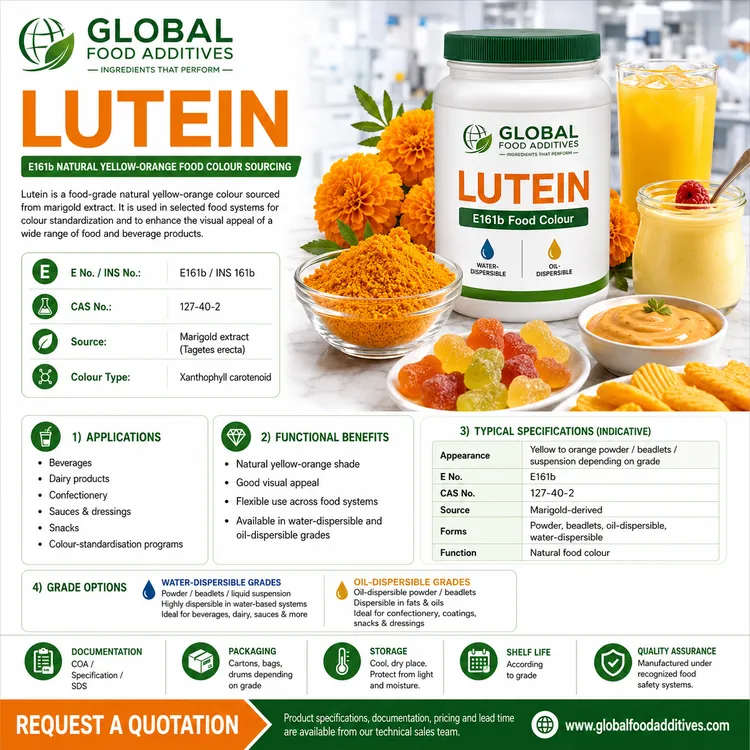
Product identity
| Product | Lutein |
|---|---|
| Common names | Lutein E161b, INS 161b, Marigold Extract, Tagetes Extract, Xanthophyll, Lutein Beadlets, Food Grade Lutein |
| Colour family | Natural carotenoid colour; yellow to orange shade depending on concentration, matrix, carrier and process conditions |
| Category | Colours & Colouring Foods |
| Function | Food colour, colouring food support, shade development ingredient, colour standardisation component and carotenoid formulation ingredient |
| E / INS number | E161b / INS 161b where permitted and applicable |
| CAS / identity | 127-40-2 |
| Typical source | Marigold flower extract, commonly associated with Tagetes erecta; exact botanical source and extraction process should be confirmed by supplier documentation |
| Typical form | Oil suspension, oleoresin, powder, beadlet, microencapsulated powder, liquid emulsion, water-dispersible powder or application-specific colour blend |
| Industrial buying focus | Lutein assay, total carotenoids, lutein ester or free-lutein status, colour value, dispersibility, carrier system, particle size, stability, solvent residues, pesticides, heavy metals, microbiology, antioxidant system, origin and regulatory declarations |
Application fit
Lutein is selected when a manufacturer needs a yellow to orange colour tone from a carotenoid source. The correct grade depends strongly on whether the product is water-based, oil-based, dry, heat-processed, acidic, clear, opaque or light-exposed.
- Beverages, juice drinks and functional drinks using water-dispersible grades
- Dairy desserts, yogurts, frozen desserts and cream systems
- Confectionery, gummies, hard candy, soft candy and fillings
- Bakery, icings, toppings, glazes and dry premixes
- Sauces, dressings, condiments and savoury emulsions
- Snacks, seasonings, coatings and extruded products
- Nutrition powders, tablets, capsules and fortified foods where permitted
- Pet food, feed and egg-yolk pigmentation programs subject to local rules
Technical purchasing notes
When reviewing Lutein, compare the supplier specification against the intended food application, target shade, pH, heat treatment, light exposure, oxygen exposure, fat content, water activity, packaging format and destination-market rules. For industrial purchasing, the most useful inquiry includes target assay, required colour shade, carrier system, physical form, quantity, destination, packaging size and documentation requirements.
Lutein is lipophilic by nature, so oil-soluble and water-dispersible grades are not interchangeable. Oil suspensions and oleoresins are usually evaluated in fat-containing systems, while beverages and water-based products typically require emulsified, encapsulated or water-dispersible preparations. Because carotenoids are sensitive to oxidation, light, heat and acidic conditions, colour stability should be validated through real shelf-life testing, not only by checking initial colour strength.
Specification parameters to compare
| Parameter | Why it matters industrially | What to request from supplier |
|---|---|---|
| Lutein assay | Assay determines colour strength, dosage, cost-in-use and label consistency. Different grades may be sold at very different active levels. | Lot-specific lutein content, analytical method, calculation basis and COA value. |
| Total carotenoids | Total carotenoids influence colour performance and may include lutein, zeaxanthin and related carotenoid fractions. | Total carotenoids value, profile by HPLC where available and specification range. |
| Free lutein vs lutein esters | Free lutein and esterified forms differ in processing, formulation, analytical reporting and nutritional positioning. The buyer should know which form is being supplied. | Declaration of free lutein, lutein esters or saponified extract, with assay basis clearly stated. |
| Zeaxanthin and related isomers | Related carotenoids can influence shade, analytical profile, nutritional positioning and regulatory documentation. | Carotenoid profile, zeaxanthin content and isomer information where relevant. |
| Colour value / shade | Industrial colour programs need repeatable shade and intensity, not only chemical assay. Colour appearance changes with matrix and processing. | Colour value, application photos, dose-response data, Lab colour data or absorbance method if available. |
| Carrier system | Carrier determines dispersibility, label impact, allergen status, halal/kosher status and application compatibility. | Full carrier composition, emulsifiers, antioxidants, starch, gum, oil, sucrose, maltodextrin or other excipient declarations. |
| Water dispersibility | Critical for beverages, syrups, gummies, water-based sauces and instant drinks. Poor dispersibility can cause rings, sediment or colour specks. | Dispersibility statement, recommended hydration or mixing method, particle size and sedimentation guidance. |
| Oil solubility / fat compatibility | Important for margarine, spreads, fillings, coatings, dairy fat systems and oil-based sauces. | Recommended oil phase, solubility data, process temperature and fat-system compatibility notes. |
| Particle size | Particle size affects powder blending, dispersion, sedimentation, colour speckling, mouthfeel and spray or dosing performance. | Particle size distribution, mesh, beadlet size, bulk density and handling notes. |
| Moisture and water activity | Moisture affects caking, flowability, microbial stability and shelf life in dry powders and beadlets. | Moisture limit, water activity where relevant, typical value and packaging barrier details. |
| Peroxide value / oxidation status | Oil-based grades can oxidize, creating colour loss, odour defects and reduced shelf life. | Peroxide value, antioxidant system, oil carrier declaration and storage recommendation. |
| Residual solvents | Extraction and purification processes may require residual solvent control for regulatory and customer approval. | Residual solvent declaration, solvent list, limits and COA data where applicable. |
| Pesticides and agricultural residues | Marigold-derived materials may require agricultural residue control for export, customer specifications and premium natural-colour programs. | Pesticide statement, multi-residue screen where required and origin traceability. |
| Heavy metals and contaminants | Required for food safety, export documentation, customer specifications and risk management. | Lead, arsenic, cadmium, mercury and other relevant contaminant limits with COA or declaration. |
| Microbiological status | Important for beverage bases, dry blends, dairy products, supplements and ready-to-eat applications. | Total plate count, yeast and mould, coliforms, E. coli, Salmonella and microbial specification where required. |
| Batch traceability | Essential for supplier approval, audits, complaint handling, export documentation and recall systems. | Lot number, production date, expiry or retest date, origin, manufacturer name and packing list. |
Application guidance by industry
| Industry / application | Technical role | Key validation points |
|---|---|---|
| Beverages and functional drinks | Provides yellow to orange colour in water-based systems when supplied as a suitable water-dispersible, emulsified or encapsulated grade. | pH, pasteurization, sedimentation, ring formation, light exposure, cloud system, preservative compatibility, bottle transparency and shelf-life colour retention. |
| Dairy desserts and yogurts | Supports yellow-orange shade in dairy matrices, custards, creams, yogurts, puddings and frozen desserts. | Fat content, protein interaction, heat treatment, homogenization, pH, fermentation, colour migration and storage stability. |
| Confectionery and gummies | Can provide warm yellow-orange colour in gummies, jellies, hard candy, soft candy and fillings. | Acid level, cooking temperature, gel system, water activity, light exposure, sugar matrix, colour bleed and flavour compatibility. |
| Bakery, icings and premixes | Provides natural yellow-orange tone in dry mixes, icings, glazes, creams and selected baked systems. | Baking temperature, dough or batter pH, oxygen exposure, powder blend uniformity, colour loss after heat and packaging barrier. |
| Sauces, dressings and condiments | Used to standardise yellow-orange colour in emulsified or oil-containing sauces and savoury systems. | Oil phase, vinegar or acid content, emulsifier system, shear, heat treatment, colour separation, ring formation and shelf-life stability. |
| Snacks and seasonings | Supports visual identity in dry seasonings, topical coatings, extruded snacks and savoury powders. | Carrier compatibility, oil spray system, powder adhesion, light exposure, oxidation, particle size and colour uniformity. |
| Nutrition powders and tablets | May provide colour and nutritional positioning where permitted, especially in formulations that include carotenoid blends. | Assay stability, tablet compression, capsule fill, powder flow, claim restrictions, dose uniformity and regulatory category. |
| Pet food and feed applications | May be evaluated for pigmentation or colour standardisation in selected animal nutrition programs subject to local regulations. | Species, dose, premix stability, heat treatment, feed matrix, oxidation control, label rules and customer specification. |
Processing and formulation considerations
- Select the correct dispersion type. Use oil-soluble grades for fat systems and water-dispersible or encapsulated grades for beverages and water-based foods. A mismatch can create floating colour, sediment, specks or poor shade development.
- Protect against light and oxygen. Lutein and other carotenoids can fade when exposed to oxygen, light and heat. Use appropriate packaging, antioxidants, nitrogen flushing or oxygen-barrier systems when required.
- Validate process temperature. Test colour before and after pasteurization, hot fill, baking, cooking, spray drying, extrusion or retort-like processing because heat history can shift shade intensity.
- Control pH and acid exposure. Acidic systems can create additional colour-stability challenges. Run shelf-life testing at the real pH and with the actual acidulant blend.
- Pre-disperse before final addition. For powders and beadlets, pre-blending with compatible dry carriers or pre-dispersing in a suitable phase can reduce specking and improve colour uniformity.
- Evaluate packaging impact. Clear bottles, transparent pouches and high-light retail displays can accelerate fading. Compare colour stability in final commercial packaging.
- Confirm regulatory and claim position. Lutein may be treated differently as a colour, colouring food, nutritional ingredient or supplement component depending on country and product category. Confirm permitted use, labelling and claims before launch.
For R&D teams
Request samples in the exact form needed for the target matrix. Compare oil-soluble, water-dispersible, emulsion and beadlet grades for shade, dose-response, sedimentation, light stability, heat stability, pH tolerance and sensory impact.
For QA teams
Build an approval file covering identity, E161b / INS 161b status where applicable, CAS number, lutein assay, carotenoid profile, residual solvents, pesticides, heavy metals, microbiology, allergens, GMO status and traceability.
For procurement teams
Compare offers by assay, colour strength, carrier system, physical form, origin, packaging, minimum order quantity, shelf life, lead time, pallet configuration, documentation quality and cost-in-use.
For production teams
Confirm addition point, pre-dispersion method, mixing speed, temperature limit, light-control requirements, oxygen exposure, dust control, tank cleaning and warehouse conditions before scale-up.
Quality-control and incoming inspection
A practical incoming inspection plan for Lutein should include document review, packaging inspection, lot number verification, appearance check, odour check, assay review, dispersibility testing and colour comparison against an approved standard. For colour-critical programs, maintain a retained reference sample and test every new lot in the finished application or in an agreed internal model system.
- Visual check: confirm expected orange-red, yellow-orange or grade-specific appearance and absence of foreign matter, caking, phase separation or leakage.
- Assay check: verify lutein content, total carotenoids and carotenoid profile according to the approved specification.
- Dispersion check: evaluate wetting, sediment, oiling-off, colour specks, ring formation and uniformity in the intended matrix.
- Colour check: compare dose-response and shade against an approved standard using visual assessment, spectrophotometry or Lab colour data where available.
- Stability check: test heat, pH, light and oxygen exposure under realistic processing and shelf-life conditions.
- Microbiology check: verify supplier COA against internal limits for dry blends, beverages, dairy products and ready-to-eat applications.
Recommended documentation package
A complete industrial sourcing file for Lutein should support supplier approval, import clearance, customer documentation, regulatory review, colour-standardisation programs and batch release.
- Product specification or technical data sheet
- Certificate of analysis for offered batch or representative lot
- Food-grade declaration
- E161b / INS 161b regulatory statement where applicable
- CAS 127-40-2 identity confirmation
- Lutein assay and total carotenoids data
- Free lutein or lutein ester declaration
- Carotenoid profile including zeaxanthin where available
- Colour value or application shade data
- Carrier composition and excipient declaration
- Residual solvent statement
- Pesticide or agricultural residue statement
- Heavy metals and contaminant statement
- Microbiological specification
- Antioxidant system declaration where applicable
- Safety data sheet where applicable
- Allergen declaration
- GMO statement
- Halal certificate where required
- Kosher certificate where required
- Vegan or vegetarian statement when needed
- Origin and botanical source statement
- Shelf-life and storage recommendation
- Label draft and packaging details
- Pallet configuration and net/gross weight
- Country-of-origin and export documentation
Storage, handling and packaging
Lutein should be stored in original sealed packaging in a cool, dry, clean and odour-free warehouse. Protect the material from direct sunlight, oxygen exposure, moisture, condensation, high heat, dust and strong odour sources. Opened containers should be resealed quickly and, where recommended by the supplier, protected with oxygen-barrier liners or nitrogen headspace.
Typical packaging may include aluminium foil bags, PE-lined cartons, fibre drums, tins, pails, bottles, drums, IBCs or small sample packs depending on form and concentration. For international shipments, buyers should confirm net weight, assay per kilogram, inner liner, oxygen and light barrier, temperature guidance, pallet dimensions, container loading quantity, shelf life at dispatch and any special transport precautions.
How to request this product
Send the product name, target grade, lutein assay, application, desired shade, reference specification, quantity, destination country, packaging preference, delivery term, expected shipment date and required documents. If you already purchase Lutein, attach your current specification, certificate of analysis, product label or sample photos so supplier options can be compared more accurately.
Recommended inquiry details
- Product identity: Lutein, E161b, INS 161b, Marigold Extract, Tagetes Extract, Lutein Beadlets or the exact name used in your formula.
- Application: beverage, dairy dessert, confectionery, bakery, sauce, dressing, snack, nutrition powder, tablet, capsule, pet food or feed application.
- Required grade: oil suspension, oleoresin, water-dispersible powder, beadlet, microencapsulated powder, emulsion, liquid dispersion or dry premix.
- Specification target: lutein assay, total carotenoids, free lutein or ester status, zeaxanthin profile, colour value, carrier system, particle size, dispersibility and stability requirements.
- Quantity: laboratory sample, pilot order, monthly demand, annual contract or container volume.
- Destination: country, port, Incoterms, required import documents and delivery schedule.
- Compliance needs: E161b declaration, halal, kosher, allergen, GMO, vegan, residual solvent, pesticide, heavy metals, origin or customer-specific declarations.
Useful answers
What is Lutein used for in food manufacturing?
Lutein is used as a yellow-orange carotenoid colour, shade-development ingredient and colour-standardisation component in selected foods, beverages, dairy products, confectionery, sauces, snacks and nutrition-oriented applications. Exact suitability depends on grade, carrier system, process conditions, regulations and supplier documents.
Is Lutein the same as E161b?
Lutein is associated with E161b / INS 161b where permitted and applicable. Buyers should confirm exact identity, botanical source, free or esterified form, assay, carrier composition and destination-market regulatory status.
Is Lutein water soluble?
Lutein is naturally lipophilic and is not normally treated as a simple water-soluble colour. Water-based applications usually require a water-dispersible, emulsified, encapsulated or beadlet grade specifically designed for that matrix.
Why does Lutein fade in some products?
Lutein and other carotenoids can lose colour through oxidation and exposure to light, heat, oxygen or challenging pH conditions. Stability depends on grade, carrier, antioxidants, packaging, process conditions and storage environment.
Which specification parameters are most important?
Key parameters include lutein assay, total carotenoids, free lutein or lutein ester status, zeaxanthin profile, colour value, carrier composition, particle size, dispersibility, residual solvents, pesticides, heavy metals, microbiology, shelf life and batch traceability.
Can Global Food Additives source Lutein?
Global Food Additives can review sourcing options for Lutein according to target specification, assay, physical form, application, quantity, destination country, packaging preference, shipment schedule and documentation requirements.
Which documents should be requested?
Buyers commonly request a technical data sheet, certificate of analysis, food-grade declaration, E161b / INS 161b statement where applicable, CAS identity confirmation, origin statement, carrier composition, residual solvent statement, pesticide statement, allergen declaration, GMO statement, halal or kosher certificates when required, shelf-life information, label details and packing list.
Is this product permitted in every country?
No. Food additive use depends on destination-market rules, exact grade, food category, maximum use level, label requirements and buyer responsibility. The final manufacturer should confirm compliance before commercial production.
What information should I send for a quotation?
Send the product name, grade, lutein assay, application, target shade, reference specification, quantity, destination country, packaging preference, Incoterms, expected shipment date and required documents. Sharing an existing COA or supplier specification helps compare alternatives faster.
Tell us which food additive or ingredient you need.
Send product names, target specifications, quantity, destination country, packaging preference, delivery term, and document requirements. Our team will review your inquiry and respond from orders@foodgradeadditives.com.
Your message has been received. You will be redirected to the home page.