
Magnesium Carbonate
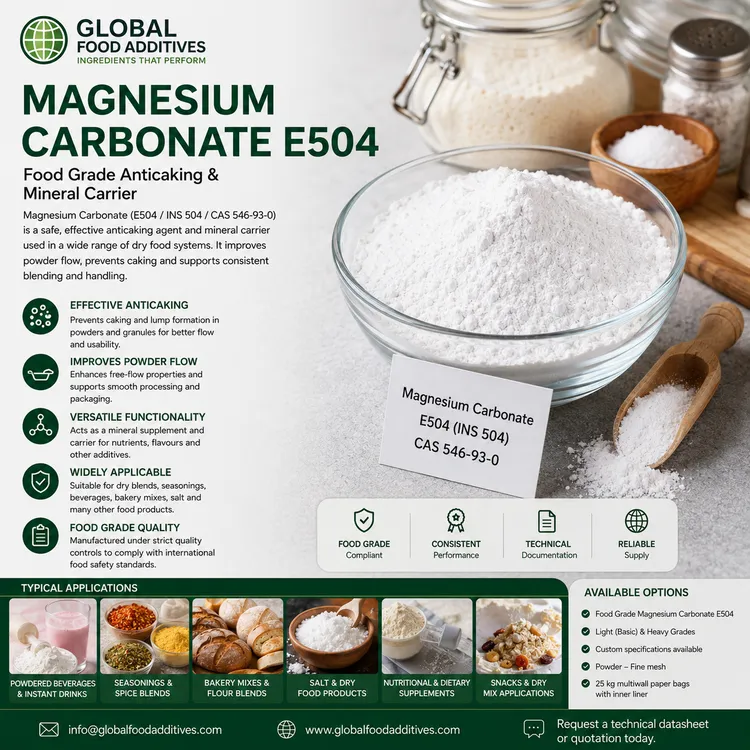
Magnesium Carbonate is a food-grade mineral carbonate used in selected dry food, powder, seasoning, premix, nutrition and tableting systems where anticaking performance, powder flow, moisture management, dry carrier behavior and mineral contribution are important. This page is prepared for procurement, R&D, QA and regulatory teams that need to compare grades, verify specification details, collect technical documents and request export-ready sourcing support.
Product identity
| Product | Magnesium Carbonate |
|---|---|
| Commercial family | Magnesium carbonates; may include normal, basic, light, heavy or hydrated forms depending on supplier |
| Category | Anticaking, Flow & Mineral Carriers |
| Function | Anticaking agent / flow aid / dry carrier / mineral processing aid / acidity regulator where permitted |
| E / INS number | E504 / INS 504 where permitted |
| CAS / identity | 546-93-0; exact form and hydrate/basic-carbonate identity should be confirmed by supplier documents |
| Formula note | MgCO3 for normal magnesium carbonate; commercial grades may be hydrated or basic magnesium carbonate |
| Typical form | Fine powder, light powder, dense powder, granule or carrier grade |
| Key buyer check | Confirm assay, MgO equivalent, magnesium content, loss on drying, loss on ignition, particle size, density and permitted food use |
Application fit
Potential use areas may include dry or low-moisture systems where powder flow, caking prevention and controlled mineral-carrier behavior are important.
- Powdered beverages and instant drink bases
- Seasonings, spice blends and savory dry mixes
- Vitamin, mineral and nutrient premixes
- Bakery mixes, cake mixes and dry dough improver systems
- Salt products, tabletop blends and dry carriers
- Food supplements, tablets, capsules and sachets where permitted
- Confectionery powders, coating systems and dry ingredient repacking where permitted
Technical purchasing notes
When reviewing Magnesium Carbonate, compare the supplier specification against the intended food application, processing conditions, powder-flow target, label expectations and destination-market rules. Food-grade Magnesium Carbonate grades can differ in basic carbonate content, hydration, particle morphology, bulk density, surface area, acid reactivity, moisture behavior and impurity profile. These differences can affect flowability, dusting, blend uniformity, mouthfeel, caking resistance, dosing accuracy and storage stability.
Industrial functionality
- Anticaking support: helps reduce lumping, bridging and poor flow in selected dry powders by improving physical separation and moisture management.
- Powder-flow improvement: can support better discharge, dosing, sachet filling, blending and repacking when particle size and density are matched to the system.
- Dry carrier behavior: can be used as a carrier or processing aid for low-dose ingredients, flavors, minerals or premix components where permitted.
- Moisture management: may help reduce surface tackiness and moisture-related caking in hygroscopic powders when used with suitable packaging and storage controls.
- Acid reaction behavior: as a carbonate, it can interact with acidic components and may influence pH, gas release, taste, sediment or processing behavior.
- Tableting and dusting: may be evaluated in supplement-style products for powder handling, dusting and mineral-carrier functions where permitted.
Performance depends on
- Light, heavy, basic or normal carbonate grade
- Particle-size distribution and surface area
- Bulk density, tapped density and flow index
- Moisture content, loss on drying and warehouse humidity
- Dosage rate and ratio to hygroscopic ingredients
- Compatibility with acids, salts, sweeteners, flavors and hydrocolloids
- Mixing sequence, shear, blend time and dosing method
- Packaging barrier, liner quality and pallet protection
Light grade, heavy grade and basic carbonate forms
Magnesium Carbonate is often discussed commercially as light, heavy, basic, dense, fine or granular grade. These terms can reflect differences in bulk density, particle structure, water content, carbonate/hydroxide balance, surface area and handling behavior. A light grade may offer high surface area and stronger moisture interaction but may be dustier. A heavier or denser grade may flow better, reduce dust and support more predictable volumetric dosing.
Buyers should not assume that all Magnesium Carbonate offers are interchangeable. If a formula was validated with a light basic magnesium carbonate, replacement with a dense granular grade may change blend uniformity, anticaking performance, sediment, taste, mouthfeel and filling behavior. Supplier changes should be reviewed by R&D, QA and regulatory teams before full-scale production.
Specification parameters to evaluate
A professional Magnesium Carbonate inquiry should include measurable quality parameters. Procurement teams should compare the technical data sheet, certificate of analysis and buyer specification before approving the material for production.
| Parameter | Why it matters |
|---|---|
| Assay / identity | Confirms whether the material is magnesium carbonate, basic magnesium carbonate or another magnesium carbonate form and supports supplier comparison. |
| MgO equivalent | Commonly used to express active magnesium carbonate quality and compare grades with different hydration or basic carbonate content. |
| Elemental magnesium content | Relevant for mineral calculation, fortified food review, supplement-style formulas and finished product label considerations where permitted. |
| Carbonate content / acid neutralizing behavior | Important in acidic powders, beverage systems, bakery mixes and formulas where carbon dioxide release or pH shift may occur. |
| Loss on drying | Indicates moisture level and helps predict caking tendency, storage stability and formula correction needs. |
| Loss on ignition | Useful for evaluating hydration, carbonate decomposition behavior and grade consistency. |
| Particle-size distribution | Affects flow, dusting, blend uniformity, segregation, mouthfeel, dissolution behavior and filling accuracy. |
| Bulk density and tapped density | Helps evaluate hopper flow, bag yield, premix volume, volumetric dosing, pallet planning and warehouse capacity. |
| pH and acid reactivity | Relevant for beverage powders, acid blends, effervescent systems, bakery mixes and flavor-sensitive applications. |
| Acid-insoluble matter | Supports purity assessment and helps identify unwanted mineral residues or insoluble contaminants. |
| Calcium, iron, chloride and sulfate | Useful for checking impurity profile, taste impact, color risk, compatibility and customer-specific limits. |
| Heavy metals | Lead, arsenic, cadmium and mercury limits should match food-grade and destination-market requirements. |
| Microbiological limits | Important for ready-to-mix powders, nutrition products, dry blends and low-moisture foods. |
| Allergen, GMO, halal, kosher and vegan status | Often required by brand owners, retailers, importers, certification bodies and private-label manufacturers. |
| Shelf life and storage | Defines warehouse planning, humidity protection, unopened-bag stability and first-expired-first-out inventory control. |
Application examples
| Application area | Typical reason for evaluation | Buyer questions to confirm |
|---|---|---|
| Powdered beverages | Dry-flow support, mineral carrier behavior and moisture-related caking control | Does the grade affect pH, sediment, turbidity, mouthfeel, flavor release or reconstitution speed? |
| Seasonings and spice blends | Caking reduction, dosing consistency and dry-blend flow improvement | Does it remain free-flowing under local humidity without changing aroma, color, saltiness or spice release? |
| Vitamin and mineral premixes | Carrier support, moisture management and mineral contribution in low-dose blends | Can the supplier provide consistent particle size, low heavy metals, microbiology data and batch-specific COA? |
| Bakery mixes | Powder flow, dry ingredient handling and possible pH or carbonate interaction | Does the grade interact with acids, leavening agents, starches, proteins or dough improvers? |
| Salt products | Anticaking support and improved flow in humid handling environments | Is the particle size compatible with salt crystals? Does the dose meet local additive and label rules? |
| Supplements and tablets | Carrier, dusting, mineral source or powder-handling support where permitted | Are density, flow, compressibility, disintegration, mineral content and contaminant limits acceptable? |
| Industrial repacking and toll blending | Stable dry handling, export-ready documentation and batch traceability | Are labels, batch codes, pallet configuration, shelf life and COA format aligned with customer requirements? |
Formulation and process considerations
Dry blending
In premixes, drink powders, bakery mixes and seasonings, Magnesium Carbonate should be evaluated inside the complete formula. Performance can change when the blend contains acids, sugars, salts, flavors, starches, proteins, hydrocolloids, fat powders or hygroscopic minerals.
Powder flow and segregation
Very fine grades may improve distribution but can increase dusting and operator handling concerns. Coarser or denser grades may improve flow but can segregate if particle size differs too much from the surrounding blend.
Acidic formulations
Magnesium Carbonate can react with acids and may influence pH, gas release, taste, sediment and finished product stability. Beverage powders, acid blends and bakery systems should be tested under real-use conditions.
Moisture-sensitive systems
Anticaking performance depends strongly on packaging barrier, opened-bag handling, humidity exposure and ingredient water activity. A suitable grade can still fail if storage and packing controls are weak.
Tableting and capsule filling
In supplement-style products, particle size, density, flow, dust level, magnesium contribution and compatibility with lubricants or binders should be reviewed before approval.
Supplier substitution
Do not substitute light, heavy, basic, granular or dense grades without reviewing assay, density, moisture, flow, sensory impact and regulatory status. Pilot trials are recommended before supplier change approval.
Regulatory and labeling review
Magnesium Carbonate E504 should be reviewed according to the destination market, food category and intended function. It may be used or declared as an anticaking agent, acidity regulator, carrier, processing aid, mineral ingredient or other locally defined role depending on the application. The buyer should confirm permitted food categories, maximum use levels, declaration format, additive class name, additive number, allergen/GMO expectations, halal/kosher requirements and retailer restrictions before formula approval.
Quality and compliance documents to request
- Product specification or technical data sheet with exact identity, CAS number, E / INS number and food-grade statement
- Certificate of analysis for the offered batch or representative current lot
- Assay, MgO equivalent, elemental magnesium content, loss on drying and loss on ignition data
- Safety data sheet where applicable
- Origin statement, manufacturer statement and country-of-origin documentation
- Allergen declaration, GMO declaration and BSE/TSE statement when required
- Halal, kosher, vegan or vegetarian status when required by the buyer or destination market
- Heavy-metal limits, microbiological limits and contaminant declarations
- Particle-size distribution, bulk density, tapped density, pH and acid-insoluble matter when available
- Shelf-life, storage, unopened-bag handling and humidity protection guidance
- Label draft, packaging details, pallet configuration and container loading information
- Market-specific declarations required by the destination country, importer, retailer or brand owner
Packaging, storage and logistics notes
Magnesium Carbonate is normally handled as a dry mineral powder or granular ingredient. Packaging should protect the material from moisture uptake, dust release, bag damage, contamination and excessive compaction during transport. For export shipments, buyers should confirm bag size, liner type, net weight, pallet type, pallet wrapping, container loading plan, batch coding, label language and document legalization needs before order confirmation.
Typical packing options to confirm
- Multi-wall paper bags with PE liner
- PE-lined woven bags for selected industrial routes
- Fiber drums, cartons or smaller specialty packs for nutrition grades
- 25 kg net bag format where available
- Palletized or non-palletized container loading
- Neutral-label, customer-label or private-label options when permitted
Warehouse controls
- Keep bags tightly closed when not in use
- Store in a cool, dry and well-ventilated area
- Avoid direct contact with floor moisture
- Protect from acids, strong odors and incompatible chemicals
- Use first-expired-first-out inventory rotation
- Protect from damaged pallets, torn bags, dust contamination and humidity exposure
- Define opened-bag resealing procedures for production areas
Supplier qualification checklist
How to request this product
Send the product name, target grade, reference specification, required function, food application, dosage range, annual demand, first order quantity, destination country, delivery term, packaging preference, expected shipment date and document requirements. If you already purchase Magnesium Carbonate, attach your current specification, certificate of analysis, label, safety data sheet or approved supplier document so available sourcing options can be compared accurately.
For faster review, include whether the required material is for powdered beverages, seasoning blends, premixes, bakery mixes, salt products, supplements, tablet dusting, repacking, private label, tender supply or distributor inventory. This helps Global Food Additives match the inquiry with the correct specification level, documentation package and logistics route.
Useful answers
What is Magnesium Carbonate used for in food manufacturing?
Magnesium Carbonate is typically evaluated for anticaking, powder flow, moisture management, dry carrier behavior, mineral contribution, tablet dusting and low-moisture ingredient systems. Exact suitability depends on grade, application, process, dosage, regulation and supplier documents.
Is Magnesium Carbonate the same in every supplier offer?
No. Supplier offers may differ by light or heavy grade, normal or basic carbonate form, hydrate level, particle size, bulk density, assay, surface area, pH behavior, acid reactivity, heavy-metal limits, microbiological limits and food-grade documentation.
Can Magnesium Carbonate improve powder flow?
It can support flow and reduce caking in selected dry powder systems, but performance depends on the complete formulation, humidity, particle size, dosing level, mixing order, packaging barrier and storage conditions. Pilot testing is recommended before production approval.
Which specification details are most important?
Important details include assay, identity, MgO equivalent, elemental magnesium content, carbonate content, particle-size distribution, bulk density, tapped density, pH, loss on drying, loss on ignition, acid-insoluble matter, heavy metals, microbiology and shelf life.
Can Magnesium Carbonate react with acids?
Yes. As a carbonate, it may react with acidic ingredients and influence pH, carbon dioxide release, taste, sediment or process behavior. Acidic beverage powders, bakery systems and effervescent-style formulas should be tested carefully.
Which documents should be requested?
Buyers commonly request a technical data sheet, certificate of analysis, safety data sheet, food-grade statement, origin statement, shelf-life information, storage guidance, allergen declaration, GMO declaration, halal or kosher certificate where needed, packaging details and pallet configuration.
Is this product permitted in every country?
No. Permission depends on destination-market rules, food category, intended function, maximum permitted level, label declaration and buyer responsibility. Local regulatory verification is required before use.
Can Global Food Additives source Magnesium Carbonate?
Global Food Additives can review sourcing options for Magnesium Carbonate according to the requested grade, target specification, application, quantity, destination, delivery term, packaging and documentation requirements.
What information should I include in a quotation request?
Include product name, target grade, exact specification, application, dosage range, quantity, destination country, preferred packaging, delivery term, required documents, shipment timing and any existing COA or approved-supplier specification.
Tell us which food additive or ingredient you need.
Send product names, target specifications, quantity, destination country, packaging preference, delivery term, and document requirements. Our team will review your inquiry and respond from orders@foodgradeadditives.com.
Your message has been received. You will be redirected to the home page.