
Maltitol Syrup
Maltitol Syrup is a food-grade liquid polyol system used by food manufacturers for sweetness, sugar replacement, humectancy, binding, viscosity, moisture retention, soft texture and reduced-sugar formulation. It is especially useful in soft confectionery, chewing gum, bakery fillings, cereal bars, chocolate fillings, dairy desserts, frozen desserts, coatings, syrups, sauces and reduced-calorie foods where a liquid sweetening and texturizing phase is required.
Unlike crystalline Maltitol, Maltitol Syrup is a mixture of hydrogenated saccharides rather than a single pure compound. Its performance depends on maltitol content, sorbitol content, maltotriitol and higher polyols, dry solids, water content, viscosity, pH, colour, flavour neutrality, crystallization behaviour, water activity, digestive tolerance, packaging format and destination-market polyol labeling rules.
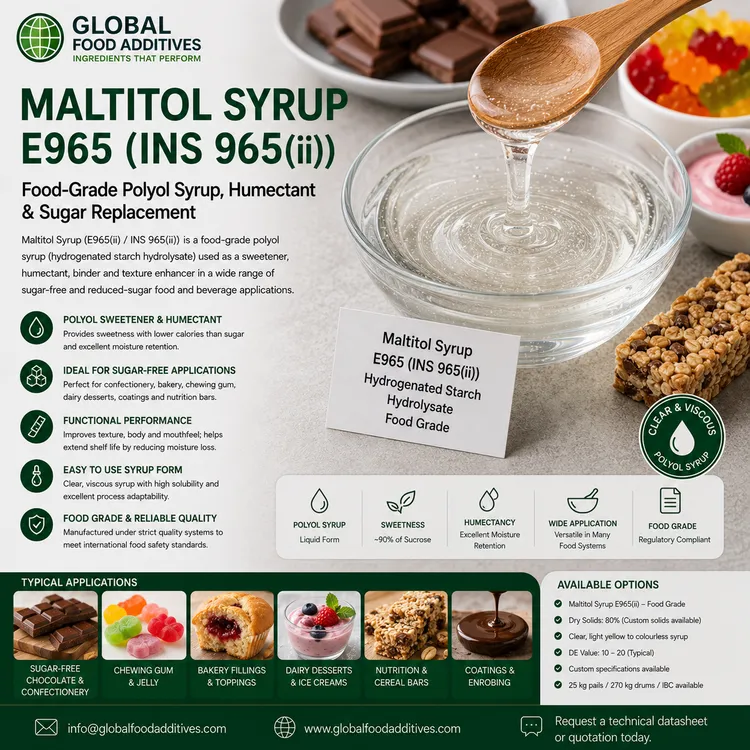
Product identity
| Product | Maltitol Syrup |
|---|---|
| Other names | Liquid maltitol, hydrogenated starch hydrolysate, hydrogenated glucose syrup, maltitol polyol syrup |
| Category | Sweeteners & Polyols |
| Function | Sweetener / polyol / bulking ingredient |
| E / INS number | E965 / INS 965; sub-classification should be confirmed by destination market |
| CAS / identity | Mixture; not one single pure CAS compound |
| Chemical nature | Hydrogenated starch hydrolysate containing maltitol and other hydrogenated saccharides |
| Typical composition | Supplier-specific maltitol content with sorbitol, maltotriitol and higher polyols depending on grade |
| Typical form | Clear to slightly yellow viscous syrup supplied in drums, IBCs, bulk tanks or tanker loads |
| Key technical behavior | Sweetness, humectancy, binding, viscosity, moisture control, soft texture, reduced crystallization and polyol label considerations |
Application fit
Potential use areas may include:
- Soft candy, chewy confectionery, gummies, jellies and caramel-style products
- Chewing gum centres, gum syrups, pan coatings and reduced-sugar confectionery
- Bakery fillings, fruit fillings, creams, spreads, glazes and cereal bars
- Chocolate fillings, compound centres, praline fillings and confectionery pastes
- Dairy desserts, frozen desserts, ice cream, yoghurt preparations and creamy systems
- Syrups, toppings, sauces, fruit preparations and sweet liquid systems
- Nutrition bars, protein bars, meal replacements and wellness-positioned products
- Polyol blends requiring viscosity, humectancy and sugar-replacement functionality
Technical overview
Maltitol Syrup is produced by hydrogenating starch hydrolysates rich in maltose and related saccharides. The result is a liquid polyol syrup containing maltitol plus other hydrogenated carbohydrates. This composition gives the ingredient a different technical profile from crystalline Maltitol: it provides sweetness and bulk, but also contributes water, viscosity, humectancy, binding and softness.
In food manufacturing, Maltitol Syrup is commonly selected when sucrose syrup, glucose syrup, invert syrup or sorbitol syrup must be replaced or partially replaced in reduced-sugar or sugar-free systems. It can help maintain chewy texture, moisture retention, viscosity, syrup handling, binding and gloss while reducing sugar contribution. Its lower crystallization tendency compared with some sugar systems can be valuable in fillings, bars, sauces and confectionery centres.
Because Maltitol Syrup is compositionally complex, supplier grade selection is critical. Two syrups may both be called “maltitol syrup” but differ in maltitol content, dry solids, sorbitol level, higher polyol level, viscosity, sweetness, water activity, crystallization tendency and digestive tolerance. Industrial approval should therefore include formulation trials and not rely only on E number or generic product name.
Functional benefits in food systems
Sweetness and sugar replacement
Provides a sucrose-like sweetening profile in liquid form and supports reduced-sugar or sugar-free concepts when permitted by local regulations.
Humectancy and softness
Helps retain moisture and reduce hardening in soft confectionery, fillings, cereal bars, bakery creams and chewy products.
Binding and viscosity
Acts as a syrup phase that can bind dry solids, suspend ingredients, support chew and improve flow during mixing, depositing or filling.
Reduced crystallization
Can help reduce unwanted crystallization and graininess in selected fillings, syrups and soft confectionery systems when grade and solids are controlled.
Application engineering guidance
| Application | Typical technical objective | Key formulation review points |
|---|---|---|
| Soft confectionery and chewy candy | Provide sweetness, body, chew, humectancy and reduced-sugar positioning. | Review dry solids, gelatin or pectin system, water activity, cooking temperature, viscosity, crystallization, acid stability, flavour release and polyol warning threshold. |
| Gummies and jellies | Control sweetness, chew, water activity, clarity and moisture retention. | Validate with gelatin, pectin, starch, acids, colours, flavours, Brix/solids, drying conditions, storage humidity and digestive tolerance per serving. |
| Chewing gum | Support gum-centre sweetness, softness, moisture retention and sugar-free positioning. | Check gum base compatibility, syrup viscosity, polyol blend, plasticization, flavour release, coating compatibility and shelf-life texture. |
| Bakery fillings and creams | Maintain softness, spreadability, humectancy and reduced-sugar sweetness. | Review water activity, starch or hydrocolloid system, fat phase, bake stability, microbial stability, crystallization and moisture migration into dough or crust. |
| Cereal bars and protein bars | Bind dry solids, reduce bar hardening and support reduced-sugar formulation. | Validate protein interaction, fibre system, water activity, syrup viscosity, bar extrusion or slab forming, shelf-life hardening and label warning requirements. |
| Chocolate fillings and praline centres | Provide syrup phase, sweetness, reduced sugar and moisture control in centres. | Control water activity, fat compatibility, emulsion stability, crystallization, migration into shell, viscosity and microbial stability. |
| Dairy and frozen desserts | Provide sweetness, solids, freezing point effect, softness and mouthfeel. | Review stabilizer system, protein interaction, freezing point depression, ice-crystal control, sweetness balance, serving size and total polyol level. |
| Syrups, toppings and sauces | Create reduced-sugar liquid sweetness, viscosity, gloss and pourability. | Check Brix-equivalent solids, pH, viscosity, microbial preservation, flavour release, colour stability, pumpability and bottle-cap stickiness. |
| Fruit preparations and jams | Support sweetness, solids, water activity and reduced-sugar fruit systems. | Validate pectin type, acid level, soluble solids, fruit load, heat process, microbial stability and local jam or fruit-preparation standards. |
Composition and grade selection
Maltitol Syrup is specified by composition rather than by a single molecular identity. Important values include maltitol content, dry solids, water content, sorbitol level, maltotriitol and higher hydrogenated saccharides, reducing sugars, colour, pH and viscosity. These parameters determine sweetness, texture, crystallization, water activity, digestive tolerance and processing behaviour.
| Specification item | Why it matters | Industrial review |
|---|---|---|
| Maltitol content | Determines sweetness contribution, product identity and polyol profile. | Confirm assay method and whether result is expressed on dry basis or as supplied. |
| Dry solids | Controls water contribution, viscosity, microbial stability and cooking requirement. | Compare dry solids when replacing glucose syrup, sucrose syrup or another polyol syrup. |
| Water content | Affects water activity, shelf life, cooking, texture and label calculation. | Adjust recipe water and heat process when changing suppliers. |
| Sorbitol and lower polyols | Influence sweetness, humectancy, crystallization, digestive tolerance and cooling perception. | Request full polyol profile, especially for sugar-free confectionery and bars. |
| Maltotriitol and higher polyols | Influence viscosity, body, crystallization and digestion profile. | Review higher-polyol distribution for chewy candy, fillings and viscosity-sensitive systems. |
| Reducing sugars | May affect browning, flavour stability and sugar claims. | Confirm limit and impact on no-added-sugar or sugar-free label calculations. |
| Viscosity | Controls pumping, dosing, mixing, depositing, coating and filling. | Review viscosity at relevant temperature, not only at a standard laboratory temperature. |
Comparison with related syrup systems
| Syrup type | Typical strength | Industrial comparison point |
|---|---|---|
| Maltitol Syrup | Sucrose-like sweetness, humectancy, binding, reduced-sugar positioning and syrup functionality. | Useful for soft confectionery, bars, fillings and syrups, but total polyol intake and label warning must be reviewed. |
| Sorbitol Syrup | Strong humectancy and moisture retention. | Often less sweet than maltitol syrup and may create different digestive tolerance and texture profile. |
| Glucose Syrup | Traditional bulk, body, browning and crystallization control. | Contains sugars and is not suitable for sugar-free formulations without label impact. |
| Isomalt Syrup or Isomalt Systems | Useful in selected sugar-free hard candy and low-hygroscopicity systems. | Often lower sweetness and different crystallization behaviour than maltitol syrup. |
| Polyglycitol or hydrogenated starch hydrolysate blends | Broad polyol profile and flexible syrup functionality. | Composition, E number and labeling may differ from maltitol syrup; verify identity carefully. |
| Sucrose / invert syrup | High sweetness, traditional flavour and browning. | Not appropriate for sugar-free claims and may create different water activity and crystallization. |
Processing and manufacturing notes
Maltitol Syrup is a viscous liquid and its handling depends strongly on temperature. Cold syrup may be difficult to pump, dose or filter, while warmed syrup flows more easily. Industrial systems may require heated storage tanks, heated transfer lines, positive-displacement pumps, inline filters, accurate flow meters and clean-in-place procedures designed for viscous carbohydrate syrups.
In confectionery production, Maltitol Syrup may be cooked with other polyols, hydrocolloids, acids, colours and flavours. Cooking temperature, residence time, vacuum, residual moisture and acid addition must be validated to avoid unwanted colour development, texture defects, excessive water, crystallization or loss of flavour quality. In bars and fillings, water activity and moisture migration should be checked over the full shelf life.
Specification and quality-control parameters
For industrial purchasing, Maltitol Syrup should be evaluated by composition, purity, physical performance and documentation. Supplier certificates should clearly state whether the material is maltitol syrup, hydrogenated starch hydrolysate, polyglycitol-type syrup or another polyol blend, because these terms may have different regulatory and labeling consequences.
Identity and composition
- Product name and E number / INS number
- Maltitol syrup or E965(ii) identity where applicable
- Mixture identity and hydrogenated starch hydrolysate description
- Maltitol content and assay basis
- Full polyol profile where available
- Reducing sugars and related carbohydrate impurities
Physical properties
- Appearance, clarity, colour and odour
- Dry solids or refractometric solids
- Water content
- Viscosity at defined temperature
- Density or specific gravity
- Crystallization tendency and pumpability guidance
Chemical limits
- pH of syrup
- Conductivity or ash where specified
- Reducing sugars and dextrose/maltose residues where applicable
- Nickel residue where relevant to hydrogenation process
- Heavy metals and elemental impurities
- Residual processing aids where applicable
Food safety controls
- Total plate count, yeast and mould
- Osmophilic yeast risk where relevant
- Specified pathogen absence where required
- Allergen and cross-contact declaration
- GMO status and raw material origin
- Halal, kosher, vegan or vegetarian suitability where commercially required
Quality effects to validate
| Quality factor | Possible Maltitol Syrup effect | Validation method |
|---|---|---|
| Sweetness profile | Provides polyol sweetness with a relatively sucrose-like profile depending on composition. | Sensory panel, sweetness time-intensity test and comparison against full-sugar or current polyol formula. |
| Humectancy | Can retain moisture and help prevent hardening in chewy products, bars and fillings. | Water activity, texture analysis, moisture migration study and accelerated storage. |
| Viscosity and processability | Affects pumping, dosing, cooking, depositing, coating and filling performance. | Viscosity curve by temperature, line trial, pump test and depositing accuracy check. |
| Crystallization | Can reduce or alter crystallization depending on polyol profile and solids. | Microscopy, storage testing, graininess evaluation and texture profile analysis. |
| Water activity | Contributes to microbial stability, softness and shelf-life performance. | Water activity measurement, challenge evaluation where required and shelf-life testing. |
| Colour and flavour | Low-colour syrup supports delicate products, while heat abuse may change colour or flavour. | Colour measurement, sensory panel, cooking trial and storage stability review. |
| Digestive tolerance | Total polyol intake may cause gastrointestinal effects in sensitive consumers or at high serving sizes. | Serving-size calculation, total polyol review, label warning review and comparison with alternative polyol blends. |
Regulatory and labeling review
Maltitol Syrup is commonly associated with E965 / INS 965, and some markets distinguish maltitol syrup from crystalline Maltitol. Buyers should verify whether the correct declaration is “maltitol syrup,” “maltitol,” “polyol,” “sweetener,” “E965,” “E965(ii),” “sugar alcohol,” or another locally accepted wording.
Polyol-containing foods may require special label statements when total polyol content exceeds local thresholds. Depending on destination market and finished product, warnings related to excessive consumption and laxative effects may be mandatory. Energy values for polyols also vary by jurisdiction, so calorie reduction and nutrition-panel calculations should be reviewed market by market.
Claims such as “sugar-free,” “no added sugar,” “reduced sugar,” “tooth-friendly,” “diabetic-friendly,” “low glycemic,” “keto,” “reduced calorie” or “clean label” should not be used unless they are permitted and substantiated in the destination market. The buyer should calculate final sugars, polyols, carbohydrates, dry solids and serving-size exposure based on the complete recipe.
Industrial purchasing notes
When reviewing Maltitol Syrup, compare the supplier specification against the intended food application, process conditions, sweetness target, texture target, water activity target, label expectations and local rules. For industrial purchasing, the most useful inquiry normally includes maltitol content, polyol profile, dry solids, viscosity, packaging size, quantity, destination and required documents.
| Purchasing factor | Why it matters |
|---|---|
| Maltitol content | Determines sweetness, product identity, polyol declaration and consistency between suppliers. |
| Polyol profile | Sorbitol, maltotriitol and higher polyols affect humectancy, viscosity, crystallization, digestive tolerance and sweetness. |
| Dry solids | Controls water contribution, cooking requirement, microbial stability and texture. |
| Viscosity | Important for pumping, heating, mixing, depositing, coating, filling and tanker unloading. |
| Colour and flavour neutrality | Critical for dairy, fruit, confectionery, clear syrups and delicate flavour systems. |
| Microbiological quality | Important for ready-to-eat fillings, low-heat products, syrups and dairy applications. |
| Packaging format | Drums, IBCs, flexitanks and bulk tanker deliveries require different handling, heating and unloading systems. |
| Documentation package | Complete food-grade, allergen, GMO, heavy metal, microbiology, halal, kosher and regulatory documents reduce approval delays. |
Documents to request
- Product specification or technical data sheet with E number and maltitol syrup identity
- Certificate of analysis for available batch or lot
- Maltitol content, polyol profile and assay basis
- Dry solids, water content, viscosity and density information
- pH, colour, clarity, ash or conductivity data where specified
- Reducing sugars and residual carbohydrate profile where available
- Nickel residue, heavy metals and elemental impurity limits where relevant
- Microbiological limits, including yeast and mould controls
- Food-grade statement and destination-market regulatory declaration
- Safety data sheet where applicable
- Origin, manufacturer, production site and raw material route information
- Allergen, gluten, GMO, irradiation and nanomaterial statements where required
- Halal, kosher, vegan or vegetarian suitability documents where commercially required
- Shelf-life, storage temperature, crystallization and reheating guidance
- Packaging details, drum type, IBC type, net weight, pallet configuration and batch coding
- Bulk delivery, tanker unloading, pumpability and temperature-excursion guidance where relevant
- Label declaration guidance, polyol warning guidance and market-specific compliance statement
- Change-control, traceability and supplier quality-system information where required
How to request this product
Send the product name, target grade or reference specification, application, maltitol content requirement, dry-solids requirement, viscosity range, packaging preference, quantity, destination country, expected shipment date and required documents. If you already purchase Maltitol Syrup, attach or describe your existing specification, label, certificate of analysis, supplier grade, polyol profile, syrup solids, process type or dosage so supplier options can be compared more accurately.
For faster technical review, include the final product type, target sweetness, sugar-free or reduced-sugar claim, water activity target, process temperature, pump or tank limitations, serving size, total polyol target, required certifications, preferred origin, annual consumption estimate and whether you need a laboratory sample, pilot quantity or commercial shipment.
Useful answers
What is Maltitol Syrup used for in food manufacturing?
Maltitol Syrup is used for sweetness design, sugar replacement, polyol bulking, reduced-calorie positioning, humectancy, binding, viscosity, moisture retention and soft texture. Typical applications include soft confectionery, chewing gum, bakery fillings, cereal bars, chocolate fillings, dairy desserts, syrups, sauces and reduced-sugar foods.
What is Maltitol Syrup made from?
Maltitol Syrup is normally produced by hydrogenating starch hydrolysates. It is a mixture that can contain maltitol, sorbitol, maltotriitol and higher hydrogenated saccharides. The exact composition should be confirmed by supplier documentation.
Is Maltitol Syrup the same as Maltitol powder?
No. Maltitol powder is a crystalline or granular solid grade, while Maltitol Syrup is a liquid polyol mixture. They differ in water content, dry solids, viscosity, humectancy, processing, crystallization behaviour and label calculation.
Does Maltitol Syrup need a laxative warning?
Many markets require a warning or special label statement when polyol intake from the finished food exceeds defined thresholds. Requirements vary by country, product category and serving size, so label compliance should be checked before launch.
Can Global Food Additives source Maltitol Syrup?
Global Food Additives can review sourcing options for Maltitol Syrup according to target specification, maltitol content, polyol profile, dry solids, viscosity, packaging, quantity, destination and required documentation.
Which documents should be requested?
Buyers commonly request a technical data sheet, product specification, certificate of analysis, maltitol content, polyol profile, dry solids, viscosity, food-grade statement, safety data sheet where applicable, origin statement, allergen declaration, GMO declaration, shelf-life information and packing details.
Is Maltitol Syrup permitted in every country?
No. Food additive and sweetener use depends on destination-market rules, food category, use level, sweetener regulations, label requirements and buyer responsibility. Final regulatory suitability should be verified before commercial use.
What should be checked before switching Maltitol Syrup suppliers?
Check maltitol content, polyol profile, dry solids, water content, viscosity, colour, odour, reducing sugars, nickel residue where applicable, heavy metals, microbiological limits, allergen status, GMO status, regulatory documents, storage guidance and finished-product performance.
Tell us which food additive or ingredient you need.
Send product names, target specifications, quantity, destination country, packaging preference, delivery term and document requirements. For Maltitol Syrup, please also include the application, target maltitol content, polyol profile, dry solids, viscosity, packaging format, storage or heating requirement and required certificates. Our team will review your inquiry and respond from orders@foodgradeadditives.com.
Your message has been received. You will be redirected to the home page.