
Maltodextrin
Maltodextrin is a food-grade starch hydrolysate used by food manufacturers as a bulking ingredient, carrier, spray-drying aid, encapsulation matrix, powder-flow support ingredient, viscosity contributor, body builder and controlled carbohydrate source. It is commonly reviewed for soups, sauces, dressings, seasonings, bakery, meat products, dairy powders, beverages, nutrition products, instant mixes, dry blends, flavours and colours.
For industrial sourcing, Maltodextrin should be selected by dextrose equivalent value, starch source, physical form, solubility, sweetness, viscosity contribution, hygroscopicity, particle size, bulk density, moisture level, clarity, flavour neutrality, label requirements and regulatory expectations. The same product name can refer to very different grades, so buyers should compare supplier documents and application performance, not only price per kilogram.
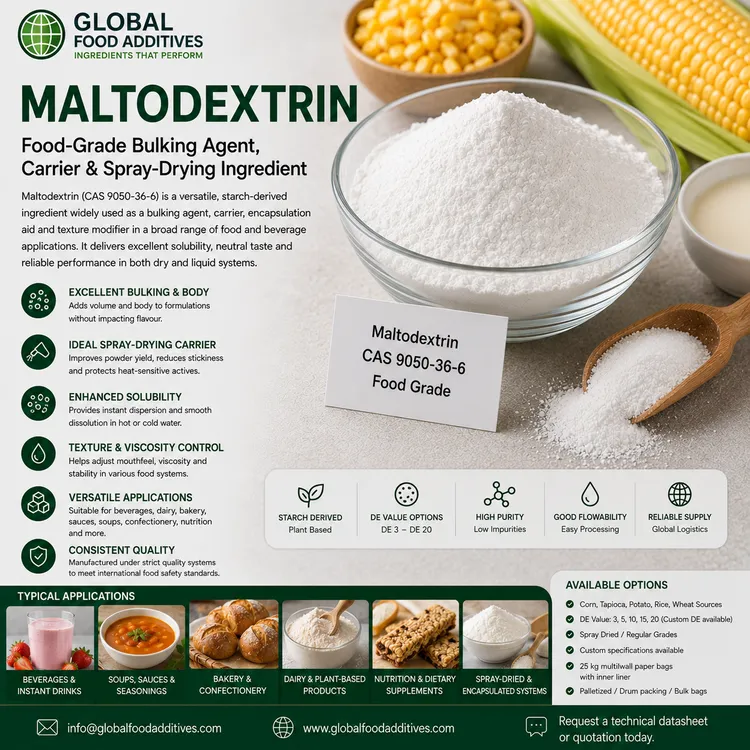
Product identity
| Product | Maltodextrin |
|---|---|
| Category | Modified Starches, Fibres & Bulking Agents |
| Function | Texture, bulking, viscosity or carrier ingredient |
| CAS / identity | 9050-36-6 |
| E / INS number | Confirm by destination market and supplier documentation |
| Ingredient type | Starch hydrolysate / glucose polymer produced by controlled hydrolysis of food starch |
| Typical starch sources | Corn, tapioca, potato, rice, wheat or other permitted starch source depending on supplier |
| Typical DE range | Supplier-specific; many standard maltodextrins are specified below DE 20 |
| Typical form | Powder, fine powder, granule, agglomerated powder or instantized grade |
| Key technical focus | DE value, solubility, viscosity, sweetness, carrier performance, powder flow, moisture, source declaration and label compliance |
Application fit
Potential use areas may include:
- Soups, sauces, gravies, dressings, marinades and ready-meal systems
- Seasonings, spice blends, savoury powders and instant soup bases
- Bakery, fillings, cake mixes, biscuit systems and batter premixes
- Meat products, poultry systems, seafood products and processed protein foods
- Beverages, powdered drinks, sports nutrition and carbohydrate beverages
- Dairy powders, creamers, ice cream mixes and dessert powders
- Spray-dried flavours, colours, oils, emulsions and encapsulated ingredients
- Nutrition powders, meal replacements, sachets, tablets and dry blends
Technical overview
Maltodextrin is produced by controlled hydrolysis of starch. The hydrolysis level is expressed as dextrose equivalent, or DE. This value influences the ingredient's sweetness, solubility, viscosity, water binding, hygroscopicity, browning tendency and powder-handling behaviour. Lower-DE grades usually provide more body and less sweetness, while higher-DE grades generally dissolve more easily and contribute more sweetness and reducing sugar character.
In food manufacturing, Maltodextrin is often selected when a formula needs solids without strong sweetness. It can add bulk to powders, improve body in liquids, act as a neutral carrier for flavours or colours, assist spray drying, reduce stickiness of hygroscopic ingredients, support dry blending, improve mouthfeel and standardize active ingredients. It is also used where a carbohydrate source is required without the full sweetness of sucrose or glucose syrup solids.
Industrial performance depends on starch source, DE value, hydrolysis method, drying process, particle size, agglomeration, moisture, density, solubility, microbiological quality and storage conditions. Corn, tapioca, rice, potato and wheat maltodextrins may be chosen for different label, allergen, GMO, gluten-free, sensory, solubility or customer-preference reasons.
Functional benefits in food systems
Bulking and solids control
Maltodextrin adds carbohydrate solids and volume with relatively low sweetness, helping balance dry mixes, sauces, seasonings, fillings, nutrition powders and reduced-sugar formulas.
Carrier and encapsulation support
It is widely used as a carrier for spray-dried flavours, colours, oils, vitamins, sweeteners, acids and actives, helping convert liquids or emulsions into free-flowing powders.
Texture and mouthfeel
Lower-DE grades can contribute body, smoothness and viscosity in beverages, dairy systems, sauces, soups and fat-reduced applications without creating excessive sweetness.
Powder flow and process stability
Appropriate grades can improve dry-blend uniformity, reduce stickiness, assist tableting or sachet filling and support consistent dosing in industrial powder systems.
Dextrose equivalent selection guide
DE selection is one of the most important technical decisions when sourcing Maltodextrin. A lower DE means longer glucose chains and typically less sweetness, higher viscosity contribution and lower hygroscopicity. A higher DE means shorter chains and typically more solubility, more sweetness, more reducing sugar character and greater hygroscopicity. Supplier specifications should define DE range and test method.
| DE range | Typical functional direction | Industrial use focus |
|---|---|---|
| Low DE | Lower sweetness, more body, higher viscosity contribution, less hygroscopicity and slower dissolution than higher-DE grades. | Body building, carrier systems, spray drying, fat replacement support, dry mixes and applications where sweetness should remain low. |
| Medium DE | Balanced solubility, moderate body and controlled sweetness depending on source and process. | Instant powders, seasonings, sauces, bakery mixes, nutrition powders and general-purpose food applications. |
| Higher DE maltodextrin | Greater solubility, more sweetness, more reducing sugars and stronger hygroscopic tendency. | Beverages, fast-dissolving systems, carbohydrate drinks, sweet blends and applications where faster dissolution is needed. |
| Specialty or agglomerated grades | Improved wettability, dispersibility, flow and instant behaviour. | Instant drink powders, consumer sachets, protein blends, dairy powders and high-speed filling lines. |
Application engineering guidance
| Application | Typical technical objective | Key formulation review points |
|---|---|---|
| Soups, sauces and gravies | Add body, solids, mild viscosity and carrier function for flavours, fats, starches and seasonings. | Review DE, solubility, pH, salt level, heat process, freeze-thaw, starch system, flavour release, mouthfeel and reconstitution behaviour. |
| Seasonings and savoury powders | Carry flavours, acids, sweeteners, spices and active ingredients while improving blend volume and flow. | Check particle size, bulk density, dusting, hygroscopicity, anti-caking system, salt level, flavour load and sachet filling performance. |
| Spray-dried flavours and oils | Convert liquid flavours, emulsions, oils or extracts into stable free-flowing powders. | Validate wall-material ratio, emulsion stability, inlet/outlet temperature, oil load, oxidation stability, encapsulation efficiency and powder yield. |
| Beverages and powdered drinks | Provide soluble carbohydrate solids, mouthfeel, instant dispersion and carrier function. | Evaluate clarity, solubility, sweetness, pH, mineral load, protein interaction, sediment, flavour release and consumer preparation conditions. |
| Bakery and dry mixes | Provide bulk, moisture control, browning support, powder flow and texture adjustment. | Check DE, reducing sugar level, Maillard browning, dough water absorption, batter viscosity, final texture and label declaration. |
| Meat and processed protein systems | Support solids, seasoning distribution, moisture balance, brine systems and flavour delivery. | Review solubility, salt compatibility, phosphate system, injection or tumbling process, purge, cook yield and label rules. |
| Dairy powders and creamers | Provide carrier solids, body, powder flow and instantization support. | Validate protein stability, fat encapsulation, lactose interaction, spray drying, dispersibility, caking, storage humidity and reconstitution. |
| Nutrition powders and meal replacements | Provide carbohydrate solids, carrier function and mouthfeel in protein and micronutrient blends. | Check glycemic positioning, serving size, protein interaction, vitamin/mineral premix compatibility, powder flow, flavour masking and label claims. |
| Tablets, sachets and dry blends | Improve dilution, carrier volume, compression support and blend uniformity. | Review particle size, density, compressibility, flowability, caking, electrostatic behaviour, active ingredient distribution and humidity protection. |
Starch source and label considerations
Maltodextrin can be produced from different starch sources, including corn, tapioca, potato, rice and wheat. Source selection can affect label wording, allergen review, gluten-free suitability, GMO status, customer preference, country-of-origin expectations and sensory requirements. Many manufacturers select tapioca or rice maltodextrin for certain label-sensitive applications, while corn maltodextrin is widely used in general-purpose industrial formulations.
| Source type | Potential reason for selection | Buyer review points |
|---|---|---|
| Corn maltodextrin | Broad availability, cost efficiency and wide industrial use. | Confirm GMO status, country of origin, DE, allergen statement and customer acceptance. |
| Tapioca maltodextrin | Often selected for clean taste, non-cereal positioning and non-GMO preference where documented. | Confirm source, DE, solubility, supply continuity, viscosity and label wording. |
| Potato maltodextrin | May be selected for specific label, texture or source-preference requirements. | Review solubility, flavour neutrality, viscosity, EU or local source expectations and allergen status. |
| Rice maltodextrin | May be used in infant, cereal, hypoallergenic-positioned or premium formulations where permitted. | Confirm arsenic monitoring, source control, DE value, infant-food suitability and regulatory documentation. |
| Wheat maltodextrin | May be available for specific industrial requirements or regional supply chains. | Review allergen declaration, gluten status, local exemptions, gluten-free claim rules and customer restrictions. |
Spray drying and encapsulation use
Maltodextrin is one of the most common wall materials and carriers in spray-dried ingredients. It helps increase total solids, reduce stickiness in the dryer, protect sensitive ingredients, improve powder recovery, reduce oxidation of oils and flavours, and create a carrier matrix that disperses when water is added. It is frequently used for spray-dried flavours, citrus oils, spice oleoresins, colours, vitamins, emulsions, botanical extracts and powdered fats.
Encapsulation performance depends on DE, wall-material ratio, emulsion droplet size, solids content, inlet and outlet temperatures, feed viscosity, drying time, carrier blend, anti-caking system and storage humidity. Maltodextrin may be combined with gum arabic, modified starch, proteins, inulin, soluble fibre, emulsifiers or other carriers to improve emulsification, film formation, oxidation protection and powder flow.
Powder handling and processing principles
Maltodextrin is usually supplied as a dry powder or agglomerated powder. Fine powders can disperse quickly in dry blends but may create dust, poor flow or caking in humid environments. Agglomerated grades improve wettability and instant dispersion, especially in consumer powders, protein blends, drink mixes and dairy powders. Granular grades may improve handling and reduce dusting in large-scale blending.
Important production factors include powder feeding, dust control, hopper flow, pneumatic conveying, blend uniformity, segregation, static charge, caking, bag opening losses and storage humidity. If Maltodextrin is used as a carrier for high-value flavours or micronutrients, blend uniformity and assay recovery should be validated after mixing, transport and filling.
| Processing factor | Why it matters | Industrial control |
|---|---|---|
| Particle size | Influences flowability, dusting, dissolution, segregation and mouthfeel. | Specify mesh size or particle size distribution and validate in the final process. |
| Bulk density | Affects bag volume, hopper flow, dosing, sachet fill weight and blend uniformity. | Compare loose and tapped density between suppliers. |
| Moisture content | Controls caking, microbial stability, flow and shelf life. | Use moisture-barrier packaging and dry warehouse conditions. |
| Agglomeration | Improves wettability and instant dispersion. | Use for instant drinks, dairy powders and consumer sachets where quick reconstitution is required. |
| Hygroscopicity | Higher-DE grades can pick up moisture more readily. | Run humidity storage tests and select packaging accordingly. |
| Carrier ratio | Controls active ingredient dilution, flavour release and powder flow. | Validate carrier-to-active ratio in finished powder and label declaration. |
Specification and quality-control parameters
For industrial purchasing, Maltodextrin should be compared by DE value, starch source, physical form, purity, powder performance and documentation. A supplier specification should provide enough information for QA, R&D, regulatory review and production scale-up.
Identity and composition
- Product name: Maltodextrin
- CAS number: 9050-36-6
- Starch source declaration
- Dextrose equivalent value and test method
- Reducing sugars or carbohydrate profile where specified
- Standard maltodextrin versus resistant maltodextrin confirmation
Physical properties
- Appearance, colour and odour
- Powder, granule or agglomerated form
- Particle size distribution or mesh size
- Bulk density and tapped density
- Flowability, dispersibility and wettability
- Solubility and clarity in water where relevant
Chemical limits
- Moisture or loss on drying
- pH of solution
- Total ash or sulfated ash
- Sulfur dioxide where relevant to process or market
- Protein or nitrogen where relevant to source
- Heavy metals and elemental impurities
Food safety controls
- Total plate count, yeast and mould
- Coliforms, E. coli, Salmonella and specified pathogens where required
- Lead, arsenic, cadmium and mercury limits where required
- Allergen and gluten declaration
- GMO, irradiation and nanomaterial statements where required
- Halal, kosher, vegan or vegetarian suitability where commercially required
Quality effects to validate
| Quality factor | Possible Maltodextrin effect | Validation method |
|---|---|---|
| Solubility | Can support quick dissolution in beverages, sauces and instant powders depending on DE and agglomeration. | Reconstitution test, wetting time, dispersion test and sediment check. |
| Viscosity and body | Lower-DE grades can contribute body and mouthfeel without high sweetness. | Brookfield viscosity, sensory mouthfeel and comparison against reference formula. |
| Powder flow | Particle size and moisture affect hopper flow, filling and blending. | Angle of repose, flowability test, bulk density, caking test and line trial. |
| Carrier performance | Can dilute actives and improve powder handling of flavours, colours and oils. | Blend uniformity, active recovery, flavour release and storage stability. |
| Spray-drying yield | Can reduce stickiness and improve powder recovery depending on DE and solids. | Spray-dryer trial, wall deposit check, powder moisture, yield and encapsulation efficiency. |
| Hygroscopicity and caking | Higher-DE or fine grades may absorb moisture and cake under humidity. | Humidity chamber test, accelerated storage, package trial and flowability after storage. |
| Sensory neutrality | Most grades are bland, but source or process may affect flavour in delicate products. | Sensory panel in water, finished product and stored product. |
Regulatory and labeling review
Maltodextrin is typically reviewed as a starch-derived food ingredient or carbohydrate ingredient, but regulatory status, naming, allergen treatment and claim rules vary by destination market. The buyer should confirm whether the label should declare “maltodextrin,” source-specific wording such as “corn maltodextrin,” or another locally required description.
Special attention is required for wheat-derived maltodextrin, gluten-free claims, non-GMO claims, organic products, infant foods, medical foods, sports nutrition and products making sugar, fibre, calorie or glycemic claims. Standard digestible Maltodextrin contributes carbohydrate and should not be used as a fibre ingredient unless the supplier specifically provides a resistant maltodextrin or soluble fibre grade supported by local regulations.
For products exported to multiple markets, buyers should request market-specific regulatory statements. A Maltodextrin grade accepted in one country may require different labeling, allergen declaration, GMO documentation, origin wording or nutrition-panel treatment in another market.
Industrial purchasing notes
When reviewing Maltodextrin, compare the supplier specification against the intended food application, DE requirement, starch source, process conditions, label expectations and local rules. For industrial purchasing, the most useful inquiry normally includes target DE, starch source, particle size, physical form, packaging size, quantity, destination and required documents.
| Purchasing factor | Why it matters |
|---|---|
| Dextrose equivalent | Controls sweetness, solubility, viscosity, hygroscopicity, browning tendency and process performance. |
| Starch source | Affects allergen review, GMO status, gluten status, customer preference, label wording and market acceptance. |
| Particle size | Influences dusting, flow, dissolution, mouthfeel, segregation and filling accuracy. |
| Agglomeration | Improves instant dispersion and consumer preparation performance. |
| Moisture and caking tendency | Important for storage, transport, dry blending and high-humidity markets. |
| Microbiological quality | Critical for infant foods, medical foods, nutrition powders, cold-prepared drinks and low-heat applications. |
| Carrier performance | Important when Maltodextrin carries flavours, colours, oils, vitamins or high-value actives. |
| Documentation package | Complete food-grade, allergen, gluten, GMO, origin, heavy metal, microbiology, halal, kosher and regulatory documents reduce approval delays. |
Documents to request
- Product specification or technical data sheet with CAS number and identity statement
- Certificate of analysis for available batch or lot
- Dextrose equivalent value, DE range and analytical method
- Starch source declaration, including corn, tapioca, potato, rice, wheat or other source
- Food-grade statement and destination-market regulatory declaration
- Standard maltodextrin versus resistant maltodextrin or dextrin clarification
- Particle size distribution, mesh size, bulk density and flowability data
- Moisture, pH, ash, solubility and colour data where specified
- Microbiological limits and pathogen absence statement
- Heavy metals and elemental impurity limits
- Allergen, gluten, GMO, irradiation and nanomaterial statements where required
- Halal, kosher, vegan or vegetarian suitability documents where commercially required
- Origin, manufacturer, production site and change-control information
- Shelf-life, storage condition and humidity-protection guidance
- Packaging details, net weight, inner liner, pallet configuration and batch coding
- Spray-drying, encapsulation or instantization guidance where available
- Label declaration guidance and market-specific compliance statement
- Traceability and supplier quality-system information where required
How to request this product
Send the product name, target DE value, starch source preference, physical form, particle size requirement, quantity, destination country, packaging preference, expected shipment date and required documents. If you already purchase Maltodextrin, attach or describe your existing specification, label, certificate of analysis, supplier grade, DE value, starch source or application so supplier options can be compared more accurately.
For faster technical review, include the final product type, target function, desired solubility, sweetness limit, viscosity target, spray-drying or carrier use, powder-flow requirement, allergen or gluten restrictions, GMO preference, required certifications, annual consumption estimate and whether you need a laboratory sample, pilot quantity or commercial shipment.
Useful answers
What is Maltodextrin used for in food manufacturing?
Maltodextrin is used for bulking, carrier systems, spray drying, encapsulation, powder flow, texture, viscosity, body, moisture control and carbohydrate solids. Typical applications include soups, sauces, dressings, seasonings, bakery, meat products, beverages, dairy powders, nutrition powders, flavours and colours.
What does DE mean in Maltodextrin?
DE means dextrose equivalent. It describes the degree of starch hydrolysis and affects sweetness, solubility, viscosity, hygroscopicity, browning tendency and processing behaviour. The DE value should be confirmed on the supplier specification.
Is Maltodextrin sweet?
Maltodextrin is usually much less sweet than sugar, but sweetness increases as DE increases. Lower-DE grades are often selected where bulk and body are needed without strong sweetness.
Is Maltodextrin the same as resistant maltodextrin?
No. Standard Maltodextrin is a digestible carbohydrate ingredient, while resistant maltodextrin is a different specialty ingredient used for soluble fibre or reduced digestibility applications. Buyers should verify the exact ingredient type before making nutrition claims.
Can Global Food Additives source Maltodextrin?
Global Food Additives can review sourcing options for Maltodextrin according to target DE, starch source, particle size, physical form, application, quantity, destination, packaging and required documentation.
Which documents should be requested?
Buyers commonly request a technical data sheet, product specification, certificate of analysis, DE value, starch-source declaration, food-grade statement, allergen and gluten statement, GMO declaration, microbiological limits, shelf-life information and packing details.
Is Maltodextrin permitted in every country?
No. Use depends on destination-market rules, ingredient status, food category, source material, allergen rules, label wording, nutrition claims and buyer responsibility. Final regulatory suitability should be verified before commercial use.
What should be checked before switching Maltodextrin suppliers?
Check DE value, starch source, particle size, bulk density, moisture, solubility, colour, odour, microbiological limits, heavy metals, allergen status, gluten status, GMO status, regulatory documents, shelf life and performance in the finished food.
Tell us which food additive or ingredient you need.
Send product names, target specifications, quantity, destination country, packaging preference, delivery term and document requirements. For Maltodextrin, please also include the target DE value, starch source, physical form, particle size, application, allergen or gluten requirements, GMO preference and required certificates. Our team will review your inquiry and respond from [email protected].
Your message has been received. You will be redirected to the home page.