
Methylcellulose
Methylcellulose is a food-grade cellulose ether used as a thermal-gelling hydrocolloid, thickener, stabilizer, binder, water-retention agent and texture-building ingredient. In industrial food manufacturing, it is especially valuable because it can hydrate in cold water and form a reversible gel when heated, allowing formulators to create hot-set structure, cooking stability, bite, juiciness and shape retention in products that must survive frying, baking, steaming, grilling or reheating.
Unlike many gums that only thicken cold or hot water, Methylcellulose can be selected by viscosity grade, gelation temperature, gel strength, substitution profile, particle size, hydration speed and surface treatment. These grade differences are critical in plant-based meats, formed foods, gluten-free bakery, batters, fillings, sauces, frozen meals and high-moisture texture systems.
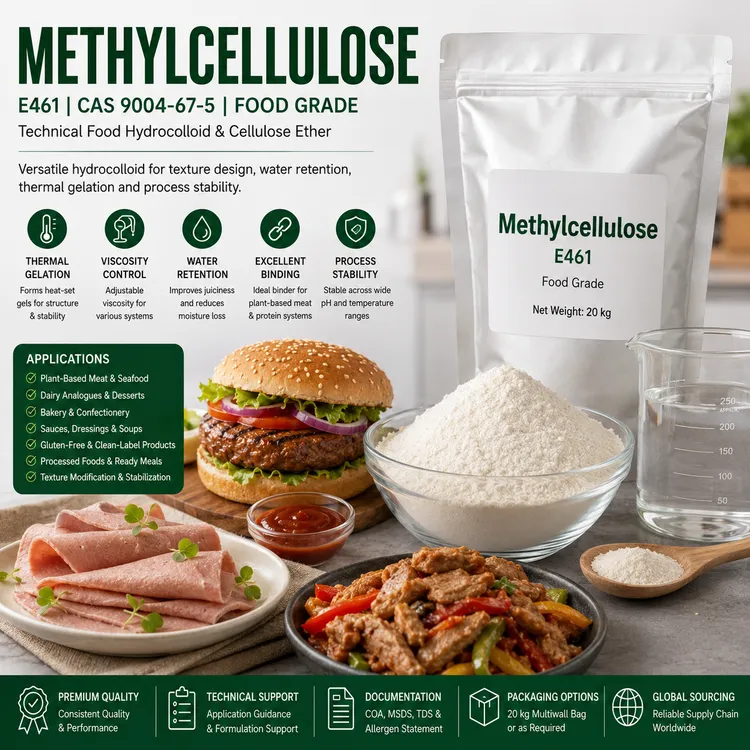
Product identity
| Product | Methylcellulose |
|---|---|
| Common abbreviation | MC |
| Category | Hydrocolloids, Gums & Gelling Agents |
| Primary function | Thermal-gelling hydrocolloid, thickener, stabilizer, binder, water-retention agent, film former and texture-building ingredient |
| E / INS number | E461, subject to destination-market confirmation |
| CAS / identity | 9004-67-5; cellulose methyl ether |
| Typical source | Purified cellulose chemically modified to produce a methylated cellulose ether |
| Typical form | Fine powder, granular powder, surface-treated powder, instantized grade or customized dry blend |
| Key performance properties | Viscosity, gelation temperature, gel strength, hydration behavior, particle size, degree of substitution, water binding and process tolerance |
| Primary purchasing basis | Food-grade compliance, viscosity grade, gel temperature, application fit, documentation, packaging and destination-market regulatory status |
Application fit
Potential use areas may include:
- Plant-based burgers, nuggets, sausages, patties and formed meat alternatives
- Hybrid meat products, restructured foods and high-moisture protein systems
- Gluten-free bakery, reduced-egg bakery, batters, coatings and fried foods
- Sauces, fillings, soups, dressings and spoonable products
- Desserts, creams, frozen meals, ready meals and reheatable foods
- Nutrition products, dry mixes, powdered preparations and instant systems
- Film-forming, moisture-control and processing-stability applications where permitted
Technical profile for manufacturers
Methylcellulose is a non-ionic cellulose ether derived from cellulose. Its key food-processing behavior is unusual: it hydrates in cold water to form viscous solutions, then gels when heated above its grade-specific gelation temperature. When cooled, the gel can soften again. This reversible thermal gelation makes it a valuable structuring ingredient in products that need firmness, bite or shape retention during cooking and reheating.
In plant-based and formed foods, Methylcellulose can help bind protein particles, oils, fibers and water into a cohesive matrix during thermal processing. In bakery and batters, it can support gas retention, film formation, water management and heat-set structure. In sauces and fillings, it can control viscosity, reduce water release and improve stability through cooking, freezing, thawing and reheating.
| Technical factor | Industrial relevance |
|---|---|
| Viscosity grade | Defines cold-solution thickness, hydration behavior, dosage efficiency, pumping behavior and finished-product texture. |
| Gelation temperature | Determines when the ingredient builds structure during cooking, frying, baking, steaming, grilling or reheating. |
| Gel strength | Controls hot bite, shape retention, firmness, sliceability, juiciness and cooking stability. |
| Degree of substitution | Influences solubility, gel temperature, hydration, thermal behavior and interaction with other formulation components. |
| Particle size | Affects dusting, wetting speed, lumping tendency, dry blending, dispersion and process consistency. |
| Surface treatment | Some grades are designed for delayed hydration or easier dispersion, reducing lumping during industrial mixing. |
| Cold-water hydration | Essential for building viscosity before heating. Incorrect hydration can create fish-eyes, dry cores, lumps or inconsistent gelation. |
| Salt and sugar tolerance | Electrolytes, acids, sugars and polyols can influence hydration, viscosity and gel behavior depending on grade and concentration. |
| Freeze-thaw behavior | Important for frozen meals, patties, fillings and ready-to-heat products where water migration affects texture. |
| Regulatory identity | E461 status, permitted applications, labeling and use levels must be checked for the destination market. |
Thermal gelation and cold hydration
The most valuable technical feature of Methylcellulose is its heat-set behavior. During heating, hydrated Methylcellulose chains associate and form a gel network. During cooling, this network can relax. This gives food developers a tool for building structure at the exact moment when a product needs to hold shape, resist cooking loss, suspend fat, retain moisture or maintain bite.
Hydration method is equally important. If powder is added directly to water without proper dispersion, the outer layer may hydrate first and form lumps with dry centers. Industrial processors often use one or more strategies: dry blending with powders, pre-dispersing in oil, adding under high shear, using hot water dispersion followed by cooling, or selecting surface-treated grades designed for controlled hydration.
| Processing stage | What to control | Why it matters |
|---|---|---|
| Dry blending | Blend Methylcellulose with salt, sugar, starch, fiber, protein or other dry ingredients before water addition. | Improves powder distribution and reduces lumping risk during hydration. |
| Dispersion | Add gradually under strong mixing or use supplier-recommended dispersion method. | Prevents fish-eyes, floating powder, dry cores and inconsistent viscosity. |
| Hydration | Allow enough time and temperature control for full hydration before forming or filling. | Incomplete hydration can reduce gel strength and create uneven texture. |
| Heating | Match gel temperature to cooking profile and product center temperature. | Correct timing supports structure formation, water retention and shape stability. |
| Cooling | Validate texture after cooling, freezing, thawing and reheating. | Some products need hot firmness, while others require stable texture after cooling. |
| Scale-up | Check real mixer energy, residence time, forming pressure and thermal profile. | Lab hydration and pilot-line hydration can differ significantly. |
Grade selection guide
Methylcellulose grades vary widely. Buyers should not compare only by product name or price. The right grade depends on the target texture, process temperature, water content, fat level, protein system, salt level, pH, mixing method and label requirements.
| Grade family | Typical purchasing logic | Common application direction |
|---|---|---|
| Low-viscosity Methylcellulose | Lower cold viscosity with easier pumping and less thickening at low temperature. | Beverage-like systems, coatings, batters, thin sauces, film-forming systems and formulations needing less cold thickening. |
| Medium-viscosity Methylcellulose | Balanced viscosity, hydration and thermal gel performance. | Plant-based meats, sauces, fillings, frozen meals, bakery systems and general food structuring. |
| High-viscosity Methylcellulose | Higher water binding, stronger cold viscosity and potentially stronger structure at lower dosage. | Meat alternatives, high-moisture systems, thick fillings, structured foods and products needing strong binding. |
| Low-gel-temperature grade | Forms gel earlier in the heating process. | Fast-cooking products, thin patties, fried foods, coatings and products with short thermal exposure. |
| High-gel-temperature grade | Forms gel later in the heating process. | Baked products, thick formed foods, high-temperature processes and products needing delay before setting. |
| Surface-treated grade | Designed for delayed hydration and improved dispersion. | Industrial mixing, dry blends, large batch systems and processes with high lumping risk. |
| Instantized or agglomerated grade | Improved wetting and easier incorporation compared with fine powders. | Dry mixes, powders, sachets, nutrition products and plants with limited hydration time. |
| Application-specific blend | Methylcellulose combined with fibers, starches, gums, proteins or emulsifiers. | Plant-based meat systems, gluten-free bakery, sauces, batters, frozen meals and customized texture systems. |
Functional roles in food systems
Methylcellulose can deliver multiple functions at the same time. It may thicken before heating, bind during cooking, retain water during reheating, stabilize emulsions, reduce oil loss, improve bite and help create a more consistent finished product.
| Functional role | What Methylcellulose can support | Typical evaluation method |
|---|---|---|
| Hot-set binding | Helps bind plant proteins, fibers, oils and water during cooking. | Cook yield, sliceability, compression, bite, shape retention and thermal gel strength. |
| Water retention | Reduces cooking loss, purge, syneresis and moisture migration. | Cook loss, centrifuge test, freeze-thaw cycling, water activity and storage trial. |
| Texture design | Builds firmness, chew, elasticity, juiciness, spoonability or cohesive structure. | Texture profile analysis, rheology, sensory panel and benchmark comparison. |
| Viscosity control | Controls cold viscosity in sauces, fillings, batters and forming systems. | Brookfield viscosity, flow curve, pumpability, deposit behavior and line trials. |
| Emulsion support | Helps stabilize water-oil-protein systems and reduce fat separation. | Oil loss, droplet distribution, thermal stability, reheating behavior and storage trial. |
| Film formation | Supports coatings, batters, surface films and moisture-control layers. | Coating adhesion, film integrity, crispness, pickup, frying stability and visual inspection. |
| Freeze-thaw support | Helps manage water release and texture change in frozen / reheated products. | Freeze-thaw cycling, drip loss, reheating texture, ice crystal impact and sensory texture. |
| Egg or gluten reduction support | Can contribute binding and structure where egg or gluten functionality is reduced. | Bake volume, crumb structure, batter viscosity, eating texture and shelf-life firmness. |
Application guidance by industry
Plant-based meat and meat alternatives
Methylcellulose is one of the most important functional binders in plant-based meat systems because it can provide structure during cooking. In burgers, nuggets, sausages and formed foods, it can bind water and oil, reduce cooking loss, improve bite and help the product hold shape under heat.
- Key requirements: hot gel strength, water retention, fat binding, juiciness, bite, shape retention and freeze-thaw stability.
- Common partners: pea protein, soy protein, wheat gluten, starches, fibers, oils, flavors, colors and emulsifiers.
- Critical tests: cook yield, purge, oil loss, bite, compression, reheating behavior, grilling performance and sensory juiciness.
Hybrid meat and formed foods
In meat, poultry, seafood and hybrid protein products, Methylcellulose can support water binding, process yield and texture. It should be evaluated together with salt, phosphates, animal proteins, plant proteins, fibers and starches because these ingredients strongly affect gel behavior and bite.
- Key requirements: yield, binding, sliceability, low purge, stable bite and compatibility with animal or plant protein systems.
- Common partners: meat proteins, soy protein, pea protein, phosphates, starches, fibers, hydrocolloids and fats.
- Critical tests: cook loss, purge, slicing, texture profile analysis, freeze-thaw behavior and label review.
Gluten-free bakery and reduced-egg systems
In gluten-free bakery, Methylcellulose can help build structure, support gas retention, improve crumb, reduce crumbling and improve volume. In reduced-egg or egg-free batters, it can contribute viscosity, film formation and heat-set structure.
- Key requirements: batter viscosity, gas retention, oven spring, crumb structure, moisture retention and reduced breakage.
- Common partners: rice flour, starches, fibers, psyllium, xanthan gum, proteins, emulsifiers, oils and leavening systems.
- Critical tests: batter viscosity, baked volume, crumb firmness, slicing, crumbling, moisture loss and shelf-life texture.
Batters, breadings and fried foods
Methylcellulose can support coating adhesion, water retention, film formation and oil-management in selected fried or baked coating systems. It may help build a cohesive film during heating and reduce coating loss during handling or frying.
- Key requirements: coating pickup, adhesion, crispness, thermal film formation, low oil uptake and stable appearance.
- Common partners: starches, flours, proteins, gums, leavening agents, seasonings and emulsifiers.
- Critical tests: pickup percentage, adhesion, frying loss, oil content, crispness retention and reheating performance.
Sauces, fillings and ready meals
In sauces, fillings and ready meals, Methylcellulose can provide viscosity, water binding and heat-stable texture. It may be useful in products that are cooked, chilled, frozen, thawed and reheated where viscosity and water retention must remain stable.
- Key requirements: pumpability, hot viscosity, reheating texture, low syneresis, freeze-thaw stability and clean flavor release.
- Common partners: modified starch, xanthan gum, guar gum, proteins, emulsifiers, fibers, salt and acid systems.
- Critical tests: viscosity after cooking, freeze-thaw cycling, syneresis, reheating behavior, filling stability and sensory texture.
Desserts, creams and frozen systems
In desserts, creams and frozen products, Methylcellulose can help control viscosity, body, water release and texture through processing and storage. It should be tested with sugars, fats, proteins, stabilizers and freezing conditions because these can shift hydration and gel behavior.
- Key requirements: smooth texture, low syneresis, controlled viscosity, freeze-thaw stability and clean mouthfeel.
- Common partners: carrageenan, guar gum, locust bean gum, starch, pectin, proteins, emulsifiers and sweeteners.
- Critical tests: viscosity, ice crystal growth, meltdown, syneresis, freeze-thaw cycling and sensory smoothness.
Specification checklist for purchasing
For industrial sourcing, Methylcellulose quotations should be compared by functionality, grade parameters and documentation. A lower-cost grade may not be economical if it hydrates poorly, gels at the wrong temperature, creates lumps, gives weak structure, causes off-texture or does not meet regulatory requirements.
| Specification area | Recommended buyer requirement |
|---|---|
| Regulatory identity | Confirm E461, CAS 9004-67-5, food-grade status, recommended label declaration and destination-market compliance. |
| Viscosity grade | Request viscosity value, concentration, temperature, method and tolerance. Compare only when test methods are aligned. |
| Gelation temperature | Request gelation temperature range and test method. Match the grade to cooking, frying, baking or reheating profile. |
| Gel strength | Ask for supplier guidance or application trial data where hot firmness, bite and shape retention are critical. |
| Substitution profile | Request methoxy content or degree of substitution where relevant to solubility, gelation and regulatory specification. |
| Particle size | Important for dry blending, dusting, wetting speed, lumping risk and processing consistency. |
| Surface treatment | Confirm whether the grade is surface-treated, instantized or standard powder. This affects hydration and order of addition. |
| Moisture / loss on drying | Controls caking, shelf life, powder flow and commercial comparison. |
| pH | Relevant for compatibility with proteins, acids, minerals, sauces, beverages and meat alternatives. |
| Ash and purity | Request ash, chloride, heavy metals, residual solvents and other supplier-specific purity parameters where required. |
| Microbiology | Total plate count, yeast and mold, coliforms, E. coli, Salmonella and application-specific limits. |
| Dietary declarations | Allergen statement, GMO statement, gluten status, vegan / vegetarian suitability, halal and kosher certificates where required. |
| Processing guidance | Request hydration method, recommended dosage range, thermal gel guidance and application notes from the supplier. |
| Packaging and shelf life | Bag type, liner, net weight, pallet configuration, shelf life, storage conditions and humidity protection. |
Hydration and processing guidance
Methylcellulose performance depends heavily on how it is dispersed and hydrated. The correct method depends on grade, batch size, mixer type, water temperature, dry mix composition, fat level, salt level and processing time. Poor hydration can create lumps, low gel strength, gritty texture, inconsistent viscosity and production variation.
Recommended trial protocol
- Define the target function: hot binding, cold viscosity, water retention, gel strength, film formation or texture design.
- Select candidate grades by viscosity, gelation temperature, particle size and application guidance.
- Prepare a control formula without Methylcellulose and benchmark texture, cooking loss and stability.
- Disperse the powder using the supplier's recommended method and hydration time.
- Test several dosage levels under the real formula conditions, including salt, fat, protein, starch and pH.
- Apply the real heating process: frying, grilling, baking, steaming, pasteurization, reheating or hot filling.
- Measure hot texture, cooled texture, cook loss, purge, syneresis, bite, viscosity or coating adhesion as relevant.
- Run pilot-scale trials with actual equipment, forming pressure, line speed, filling conditions and packaging.
- Confirm regulatory status, label declaration and documentation before commercial approval.
Common processing issues
- Fish-eye lumps from fast surface hydration
- Weak hot binding because the gelation temperature does not match the cooking profile
- Excessive cold viscosity causing poor pumping or forming
- Rubbery or gummy bite from overuse or wrong viscosity grade
- Dry mouthfeel when water binding is too strong or fat balance is incorrect
- Poor juiciness in plant-based meat due to insufficient oil and water structuring
- Syneresis after freezing and thawing from incomplete stabilizer design
- Batch-to-batch variation caused by inconsistent hydration time or shear
- Regulatory mismatch between intended food category and destination-market permissions
Synergies and formulation partners
Methylcellulose is often used with proteins, fibers, starches, gums, emulsifiers and oils to build a complete texture system. It is rarely the only functional ingredient in complex industrial foods. The best combination depends on whether the target product is grilled, fried, baked, frozen, reheated, sliced, filled, pumped or deposited.
| Partner ingredient | Industrial purpose |
|---|---|
| Pea protein, soy protein or wheat gluten | Provides protein matrix while Methylcellulose contributes hot binding, water retention and cooking structure. |
| Starches and modified starches | Support viscosity, water binding, freeze-thaw stability and texture in sauces, fillings, nuggets and formed foods. |
| Fibers | Build bite, water holding, nutritional positioning and structure in plant-based meats and reduced-fat systems. |
| Xanthan gum | Improves cold viscosity, suspension and yield stress in sauces, dressings and hydrated mixes. |
| Guar gum or locust bean gum | Supports viscosity, water control and freeze-thaw texture in desserts, sauces and frozen systems. |
| Emulsifiers | Support fat dispersion, batter stability, oil binding and improved texture in multi-phase systems. |
| Vegetable oils and structured fats | Provide juiciness and mouthfeel while Methylcellulose helps retain oil during heating. |
| Salt, phosphates, acids and buffers | Influence hydration, protein interaction, flavor and water binding; compatibility should be tested in the full formula. |
Regulatory, label and positioning considerations
Methylcellulose is often used in vegan, vegetarian, plant-based, egg-free and gluten-free product development because it is cellulose-derived and provides heat-set functionality. However, finished-product claims depend on the complete formula, processing aids, cross-contact controls and destination-market rules. Buyers should not assume claim suitability from the ingredient name alone.
| Regulatory question | Buyer action |
|---|---|
| How should it be declared? | Request supplier label recommendation and verify whether local rules require “methylcellulose,” “cellulose gum derivative,” “E461” or another accepted declaration. |
| Can it be used in plant-based products? | Often evaluated for plant-based foods, but vegan / vegetarian suitability should be confirmed by supplier declaration and full formula review. |
| Is it clean-label? | Clean-label acceptance is brand- and market-specific. Some buyers accept it for functionality; others may seek alternative hydrocolloid systems. |
| Can gluten-free claims be made? | Claims depend on the full formula, supplier gluten statement, cross-contact controls and local thresholds. |
| Is it permitted in all food categories? | No. Confirm permitted food categories, maximum use levels and labeling in the destination market. |
| Are halal or kosher certificates required? | Certification must match the exact grade, manufacturing site and supply chain. |
Quality, safety and compliance documents to request
- Product specification or technical data sheet with exact grade and E / INS identity
- Certificate of analysis for available batch or representative lot
- Safety data sheet where applicable for handling, dust control, storage and transport review
- Food-grade declaration and destination-market compliance statement
- CAS / identity statement and recommended label declaration
- Viscosity specification with method, concentration, temperature and tolerance
- Gelation temperature, substitution profile, particle size and hydration guidance where available
- Origin statement, cellulose source declaration and traceability information
- Allergen statement, GMO statement, gluten statement, vegan / vegetarian statement and cross-contact information
- Halal, kosher, organic suitability or other certificates when required
- Heavy metals, ash, residual solvents and other purity declarations where required
- Microbiological specification and lot-specific microbiological results
- Shelf-life statement, storage conditions and retest policy
- Packaging specification, net weight, pallet configuration and container loading information
- Application guidance for dispersion, hydration, thermal gelation and order of addition where available
Packaging, storage and handling
Methylcellulose is normally supplied as a dry powder in food-grade multiwall bags, lined cartons, drums or big bags depending on grade and volume. Because it is hygroscopic and can generate dust during handling, storage and production areas should be dry, clean, ventilated and controlled against contamination. Proper storage helps maintain powder flow, hydration behavior, viscosity and microbiological quality.
| Common packaging | Typical options may include 10 kg, 20 kg or 25 kg bags / cartons, drums or big bags depending on supplier, grade and order size. |
|---|---|
| Storage conditions | Store sealed in a cool, dry, clean and odor-free warehouse away from moisture, strong odors and contamination sources. |
| Humidity control | Protect from high humidity to reduce caking, lumping, poor flow and inconsistent hydration. |
| Dust control | Use appropriate powder-handling practices, local exhaust ventilation where required and protective measures stated in the SDS. |
| Handling | Use hygienic transfer, calibrated dosing, closed systems where possible and segregation from allergens if required by the plant program. |
| Shelf life | Supplier-specific. Request shelf-life statement, storage conditions and retest policy before order confirmation. |
| Logistics | Confirm HS code, country of origin, pallet configuration, container loading, temperature and humidity considerations and destination import requirements. |
Technical purchasing notes
When reviewing Methylcellulose, compare the supplier specification against the intended food application, process conditions, target function, label expectations and local rules. For industrial purchasing, the most useful inquiry normally includes target viscosity grade, gelation temperature, gel strength requirement, particle size, hydration method, application, processing temperature, packaging size, quantity, destination and document requirements.
Cost comparison should be based on cost-in-use and verified functionality rather than price per kilogram alone. A technically suitable Methylcellulose grade can improve cooking yield, reduce purge, improve plant-based meat bite, stabilize batters, improve bakery structure and reduce production defects. A cheaper grade may create lumping, weak gelation, poor texture or unstable processing if it does not match the application.
How to request this product
Send the product name, target Methylcellulose grade, application, target function, viscosity requirement, gelation temperature requirement, quantity, destination country, packaging preference, expected shipment date and required documents. If you already purchase Methylcellulose, attach or describe your existing specification, certificate of analysis, dosage level, hydration method, cooking process, label declaration or trial result so supplier options can be compared more accurately.
Recommended RFQ information
- Product name: Methylcellulose / MC / E461
- Required function: thermal gelation, hot binding, viscosity control, water retention, texture building, film formation, batter adhesion or freeze-thaw stability
- Preferred grade: low, medium or high viscosity; low-gel or high-gel temperature; standard, surface-treated or instantized grade
- Application: plant-based meat, formed food, bakery, batter, coating, sauce, filling, dessert, frozen meal, nutrition product or other use
- Target physical properties: viscosity, gelation temperature, gel strength, particle size, moisture, pH and hydration behavior
- Process conditions: hydration method, shear level, mixing time, salt level, fat level, protein system, pH, heating temperature, cooking time, freezing or reheating
- Performance target: cook yield, bite, juiciness, viscosity, syneresis control, coating adhesion, bakery volume, freeze-thaw stability or shelf-life texture
- Regulatory requirement: E461 confirmation, food-grade declaration, label wording, destination-market compliance and permitted use review
- Quality requirements: microbiology, heavy metals, residual solvents, source declaration, allergen, GMO, halal, kosher, vegan / vegetarian or gluten status
- Quantity: sample quantity, first commercial order and annual forecast
- Destination: country, port, incoterm and required import documents
- Packaging: bag size, drum size, big bag requirement, pallet format or warehouse handling preference
- Documentation: TDS, COA, SDS, food-grade declaration, regulatory statement, origin, microbiology, contaminant declarations, shelf life and packaging details
- Commercial requirement: target price basis, shipment date, payment term and preferred delivery schedule
Useful answers
What is Methylcellulose used for in food manufacturing?
Methylcellulose is used for thermal gelation, viscosity, suspension, gel texture, water binding, freeze-thaw stability, film formation and mouthfeel. It is especially useful where a product needs to build structure during heating, such as plant-based meat, batters, bakery, fried foods, sauces and reheatable meals.
Why is Methylcellulose used in plant-based meat?
Methylcellulose can hydrate in the formula and form a gel during cooking. This helps bind water, oil, proteins and fibers, improving hot bite, juiciness, shape retention and reduced cooking loss in plant-based burgers, nuggets, sausages and formed foods.
Does Methylcellulose dissolve in hot or cold water?
Methylcellulose is normally hydrated in cold water after proper dispersion. If powder is added incorrectly, it can form lumps with dry centers. Many processors disperse it first in dry ingredients, oil, hot water or another carrier, then cool and mix to complete hydration.
Which grade should I request?
The correct grade depends on application and process. Plant-based meats usually require hot gel strength and suitable gelation temperature. Sauces may require viscosity and freeze-thaw stability. Bakery may require film formation and gas retention. Batters may require coating adhesion and heat-set structure. Request viscosity, gelation temperature, particle size, surface treatment and application guidance.
Can Global Food Additives source Methylcellulose?
Global Food Additives can review sourcing options for Methylcellulose according to target grade, viscosity, gelation temperature, application, quantity, destination, packaging and required documentation.
Which documents should be requested?
Buyers commonly request a technical data sheet or specification, certificate of analysis, safety data sheet where applicable, food-grade declaration, E461 confirmation, origin statement, allergen statement, GMO statement, shelf-life information, label recommendation and packaging details.
Is this product permitted in every country?
No. Food additive use depends on destination-market rules, food category, use level, label requirements and buyer responsibility. Buyers should verify the exact regulatory identity, permitted use, labeling language and import requirements before commercial use.
Tell us which food additive or ingredient you need.
Send product names, target specifications, quantity, destination country, packaging preference, delivery term, and document requirements. Our team will review your inquiry and respond from orders@foodgradeadditives.com.
Your message has been received. You will be redirected to the home page.