
Mixed Tocopherols
Mixed Tocopherols is a food-grade antioxidant ingredient used to support oxidative stability in fats, oils, lipid-containing foods, colors, flavors, vitamins and sensitive ingredient systems. In industrial formulation, it is selected to help delay rancidity, protect sensory quality, reduce peroxide formation, preserve flavor freshness and support shelf-life performance in products exposed to oxygen, light, heat, metal ions or long storage conditions.
Commercial Mixed Tocopherols is not a single molecule. It is a supplier-specific blend of tocopherol homologues, commonly including alpha, beta, gamma and delta tocopherols in different ratios. The antioxidant performance of a grade depends on total tocopherol content, individual tocopherol profile, oil source, purity, carrier system, solubility, dosage, application matrix and processing conditions.
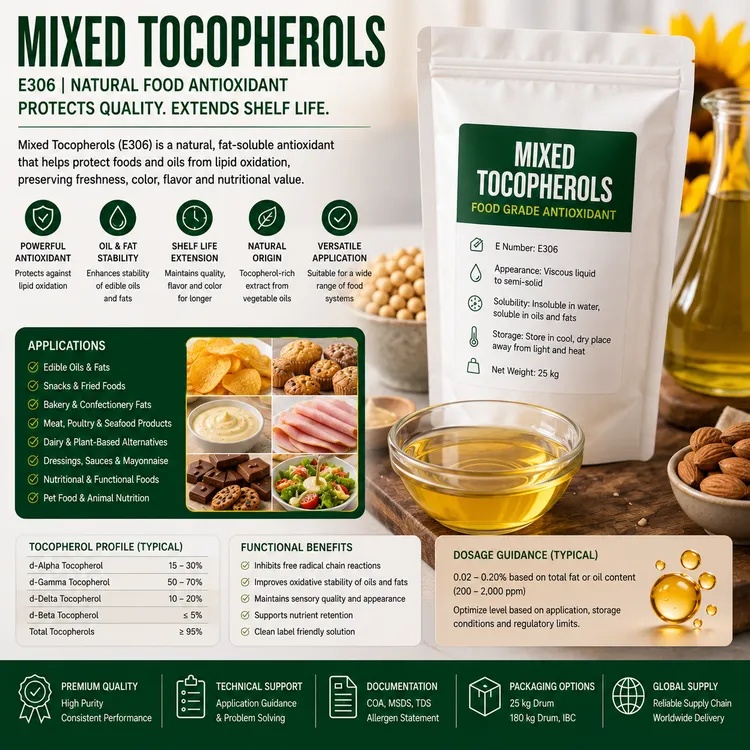
Product identity
| Product | Mixed Tocopherols |
|---|---|
| Also known as | Tocopherol-rich extract, natural mixed tocopherols, vitamin E antioxidant concentrate, E306 |
| Category | Antioxidants & Oxidation Control |
| Primary function | Antioxidant / oxidation-control ingredient for lipid-containing food systems |
| E / INS number | E306 for tocopherol-rich extract, subject to destination-market confirmation |
| CAS / identity | Mixture; exact identity depends on tocopherol profile, source oil and supplier specification |
| Typical composition | Alpha, beta, gamma and delta tocopherols in supplier-specific ratios |
| Typical form | Oil-soluble liquid, viscous amber concentrate, powder on carrier, water-dispersible preparation or custom blend |
| Typical source | Often derived from vegetable oil deodorizer distillates such as soybean, sunflower, rapeseed or other plant oil streams, depending on supplier |
| Primary purchasing basis | Total tocopherols, individual tocopherol profile, source declaration, carrier, solubility, documentation and regulatory suitability |
Application fit
Potential use areas may include:
- Edible oils, frying oils, cooking oils and specialty fats
- Snacks, nuts, seeds, cereals, crackers and extruded products
- Meat systems, poultry products, seafood products and plant-based meat alternatives
- Bakery fats, margarines, shortenings, fillings, creams and coatings
- Beverages, emulsions, cloud systems, oil-soluble flavors and color preparations
- Infant nutrition, medical nutrition, sports nutrition and fortified food systems
- Spray-dried flavors, encapsulated oils, powdered fats and sensitive premixes
Technical profile for manufacturers
Mixed Tocopherols functions primarily as a chain-breaking antioxidant in lipid oxidation systems. In simplified terms, tocopherols can donate hydrogen to lipid radicals and help interrupt the free-radical chain reactions that lead to rancid odors, off-flavors, color loss, vitamin degradation and nutritional quality decline. The practical result is improved oxidative stability when the correct tocopherol profile is used at an appropriate dosage and added at the correct manufacturing stage.
Oxidation risk increases when products contain unsaturated oils, omega-3 fatty acids, pigments, flavors, vitamins, metal traces, oxygen exposure, porous structures, large surface area, high storage temperatures or light-sensitive packaging. For this reason, Mixed Tocopherols is often evaluated together with packaging design, oxygen control, chelators, rosemary extract, ascorbyl palmitate, citric acid, nitrogen flushing, barrier films and process hygiene.
| Technical factor | Industrial relevance |
|---|---|
| Total tocopherol content | Defines active antioxidant concentration and helps compare cost-in-use between suppliers. Common commercial grades vary widely in active content. |
| Individual tocopherol profile | Alpha, gamma and delta tocopherols may show different antioxidant behavior depending on the food matrix. High-gamma or high-delta profiles are often considered for oil stabilization. |
| Oil solubility | Critical for fats, oils, frying systems, lipid flavors, emulsions and fat-based fillings. Poor dispersion can reduce protection and create inconsistent results. |
| Carrier system | Powder grades may use carriers such as maltodextrin, starch, gum arabic, silica, vegetable oil or other approved carriers. Carrier identity affects labeling, allergen status, solubility and dosage. |
| Source oil | Source affects allergen, GMO, sustainability, organic, halal, kosher, vegan and regional compliance expectations. |
| Dosage efficiency | Performance is not always linear. Too little may be ineffective, while excessive dosage may not deliver proportional benefit and may affect flavor, color or cost. |
| Process timing | Best results are usually achieved when tocopherols are added early enough to protect the lipid phase before oxidation accelerates. |
| Packaging interaction | Oxygen barrier, headspace oxygen, light exposure, nitrogen flushing and container type can determine whether antioxidant performance is commercially successful. |
Tocopherol profile and grade selection
Mixed Tocopherols grades are often differentiated by total tocopherol assay and the ratio of alpha, beta, gamma and delta tocopherols. A nutrition-focused grade may not be the same as an oxidation-control grade. For food preservation work, formulators should evaluate the full tocopherol profile and application performance rather than selecting only by “natural vitamin E” wording.
| Grade characteristic | What buyers should check | Why it matters |
|---|---|---|
| High-alpha tocopherol profile | Alpha tocopherol percentage, vitamin E activity and intended claim position | May be relevant for nutrition applications, but antioxidant performance still needs application testing. |
| High-gamma tocopherol profile | Gamma tocopherol percentage and oil-stabilization trial data | Often considered in edible oils, nuts, snack fats and lipid-rich systems requiring oxidative stability. |
| High-delta tocopherol profile | Delta tocopherol content and performance in high-unsaturation oils | Can be relevant in challenging fat systems, but performance depends on matrix, dosage and process. |
| Liquid oil-soluble concentrate | Viscosity, active content, solvent status, carrier oil and ease of dosing | Useful for direct addition to fats, oils, dressings, emulsions and oil-soluble flavor systems. |
| Powder or dry blend | Carrier, flowability, bulk density, assay, particle size and dispersion behavior | Useful for premixes, dry seasoning systems, powdered fats, nutrition powders and encapsulated applications. |
| Water-dispersible preparation | Emulsifier system, dispersion method, particle size, cloud impact and application compatibility | Useful where the antioxidant must be introduced into beverage, emulsion or water-continuous systems. |
Application guidance by industry
Edible oils and specialty fats
In edible oils, Mixed Tocopherols is used to help delay oxidative rancidity and preserve flavor quality during storage and distribution. It is especially relevant for oils with high unsaturated fatty acid content, specialty nutritional oils and premium oils exposed to oxygen or light.
- Key requirements: oil solubility, low flavor impact, appropriate tocopherol profile and stable dispersion.
- Common partners: citric acid, ascorbyl palmitate, rosemary extract, nitrogen blanketing and light-barrier packaging.
- Critical tests: peroxide value, anisidine value, Totox value, induction time, sensory rancidity and storage stability.
Snacks, nuts and cereals
Snacks and nut-based foods have high surface area and often contain oils that oxidize during storage. Mixed Tocopherols can be added to seasoning oils, coating oils, nut roasting oils or fat systems to help protect aroma and reduce rancid notes.
- Key requirements: compatibility with seasoning oils, minimal flavor contribution and stable performance after roasting or coating.
- Common partners: oxygen-barrier packaging, nitrogen flushing, moisture control and metal control.
- Critical tests: accelerated shelf-life, headspace oxygen, sensory panel, rancid odor score and oil extraction analysis.
Meat, poultry and seafood systems
In meat and seafood systems, lipid oxidation can create warmed-over flavor, color instability and quality loss. Mixed Tocopherols may be evaluated in marinades, fat systems, spice blends, emulsified meat products, plant-based meat alternatives and frozen products.
- Key requirements: dispersion into fat phase, compatibility with salt, proteins, phosphates, spices and heat treatment.
- Common partners: rosemary extract, ascorbate systems, chelators, vacuum packaging and modified atmosphere packaging.
- Critical tests: TBARS, sensory oxidation notes, color retention, purge, freeze-thaw stability and reheating performance.
Bakery fats, fillings and coatings
Bakery fats, shortenings, cream fillings, laminated products and coatings can develop oxidized notes during storage. Mixed Tocopherols may help protect fat-based components, especially where clean-label or natural-origin antioxidant positioning is preferred.
- Key requirements: fat compatibility, neutral flavor, thermal tolerance during processing and stable performance in finished packaging.
- Common partners: emulsifiers, lecithin, ascorbyl palmitate, barrier films and controlled warehouse temperature.
- Critical tests: sensory shelf life, peroxide value in extracted fat, bloom behavior, texture stability and aroma retention.
Beverages, emulsions and flavor systems
In beverages and emulsions, oxidation can affect oil-soluble flavors, clouding agents, colors and vitamins. Mixed Tocopherols may be used in the oil phase before emulsification or in prepared antioxidant systems designed for water-continuous products.
- Key requirements: correct phase addition, emulsion compatibility, cloud stability, flavor neutrality and low turbidity impact.
- Common partners: gum arabic, modified starch, emulsifiers, ascorbic acid, chelators and oxygen-barrier packaging.
- Critical tests: emulsion stability, droplet size, color retention, flavor retention, sediment, ring formation and light exposure stability.
Nutrition products and sensitive premixes
Nutrition powders, fortified foods, encapsulated oils, vitamin premixes and medical nutrition products may contain sensitive lipids, fat-soluble vitamins and flavors. Mixed Tocopherols can be part of an antioxidant strategy for ingredient protection and shelf-life support.
- Key requirements: carrier compatibility, low odor, low color, assay reliability, documentation and regulatory clarity.
- Common partners: encapsulation carriers, oxygen absorbers, desiccants, barrier laminates and nitrogen flushing.
- Critical tests: active retention, peroxide value, sensory profile, caking, powder flow, moisture and accelerated storage.
Specification checklist for purchasing
For industrial procurement, Mixed Tocopherols should be compared by functional performance, assay, profile, source, documentation and cost-in-use. A lower price per kilogram may not be economical if the grade has lower active content, poorer dispersion, unsuitable carrier, undesirable source declaration or insufficient regulatory support.
| Specification area | Recommended buyer requirement |
|---|---|
| Total tocopherols | Request percentage or mg/g total tocopherols, analytical method and accepted tolerance. |
| Individual profile | Request alpha, beta, gamma and delta tocopherol breakdown. For specialist grades, ask for high-gamma or high-delta confirmation where needed. |
| Source declaration | Confirm soybean, sunflower, rapeseed, mixed vegetable source or other origin. Verify non-GMO, allergen and regional requirements. |
| Form and carrier | Define liquid, powder, dry blend or water-dispersible grade. Confirm carrier oil, emulsifier, maltodextrin, silica, starch, gum or other carrier components. |
| Physical properties | Appearance, color, odor, viscosity, specific gravity, solubility, particle size, bulk density and flowability where applicable. |
| Quality indices | Acid value, peroxide value, residual solvents, moisture, ash and other supplier-specific purity indicators. |
| Contaminants | Heavy metals, pesticide residues, PAH where relevant, residual solvents and potential process contaminants according to application needs. |
| Microbiology | Especially relevant for powder grades. Request total plate count, yeast and mold, coliforms, E. coli and Salmonella limits where applicable. |
| Regulatory status | Confirm E306 / local additive identity, labeling recommendation, permitted food categories, maximum levels and destination-market compliance. |
| Certifications | Halal, kosher, vegan / vegetarian, non-GMO, organic suitability, ISO, FSSC, BRCGS or other site certificates when required. |
| Packaging and shelf life | Container type, nitrogen blanketing, net weight, pallet configuration, shelf life, storage temperature and light protection. |
Oxidation-control strategy
Mixed Tocopherols should be part of a complete oxidation-control program rather than a stand-alone solution. Lipid oxidation is affected by raw material freshness, oil refining quality, free fatty acid level, peroxide value at intake, metal contamination, water activity, oxygen exposure, processing temperature, packaging barrier and distribution conditions. The same tocopherol dosage may perform differently in two products with different oil types or storage systems.
Recommended trial protocol
- Define the target product, oil type, fat level, shelf-life goal and oxidation failure mode.
- Measure baseline peroxide value, anisidine value and sensory profile of the untreated control.
- Test at least two Mixed Tocopherols grades with known tocopherol profiles.
- Add the antioxidant to the lipid phase at controlled dosage and mixing conditions.
- Run accelerated and real-time storage under the intended packaging and distribution conditions.
- Compare peroxide value, anisidine value, sensory rancidity, color retention and flavor retention.
- Confirm regulatory status, label wording and maximum use level before commercial launch.
Common failure modes
- Adding antioxidant after oxidation has already progressed
- Using a grade with the wrong tocopherol profile for the oil matrix
- Poor dispersion in the fat phase or incorrect addition point
- Excessive oxygen exposure during mixing, filling or headspace storage
- Insufficient light or oxygen barrier in final packaging
- Metal-catalyzed oxidation from processing equipment or mineral ingredients
- Unexpected flavor contribution at high dosage
- Assuming the same dosage works across all oils, snacks, meats and emulsions
Synergies and formulation partners
Mixed Tocopherols is frequently combined with other oxidation-control tools. The best antioxidant system depends on whether the product is oil-continuous, water-continuous, emulsified, powdered, frozen, heated, light-exposed or oxygen-sensitive.
| Partner system | Industrial purpose |
|---|---|
| Ascorbyl palmitate | Oil-soluble antioxidant partner often evaluated in fat systems, emulsions and flavor preparations. |
| Citric acid or citrate systems | Can help manage trace metals that catalyze oxidation, subject to pH and regulatory compatibility. |
| Rosemary extract | Often used in natural-origin antioxidant systems for meats, oils, snacks and fat-containing products. |
| Ascorbic acid | Water-phase antioxidant used in beverage, fruit and color-protection systems; compatibility depends on formula and process. |
| Nitrogen flushing | Reduces oxygen exposure in oils, snacks, powders and headspace-sensitive products. |
| Barrier packaging | Improves antioxidant effectiveness by reducing oxygen and light exposure during distribution. |
| Encapsulation | Protects sensitive oils, flavors and vitamins in powders and dry premixes. |
| Good raw material control | Low-peroxide oils and fresh ingredients improve the starting point for antioxidant performance. |
Quality, safety and compliance documents to request
- Product specification or technical data sheet with total tocopherols and individual tocopherol profile
- Certificate of analysis for available batch or representative lot
- Safety data sheet where applicable for handling, storage and transport review
- Food-grade declaration and destination-market compliance statement
- E306 / local additive identity confirmation and recommended label declaration
- Source oil declaration, origin statement and traceability information
- Allergen statement, GMO statement, gluten statement and cross-contamination information
- Halal, kosher, vegan / vegetarian, organic suitability or other certificates when required
- Heavy metals, pesticide residues, residual solvents and PAH statements where relevant
- Microbiological specification for powder or carrier-based grades
- Acid value, peroxide value, moisture, ash and quality-index limits where applicable
- Shelf-life statement, storage conditions and retest policy
- Packaging details, net weight, pallet configuration and transport recommendations
Packaging, storage and handling
Mixed Tocopherols should be protected from unnecessary exposure to air, heat and light. Liquid concentrates are commonly packed in sealed drums, cans, HDPE containers or IBCs depending on grade and quantity. Powder grades may be supplied in lined cartons, bags or drums. Because antioxidant ingredients are used at relatively low levels, accurate dosing, uniform dispersion and good warehouse control are essential.
| Common packaging | 1 kg, 5 kg, 10 kg, 20 kg, 25 kg containers, drums or IBCs depending on supplier, form and order volume. |
|---|---|
| Storage conditions | Store sealed in a cool, dry, clean and odor-free area away from direct sunlight, heat and oxidizing materials. Follow the supplier's exact storage recommendation. |
| Light and oxygen control | Use tightly closed containers. For sensitive liquid grades, minimize headspace exposure and reseal immediately after use. |
| Shelf life | Supplier-specific. Request shelf-life statement, retest policy and storage condition limits before order confirmation. |
| Handling | Use hygienic handling, calibrated dosing equipment and appropriate personal protective measures stated in the SDS. |
| Processing addition | Add to the fat phase or suitable carrier system with enough mixing time to ensure uniform distribution before filling or heat exposure. |
| Logistics | Confirm HS code, country of origin, container loading, pallet configuration, temperature sensitivity and destination import requirements. |
Technical purchasing notes
When reviewing Mixed Tocopherols, compare the supplier specification against the intended food application, process conditions, target shelf life, label expectations and local rules. For industrial purchasing, the most useful inquiry normally includes target total tocopherol content, individual tocopherol profile, source oil, physical form, carrier, packaging size, quantity, destination and document requirements.
Cost comparison should be based on cost-in-use and confirmed performance rather than price per kilogram alone. Important commercial factors include antioxidant efficiency, dosage, assay, tocopherol profile, flavor impact, source declaration, lead time, documentation completeness, packaging suitability and regulatory acceptance in the destination market.
How to request this product
Send the product name, target tocopherol profile, total assay, physical form, application, oil or fat system, target shelf life, quantity, destination country, packaging preference, expected shipment date and required documents. If you already purchase Mixed Tocopherols, attach or describe your existing specification, certificate of analysis, label declaration, dosage level or stability result so supplier options can be compared more accurately.
Recommended RFQ information
- Product name: Mixed Tocopherols / Tocopherol-Rich Extract / E306
- Required function: oil stabilization, flavor protection, color protection, vitamin protection, meat oxidation control, emulsion protection or powder protection
- Target grade: total tocopherol content, alpha/gamma/delta profile or supplier reference code
- Preferred form: liquid oil-soluble concentrate, powder on carrier, water-dispersible preparation or custom blend
- Source requirement: soybean, sunflower, rapeseed, non-GMO, organic suitable or other preference
- Application: edible oil, snack, bakery fat, meat system, beverage emulsion, flavor, color, vitamin premix or nutrition powder
- Process conditions: heating, mixing, homogenization, frying, spray drying, retorting, freezing or light exposure
- Target shelf-life objective: peroxide control, flavor retention, color retention, vitamin retention or sensory stability
- Quantity: sample quantity, first commercial order and annual forecast
- Destination: country, port, incoterm and required import documents
- Packaging: container size, drum type, nitrogen blanketing, pallet format or warehouse handling preference
- Documentation: TDS, COA, SDS, allergen, GMO, halal, kosher, origin, heavy metals, pesticide, residual solvents, microbiology, shelf-life and regulatory statements
- Commercial requirement: target price basis, shipment date, payment term and preferred delivery schedule
Useful answers
What is Mixed Tocopherols used for in food manufacturing?
Mixed Tocopherols is used for protection of fats, oils, colors, flavors, vitamins and sensitive finished products against oxidative deterioration. It is commonly discussed for edible oils, snacks, meat systems, bakery fats, beverages, emulsions, nutrition products and ingredient premixes. Exact suitability depends on grade, application, process, regulations and supplier documents.
Is Mixed Tocopherols a preservative?
Mixed Tocopherols is normally used as an antioxidant rather than as an antimicrobial preservative. It helps control oxidation-related quality loss such as rancidity, off-flavor, color fading and vitamin degradation. It does not replace microbial preservation, heat treatment, pH control, water activity control or hygienic processing.
Which grade should I request?
The correct grade depends on the product matrix and oxidation challenge. Buyers should define total tocopherol content, alpha/gamma/delta profile, liquid or powder form, carrier, source oil, solubility, dosage method, application, destination country and required certifications. For oil stabilization, high-gamma or high-delta profiles may be evaluated, but final performance should be confirmed by shelf-life testing.
Can Global Food Additives source Mixed Tocopherols?
Global Food Additives can review sourcing options for Mixed Tocopherols according to target specification, tocopherol profile, source declaration, quantity, destination, packaging and required documentation.
Which documents should be requested?
Buyers commonly request a technical data sheet or specification, certificate of analysis, safety data sheet where applicable, food-grade declaration, origin statement, source oil declaration, allergen statement, GMO statement, shelf-life information, label recommendation, packaging details and market-specific declarations.
Is this product permitted in every country?
No. Food additive use depends on destination-market rules, food category, use level, label requirements and buyer responsibility. Buyers should verify the exact regulatory identity, permitted use, labeling language and import requirements before commercial use.
Tell us which food additive or ingredient you need.
Send product names, target specifications, quantity, destination country, packaging preference, delivery term, and document requirements. Our team will review your inquiry and respond from orders@foodgradeadditives.com.
Your message has been received. You will be redirected to the home page.