
Modified Starch
Modified Starch is a broad family of food-grade starch ingredients engineered to deliver controlled viscosity, texture, stability, binding, moisture management, freeze-thaw resistance, emulsion stabilization and processing tolerance. In industrial food manufacturing, the term does not describe one single product; it covers many starch types with different raw materials, modification chemistries, functional behaviors and regulatory identities.
For procurement and formulation teams, the most important question is not only “Can you supply modified starch?” but “Which modified starch performs correctly under the real process conditions?” The correct grade depends on heating profile, pH, shear, salt level, sugar level, fat content, freezing, retorting, homogenization, storage temperature, clean-label expectations and destination-market rules.
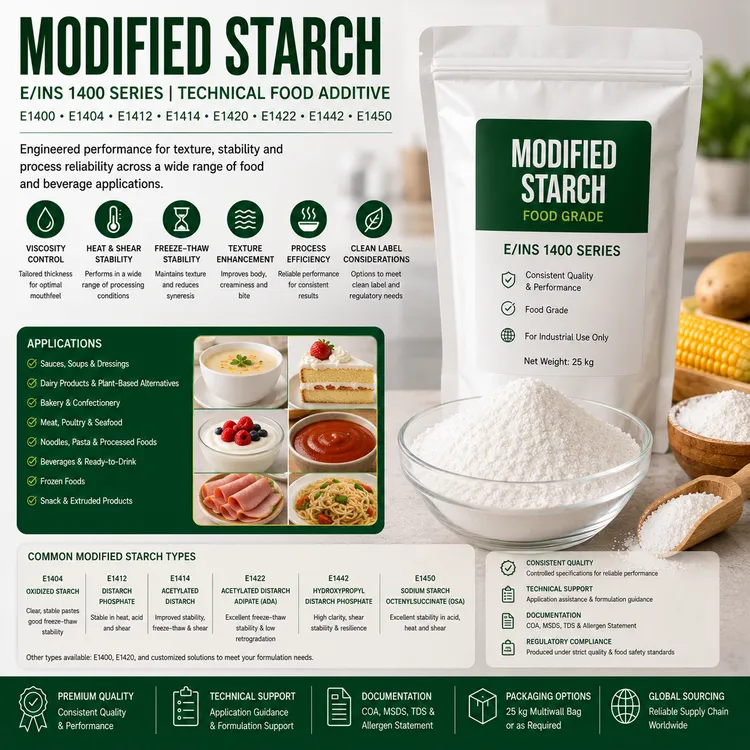
Product identity
| Product | Modified Starch |
|---|---|
| Category | Modified Starches, Fibres & Bulking Agents |
| Primary function | Texture, viscosity, stabilization, bulking, binding, moisture control, encapsulation, film forming or carrier ingredient |
| E / INS number | Commonly associated with the 1400-series; exact E / INS number depends on the specific modification and destination market |
| CAS / identity | Varies by starch source, modification type and regulatory classification |
| Typical base starches | Corn, waxy maize, potato, tapioca, wheat, rice or pea depending on supplier and application |
| Typical form | Fine powder, pregelatinized powder, agglomerated instant powder, spray-drying carrier grade or customized blend |
| Key selection criteria | Viscosity profile, gelatinization behavior, hot viscosity, cold viscosity, pH stability, shear stability, freeze-thaw stability, clarity, texture, source declaration and documentation |
Application fit
Potential use areas may include:
- Soups, sauces, gravies and culinary bases
- Dressings, mayonnaise-style systems and emulsified sauces
- Bakery creams, pie fillings, fruit preparations and custards
- Meat products, poultry products, seafood analogues and plant-based meat systems
- Dairy desserts, yogurts, puddings, cheese sauces and cream fillings
- Frozen foods, ready meals and retorted or pasteurized convenience products
- Flavor encapsulation, cloud emulsions, dry mixes and seasoning carriers
Technical profile for manufacturers
Modified Starch is produced by changing native starch functionality through physical, enzymatic or chemical processes. The objective is to improve performance characteristics such as heat resistance, acid stability, shear tolerance, cold-water swelling, freeze-thaw stability, emulsion stabilization, film formation, viscosity control or reduced retrogradation. These improvements allow formulators to build consistent texture and stability in industrial products that experience demanding processing conditions.
Native starch can thicken effectively after gelatinization, but it may break down under high shear, lose viscosity in acid systems, release water during freezing and thawing, or form gels that become too firm during storage. Modified starch grades are designed to solve these problems by controlling swelling, granule integrity, molecular interaction and water binding.
| Functional requirement | Why it matters industrially |
|---|---|
| Hot viscosity | Controls product body during cooking, pasteurization, sterilization, retorting, evaporation or kettle processing. |
| Cold viscosity | Important for instant sauces, dry mixes, cold-prepared desserts, beverage powders and products where heating is limited. |
| Shear stability | Needed in homogenizers, scraped-surface heat exchangers, pumps, mixers, filling lines and high-speed sauce processing. |
| Acid stability | Critical for tomato sauces, fruit fillings, salad dressings, acidified dairy products and low-pH beverage systems. |
| Freeze-thaw stability | Reduces syneresis, water separation and texture breakdown in frozen meals, fillings, desserts and sauces. |
| Texture profile | Determines whether the finished product is short, creamy, pulpy, elastic, spoonable, pourable, cuttable or gel-like. |
| Clarity and gloss | Important for fruit preparations, glazes, fillings, clear sauces and premium visual presentation. |
| Emulsion stabilization | Specific modified starches, especially OSA-type starches, may help stabilize oil droplets in beverage emulsions, flavor systems and sauces. |
Common modified starch families
The term Modified Starch can refer to several functional families. The final specification should identify the exact type, raw material source, performance profile and regulatory identity. The list below is a practical purchasing guide and does not replace destination-market regulatory verification.
| Modified starch family | Typical industrial purpose | Common application logic |
|---|---|---|
| Pregelatinized / instant starch | Cold-water swelling and rapid viscosity development | Dry soup mixes, instant sauces, cold creams, bakery premixes, seasoning blends and emergency viscosity correction. |
| Oxidized starch | Lower viscosity, improved film formation and surface properties | Coatings, confectionery, batters, dusting systems, surface gloss and controlled thin-boiling texture. |
| Crosslinked starch | Improved resistance to heat, acid and mechanical shear | Retorted sauces, canned foods, high-shear processed dressings, acidic products and long processing cycles. |
| Acetylated starch | Improved clarity, texture softness and freeze-thaw stability | Frozen foods, dairy desserts, fruit fillings, refrigerated sauces and products requiring reduced retrogradation. |
| Hydroxypropylated starch | Improved freeze-thaw stability, storage stability and smooth texture | Frozen meals, puddings, creams, sauces, fillings and dairy-style systems. |
| Acetylated distarch adipate | High stability against heat, acid, shear and freezing | Culinary sauces, tomato-based systems, frozen meals, canned foods, fruit preparations and retorted applications. |
| Hydroxypropyl distarch phosphate | Strong process tolerance and freeze-thaw stability | Frozen sauces, dairy desserts, pie fillings, ready meals and high-shear processing lines. |
| Starch sodium octenyl succinate | Emulsion stabilization, encapsulation and carrier functionality | Beverage emulsions, flavor encapsulation, clouding systems, spray-dried oils, colors and powdered flavors. |
Application guidance by industry
Soups, sauces and gravies
Modified starch is widely used to build viscosity, suspension, mouthfeel and heat stability in culinary systems. In soups, sauces and gravies, selection depends on cooking method, filling temperature, salt level, fat level, pH, shear and whether the final product is ambient, chilled or frozen.
- Key requirements: hot viscosity, smooth texture, pumpability, acid stability and minimal viscosity breakdown.
- Common grades: crosslinked starches, acetylated distarch adipate, hydroxypropyl distarch phosphate and instant starches.
- Critical tests: cook-up viscosity, holding viscosity, reheating stability, syneresis, color impact and sensory mouthfeel.
Dressings and emulsified sauces
In salad dressings, mayonnaise-style products and emulsified sauces, modified starch contributes viscosity, emulsion support, fat reduction, suspension and creamy texture. Low-pH stability is especially important in vinegar-based systems.
- Key requirements: acid stability, shear stability, short texture, clean flavor and stable viscosity after filling.
- Common partners: gums, emulsifiers, proteins, egg yolk, vegetable oil, acids, salt and preservatives.
- Critical tests: emulsion stability, viscosity after homogenization, oil separation, microbial stability and storage texture.
Bakery fillings, creams and fruit preparations
Modified starch can provide bake stability, freeze-thaw stability, gloss, spoonable texture and water control in fruit fillings, custards, pastry creams and bakery toppings. The correct grade helps reduce boil-out, water separation and texture collapse during baking or freezing.
- Key requirements: heat stability, bake stability, clarity, gloss, clean cut, freeze-thaw performance and low syneresis.
- Common grades: acetylated or hydroxypropylated crosslinked starches and selected pregelatinized grades.
- Critical tests: baking trial, freeze-thaw cycling, water activity, Brix interaction, fruit acid stability and filling deposition behavior.
Meat, poultry, seafood and plant-based products
In meat systems, modified starch can support water binding, yield, sliceability, freeze-thaw stability and texture. In plant-based meat alternatives, starch can contribute binding, juiciness, bite, thermal set and fat or water retention.
- Key requirements: hydration, binding, heat-set texture, purge reduction and freeze-thaw stability.
- Common partners: proteins, phosphates, fibers, hydrocolloids, salts, fats and seasonings.
- Critical tests: cook yield, purge, sliceability, bite, reheating performance, freeze-thaw behavior and allergen declaration.
Dairy desserts and chilled products
Modified starch is used in puddings, custards, yogurts, flavored dairy desserts and cream fillings to control body, spoonability, water release and storage texture. Protein interaction, pH and heat treatment must be considered during grade selection.
- Key requirements: smooth texture, low graininess, storage stability, heat stability and controlled gelation.
- Common grades: acetylated, hydroxypropylated or crosslinked starches depending on process severity.
- Critical tests: pasteurization stability, cooling curve, viscosity after storage, syneresis and sensory smoothness.
Encapsulation, beverage emulsions and powders
Specific modified starches can act as carriers or emulsion stabilizers for flavors, colors, vitamins, oils and clouding agents. Spray-drying grades require excellent solubility, emulsification performance, low viscosity at high solids and good powder flow.
- Key requirements: emulsion stability, low processing viscosity, encapsulation efficiency, oxidation protection and reconstitution.
- Common grades: OSA-modified starches and customized carrier blends.
- Critical tests: droplet size, emulsion stability, spray-drying yield, powder flow, moisture, caking and flavor retention.
Specification checklist for purchasing
For industrial purchasing, Modified Starch quotations should be compared on a functional and regulatory basis. A cheaper grade may fail during high shear, acid processing, freezing, retorting or long storage. A technically complete RFQ helps suppliers recommend the correct starch and prevents mismatched samples.
| Specification area | Recommended buyer requirement |
|---|---|
| Starch source | Declare corn, waxy maize, potato, tapioca, wheat, rice, pea or other botanical source. Confirm allergen and GMO implications. |
| Modification type | Identify whether the grade is pregelatinized, oxidized, acetylated, crosslinked, hydroxypropylated, OSA-modified or otherwise modified. |
| E / INS identity | Request exact E number, INS number or regulatory identity where applicable. Do not rely only on a broad “E1400-1452” description. |
| Viscosity profile | Request method, concentration, temperature, pH, cooking procedure and viscosity units. Compare using the same method whenever possible. |
| Process tolerance | Define required resistance to heat, acid, shear, freezing, thawing, retorting, homogenization or long holding time. |
| Physical properties | Appearance, odor, color, particle size, bulk density, moisture, ash, pH, solubility, swelling behavior and flowability. |
| Microbiology | Total plate count, yeast and mold, coliforms, E. coli, Salmonella and application-specific microbiological limits. |
| Contaminants | Heavy metals, pesticide residues, mycotoxins where relevant, sulfur dioxide where relevant and residual reagent limits where required. |
| Dietary declarations | Allergen statement, gluten status, GMO statement, vegan / vegetarian suitability, halal and kosher status where required. |
| Packaging and shelf life | Bag type, liner, net weight, pallet configuration, shelf life, recommended storage and moisture protection. |
Performance testing before approval
A laboratory viscosity result is useful, but it is not enough for final approval. Modified starch should be tested in the real formulation, under real processing conditions and with the intended packaging and shelf-life target. The following tests help reduce scale-up risk.
Bench and pilot tests
- Prepare a control batch with the current starch or reference texture.
- Test candidate grades at several dosage levels using the final recipe.
- Apply the real cooking temperature, heating rate, mixing intensity and holding time.
- Measure hot viscosity, cooled viscosity, pH, water release and sensory texture.
- Run freeze-thaw, reheating, pasteurization or retort tests where relevant.
- Confirm label declaration, E / INS identity and market permissions before commercial approval.
Common failure modes
- Viscosity loss after high shear processing
- Water separation after freezing and thawing
- Excessive thickening during storage
- Grainy texture due to incomplete hydration or wrong cooking profile
- Acid thinning in tomato, fruit or vinegar-based systems
- Poor pumpability during hot filling
- Loss of gloss or clarity in fruit fillings and glazes
- Caking or poor dispersion in dry mixes
Clean-label and labeling considerations
Some manufacturers use Modified Starch for maximum process stability, while others request native starch, physically modified starch, clean-label starch or functional native starch to support label positioning. These categories are not interchangeable. A clean-label starch may improve label perception, but it may not always deliver the same acid, shear or freeze-thaw tolerance as a chemically modified starch.
Before selecting a grade, confirm how the ingredient must be declared in the destination market. The same commercial ingredient may require different labeling language depending on jurisdiction, food category, modification type and local interpretation. Buyers should request the supplier’s recommended label declaration and verify it with their regulatory team.
| Selection question | Why it matters |
|---|---|
| Is “modified starch” acceptable on the label? | Some brands prefer clean-label positioning, while others prioritize process robustness and shelf-life performance. |
| Is the starch source important? | Wheat starch may create gluten or allergen questions, while corn, potato, tapioca and rice may be preferred in certain markets. |
| Does the product need halal or kosher certification? | Certification must match the supplier, manufacturing site and exact grade, not only the ingredient family. |
| Does the product claim non-GMO? | GMO status depends on botanical source, country of origin, traceability and supplier certification. |
| Is the starch used as a carrier? | Carrier status may affect additive carry-over, labeling, dosage calculation and documentation requirements. |
Packaging, storage and handling
Modified Starch is normally supplied in food-grade multiwall paper bags, PE-lined bags, cartons, drums or big bags depending on grade and order volume. Moisture protection is essential because starch powders can absorb humidity, form lumps, lose flowability or become difficult to disperse. Warehouses should be clean, dry, odor-free and protected from pests.
| Common packaging | 20 kg or 25 kg bags are common for industrial grades; smaller bags, drums, cartons or big bags may be available by supplier and grade. |
|---|---|
| Storage conditions | Store sealed in a cool, dry, well-ventilated area away from moisture, strong odors, direct sunlight and contamination sources. |
| Shelf life | Supplier-specific. Request shelf-life statement, retest policy and recommended storage conditions before confirming orders. |
| Handling | Control dust, avoid moisture exposure, use hygienic transfer methods and follow plant allergen / gluten segregation requirements where relevant. |
| Dispersion guidance | Some cook-up starches require proper slurry preparation before heating. Instant starches require controlled addition to avoid lumping. |
| Logistics | Confirm HS code, origin, pallet configuration, container loading, export documents and destination import requirements. |
Documents to request
- Product specification or technical data sheet with exact starch source and modification type
- Certificate of analysis for available batch or representative lot
- Safety data sheet where applicable for handling and warehouse review
- Food-grade declaration and compliance statement for the destination market
- E / INS number or regulatory identity confirmation where applicable
- Allergen statement, gluten statement and cross-contamination information
- GMO declaration, origin statement and traceability information
- Halal, kosher, vegan or vegetarian certification when required
- Microbiological specification and lot-specific microbiological results
- Heavy metal limits, pesticide residue declaration and mycotoxin statement where relevant
- Shelf-life statement, storage conditions and packaging specification
- Labeling recommendation and carrier / processing aid clarification where relevant
- Pallet configuration, net weight, gross weight and container loading information
Technical purchasing notes
When reviewing Modified Starch, compare the supplier specification against the intended food application, process conditions, target function, label expectations and local rules. For industrial purchasing, the most useful inquiry normally includes starch source, modification type, target viscosity, process conditions, application, physical form, packaging size, quantity, destination and documentation requirements.
Cost comparison should be based on cost-in-use rather than price per kilogram alone. A higher-priced starch may be more economical if it provides better viscosity efficiency, lower dosage, stronger freeze-thaw stability, fewer rejects, shorter processing time or more consistent quality. Trial results, not only quotation price, should guide final approval.
How to request this product
Send the product name, target grade or reference specification, application, process conditions, target viscosity, quantity, destination country, packaging preference, expected shipment date and required documents. If you already purchase Modified Starch, attach or describe your existing specification, label, certificate of analysis, viscosity curve or trial result so supplier options can be compared more accurately.
Recommended RFQ information
- Product name: Modified Starch / Modified Food Starch
- Required function: thickening, stabilizing, binding, freeze-thaw stability, emulsion stabilization, encapsulation, carrier use or instant viscosity
- Preferred starch source: corn, waxy maize, potato, tapioca, wheat, rice or other source
- Preferred modification: instant, crosslinked, acetylated, oxidized, hydroxypropylated, OSA-modified or supplier-recommended grade
- Application: sauce, soup, dressing, dairy dessert, bakery filling, meat product, frozen food, beverage emulsion, dry mix or other use
- Process conditions: pH, temperature, heating time, shear, homogenization, retort, freezing, thawing or hot filling
- Target texture: short, long, creamy, pulpy, clear, glossy, pourable, spoonable, cuttable or gel-like
- Quantity: sample quantity, first commercial order and annual forecast
- Destination: country, port, incoterm and required import documents
- Packaging: bag size, pallet format, big bag requirement or warehouse handling preference
- Documentation: TDS, COA, SDS, allergen, GMO, halal, kosher, origin, microbiology, heavy metals, pesticide, shelf-life and regulatory statements
- Commercial requirement: target price basis, delivery schedule, payment term and shipment date
Useful answers
What is Modified Starch used for in food manufacturing?
Modified Starch is used for texture, viscosity, thickening, stabilization, binding, moisture control, freeze-thaw stability, emulsion stabilization, encapsulation and process tolerance. Exact suitability depends on grade, starch source, modification type, process conditions, regulations and supplier documents.
Is Modified Starch the same as genetically modified starch?
No. Modified Starch normally means the starch has been physically, enzymatically or chemically modified to improve performance. It does not automatically mean the starch is genetically modified. GMO status depends on crop source, traceability, country of origin and supplier declarations.
Which grade should I request?
The correct grade depends on the application. For sauces, acid and shear stability may be important. For frozen foods, freeze-thaw stability is critical. For dry mixes, instant viscosity and dispersion are important. For beverage emulsions and encapsulation, OSA-type modified starches may be considered. A supplier should select the grade based on the real product matrix and process.
Can Global Food Additives source Modified Starch?
Global Food Additives can review sourcing options for Modified Starch according to base source, modification type, target viscosity, quantity, destination, packaging and required documentation.
Which documents should be requested?
Buyers commonly request a technical data sheet, product specification, certificate of analysis, safety data sheet where applicable, origin statement, food-grade declaration, allergen statement, GMO statement, shelf-life information, label recommendation, packaging details and market-specific declarations.
Is this product permitted in every country?
No. Food additive use depends on destination-market rules, food category, use level, label requirements and buyer responsibility. Buyers should verify the exact E / INS identity, permitted use, labeling language and import requirements before commercial use.
Tell us which food additive or ingredient you need.
Send product names, target specifications, quantity, destination country, packaging preference, delivery term, and document requirements. Our team will review your inquiry and respond from orders@foodgradeadditives.com.
Your message has been received. You will be redirected to the home page.