
Mono- and Diacetyl Tartaric Acid Esters
Mono- and Diacetyl Tartaric Acid Esters of mono- and diglycerides, commonly known as DATEM, E472e or INS 472e, is a surface-active food additive used by manufacturers that need controlled dough strength, emulsion performance, fat dispersion, processing tolerance and repeatable industrial functionality. This page is prepared for technical buyers, R&D teams, QA departments and purchasing managers who need a structured starting point for specification review, document collection and quotation requests.
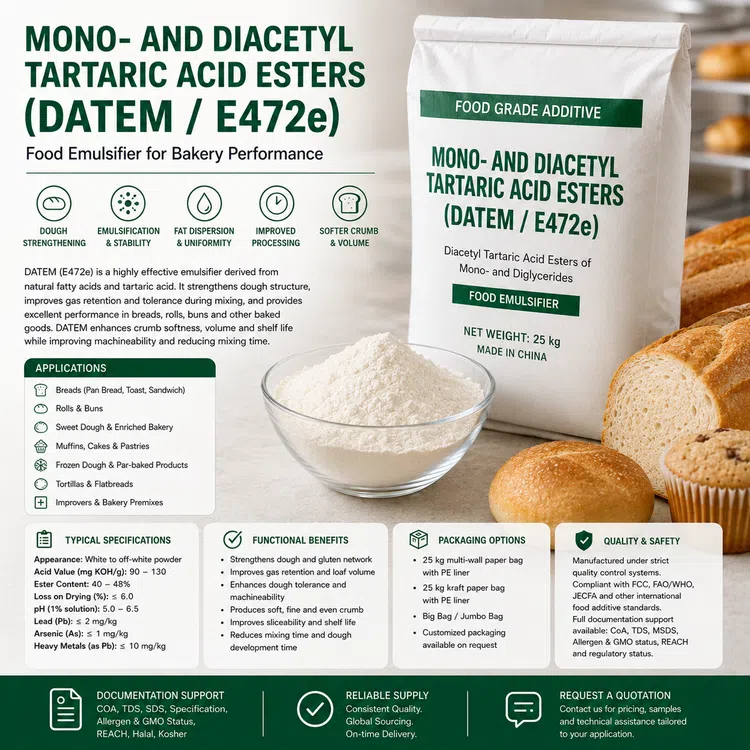
Product identity
| Product | Mono- and Diacetyl Tartaric Acid Esters of Mono- and Diglycerides |
|---|---|
| Common name | DATEM |
| Category | Emulsifiers & Surface Active Ingredients |
| Function | Emulsifier, dough strengthener and surface-active food ingredient |
| E / INS number | E472e / INS 472e |
| CAS / identity | Mixture; supplier specification should define the commercial grade and composition profile |
| Typical form | Powder, bead, flake, paste or liquid grade depending on supplier and application |
| Typical declaration focus | Food-grade emulsifier; final ingredient declaration depends on local labeling rules |
Application fit
DATEM / E472e is normally evaluated where a recipe needs stronger interface control, improved dough handling or better dispersion of fat and water phases. Potential use areas may include:
- Industrial bread, buns, rolls, toast bread and frozen dough systems
- Bakery improver blends and premixes
- Margarine, shortening and fat-based systems
- Dairy analogues, coffee whiteners and cream-type emulsions
- Confections, frostings and aerated or fat-containing fillings
- Selected beverages and emulsion-based food systems, where permitted
Technical overview
DATEM is a functional emulsifier produced as a mixture of esters based on glycerol, fatty acids and diacetyl tartaric acid chemistry. In industrial use, the value of the ingredient is not only its chemical identity but also its grade consistency, physical form, dispersion behaviour and performance inside a specific process. A bakery-grade powder, for example, may be selected for dry blending into flour improver systems, while a paste or liquid grade may be evaluated for fat-phase incorporation or high-shear emulsion preparation.
Because commercial DATEM is not a single pure molecule, buyers should avoid comparing offers only by product name. Meaningful comparison requires a technical data sheet, batch certificate, manufacturing standard, permitted-use confirmation, source material declaration and application test results under the buyer’s real processing conditions.
Industrial functionality
Bakery performance
In bakery systems, DATEM is usually selected as a dough-strengthening emulsifier. It may help improve dough tolerance during mixing, dividing, rounding, moulding, proofing and baking. In properly designed formulas, it can support gas retention, loaf volume, crumb structure, slicing performance and production consistency.
- Supports dough strength and machinability in high-speed bakery lines
- Helps stabilize gas cells during fermentation and oven spring
- Can improve crumb grain, volume and process tolerance when matched with flour quality
- Often used alongside enzymes, ascorbic acid, mono- and diglycerides, SSL, CSL or other improver components
Emulsion and fat dispersion
In non-bakery systems, DATEM may be evaluated for fat dispersion, oil-water interface management, emulsion stability, viscosity control and texture support. Performance depends on the oil phase, water phase, protein content, pH, heat treatment, shear profile, solids content and interaction with other emulsifiers or stabilizers.
- Assists dispersion of fat phases in selected food emulsions
- Can support stability in aerated, fat-containing or cream-like systems
- May be tested in synergy with lecithin, mono- and diglycerides, hydrocolloids or proteins
- Requires pilot trials to confirm stability, mouthfeel, viscosity and shelf-life performance
Process integration guidance
The correct addition method depends on the supplier grade and the buyer’s production line. Powder or bead grades are often easier to handle in dry premixes, while paste or liquid grades may require pre-dispersion, melting or addition to a fat phase. Processing teams should validate mixing time, temperature, shear, hydration sequence, pH, holding time and compatibility with enzymes, proteins, salts, sugars, oils and stabilizers.
Dry bakery systems
- Check whether the grade is suitable for direct dry blending with flour or improver premix.
- Verify distribution uniformity in low-dose applications.
- Run line trials to compare dough development time, stability and tolerance.
- Measure finished product volume, crumb structure, softness and shelf-life behaviour.
Fat or emulsion systems
- Confirm melting or dispersion conditions recommended by the supplier.
- Evaluate high-shear versus low-shear incorporation methods.
- Check emulsion stability after heat treatment, cooling, freezing or storage.
- Compare performance against alternative emulsifiers or blended systems.
Specification points to compare
DATEM specifications vary by manufacturer, origin and grade. A strong purchasing review should compare the technical parameters that influence quality, processing and regulatory acceptance. Depending on the supplier, the specification may include:
| Parameter group | Why it matters |
|---|---|
| Identity and composition | Confirms that the offered material matches DATEM / E472e identity and the buyer’s target standard. |
| Acid value, ester value and saponification value | Useful for comparing esterification profile, batch consistency and supplier-to-supplier differences. |
| Free glycerol and free fatty acids | Can affect functionality, taste, processing behaviour and conformity with specification limits. |
| Moisture or loss on drying | Important for shelf life, flowability, caking risk and microbiological control. |
| Melting range, drop point or physical form | Influences dosing, dispersion, premix uniformity and compatibility with the production process. |
| Particle size and flowability | Important for automated dosing, dry blending and consistent distribution in flour or powder systems. |
| Colour, odour and sensory neutrality | Relevant for clean-taste applications, light-coloured products and premium formulations. |
| Heavy metals and microbiology | Required for food-grade quality assurance and destination-market compliance review. |
| Carrier, anti-caking agent or blend components | Must be declared and checked against formula, allergen, label and regulatory requirements. |
| Source material and certification | Important for halal, kosher, vegetarian, vegan, palm-origin, RSPO, GMO and customer policy review. |
Application development checklist
Before approving a new DATEM grade, R&D and production teams should define measurable success criteria. The same product name can perform differently depending on flour protein quality, fermentation time, water absorption, fat level, mixing energy, proofing conditions, baking profile, shelf-life targets and interaction with other ingredients.
Bakery trial measurements
- Water absorption and dough development time
- Dough stability, extensibility and handling tolerance
- Proofing tolerance and gas retention
- Loaf volume, symmetry and oven spring
- Crumb grain, softness and slicing quality
- Freshness, staling profile and shelf-life performance
Emulsion trial measurements
- Oil droplet dispersion and phase stability
- Viscosity, mouthfeel and texture consistency
- Aeration, overrun and foam stability where relevant
- Heat, freeze-thaw and storage stability
- Sensory neutrality and colour impact
- Compatibility with proteins, gums, salts, acids and sweeteners
Commercial and sourcing considerations
Industrial buyers should request more than a price per kilogram. A reliable offer should clarify the technical grade, origin, packaging, lead time, minimum order quantity, shelf life, storage conditions, documentation package, regulatory basis and whether the product is a direct equivalent to the buyer’s current material. For multinational manufacturers, the same grade may also need separate review for the EU, USA, UK, GCC, Türkiye, Asia-Pacific or other target markets.
Common purchasing questions
- Is the material offered as DATEM / E472e or as a blended emulsifier system?
- Which standard does the product claim to meet: supplier specification, FCC, EU, JECFA or another standard?
- Is the fatty acid source palm, rapeseed, sunflower, soybean, animal-derived or mixed?
- Are halal, kosher, vegetarian, vegan, GMO, allergen and palm-origin declarations available?
- Is the grade suitable for direct replacement of the current supplier material?
- What are the recommended storage temperature, shelf life and opened-bag handling instructions?
Packaging and logistics
- Typical industrial formats may include multiwall bags, cartons, drums, pails or IBCs depending on form.
- Ask for net weight, gross weight, pallet pattern and container loading estimates.
- Confirm whether the product requires temperature-controlled storage or protection from heat.
- Check caking, melting, leakage or deformation risk for summer shipments.
- Request batch coding, production date, expiry date and traceability information before shipment.
Documents to request
A complete technical purchasing file helps QA, regulatory and procurement teams approve the material faster. For DATEM / E472e, buyers commonly request:
- Product specification or technical data sheet
- Certificate of analysis for the offered batch or representative lot
- Safety data sheet where applicable
- Food-grade statement and applicable regulatory declaration
- Origin, manufacturer, shelf-life and storage information
- Allergen, GMO, gluten, vegetarian, vegan and animal-origin declarations where relevant
- Halal, kosher, RSPO or other customer-required certificates if applicable
- Label draft, packaging details and pallet configuration
- Heavy metal and microbiology information if not shown on the standard specification
- Market-specific declarations required by the destination country
How to request this product
Send the product name, target grade or reference specification, quantity, destination country, preferred packaging, expected shipment date, Incoterms preference and required documents. If you already purchase DATEM / E472e, attach or describe your current specification, label, certificate of analysis or supplier reference so available options can be compared more accurately.
Useful answers
What is Mono- and Diacetyl Tartaric Acid Esters used for in food manufacturing?
Mono- and Diacetyl Tartaric Acid Esters of mono- and diglycerides, commonly known as DATEM or E472e, is typically evaluated for dough strengthening, emulsion stability, fat dispersion, aeration, processing tolerance and application-specific texture improvement. Exact suitability depends on grade, dosage, formulation, process, regulations and supplier documentation.
Is DATEM mainly used in bakery?
DATEM is strongly associated with industrial bakery because it can support dough strength, proofing tolerance, gas retention, loaf volume and crumb structure. It may also be considered in selected fat, oil, dairy analogue, beverage, confectionery and emulsion systems where technically suitable and legally permitted.
What should be checked before replacing an existing DATEM supplier?
Compare active profile, physical form, particle size, melting behaviour, acid value, ester value, free glycerol, moisture, sensory properties, source material, documentation, certification, permitted-use status and application trial performance. A simple product-name match is not enough for industrial replacement.
Can Global Food Additives source DATEM / E472e?
Global Food Additives can review sourcing options for DATEM / E472e according to target specification, application, quantity, destination, packaging, origin preference, certification requirements and required documentation.
Which documents should be requested?
Buyers commonly request a technical data sheet or specification, certificate of analysis, safety data sheet where applicable, food-grade statement, origin statement, shelf-life and storage declaration, allergen/GMO statement, halal or kosher certificate if required, label draft and packing details.
Is this product permitted in every country?
No. Food additive use depends on destination-market rules, food category, maximum level, label declaration, customer policy and buyer responsibility. Regulatory verification should be completed before final approval and commercial use.
Tell us which food additive or ingredient you need.
Send product names, target specifications, quantity, destination country, packaging preference, delivery term, and document requirements. Our team will review your inquiry and respond from orders@foodgradeadditives.com.
Your message has been received. You will be redirected to the home page.