
Mono- and Diglycerides of Fatty Acids E471
Mono- and Diglycerides of Fatty Acids, commonly identified as E471, are food-grade emulsifiers used to improve emulsion stability, aeration, crumb softness, fat dispersion, ice cream structure, margarine performance, chocolate flow, texture control and processing tolerance. They are one of the most widely reviewed emulsifier families for bakery, dairy, fat-based, beverage, confectionery and dry-mix applications.
For industrial food manufacturers, E471 should not be treated as a single interchangeable commodity. Commercial performance depends on monoglyceride content, alpha-monoglyceride level, fatty-acid profile, degree of saturation, iodine value, melting point, physical form, crystallization behavior, origin, certifications and the way the ingredient is incorporated into the process.
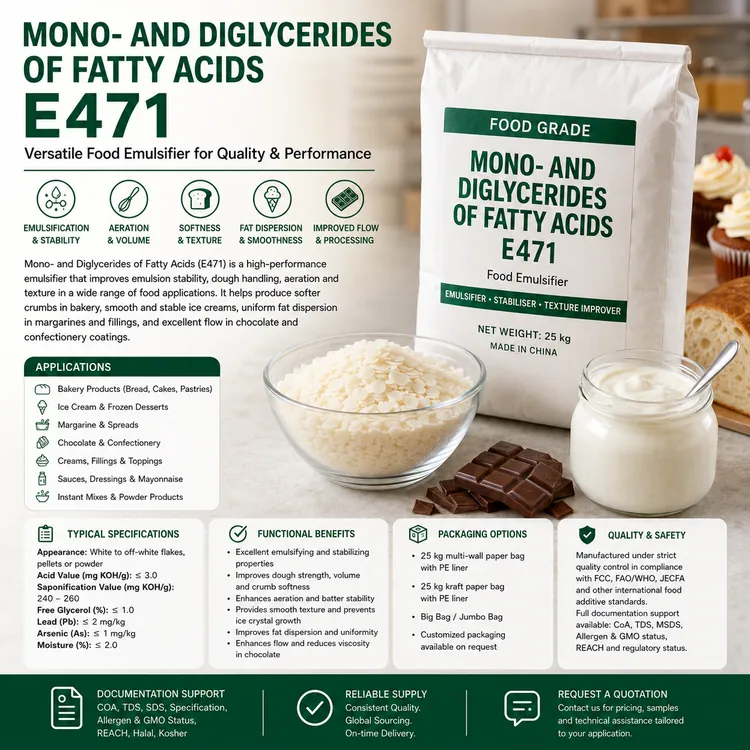
Product identity
| Product | Mono- and Diglycerides of Fatty Acids |
|---|---|
| Common names | Mono- and diglycerides; monoglycerides and diglycerides; partial glycerides; glycerol mono- and diesters of fatty acids |
| Category | Emulsifiers & Surface Active Ingredients |
| Function | Emulsifier / surface-active food ingredient / aeration and texture-control ingredient |
| E / INS number | E471 / INS 471 |
| CAS / identity | Mixture; exact CAS and identity depend on fatty-acid source, monoester content and supplier specification |
| Ingredient family | Partial glycerides of edible fatty acids |
| Typical form | Powder, bead, flake, pellet, paste, molten liquid, hydrated gel, cake gel or spray-dried blend |
| Key purchasing variables | Monoglyceride content, alpha-monoglyceride content, fatty-acid profile, iodine value, melting point, acid value, free glycerol, origin, physical form and certifications |
Application fit
Potential industrial use areas may include:
- Bakery, bread, cakes, muffins and dry bakery mixes
- Margarine, spreads, shortenings and fat systems
- Ice cream, frozen desserts and whipped toppings
- Beverages, creamers and spray-dried emulsions
- Chocolate, compound coatings and confectionery
- Sauces, dressings, fillings and processed foods
- Meat products, meat analogues and prepared meals
Technical overview for food manufacturers
Mono- and Diglycerides of Fatty Acids are amphiphilic molecules: the glycerol portion interacts with water or polar phases, while the fatty-acid portion interacts with oils, fats and air-cell interfaces. This dual affinity allows E471 to stabilize interfaces, disperse fat, influence crystallization, improve aeration, soften crumb and modify texture in complex food systems.
Commercial E471 is typically produced from edible fats and oils reacted with glycerol, followed by processing and standardization. The final ingredient may be a standard mono- and diglyceride blend, a distilled monoglyceride grade, a hydrated gel, a powder on a carrier, a bead, a flake, a paste or an application-ready emulsifier system. The right option depends on the target food, process, regulatory market and desired functionality.
Functional role in food systems
Mono- and diglycerides can support different technical objectives depending on their composition and physical form. Formulators should define the primary function before requesting a quotation because the most suitable grade changes by application.
- Emulsion stability: helps stabilize oil-water interfaces in spreads, creamers, sauces, beverages and prepared foods.
- Aeration support: supports air incorporation and foam stability in cakes, whipped toppings, desserts and batter systems.
- Crumb softness: monoglycerides can complex with starch, helping improve bread softness and slow firming during storage.
- Fat dispersion: improves distribution of fats and oils in doughs, batters, fillings, dairy systems and dry blends.
- Fat crystallization control: influences crystal network formation in margarine, shortening, spreads and confectionery fats.
- Texture modification: contributes to creaminess, mouthfeel, viscosity, lubricity, bite and structural stability.
- Processing tolerance: improves consistency during mixing, heating, cooling, freezing, whipping, filling and storage.
- Release and flow behavior: may support chocolate or compound coating flow, mould release and surface quality depending on grade.
Grade selection and composition variables
E471 grades differ by monoester concentration, fatty-acid chain length, saturation level, physical form and processing route. These differences affect melting point, crystallization, dispersion, solubility, HLB behavior, starch interaction and sensory impact.
Common grade types
- Standard mono- and diglycerides: balanced blends used for general emulsification and texture control.
- Distilled monoglycerides: higher monoglyceride grades often selected for bakery softness, aeration and stronger emulsifying action.
- Glyceryl monostearate-rich grades: saturated, higher-melting materials used in bakery, dairy, fat systems and dry blends.
- Unsaturated monoglyceride grades: softer or more liquid systems used where different fat compatibility or dispersion is needed.
- Powdered or spray-dried grades: easier to dose in dry mixes, beverages, bakery blends and premixes.
- Hydrated gels and cake gels: designed for rapid aeration, batter stability and bakery production convenience.
Technical selection questions
- Is the main goal emulsification, aeration, anti-staling, fat crystallization or flow control?
- Is the formula oil-in-water, water-in-oil, foam, dough, batter, fat continuous or dry blend?
- Should the grade be vegetable origin, palm-free, soy-free, non-GMO, halal, kosher or vegan suitable?
- Is a powder, bead, flake, paste, molten liquid, hydrated gel or premix required?
- What melting point, iodine value and monoglyceride content are required?
- Will the ingredient face high shear, heat treatment, freezing, whipping, homogenization or long storage?
Application guidance by food category
The correct E471 grade depends on the production line, formula and shelf-life target. A bakery emulsifier designed for crumb softness may not be suitable for beverage emulsion stability, and a fat-based flake grade may not disperse correctly in cold dry-mix systems.
Bakery, bread and dough systems
In bread and dough systems, E471 is reviewed for dough handling, volume, crumb softness, anti-staling performance and fat dispersion. Distilled monoglycerides are often selected where starch complexing and softness retention are key objectives.
- Evaluate dough development, mixing tolerance and gas retention.
- Measure loaf volume, crumb grain, softness and resilience.
- Monitor crumb firming over declared shelf life.
- Check compatibility with enzymes, DATEM, SSL, CSL, lecithin and oxidizing systems.
- Validate performance in fresh, packaged, frozen dough or par-baked systems.
Cakes, muffins and aerated batters
In cakes and aerated batters, E471 supports air incorporation, foam stability, batter viscosity, volume and crumb uniformity. Hydrated emulsifier gels or cake gels may be used where rapid dispersion and consistent aeration are required.
- Measure batter specific gravity and air-cell stability.
- Evaluate cake volume, symmetry, crumb structure and softness.
- Check compatibility with sugar, egg, milk powders, oils, starches and gums.
- Validate deposit accuracy, batter hold time and baking response.
- Monitor shelf-life softness, moisture migration and sensory quality.
Margarine, spreads and shortening
In fat-continuous systems, E471 can influence water dispersion, crystal network formation, plasticity, spreadability, oiling-out and emulsion stability. The grade must match the fat blend, melting profile and cooling process.
- Check water droplet distribution and emulsion stability.
- Evaluate spreadability, plasticity, hardness and oil separation.
- Validate performance with palm, palm kernel, coconut, sunflower, rapeseed, butterfat or other fat systems.
- Measure stability after tempering, refrigeration and ambient storage.
- Review interaction with lecithin, PGPR, polyglycerol esters and stabilizer systems.
Ice cream and frozen desserts
In ice cream, E471 supports fat destabilization, partial coalescence, overrun, dryness, meltdown control and creamy texture. It is usually evaluated together with stabilizers such as guar gum, locust bean gum, carrageenan, CMC or other hydrocolloids.
- Measure mix viscosity, homogenization performance and ageing behavior.
- Evaluate overrun, body, creaminess and dryness after freezing.
- Check meltdown, heat-shock stability and ice-crystal control.
- Validate compatibility with milk fat, vegetable fat, proteins and stabilizers.
- Monitor sensory quality after frozen distribution and storage abuse.
Beverages, creamers and spray-dried emulsions
In beverage emulsions and creamers, E471 can support oil droplet formation, fat dispersion, whitening effect, mouthfeel and stability. Spray-dried or carrier-based grades may be preferred for instant powders and dry blends.
- Check dispersibility in hot and cold water where relevant.
- Evaluate emulsion droplet size, creaming, ringing and sediment.
- Validate homogenization pressure, heat treatment and storage conditions.
- Review compatibility with proteins, phosphates, caseinates, gums and sugars.
- Measure powder flowability, caking and reconstitution performance.
Chocolate, compound coatings and confectionery
In chocolate and compound coatings, E471 may be reviewed for flow, fat dispersion, surface quality and processing behavior. It is not a universal replacement for lecithin or PGPR, so viscosity, yield value and fat compatibility should be tested in the actual formula.
- Measure viscosity, yield value and coating thickness.
- Evaluate fat compatibility and crystallization behavior.
- Check mould release, gloss, snap and surface defects.
- Validate performance with cocoa butter, cocoa butter equivalents or compound fats.
- Review interaction with lecithin, PGPR, sugar particle size and milk solids.
Sauces, dressings and prepared foods
In sauces, dressings and prepared foods, E471 can support oil dispersion, mouthfeel, texture and emulsion stability. The selected grade must be compatible with acidity, salt, starches, gums, proteins, heat treatment and packaging format.
- Evaluate stability against oil separation, creaming and syneresis.
- Check performance at target pH and salt level.
- Validate pasteurization, retort, hot-fill or chilled-storage conditions.
- Measure viscosity, mouthfeel and appearance during shelf life.
- Review label declaration and finished-product additive limits.
Meat systems and meat analogues
In meat products and plant-based meat analogues, E471 may help disperse fat, improve juiciness perception, support texture and stabilize formulated emulsions. It should be evaluated with proteins, fibres, starches, gums, salts and heat processing.
- Check fat distribution, purge, cook yield and reheating quality.
- Evaluate bite, juiciness, mouthcoating and texture stability.
- Validate compatibility with plant proteins, animal proteins, fats and flavour systems.
- Monitor freeze-thaw stability and oiling-out.
- Confirm vegetarian, vegan, halal or kosher suitability by documents.
Formulation and process-control notes
E471 functionality depends heavily on how it is dispersed and activated. Some grades must be melted into the fat phase, some are designed for dry blending, some require hydration, and some are supplied as ready-to-use gels or premixes. Incorrect addition can reduce emulsification, create particles, cause poor aeration or produce inconsistent texture.
- Phase selection: determine whether the grade should be added to the fat phase, water phase, dry blend or pre-emulsion.
- Melting and dispersion: melt fat-soluble grades completely before incorporation where required by the supplier.
- Hydration: hydrated or gel systems require controlled water, temperature and mixing to activate the correct structure.
- Crystallization: cooling rate and tempering can affect crystal form, emulsifier performance and final texture.
- Particle size: match powder or bead size with the process to improve dispersion and reduce specking.
- Shear exposure: validate performance under real mixing, homogenization, whipping, pumping and filling conditions.
- pH and salts: test in acidic, salty or mineral-rich systems because interface behavior can shift.
- Compatibility: evaluate with lecithin, DATEM, SSL, CSL, PGPR, polyglycerol esters, gums, proteins, starches and enzymes.
- Shelf-life testing: measure softness, emulsion stability, oiling-out, meltdown, caking, bloom or phase separation over time.
Specification checkpoints before purchasing
For industrial purchasing, buyers should compare more than the additive number. A complete E471 specification should identify composition, origin, physical form, performance grade and compliance package. This is especially important for bakery, infant or child-focused foods, export products, private-label projects and religious or vegan-certified supply chains.
Core quality parameters
- Total monoglyceride content
- Alpha-monoglyceride content where applicable
- Diglycerides and triglycerides profile where specified
- Free glycerol and free fatty acids
- Acid value, saponification value and iodine value
- Melting point, drop point or softening point
- Fatty-acid profile and degree of saturation
- Moisture, peroxide value and oxidative stability
- Particle size, bulk density and physical form
- Colour, odour and sensory neutrality
- Heavy metals, arsenic, lead and contaminants where required
- Microbiological status for food-grade handling
Commercial and compliance checks
- E471 / INS 471 confirmation where applicable
- Food-grade and intended-use statement
- Fatty-acid source: palm, soy, sunflower, rapeseed, coconut, animal-derived or other
- Vegetable-origin, vegan, vegetarian, halal or kosher status where required
- Allergen, GMO, irradiation and BSE/TSE declarations
- Trans-fat, partially hydrogenated oil or hydrogenation status where requested
- RSPO, palm-free, sustainable palm or country-of-origin documentation if needed
- Packaging size, liner type and pallet configuration
- Minimum order quantity, lead time and available shelf life
Origin, dietary and certification considerations
Because E471 is produced from fatty acids, origin matters. The fatty-acid source may be vegetable, animal-derived or mixed depending on supplier route. Even when the chemistry is similar, buyer requirements for vegan, vegetarian, halal, kosher, palm-free, soy-free, non-GMO, allergen-controlled or sustainable palm supply must be confirmed with written documentation.
For sensitive markets, procurement teams should request a clear raw-material-origin statement and certification package before sample approval. This is particularly important for export foods, private-label projects, religious certification, plant-based products and brands making “vegan,” “vegetarian,” “palm-free,” “non-GMO” or sustainability claims.
Regulatory and labelling considerations
Mono- and Diglycerides of Fatty Acids are commonly identified as E471 / INS 471, but permission, food-category limits, maximum use, functional class, label declaration and claim suitability depend on the destination market. Buyers should confirm whether the finished product must declare “mono- and diglycerides of fatty acids,” “E471,” “INS 471,” “emulsifier,” “emulsifier E471” or another market-specific term.
Additional review is needed when the finished product is positioned as vegan, vegetarian, halal, kosher, palm-free, non-GMO, clean label, dairy-free, infant-oriented, reduced fat or sustainable. The additive may also interact with nutrition, allergen, origin and customer-specific standards beyond the basic additive approval.
Quality assurance and validation plan
A structured approval process helps avoid problems with poor dispersion, unstable emulsions, volume loss, crumb firming, oiling-out, fat bloom, ice cream shrinkage, caking, label rejection or certification gaps. The ingredient should be validated in the full formula and production process.
- Document screening: review TDS, specification, COA, regulatory declaration, food-grade statement, origin and certifications.
- Grade matching: select standard E471, distilled monoglyceride, gel, powder, flake, bead or premix according to the application.
- Bench formulation: test at multiple use levels against the current formula and target performance.
- Process trial: run through real melting, hydration, mixing, homogenization, whipping, baking, freezing, filling or cooling conditions.
- Analytical review: check pH, viscosity, particle dispersion, droplet size, overrun, texture, softness, fat separation or other relevant measures.
- Sensory panel: assess mouthfeel, waxiness, flavour release, aftertaste, oiliness, creaminess and finished-product quality.
- Shelf-life study: monitor phase separation, crumb firming, meltdown, bloom, caking, oiling-out, moisture migration and texture drift.
- Regulatory review: confirm permitted use, additive declaration, origin claims, religious certification and customer-specific standards.
- Commercial approval: finalize grade, supplier, specification, use level, packaging, MOQ, lead time and release criteria.
Storage, handling and logistics
E471 grades should be stored according to the supplier technical data sheet. As a general industrial practice, keep the material in clean, dry, odour-free conditions, protected from heat, moisture, direct sunlight, pests and damaged packaging. Fat-based emulsifiers can absorb odours and may be affected by oxidation, melting, caking or crystal changes if storage conditions are poor.
Packaging options to confirm
- Net weight per bag, carton, drum, pail, box, block or big bag
- Inner liner, oxygen barrier and moisture protection
- Physical form: powder, bead, flake, pellet, paste, liquid or gel
- Storage temperature and heat-protection requirement
- Batch code, production date and expiry format
- Pallet configuration and container loading data
- Export label language and country-specific marking
Purchasing information to provide
- Target application and finished product type
- Required grade: standard E471, DMG, GMS, gel, powder, flake, bead or blend
- Target function: emulsification, aeration, anti-staling, fat dispersion or crystallization control
- Required monoglyceride content, melting point or iodine value if known
- Required origin, vegan, halal, kosher, non-GMO or palm status
- First-order quantity and annual volume estimate
- Destination country and delivery term
- Preferred packaging size and required documents
Documents to request
The document package should be agreed before purchase, especially for regulated markets, export shipments, private-label foods, plant-based products, halal or kosher supply chains and large industrial bakery or dairy projects.
- Product specification or technical data sheet
- Certificate of analysis for available batch or lot
- Safety data sheet where applicable
- Food-grade, intended-use and regulatory compliance statement
- E471 / INS 471 statement where applicable
- Monoglyceride content, alpha-monoglyceride content and fatty-acid profile where available
- Acid value, iodine value, saponification value, melting point and peroxide value where specified
- Origin statement for fatty acids and glycerol
- Vegetable-origin, vegan, vegetarian, halal and kosher declarations where required
- Allergen, GMO, irradiation and BSE/TSE declarations where required
- Palm, RSPO, palm-free or sustainability declarations where required
- Heavy metal, contaminant and microbiological specifications
- Shelf-life, storage and handling information
- Label draft, packaging details and pallet configuration
- Market-specific declarations required by the destination country
How to request this product
Send the product name, E number, target grade or reference specification, desired physical form, intended application, target function, quantity, destination country, packaging preference, delivery term, expected shipment date and required documents. If you already purchase Mono- and Diglycerides of Fatty Acids, attach or describe your current specification, supplier label, certificate of analysis, benchmark sample or production issue so supplier options can be compared more accurately.
Useful answers
What are Mono- and Diglycerides of Fatty Acids used for in food manufacturing?
Mono- and Diglycerides of Fatty Acids are used for emulsion stability, aeration, crumb softness, anti-staling support, fat dispersion, chocolate flow, ice cream structure, margarine performance and processing tolerance. Exact suitability depends on grade, application, process, regulations and supplier documents.
What is the E number for Mono- and Diglycerides of Fatty Acids?
Mono- and Diglycerides of Fatty Acids are commonly identified as E471 or INS 471. Buyers should confirm the correct label declaration and permitted use according to the destination market and finished food category.
Is E471 a single chemical?
No. E471 is a mixture of mono- and diglycerides of fatty acids. Commercial grades vary by fatty-acid source, monoester content, diglyceride level, physical form, melting point, iodine value and intended application.
What is the difference between E471 and distilled monoglycerides?
Distilled monoglycerides are higher-purity monoglyceride grades with increased monoester content. They are often selected for stronger emulsification, crumb-softening, starch-complexing and aeration performance.
Is E471 always vegetable based?
No. E471 may be made from vegetable or animal-derived fatty acids depending on supplier route. Buyers requiring vegan, vegetarian, halal, kosher, palm-free or specific-origin material should request written origin and certification documents.
Which specification parameters should be checked?
Buyers should check monoglyceride content, alpha-monoglyceride content, fatty-acid profile, iodine value, acid value, saponification value, melting point, free glycerol, free fatty acids, moisture, peroxide value, particle size, heavy metals, microbiology, origin, allergen status, GMO status, shelf life and storage conditions.
Can Global Food Additives source Mono- and Diglycerides of Fatty Acids?
Global Food Additives can review sourcing options for Mono- and Diglycerides of Fatty Acids according to target specification, grade, application, physical form, quantity, destination, packaging and required documentation.
Is E471 permitted in every country?
No. Food additive use depends on destination-market rules, food category, use level, label requirements and buyer responsibility. Regulatory status should be verified before commercial use.
Tell us which food additive or ingredient you need.
Send product names, target specifications, quantity, destination country, packaging preference, delivery term, and document requirements. Our team will review your inquiry and respond from orders@foodgradeadditives.com.
Your message has been received. You will be redirected to the home page.