
Natamycin E235
Natamycin, also known as pimaricin, is a food-grade polyene macrolide antimycotic preservative used for mould and yeast control in selected food systems. For industrial manufacturers, it is typically evaluated as a surface-focused shelf-life tool for cheese, coatings, brines, dips, sprays and other permitted applications where fungal spoilage, visible mould growth, product returns or export stability are critical.
Global Food Additives supports Natamycin inquiries with practical specification review, supplier coordination, document collection, packaging comparison and export-ready quotation guidance for food manufacturers, distributors and procurement teams.
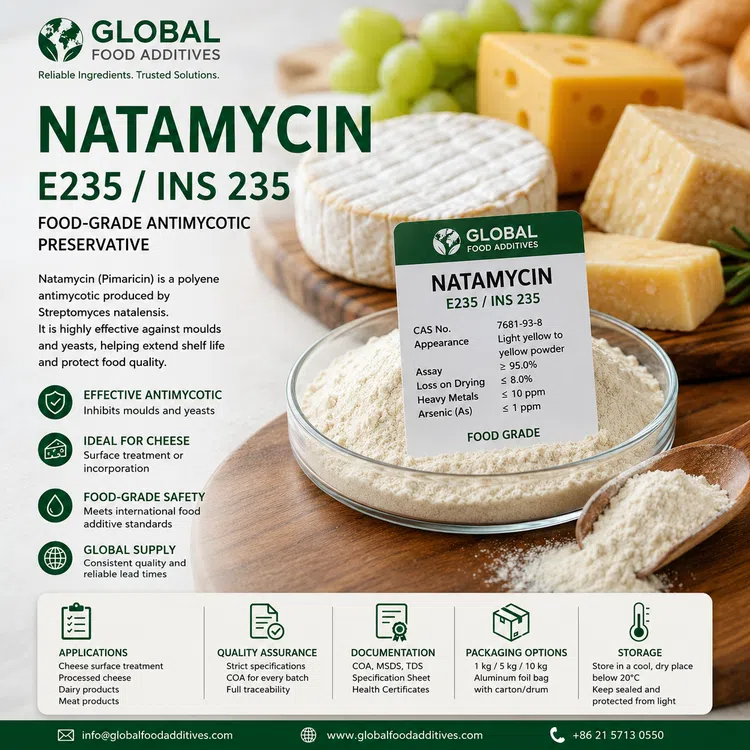
Product identity
| Product | Natamycin |
|---|---|
| Synonym | Pimaricin |
| Category | Preservatives & Antimicrobials |
| Function | Antimycotic preservative for mould and yeast control |
| E / INS number | E235 / INS 235 |
| CAS / identity | 7681-93-8 |
| Chemical family | Polyene macrolide antimycotic |
| Empirical formula | C33H47NO13 |
| Molecular weight | 665.7 |
| Typical form | Powder, standardized preparation, aqueous suspension or application-ready blend depending on supplier |
Application fit
Natamycin is normally reviewed when fungal spoilage risk is high and the manufacturer needs a targeted antimycotic solution that can be validated within a controlled food safety and shelf-life program.
- Cheese surface treatment and rind protection
- Cheese coatings, brines, dips and spray systems
- Selected fermented or dried meat surfaces where permitted
- Bakery, sauces or prepared foods only where regulations and validation allow
- Export products requiring stronger mould and yeast shelf-life control
Technical overview for food manufacturers
Natamycin is selected for its antifungal activity against many spoilage yeasts and moulds. It is not normally positioned as a bacterial preservative, so it should not replace validated controls for pathogens or bacterial spoilage. In a robust industrial design, Natamycin is used as one hurdle within a broader system that may include hygienic processing, sanitation, water activity control, pH control, salt balance, packaging integrity, oxygen management and cold-chain discipline.
Mode of action and performance profile
Natamycin is a polyene antimycotic associated with fungal membrane sterols. In practical food applications, this makes it valuable for controlling yeasts and moulds on exposed or semi-exposed product surfaces where fungal growth may appear during storage, maturation, transport or retail display.
- Target organisms: primarily moulds and yeasts; not intended as the main bacterial kill or pathogen-control step.
- Functional role: delays visible fungal growth, supports shelf-life design and helps reduce spoilage-related quality complaints when properly validated.
- Application logic: most useful where active material can contact the product surface or coating zone requiring protection.
- System dependency: performance depends on surface coverage, dosage, food matrix, moisture, pH, salt, temperature, packaging atmosphere and initial contamination load.
- Validation need: every commercial process should confirm performance using real product, real packaging and realistic storage conditions.
Industrial application methods
Application design should be selected according to the product surface, target shelf life, line layout, regulatory permission and required residue control. Manufacturers should confirm whether the Natamycin grade is intended for direct food use, surface treatment, coating systems or another specific application route.
Cheese and dairy systems
Natamycin is commonly reviewed for cheese surface protection, especially where mould growth on rind, shredded cheese, sliced cheese, coated cheese or packed cheese creates quality loss. Application may involve brine addition, dipping, spraying, coating dispersion or another validated process.
- Confirm compatibility with cheese type, rind structure and moisture level.
- Control surface coverage and avoid uneven application.
- Validate residue levels according to destination-market rules.
- Check whether the selected coating, wax, cellulose system or anti-caking carrier affects distribution.
Fermented and dried foods
For fermented or dried products, Natamycin may be considered where permitted for surface mould management. The process should be assessed carefully because humidity, casing type, maturation conditions and surface flora can strongly affect performance.
- Review local permission by food category before sampling.
- Confirm whether the target is natural surface flora, unwanted mould, yeast bloom or retail spoilage.
- Evaluate sensory impact, appearance and label expectations.
- Document the validated application concentration and method.
Formulation and processing considerations
Natamycin preparations may behave differently depending on active content, particle size, carrier system, wettability, dispersion quality and suspension stability. For industrial lines, the handling method is as important as the nominal dosage.
- Dispersion: many Natamycin systems are handled as suspensions rather than true solutions; agitation and uniform mixing are important.
- Pre-mixing: pre-disperse according to supplier instructions before adding to brine, coating, spray tank or dipping bath.
- Application control: monitor concentration, bath turnover, spray pressure, nozzle condition, contact time and product throughput.
- Light and storage exposure: protect the ingredient and prepared suspension from unnecessary light, heat and prolonged open-air exposure.
- Compatibility: verify interaction with salts, acids, gums, starches, cellulose carriers, waxes, coatings, enzymes, cultures and packaging materials.
- Residue management: where legal limits or rind-depth requirements apply, analytical verification may be required before commercial release.
Specification checkpoints before purchasing
For industrial purchasing, the buyer should compare more than price per kilogram. A correct Natamycin offer should match the intended application, active content, regulatory market, document requirements and handling system.
Core quality parameters
- Assay or active Natamycin content
- Purity basis and analytical method
- Moisture or loss on drying
- Particle size or dispersion behavior
- pH of suspension where relevant
- Ash, impurities and degradation markers where specified
- Microbiological limits
- Heavy metals and arsenic limits
Commercial and compliance checks
- Food-grade statement and intended-use declaration
- Carrier, anti-caking agent or standardization material
- Allergen, GMO, irradiation and BSE/TSE declarations
- Halal, kosher or other certification if required
- Country of origin and manufacturing site information
- Shelf life, storage condition and retest policy
- Packaging size, pallet configuration and batch traceability
- Destination-market regulatory declaration when available
Reference regulatory considerations
Food additive rules are market-specific. Natamycin may be permitted in one country, limited to selected food categories in another country, or restricted by maximum level, surface-only use, residue limit, label declaration or analytical detection requirement. Buyers should confirm compliance for the destination country before ordering, importing or using the product commercially.
For U.S.-oriented review, Natamycin is listed as pimaricin under 21 CFR 172.155. The reference identifies Natamycin by CAS number, empirical formula and molecular weight, and includes specification points such as purity, arsenic and heavy metals. It also describes use on cheese as an antimycotic with a maximum finished-product level under the cited method. This does not automatically establish permission for other countries, food categories or customer specifications.
Quality assurance and validation plan
A strong Natamycin implementation should be validated through technical and quality-control steps before full-scale production. This is especially important for export products, private-label goods, long shelf-life products and high-value cheese or fermented food lines.
- Specification review: compare supplier specification against buyer requirements and destination regulations.
- Pilot trial: test the intended application method on real product and real packaging.
- Coverage verification: confirm that spray, dip, brine or coating delivers consistent surface distribution.
- Microbial challenge or shelf-life test: evaluate mould and yeast performance under realistic storage and abuse conditions.
- Analytical control: use appropriate residue testing such as HPLC or recognized methods where required.
- Sensory review: check appearance, flavour, odour, coating behavior and consumer-facing quality.
- Process documentation: record concentration, batch number, preparation method, contact time, line speed and corrective actions.
- Release criteria: define acceptance limits before commercial production begins.
Storage, handling and logistics
Natamycin should be stored and handled according to the supplier technical data sheet and safety documentation. As a general industrial practice, keep containers tightly closed, dry, clean and protected from unnecessary heat, humidity and direct light. Prepared suspensions should be managed with defined hold times, agitation rules and hygiene controls.
Packaging options to confirm
- Net weight per carton, drum, bag or pail
- Inner liner and moisture barrier
- Batch coding and tamper evidence
- Pallet pattern and gross weight
- Export marking and label language
- Temperature or humidity protection during transport
Import and purchasing data
- Country of origin
- Manufacturer or approved supply chain route
- HS code guidance where available
- MOQ and lead time
- Incoterms and port of loading
- Available shelf life at shipment
Documents to request
The document package should be agreed before purchase, especially for regulated markets, multinational customers and food manufacturers with strict vendor approval systems.
- Technical data sheet or product specification
- Certificate of analysis for available batch or lot
- Safety data sheet where applicable
- Food-grade, intended-use and regulatory compliance statement
- Origin, manufacturer, shelf-life and storage information
- Microbiological, heavy metal and contaminant limits
- Allergen, GMO, irradiation, BSE/TSE and residual solvent declarations where required
- Halal, kosher or other certification if required by the customer
- Label draft, packaging details and pallet configuration
- Market-specific declarations required by the destination country
How to request this product
Send the product name, target grade, active content, reference specification, quantity, destination country, packaging preference, delivery term, expected shipment date and required documents. If you already purchase Natamycin, attach your current specification, supplier label or certificate of analysis so options can be compared accurately.
Useful answers
What is Natamycin used for in food manufacturing?
Natamycin is used as an antimycotic preservative for mould and yeast control. It is commonly reviewed for surface-focused shelf-life support in selected products such as cheese, cheese coatings, brines, dips, sprays and certain fermented or dried food applications where permitted.
Is Natamycin the same as pimaricin?
Yes. Natamycin is also known as pimaricin. In food additive systems it is commonly identified as E235 or INS 235, with CAS number 7681-93-8.
Does Natamycin control bacteria?
Natamycin is primarily selected for yeasts and moulds. It should not be used as the main bacterial control. Bacterial safety must be managed through validated processing, hygiene, pH, water activity, salt control, packaging and cold-chain systems.
Which applications should be checked before ordering?
Buyers should confirm the exact food category, application method, target dosage, finished-product limit, labelling requirement and destination-market permission before ordering. Regulations vary by country and product type.
Which documents should be requested?
Buyers commonly request a technical data sheet, product specification, certificate of analysis, safety data sheet where applicable, origin statement, shelf-life information, storage conditions, label and packaging details, allergen and GMO declarations, and market-specific compliance documents.
Can Global Food Additives source Natamycin?
Global Food Additives can review sourcing options for Natamycin according to target specification, application, active content, quantity, destination, packaging preference and documentation requirements.
How should Natamycin be validated in production?
Validation should include specification review, pilot trials, surface coverage checks, shelf-life or challenge testing, residue analysis where required, sensory review, label review and confirmation that the proposed use complies with the destination market.
Is Natamycin permitted in every country?
No. Food additive use depends on destination-market rules, food category, use level, residue limits, label requirements and buyer responsibility. Permission in one market does not automatically mean permission in another market.
Tell us which food additive or ingredient you need.
Send product names, target specifications, quantity, destination country, packaging preference, delivery term, and document requirements. Our team will review your inquiry and respond from orders@foodgradeadditives.com.
Your message has been received. You will be redirected to the home page.