
Native Tapioca Starch
Native Tapioca Starch is a food-grade starch obtained from cassava roots and used by industrial food manufacturers for thickening, viscosity development, water binding, clean-label texture design, bulking and carrier applications. It is valued for its neutral flavour, light colour, smooth texture and suitability in many sauces, soups, dressings, bakery systems, noodles, snacks, meat products and dry mixes.
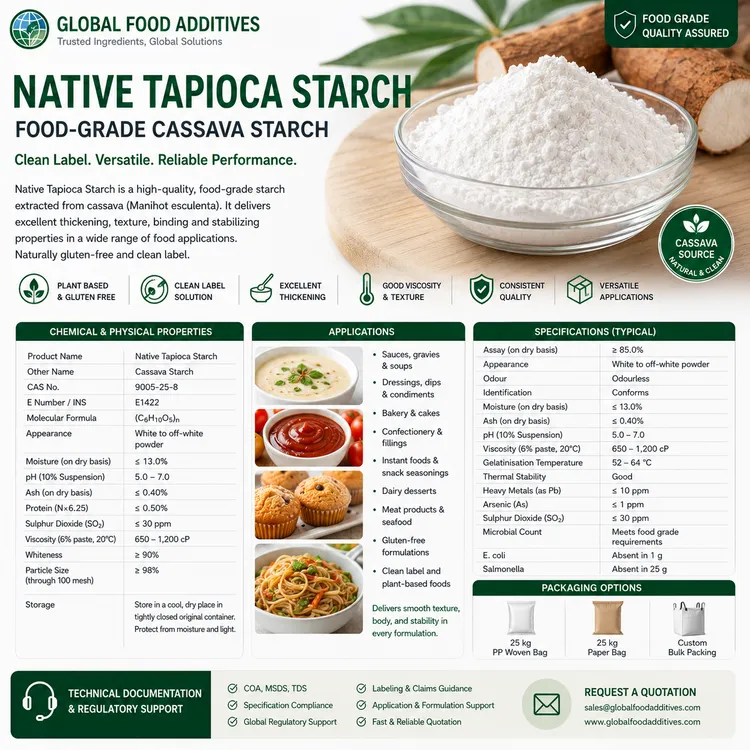
Product identity
| Product | Native Tapioca Starch |
|---|---|
| Common names | Tapioca starch, cassava starch, native cassava starch, food-grade tapioca starch |
| Source | Cassava root / tapioca root, depending on regional terminology |
| Category | Native starches, texturizers and bulking ingredients |
| Primary function | Thickening, viscosity building, texture improvement, water binding, bulking and carrier function |
| E / INS number | Not normally positioned as a modified-starch E-number; confirm classification by destination market and supplier documents |
| CAS / identity | 9005-25-8 |
| Typical form | Fine white to off-white powder |
| Typical taste profile | Neutral, bland and low in cereal notes compared with some grain-based starches |
| Clean-label relevance | Often suitable where the buyer wants a recognisable native starch declaration instead of a chemically modified starch, subject to local labelling rules |
Application fit
Native Tapioca Starch can be considered where a formulation requires viscosity, body, smooth mouthfeel, opacity control, moisture management or dry-blend bulk. It should be tested under the actual pH, heat, shear and storage conditions of the finished product.
- Soups, sauces and gravies
- Dressings, marinades and condiments
- Bakery fillings, creams and fruit preparations
- Noodles, pasta, extruded snacks and pellets
- Meat, poultry and seafood products
- Dairy-style desserts and puddings
- Dry mixes, seasoning blends and instant foods
- Clean-label formulations requiring native starch declaration
Industrial formulation value
Native Tapioca Starch is selected by food manufacturers when they need a cost-effective, plant-based texture ingredient with a clean taste and broad application range. In cooked systems, starch granules absorb water, swell and develop viscosity during gelatinisation. After cooling, the starch paste contributes body, spoonability, cling, suspension and mouthfeel. In dry systems, the same ingredient may be used as a carrier, filler, dusting agent, processing aid or bulk contributor.
The commercial value of tapioca starch often comes from its sensory neutrality. Compared with some cereal-based starches, tapioca starch is usually preferred when the formulator wants texture without strong grain flavour. This makes it useful in delicate flavour systems such as vanilla creams, fruit fillings, dairy-style desserts, light sauces, seasoning carriers and clean-label prepared foods.
Key technical effects
- Viscosity development: Builds body after heating in sufficient water.
- Smooth texture: Helps create short, smooth and glossy textures in many cooked systems.
- Water binding: Supports moisture control, yield and product consistency.
- Bulking: Adds solids in dry blends, bakery mixes, seasoning systems and processed foods.
- Carrier function: Can carry flavours, colours, seasonings and minor ingredients in powder systems.
- Clean-label support: Useful where a native starch declaration is preferred over a modified starch declaration.
Formulation considerations
- Cold-water behaviour: Native tapioca starch does not normally provide full instant viscosity in cold water unless it is pregelatinised or otherwise processed.
- Gelatinisation: Requires heat and available water to develop viscosity; sugar, salt, acid, fat and solids can shift performance.
- Shear sensitivity: High mechanical shear after gelatinisation can reduce viscosity.
- Acid sensitivity: Low-pH systems may thin during cooking or storage.
- Freeze-thaw limitation: Native starch may show syneresis or texture breakdown in frozen and thawed products.
- Batch variation: Viscosity, whiteness, moisture and microbial profile should be checked against the supplier specification.
Application guidance by industry
Soups, sauces and gravies
Native Tapioca Starch can provide body, cling and spoonability in neutral to mildly acidic sauces, soups and gravies. It is most suitable where the process includes adequate hydration and controlled heating. For high-acid sauces, retort products or long hot-hold lines, modified starch may be required to maintain viscosity and prevent breakdown.
Dressings, marinades and condiments
In dressings, marinades, dips and condiments, tapioca starch may support viscosity, suspension and mouthfeel. The final choice depends on pH, oil level, emulsifier system, salt level, shear conditions and whether the product is hot-filled, pasteurised, chilled or ambient-stable.
Bakery and fillings
In bakery fillings, creams, glazes and fruit preparations, Native Tapioca Starch can help build structure and reduce free water. For bake-stable fillings, freeze-thaw items or high-sugar/high-acid fruit systems, buyers should test whether native tapioca starch provides enough stability or whether a modified starch is needed.
Noodles and snack systems
Tapioca starch may be used in noodles, glass noodle systems, extruded snacks, pellets and crisp products to adjust expansion, bite, chew, clarity, binding and texture. Performance depends on particle size, moisture addition, cooking profile, extrusion parameters and drying conditions.
Meat, poultry and seafood
In processed meat, poultry and seafood products, Native Tapioca Starch can support water binding, yield, sliceability and texture. It may be used in brines, emulsified systems, formed products and coatings. Salt level, phosphate system, protein extraction, heat treatment and freeze-thaw handling should be considered during trial work.
Dry mixes and carriers
Native Tapioca Starch can function as a carrier, filler or flow-supporting powder in dry soups, seasoning blends, bakery premixes and instant food bases. For dry applications, particle size, bulk density, moisture, dusting behaviour and compatibility with flavours or hygroscopic ingredients are important purchasing parameters.
Native starch versus modified starch
Native Tapioca Starch is attractive when a clean-label declaration, simple ingredient list or natural positioning is important. However, chemically modified or physically modified starches may be better when the food process is technically demanding. The correct choice depends on finished-product requirements rather than product name alone.
| Requirement | Native Tapioca Starch | Modified / Pregelatinised Starch Option |
|---|---|---|
| Clean-label ingredient declaration | Often preferred, subject to local labelling rules | May require modified-starch declaration or E / INS number depending on market |
| Cold-water instant viscosity | Usually limited unless pregelatinised | Pregelatinised starch can provide cold-process viscosity |
| High heat and retort stability | May lose viscosity under severe conditions | Crosslinked or stabilised starches are often stronger |
| Low-pH stability | Requires careful testing | Acid-stable modified starch may perform better |
| Freeze-thaw stability | May show syneresis or texture breakdown | Stabilised starch or hydrocolloid blend may improve performance |
| High-shear processing | Can thin after granule rupture | Modified starch can provide better shear tolerance |
Technical purchasing notes
When reviewing Native Tapioca Starch, compare the supplier specification against the intended application, process conditions, target viscosity, sensory profile, label expectations and local rules. For industrial purchasing, the most useful inquiry normally includes the target grade, viscosity requirement, moisture limit, particle size, microbiological requirement, packaging size, quantity, destination and documentation requirements.
| Evaluation point | Why it matters |
|---|---|
| Viscosity profile | Determines thickening strength, cooking behaviour, hot viscosity, final viscosity and batch consistency. |
| Moisture | Affects shelf life, flowability, microbial stability and net dry solids. |
| pH | Helps confirm suitability for the intended food system and detects abnormal processing variation. |
| Whiteness / colour | Important for light-coloured sauces, dairy-style products, bakery creams and dry mixes. |
| Odour and taste | Critical for neutral-flavour systems where cereal or root notes may be noticeable. |
| Particle size | Influences dusting, dispersion, hydration rate, mixing behaviour and powder handling. |
| Ash and impurities | Supports quality control and indicates mineral residue or process consistency. |
| Microbiological profile | Important for dry blends, low-moisture foods and products without a later kill step. |
| Heavy metals and contaminants | Required for food safety, customer approval and import compliance. |
| Origin and crop source | Relevant for traceability, customer preferences, import controls and sustainability questionnaires. |
Typical specification items to compare
Specifications vary by producer, country of origin and grade. Before approving a supplier, request the current technical data sheet and a batch-specific certificate of analysis. The following parameters are commonly reviewed during industrial qualification:
- Product name, botanical source and ingredient declaration
- CAS / identity information: 9005-25-8
- Appearance, colour, odour and taste
- Moisture or loss on drying
- pH, ash and acidity where specified
- Viscosity method and viscosity range, such as Brookfield, RVA, Brabender or supplier-defined method
- Particle size, mesh profile or granulation type
- Whiteness or colour value
- Protein, fat and fibre values where nutritionally relevant
- Sulphur dioxide or sulphite declaration where applicable
- Heavy metals such as lead, arsenic, mercury and cadmium according to buyer requirements
- Pesticide, mycotoxin or contaminant statements where requested by the destination market
- Total plate count, yeast and mould, coliforms, E. coli and Salmonella criteria
- Packaging material, net weight, lot coding and pallet configuration
- Shelf life, recommended storage and retest policy
Processing and handling guidance
Native Tapioca Starch is typically dispersed in water or mixed with other dry ingredients before heating. During heating, starch granules absorb water and swell. With sufficient temperature and water, gelatinisation creates viscosity and texture. If the cooked starch is exposed to excessive shear, acid, prolonged heat or repeated freeze-thaw cycles, the paste can lose viscosity or release water.
Dry addition
For powder blends, disperse starch uniformly with other dry ingredients before hydration. Avoid adding starch directly into hot liquid without adequate agitation, because lumping or uneven hydration may occur.
Slurry preparation
In cooked systems, starch is commonly made into a slurry with cool water before addition. This helps dispersion and reduces the risk of fish-eyes or agglomerates during heating.
Heating profile
Heat must be sufficient to gelatinise the starch and develop viscosity. The required process conditions depend on water availability, solids content, sugar, salt, acid, fat and mixing system.
Shear management
Apply enough mixing to disperse and hydrate the starch, but avoid unnecessary high shear after full gelatinisation if viscosity retention is important.
Cooling and storage
During cooling and storage, starch pastes can change texture due to molecular reassociation. Finished-product trials should include the expected shelf life, chilled storage or frozen distribution conditions.
Quality control
Keep retained samples and compare incoming lots against an approved reference. For critical products, test viscosity in the buyer’s own formulation rather than relying only on supplier laboratory water-based viscosity data.
Regulatory and labelling review
Native Tapioca Starch is generally treated differently from chemically modified starches, but classification and labelling must always be confirmed by market, application and supplier documentation. Buyers should check whether the product is declared as tapioca starch, cassava starch, native starch, starch or another legally required term in the destination country.
- Confirm the exact legal ingredient declaration required in the target market.
- Confirm whether the product is native, physically processed, pregelatinised or chemically modified.
- Review whether an E / INS number is relevant. Native starches are often not positioned like chemically modified starch additives.
- Check allergen, gluten-free, GMO, vegan, halal, kosher and country-of-origin requirements.
- Confirm contaminant, microbiological and pesticide requirements for the destination country.
- Review claims such as clean-label, natural, gluten-free, non-GMO or allergen-free against local rules and actual documents.
Documents to request
- Product specification or technical data sheet
- Batch-specific certificate of analysis
- Food-grade statement and intended-use declaration
- Safety data sheet where applicable
- Allergen statement
- GMO status declaration
- Gluten-free statement, if required by buyer or market
- Vegan / vegetarian declaration, if required
- Halal and kosher certificates, if required
- Origin statement and manufacturer information, where disclosable
- Heavy metal, pesticide and contaminant statements where required
- Microbiological limits and test method information
- Shelf-life, storage and handling information
- Packaging details, label draft and pallet configuration
- Market-specific declarations required by the destination country
Packaging, storage and logistics
Native Tapioca Starch is commonly supplied in multiwall paper bags, woven polypropylene bags or food-grade bulk packaging, depending on supplier and volume. Typical industrial pack sizes may include 20 kg, 25 kg or larger bulk formats, subject to producer availability. Packaging should protect the powder from moisture, odour pickup, contamination and physical damage during export handling.
| Commercial detail | Recommended RFQ information |
|---|---|
| Order quantity | State sample, trial, first commercial order, monthly demand and annual forecast. |
| Packaging | Specify 20 kg, 25 kg, palletised bags, container load, big bag or other required format. |
| Destination | Provide country, port, delivery city and consignee requirements if available. |
| Delivery term | Indicate EXW, FCA, FOB, CFR, CIF, DAP or another Incoterms preference if known. |
| Application | Share whether the starch will be used in sauce, bakery, meat, noodle, snack, dry mix or another system. |
| Technical requirement | Include viscosity target, moisture limit, microbiological requirement, clean-label requirement or reference specification. |
| Documentation | List all required certificates before quotation to avoid delays after order confirmation. |
Storage recommendations
Store Native Tapioca Starch in a cool, dry, well-ventilated warehouse away from moisture, strong odours, direct sunlight, chemicals and pest risk. Keep bags closed until use and reseal opened material where possible. Because starch is hygroscopic and powder handling can create dust, factories should follow their internal food safety, dust control and housekeeping procedures.
How to request this product
Send the product name, target grade or reference specification, quantity, destination country, packaging preference, expected shipment date and required documents. If you already purchase Native Tapioca Starch, attach or describe your existing specification, viscosity target, label or certificate of analysis so supplier options can be compared more accurately.
For formulation-driven projects, include the application type, process temperature, pH, shear level, storage condition, desired texture and whether the finished product will be chilled, frozen, ambient-stable, retorted, baked or hot-filled. This information helps determine whether native tapioca starch is suitable or whether a modified starch, pregelatinised starch or blended texture system should also be evaluated.
Useful answers
What is Native Tapioca Starch used for in food manufacturing?
Native Tapioca Starch is used for thickening, viscosity development, water binding, texture improvement, bulking and carrier applications. It is commonly evaluated in soups, sauces, dressings, bakery fillings, noodles, snacks, meat products, dairy-style desserts and dry mixes.
Is Native Tapioca Starch a modified starch?
No. Native Tapioca Starch is not chemically modified. It can support clean-label formulations, but it is usually less resistant to severe heat, acid, shear, long hot-holding and freeze-thaw cycles than many modified starches.
Can Global Food Additives source Native Tapioca Starch?
Global Food Additives can review sourcing options for Native Tapioca Starch according to target specification, viscosity requirement, quantity, destination, packaging preference, delivery term and required documentation.
Which documents should be requested?
Buyers commonly request a technical data sheet, product specification, batch certificate of analysis, food-grade statement, origin declaration, allergen statement, GMO status, safety data sheet where applicable, microbiological data, shelf-life information and packing details.
Is Native Tapioca Starch suitable for frozen products?
It may be suitable in some frozen systems, but native starch can show water release or texture breakdown after freeze-thaw cycles. Frozen meals, frozen sauces and thawed bakery fillings should be tested carefully, and a modified starch or stabiliser blend may be required.
Is this product permitted in every country?
Food ingredient classification, permitted use, labelling and documentation depend on destination-market rules, food category, claims and buyer responsibility. Buyers should verify the final regulatory status before commercial use.
Tell us which food additive or ingredient you need.
Send product names, target specifications, quantity, destination country, packaging preference, delivery term, and document requirements. Our team will review your inquiry and respond from orders@foodgradeadditives.com.
Your message has been received. You will be redirected to the home page.