
Neohesperidine DC
Neohesperidine DC, commonly referred to as Neohesperidin Dihydrochalcone or NHDC, is a low-dosage high-intensity sweetener and flavour modifier used by food and beverage manufacturers to support sugar-reduction targets, improve sweetness perception, mask bitterness and round harsh flavour notes. It is best evaluated as a technical sweetener system component rather than a bulk sweetener or polyol.
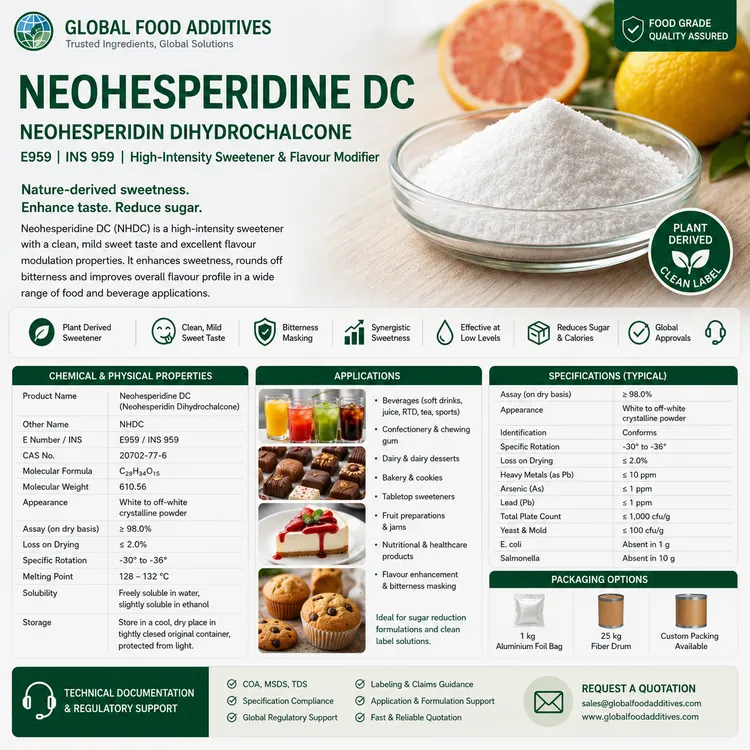
Product identity
| Product name | Neohesperidine DC |
|---|---|
| Common names | Neohesperidin Dihydrochalcone, NHDC, Neohesperidin DC |
| Category | High-intensity sweetener / flavour modifier |
| Primary function | Sweetness enhancement, bitterness masking, flavour rounding and sugar-reduction support |
| E / INS number | E959 / INS 959 |
| CAS number | 20702-77-6 |
| Molecular formula | C28H36O15 |
| Molecular weight | 612.58 g/mol |
| Typical appearance | White to off-white crystalline powder, subject to supplier specification |
| Typical positioning | Low-dosage sweetener and flavour-modifying ingredient, not a bulking polyol |
Application fit
NHDC can be considered where formulators need high sweetness impact at low dosage, especially when the finished product also requires bitterness masking, aftertaste balancing or improved sweetness duration.
- Carbonated and still beverages
- Powder drink mixes and instant beverages
- Chewing gum and confectionery
- Dairy desserts, yoghurt-style products and ice cream systems
- Table-top sweetener blends
- Fruit preparations, syrups and flavour bases
- Sauces, condiments and savoury flavour systems
- Nutritional products, supplements and selected specialty formulations
Industrial formulation value
Neohesperidine DC is valuable when a formulation requires more than sweetness intensity. In many industrial systems, the key commercial benefit is flavour architecture: it can help smooth acidic, bitter, metallic or botanical notes and can extend perceived sweetness in products where sucrose reduction creates a thin or incomplete taste profile. This makes NHDC relevant for beverage concentrates, flavour houses, dairy dessert systems, chewing gum, confectionery compounds and nutritional products where small changes in sweetener balance can strongly affect consumer acceptance.
Key technical effects
- High sweetness impact: Used at low dosage compared with nutritive sweeteners.
- Sweetness extension: Helps lengthen sweetness perception where fast-onset sweeteners fade quickly.
- Bitterness masking: Useful in citrus, botanical, mineral, protein, vitamin and high-intensity sweetener systems.
- Flavour rounding: Can soften sharp edges in acidic beverages, dairy flavours and savoury sauces.
- Synergy potential: Often evaluated with other high-intensity sweeteners to improve sweetness quality and reduce total sweetener cost-in-use.
- Low usage mass: Helps sweetness design without adding significant solids, calories or fermentable sugars.
Formulation considerations
- Onset and lingering: NHDC can show a slower sweetness onset and longer finish than sucrose; dosage should be balanced through sensory trials.
- Solubility planning: Pre-dissolution, warm-water processing, premix dilution or carrier systems may be required depending on grade and process.
- pH and flavour matrix: Perceived sweetness and masking performance can change with acidity, flavour load, carbonation, fat phase and solids content.
- Overdose risk: Excessive dosage may create an overly lingering sweetness or liquorice-like aftertaste in sensitive matrices.
- Carrier selection: For dry blends, dispersion may improve when NHDC is preblended with maltodextrin, dextrose, erythritol, fibre or another approved carrier.
- Regulatory limits: Always confirm market-specific permitted food categories and maximum levels before commercial launch.
Application guidance by industry
Beverages
In soft drinks, flavoured waters, powdered drinks, isotonic beverages and beverage syrups, NHDC may support reduced-sugar sweetness systems and help mask bitter notes from acids, caffeine, botanical extracts, minerals, vitamins or high-intensity sweeteners. It is typically evaluated in bench trials against the complete acid, flavour and carbonation profile rather than in water alone.
Dairy and frozen desserts
In yoghurt-style products, dairy desserts, ice cream systems and cream-flavour profiles, NHDC may help improve perceived sweetness, round acidity and support creamy notes. Because dairy fat, protein and stabiliser systems influence flavour release, sensory screening should include the final stabiliser, fat and solids system.
Confectionery and chewing gum
NHDC can be evaluated in chewing gum, compressed tablets, candies and confectionery fillings where extended sweetness and flavour persistence are valuable. It may be particularly useful where mint, fruit acid, cocoa, herbal or high-intensity sweetener notes require smoothing.
Sauces, condiments and savoury systems
In ketchup, dressings, marinades, savoury sauces and seasoning systems, NHDC can help round acidity, bitterness and spice harshness while contributing sweetness at very low use levels. Final evaluation should consider heat treatment, salt level, vinegar system and flavour declaration rules.
Technical purchasing notes
For industrial purchasing, NHDC should be compared by identity, assay, impurity profile, sensory performance, particle size, solubility behaviour, documentation quality and regulatory fit for the destination market. A low price per kilogram is not always the lowest cost-in-use: formulation performance, batch consistency, dissolving behaviour, aftertaste control and documentation reliability can materially affect production cost and launch risk.
| Evaluation point | Why it matters |
|---|---|
| Assay / purity | Confirms active NHDC content and supports consistent dosage from batch to batch. |
| Identity testing | Helps verify the correct ingredient through supplier specification, COA and appropriate analytical method. |
| Particle size | Influences dry blending, dusting, dispersion and dissolution performance in production. |
| Loss on drying / moisture | Supports shelf-life control, flowability and powder handling performance. |
| Residual solvents | Important for food-grade compliance and supplier qualification, especially for chemically processed ingredients. |
| Heavy metals | Required for food safety, import checks and customer quality agreements. |
| Microbiology | Relevant for food-grade approval and dry-blend applications where the ingredient is not further kill-stepped. |
| Regulatory declarations | Destination-market compliance depends on food category, maximum permitted use level and labelling rules. |
Typical specification items to compare
Specifications vary by producer and grade. Before approving any supplier, request the current technical data sheet and a batch-specific certificate of analysis. The following parameters are commonly reviewed during supplier qualification:
- Product name, synonym list, CAS number and E / INS number
- Assay or active content by declared analytical method
- Appearance, colour, odour and sensory description
- Particle size or mesh profile, where relevant
- Moisture or loss on drying
- Ash or residue on ignition, where specified
- Related substances, process impurities and residual solvents
- Heavy metals such as lead, arsenic, mercury and cadmium according to buyer requirements
- Total plate count, yeast and mould, coliforms, E. coli and Salmonella criteria where applicable
- Packaging type, net weight, pallet configuration and tamper evidence
- Shelf life, recommended storage and retest policy
Processing and handling guidance
Neohesperidine DC is normally handled as a potent powder ingredient. Because dosage can be low, production accuracy depends on good weighing practice, dilution strategy and homogeneous distribution. For small additions into large dry or liquid batches, manufacturers often prepare a controlled premix before adding NHDC to the main batch.
Dry blending
Use a preblend when addition levels are very low. Blend NHDC first with a compatible carrier or part of the powder base, then add the premix to the full batch. Validate homogeneity with the actual mixer, batch size and blending time.
Liquid processing
Confirm dissolution behaviour in the actual process water, pH, solids level and temperature. Avoid adding a concentrated powder directly into high-viscosity systems unless dispersion has been validated.
Thermal processes
Review heat exposure, holding time and finished-product sensory impact. Even when the ingredient is suitable for a process, sweetness balance should be checked after pasteurisation, UHT, retort, baking or hot-fill conditions if relevant.
Quality control
Keep retained samples, batch COAs and incoming inspection records. For high-value formulations, compare each new lot against an approved reference sample through sensory and analytical checks.
Regulatory and labelling review
Neohesperidine DC is identified with E / INS number 959, but permitted use is not universal. Approval can depend on the country, food category, technical function, maximum level, consumer group and label wording. Manufacturers should verify the rules in the destination market before commercial production, especially for exports, private-label projects and products sold through multiple jurisdictions.
- Confirm whether NHDC is permitted in the target country and food category.
- Check whether it is declared as a sweetener, flavouring, flavour enhancer or other permitted class according to local rules.
- Confirm maximum use level and whether the limit applies to the final food, concentrate, ready-to-drink equivalent or consumed portion.
- Review front-of-pack and nutrition claims such as “sugar-free”, “no added sugar”, “reduced sugar” or “low calorie”.
- Check export documentation requirements, including health certificate, free sale certificate, origin declaration or market-specific compliance letter.
Documents to request
- Product specification or technical data sheet
- Batch-specific certificate of analysis
- Food-grade statement and intended-use declaration
- Safety data sheet where applicable
- Allergen statement
- GMO status declaration
- Vegan / vegetarian statement, if required by customer programme
- Halal and kosher certificates, if required
- Origin statement and manufacturer information, where disclosable
- Residual solvent, heavy metal and microbiological limits
- Storage conditions, shelf-life and retest information
- Label draft, packing list format and pallet configuration
- Market-specific declarations required by the destination country
Packaging, storage and logistics
NHDC is commonly supplied in sealed food-grade fibre drums, cartons or bags with inner polyethylene liners, depending on supplier and order size. Packaging should protect the powder from moisture, contamination, odour pickup and excessive heat. Store in a cool, dry, well-ventilated area away from strong odours and direct sunlight. Keep containers tightly closed after opening and manage opened material under the buyer’s internal food safety system.
| Commercial detail | Recommended RFQ information |
|---|---|
| Order quantity | State first order, annual forecast and whether you need sample, pilot, pallet or container volume. |
| Packaging | Specify preferred net weight, inner liner, drum/carton/bag type and pallet requirements. |
| Destination | Provide country, port or delivery city so freight, documents and import rules can be checked. |
| Delivery term | Indicate EXW, FCA, FOB, CFR, CIF, DAP or another Incoterms preference if known. |
| Documentation | List required certificates before quotation to avoid delays after order confirmation. |
| Approval process | Clarify whether you need a sample, COA review, sensory trial, regulatory review or supplier questionnaire first. |
How to request this product
Send the product name, target grade, assay requirement, quantity, destination country, packaging preference, delivery term, expected shipment date and required documents. If you already purchase Neohesperidine DC, attach or describe your existing specification, label or certificate of analysis so supplier options can be compared accurately.
For formulation-driven projects, include the application type, target sweetness profile, sugar-reduction objective, pH range, heat process, flavour system and any sweeteners already used. This helps determine whether the inquiry requires a standard NHDC quotation, a specific particle-size grade, a premix approach or a documentation-heavy export offer.
Useful answers
What is Neohesperidine DC used for in food manufacturing?
Neohesperidine DC is used as a high-intensity sweetener, sweetness enhancer and flavour modifier. It can support sugar reduction, bitterness masking, flavour rounding and improved sweetness duration in selected food and beverage applications. Suitability depends on grade, use level, process, finished product matrix and destination-market regulations.
Is Neohesperidine DC the same as a polyol?
No. NHDC is not a polyol and should not be positioned as a bulking sweetener. Polyols such as sorbitol, maltitol, xylitol and erythritol contribute bulk, solids and water activity effects. NHDC is used at low dosage for sweetness and sensory modification.
Can Global Food Additives source Neohesperidine DC?
Global Food Additives can review sourcing options for Neohesperidine DC according to target assay, physical form, quantity, destination, packaging, delivery term and required documentation. For accurate comparison, buyers should share a specification or recent COA where possible.
Which documents should be requested?
Buyers commonly request a technical data sheet, product specification, batch COA, food-grade statement, allergen statement, GMO declaration, safety data sheet where applicable, origin statement, shelf-life information, packing details and market-specific declarations.
What applications are most suitable for NHDC?
NHDC is commonly evaluated in beverages, chewing gum, confectionery, dairy desserts, ice cream systems, table-top sweetener blends, fruit preparations, sauces, condiments and specialty nutrition products. It is particularly relevant where bitterness masking or extended sweetness is required.
Is this product permitted in every country?
No. Food additive use depends on destination-market rules, product category, technical function, use level, label requirements and buyer responsibility. Always verify regulatory status before commercial use.
Tell us which food additive or ingredient you need.
Send product names, target specifications, quantity, destination country, packaging preference, delivery term, and document requirements. Our team will review your inquiry and respond from orders@foodgradeadditives.com.
Your message has been received. You will be redirected to the home page.