
Nicotinic Acid
Nicotinic Acid, also known as niacin or vitamin B3, is a food-grade fortification nutrient used in enrichment systems, vitamin-mineral premixes and nutrition-positioned foods where permitted. This page is prepared as an industrial sourcing and specification-review guide for food manufacturers, premix producers, flour millers, beverage companies and nutrition brands that need defined assay, suitable particle size, reliable premix compatibility, label-support documentation and destination-market compliance.
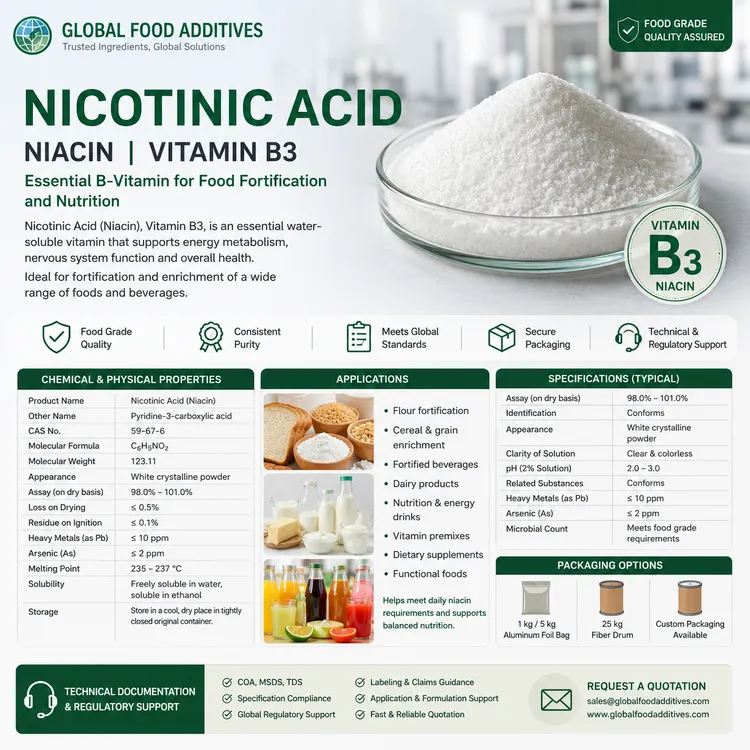
Product identity
| Product | Nicotinic Acid |
|---|---|
| Common names | Niacin, vitamin B3, pyridine-3-carboxylic acid, food-grade nicotinic acid |
| Category | Fortification Nutrients |
| Function | Vitamin B3 fortification, enrichment nutrient and premix-ready nutritional ingredient |
| E / INS number | Usually treated as a nutrient or vitamin ingredient; confirm by destination market and supplier documentation |
| CAS / identity | 59-67-6 |
| Chemical name | Pyridine-3-carboxylic acid |
| Molecular formula | C6H5NO2 |
| Typical form | Fine powder, crystalline powder, granule, beadlet, premix-ready grade or solution-compatible grade |
| Procurement focus | Assay, identity, purity, particle size, solubility, premix uniformity, stability, label claim support and regulatory suitability |
Application fit
Potential use areas may include:
- Flour enrichment and cereal grain fortification
- Breakfast cereals, extruded cereals and cereal bars
- Beverage powders, fortified drinks and nutrition beverages
- Dairy products and dairy-based nutritional systems
- Infant, follow-on and medical foods where permitted
- Sports nutrition, meal replacements and dietary supplement blends
- Vitamin-mineral premixes for industrial food production
Industrial function and nutritional role
Nicotinic Acid is used as a defined source of niacin activity in fortified foods and premixes. In nutrition science, niacin is a water-soluble B vitamin family that includes nicotinic acid and nicotinamide. In industrial food manufacturing, Nicotinic Acid is purchased for accurate nutrient delivery, enrichment compliance, nutrition-label support and consistent premix performance. The correct grade must be selected according to assay, particle size, bulk density, solubility, sensory profile, processing conditions and the final product's legal fortification limits.
Nicotinic Acid versus other vitamin B3 forms
Food and supplement developers often compare Nicotinic Acid with Niacinamide, also called Nicotinamide. Both are vitamin B3 forms, but they may differ in formulation behavior, customer preference, nutritional labeling, physiological response and permitted use in certain product categories. Buyers should specify the exact form required by the regulation, customer standard, premix design and product label. Substitution should be approved by R&D, regulatory, QA and the brand owner before purchasing.
| Vitamin B3 form | Main industrial consideration | Buyer note |
|---|---|---|
| Nicotinic Acid | Defined niacin source for fortification and enrichment applications | Commonly reviewed for flour, cereals and premixes where the specification calls for niacin or nicotinic acid. |
| Niacinamide / Nicotinamide | Alternative vitamin B3 form used in many food, beverage and supplement systems | May be preferred in some applications because it differs from nicotinic acid in sensory and physiological behavior. |
| Vitamin B-complex premix | Preblended nutrient system containing niacin with other B vitamins | Useful for uniform dosing and lower weighing risk; requires premix stability and homogeneity documentation. |
| Encapsulated or beadlet grade | Improved handling, reduced dusting or enhanced stability in selected systems | Carrier, coating, allergen status and label declaration must be reviewed. |
Application guidance by food category
| Application | Industrial purpose | Key evaluation points |
|---|---|---|
| Flour and grain enrichment | Restore or increase niacin content in standardized enrichment systems | Legal enrichment level, premix uniformity, mill addition point, iron and B-vitamin compatibility, flour flow and finished-flour assay |
| Breakfast cereals | Vitamin B3 fortification and nutrition-label support | Extrusion heat, coating step, overage design, serving size, vitamin retention, flavor impact and label claim thresholds |
| Beverages and drink powders | Vitamin fortification in liquid or reconstituted systems | Solubility, pH, clarity, flavor, color, heat treatment, light exposure, precipitation risk and shelf-life retention |
| Dairy and dairy alternatives | Nutrition positioning and B-vitamin enrichment | pH, protein interaction, heat process, homogenization, sensory impact, label declaration and vitamin stability |
| Infant and medical foods | Controlled nutrient delivery in specialized foods where permitted | Strict regulatory limits, assay control, supplier qualification, contaminant limits, homogeneity, stability and finished-product release testing |
| Nutrition bars and meal replacements | Vitamin B3 contribution and nutrition panel design | Water activity, vitamin retention, flavor masking, premix distribution, serving-size contribution and overage control |
| Vitamin-mineral premixes | Accurate microingredient dosing and uniform nutrient distribution | Particle size, bulk density, segregation risk, carrier compatibility, blend uniformity and analytical verification |
Fortification design and dosage planning
Industrial use of Nicotinic Acid requires a controlled fortification plan. Formulators should define the target niacin contribution per serving, legal minimum and maximum levels, expected processing losses, shelf-life overage, finished-product assay method and label claim objective. The nutrient contribution should be calculated on the actual assay of the ingredient, not only on nominal purchase weight.
Assay-based dosing
The active nutrient contribution depends on the assay of the supplied Nicotinic Acid grade. Buyers should use the certificate value and specification range when calculating addition rates.
- Confirm assay on dry or as-is basis
- Calculate dose using actual active content
- Include process and shelf-life overage where justified
- Verify finished-product niacin content by analysis where required
Premix uniformity
Because vitamin addition levels are often small, industrial users commonly add Nicotinic Acid through a premix. Particle size and bulk density should match carriers and other nutrients to reduce segregation.
- Review blend homogeneity data
- Match particle size to carrier system
- Control mixing time and order of addition
- Validate dosing accuracy at plant scale
Overage strategy
Overage may be used to ensure the declared or required vitamin level is maintained through shelf life. Overage must be scientifically justified and remain within regulatory and customer limits.
- Base overage on stability data, not guesswork
- Review heat, moisture, oxygen and light exposure
- Avoid exceeding maximum permitted nutrient levels
- Document rationale for QA and regulatory files
Label claim control
Niacin claims must be reviewed against the finished product, not only the ingredient. Serving size, nutrient reference values, tolerances and destination-market wording must be confirmed.
- Check local thresholds for source or high-source claims
- Confirm nutrient declaration units and rounding rules
- Verify whether niacin equivalents are permitted for calculation
- Maintain analytical and formulation records for claim support
Processing and stability considerations
Nicotinic Acid is generally a stable B vitamin compared with some more sensitive vitamins, but the finished product still requires stability review. Losses or distribution problems can occur through poor mixing, segregation, dusting, interaction with alkaline systems, exposure to moisture, packaging defects or inaccurate dosing. For high-value nutrition products, a stability protocol should test nutrient retention at the end of shelf life under real packaging and storage conditions.
Heat processing
Fortified cereals, bakery products, dairy systems and beverages may expose Nicotinic Acid to heat. The chosen overage and addition point should be validated using the actual process.
- Test before and after extrusion, baking, pasteurization or drying
- Compare addition before versus after heat where possible
- Monitor finished-product niacin through shelf life
- Review interaction with other vitamins and minerals
Moisture and caking
Powder handling can be affected by humidity, fine particle size and packaging barrier. Poor storage can reduce flowability and dosing accuracy.
- Keep containers tightly closed
- Control humidity in weighing and premix rooms
- Use moisture-protective packaging
- Inspect for caking before release to production
Solubility and sensory impact
Liquid products require special attention to solubility, pH, clarity and taste. High local concentration can create processing or sensory issues.
- Prepare stock solutions according to supplier instructions
- Check final beverage clarity and precipitation risk
- Evaluate bitterness or acidic notes where relevant
- Confirm compatibility with flavors, acids and minerals
Premix compatibility
Nicotinic Acid is often blended with thiamin, riboflavin, folic acid, iron, zinc, calcium, vitamin A, vitamin D or other micronutrients. Compatibility should be assessed in the final premix.
- Review interactions with minerals and hygroscopic ingredients
- Check color and odor changes during storage
- Use suitable carriers and anticaking systems where allowed
- Validate homogeneity after transport vibration
Technical purchasing notes
When reviewing Nicotinic Acid, compare the supplier specification against the intended food application, process conditions, nutrient target, label expectations and local rules. For industrial purchasing, the most useful inquiry normally includes target grade, assay, active content basis, particle size, physical form, packaging size, quantity, destination country and document requirements.
Specification parameters to request
A complete Nicotinic Acid quotation should include a specification that allows R&D, QA, regulatory and purchasing teams to compare grades objectively. The following parameters are commonly useful when evaluating a new supplier:
| Parameter | Why it matters |
|---|---|
| Assay | Primary value for dose calculation, premix formulation and finished-product nutrient claims. |
| Identity | Confirms the material is Nicotinic Acid and not another vitamin B3 form such as niacinamide. |
| Purity and related substances | Supports quality comparison and compliance with food, pharmacopeial or customer-specific standards. |
| Moisture or loss on drying | Affects flowability, shelf life, weighing accuracy and dry-basis calculation. |
| Residue on ignition / ash | Indicates inorganic residue and supports specification comparison. |
| Heavy metals | Relevant for food safety, infant-food review, medical-food review and import approval. |
| Residual solvents | Important where manufacturing process and customer standards require solvent control. |
| Particle size | Controls blend uniformity, dusting, segregation, dissolution speed and mouthfeel risk. |
| Bulk density | Important for premix design, dosing equipment, filling equipment and warehouse planning. |
| Solubility | Critical for beverages, liquid premixes, dairy systems and solution dosing. |
| Microbiological limits | May be required for food-grade approval, especially in infant, medical, beverage or ready-to-eat applications. |
| Allergen and GMO status | Required for label review, customer approval and market-specific declarations. |
| Certifications | Halal, kosher, vegan, vegetarian, ISO, FSSC 22000, BRCGS, USP, FCC or other documents may be required by the buyer. |
| Shelf life and storage | Important for activity retention, inventory control, import planning and premix stability. |
Quality, storage and handling
Nicotinic Acid is typically handled as a fine powder or crystalline powder. Store in closed original packaging, protected from moisture, dust contamination, strong odors, direct sunlight and excessive heat. Manufacturing sites should use controlled weighing procedures, dust management and verified microingredient dosing systems. Because fortification nutrients are used at small levels, weighing errors and poor blending can create out-of-spec finished products.
Incoming inspection
- Check product name, lot number, net weight and assay
- Inspect packaging integrity, odor, appearance, caking and foreign matter
- Compare certificate of analysis against purchase specification
- Confirm allergen, GMO, origin and certification documents
- Retain samples according to the factory quality plan
Factory handling
- Use dust-control procedures during weighing and premixing
- Control humidity in storage and weighing rooms
- Avoid cross-contamination with allergens or strong odors
- Use first-expired, first-out stock rotation
- Keep containers sealed when not in use
Premix preparation
- Use validated scales for microingredient dosing
- Pre-dilute into a carrier when direct dosing is too small
- Control mixing time and order of addition
- Test homogeneity using validated sampling plans
- Protect premixes from moisture and segregation during transport
Finished-product verification
- Confirm nutrient addition through batch records
- Use analytical testing where required by regulation or customer standard
- Monitor retention after processing and storage
- Review label compliance after final formula approval
- Maintain records for audits and market inspections
Food fortification and label review
Nicotinic Acid can support vitamin B3 fortification and enrichment, but nutrition claims must be approved against the final food. Requirements vary by market and food category. Buyers should review whether the product is mandatory-enriched, voluntarily fortified, intended for general consumers, intended for infants or medical nutrition, or positioned as a dietary supplement. Each route may have different limits, tolerances, analytical expectations and label wording.
Enrichment applications
- Confirm mandatory or voluntary enrichment rules by country
- Check required niacin level and permitted vitamin form
- Validate flour or cereal premix distribution
- Maintain records for mill, bakery or cereal-product audits
Fortified foods
- Calculate niacin contribution per serving
- Review minimum and maximum permitted levels
- Check whether nutrient-content claims are allowed
- Confirm final nutrition facts declaration and tolerances
Specialized nutrition
- Infant and medical foods require strict regulatory review
- Supplier qualification and contaminant limits may be tighter
- Finished-product assays may be required for release
- Formula changes should be controlled through QA and regulatory approval
Claim and safety review
- Review tolerable upper intake limits where applicable
- Avoid excessive fortification or duplication from multiple premixes
- Check local rules for vitamin B3, niacin and niacin-equivalent declarations
- Ensure claims are supported by finished-product data
Packaging and logistics options
Nicotinic Acid may be supplied in fiber drums, cartons, foil bags, PE-lined bags, HDPE containers, small laboratory packs or premix-ready packaging depending on supplier and order size. Packaging should protect the product from moisture and contamination while supporting accurate weighing and safe industrial handling. For export shipments, buyers should confirm shelf life remaining, pallet configuration, label language, customs documents and whether the material is shipped as food grade, feed grade, pharmaceutical grade or technical grade.
| Packaging item | What to confirm |
|---|---|
| Primary pack | Foil bag, PE liner, drum, carton or container suitable for food-grade vitamin storage. |
| Net weight | Common commercial pack sizes vary by supplier; confirm trial packs, production packs and minimum order quantity. |
| Moisture protection | Important for powder flow, caking prevention and long-term stability. |
| Batch coding | Each unit should show product name, grade, batch number, net weight, manufacture date and expiry or retest date. |
| Pallet configuration | Confirm units per pallet, pallet dimensions, stretch wrapping, stacking limits and transport protection. |
| Storage conditions | Confirm recommended temperature, humidity control, odor protection and shelf-life conditions. |
Documents to request
Buyers should request a complete document package before approving a new Nicotinic Acid supplier. Documentation needs vary by destination country, customer audit standard and application, but the following documents are commonly requested:
- Product specification or technical data sheet
- Certificate of analysis for available batch or lot
- Assay, identity and purity data
- Safety data sheet where applicable
- Food-grade declaration or nutrient suitability statement
- Pharmacopeial, FCC, USP, EP or customer-specific compliance statement where required
- Origin, manufacturer and production-site information
- Allergen statement
- GMO statement or non-GMO certificate if required by the buyer
- Halal, kosher, vegan, vegetarian or market-specific declarations where applicable
- Heavy metals, residual solvents, microbiological limits and contaminant statements
- Shelf-life, storage conditions and handling information
- Label draft, packaging details, net weight, pallet configuration and loading quantity
- Market-specific declarations required by the destination country
Regulatory and buyer responsibility
Nicotinic Acid may be treated as a nutrient, vitamin ingredient, enrichment ingredient or supplement ingredient depending on the market, food category and intended use. It should not automatically be handled as an E-number additive unless local rules and supplier documentation support that classification. Buyers should verify permitted food categories, nutrient source rules, use levels, label declarations, nutrition claims, maximum intake considerations and import requirements before purchase.
How Global Food Additives can support
Global Food Additives, Inc. supports food manufacturers and distributors with practical sourcing coordination for fortification nutrients, preservatives, acidulants, hydrocolloids, proteins, cultures, gases and functional ingredients. For Nicotinic Acid, our team can help review the target specification, identify suitable supply options, collect supplier documents, clarify packaging and logistics constraints and coordinate quotation details for export-ready procurement.
- Specification and documentation review before quotation
- Supplier comparison by assay, grade, particle size, packaging, certifications and destination market
- Coordination of CoA, SDS, food-grade declaration, allergen, GMO and origin documents
- Support for flour, cereal, beverage, dairy, nutrition powder and premix inquiries
- Packaging, palletization, shipment and export-document coordination
- Technical communication for R&D, QA, regulatory and procurement teams
How to request this product
Send the product name, target grade or reference specification, required assay, application, quantity, destination country, packaging preference, expected shipment date and required documents. If you already purchase Nicotinic Acid, attach or describe your existing specification, label, certificate of analysis, assay, particle size, current dosage, target food category and premix system so supplier options can be compared more accurately.
For R&D and QA teams
- Target food application and finished-product category
- Required niacin contribution per serving or per 100 g
- Required vitamin form: Nicotinic Acid, Niacinamide or premix
- Processing conditions, pH, moisture, heat exposure and shelf-life target
- Premix carrier, particle size and blend-uniformity requirements
- Analytical testing, overage and label-claim requirements
For purchasing teams
- Required trial, monthly or annual quantity
- Preferred pack size and storage conditions
- Destination country, port, delivery address and Incoterms
- Required certifications and document package
- Food-grade, pharmacopeial, halal, kosher, vegan, non-GMO or customer-specific requirements
- Target price structure, lead time and shipment schedule
Useful answers
What is Nicotinic Acid used for in food manufacturing?
Nicotinic Acid is typically discussed for vitamin B3 fortification, enrichment, nutrition positioning and premix-ready formulation. Common review areas include flour, cereals, beverages, dairy products, infant and medical foods where permitted, nutrition powders and vitamin-mineral premixes.
Is Nicotinic Acid the same as niacin?
Yes. Nicotinic Acid is one form of niacin, also known as vitamin B3. However, niacin can also refer to other related forms such as niacinamide. Buyers should specify the exact form required for the formula and destination market.
Can Nicotinic Acid be replaced with Niacinamide?
Not automatically. Nicotinic Acid and Niacinamide are both vitamin B3 forms, but they can differ in physiological behavior, customer requirements, specification, label declaration and regulatory use. Substitution should be approved by R&D, QA and regulatory teams.
Is Nicotinic Acid an E-number additive?
In many applications, Nicotinic Acid is treated as a nutrient or vitamin ingredient rather than an E-number additive. Classification depends on the destination market, food category and supplier documentation.
Which applications are most relevant?
Common review areas include flour enrichment, breakfast cereals, cereal bars, beverages, dairy products, nutrition powders, meal replacements, infant and medical foods where permitted, and industrial vitamin-mineral premixes.
Which documents should be requested?
Buyers commonly request a technical data sheet or specification, certificate of analysis, assay and identity data, safety data sheet where applicable, food-grade declaration, pharmacopeial or FCC compliance statement where required, origin statement, allergen statement, GMO statement, heavy metals, residual solvents, shelf-life information, label draft and packing details.
What should I specify when requesting a quote?
Provide the target application, required assay, vitamin form, quantity, destination country, packaging preference, delivery term, required certifications and document package. If replacing an existing grade, share the current specification, certificate of analysis and premix or finished-product application.
Is Nicotinic Acid permitted in every country?
No. Food fortification and vitamin use depend on destination-market rules, food category, nutrient level, label requirements, nutrition claims and buyer responsibility. Always verify local compliance before import or commercial use.
Can Global Food Additives source Nicotinic Acid?
Global Food Additives can review sourcing options for Nicotinic Acid according to target specification, assay, grade, application, quantity, destination, packaging and required documentation.
Tell us which fortification nutrient or food additive you need.
Send product names, target specifications, quantity, destination country, packaging preference, delivery term, and document requirements. For Nicotinic Acid, please include target application, required assay, vitamin form, particle size requirement, premix use, packaging format and any regulatory or customer documentation needs. Our team will review your inquiry and respond from orders@foodgradeadditives.com.
Your message has been received. You will be redirected to the home page.