
Oat Fiber
Oat Fiber is a food-grade plant fiber ingredient used by food manufacturers for dietary fiber enrichment, texture control, bulking, water binding, oil binding, moisture management and process stability. This page is prepared as an industrial sourcing and specification-review guide for buyers who need the right oat fiber grade, particle size, fiber profile, gluten control, documentation package, packaging format and destination-market suitability.
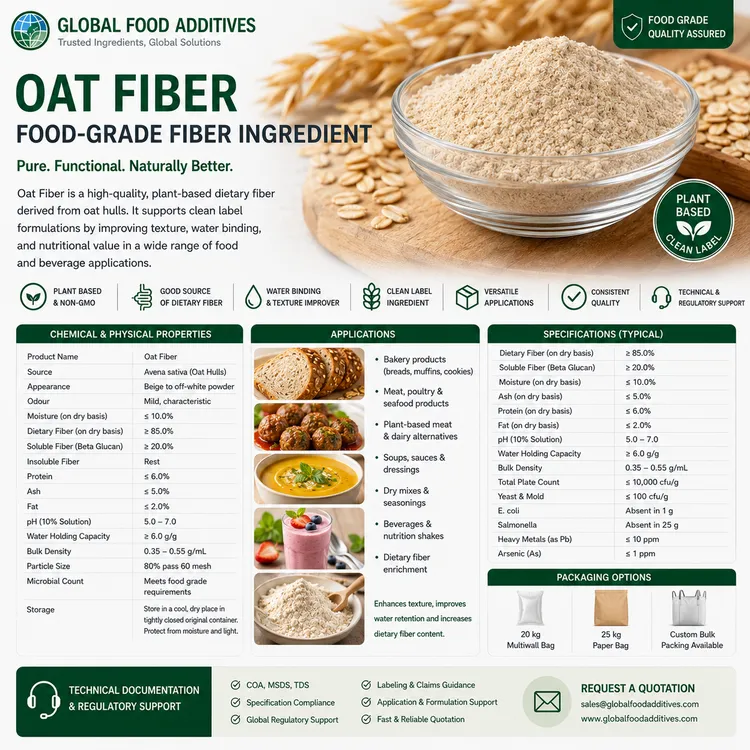
Product identity
| Product | Oat Fiber |
|---|---|
| Common names | Food-grade oat fiber, oat dietary fiber, oat fibre, insoluble oat fiber, oat bran fiber, oat beta-glucan fiber depending on grade |
| Category | Modified Starches, Fibres & Bulking Agents |
| Function | Texture, bulking, water binding, oil binding, dietary fiber enrichment, viscosity support and carrier ingredient |
| E / INS number | Usually treated as a food ingredient; confirm by destination market and supplier documentation |
| CAS / identity | Plant fiber ingredient from oat raw material; supplier and market specific |
| Typical form | Fine powder, coarse powder, granule or agglomerated grade |
| Typical appearance | Light beige to cream powder, depending on raw material, milling and heat treatment |
| Key technical variables | Total dietary fiber, soluble/insoluble ratio, beta-glucan level, particle size, water-holding capacity, oil-binding capacity and bulk density |
| Main sourcing concern | Consistent fiber composition, gluten status, microbiological quality, mycotoxin control, allergen documentation and label suitability |
Application fit
Potential use areas may include:
- Bakery products, breads, tortillas, cookies, crackers and muffins
- Meat products, processed poultry, sausages and formed foods
- Plant-based meat alternatives and vegetarian protein systems
- Soups, sauces, dressings, fillings and ready-meal components
- Breakfast cereals, granola, nutrition bars and fiber-enriched snacks
- Dry blends, premixes, seasonings and powder carrier systems
- Reduced-fat, reduced-calorie or high-fiber product development
Industrial function and value
Oat Fiber is selected when a food system needs fiber enrichment together with practical processing benefits. Depending on the grade, it can increase dietary fiber content, absorb water, bind oil, improve dough handling, reduce purge in meat systems, support structure in plant-based products, improve bite, reduce stickiness, add bulk and help manage moisture migration. In formulation work, it is often compared with wheat fiber, pea fiber, citrus fiber, bamboo fiber, cellulose, resistant starch and other cereal or plant fibers.
Fiber composition and functional profile
Commercial oat fiber grades may be designed mainly as insoluble dietary fiber ingredients, soluble fiber ingredients, beta-glucan-containing ingredients or blended oat fiber systems. Insoluble fractions contribute bulking, water binding, structure and texture. Soluble beta-glucan fractions may contribute viscosity, mouthfeel and nutrition-positioning value when present at meaningful levels. Buyers should request the full fiber profile because two oat fiber products with the same name may perform very differently in production.
Insoluble fiber contribution
Insoluble oat fiber grades are often used for bulking, water holding and texture control. They can improve structure in bakery, meat, plant-based and snack applications without creating excessive viscosity.
- Supports bulk and structure
- Improves water management in selected systems
- Can reduce purge or cooking loss in some applications
- Particle size strongly affects mouthfeel and appearance
Soluble fiber and beta-glucan
Some oat ingredients contain soluble beta-glucan, which may increase viscosity and support nutrition claims if the product and label meet local rules. A standard oat fiber grade should not be assumed to qualify for beta-glucan claims unless the specification confirms the level and method.
- Can contribute viscosity and mouthfeel
- May support specific nutrition or health-claim strategies where permitted
- Requires analytical confirmation of beta-glucan content
- Claim eligibility depends on final formulation and destination market
Water and oil binding
Oat fiber can bind water and oil, helping formulators manage yield, texture, moisture migration and eating quality. Water-holding and oil-binding values should be measured using the supplier method and confirmed in the buyer's matrix.
- Useful in meat, plant-based, bakery and snack systems
- Can reduce free water or surface moisture
- May influence dough hydration and processing tolerance
- Excess dosage can create dryness, roughness or fiber notes
Carrier and bulking function
In dry blends and premixes, oat fiber can provide bulk, improve dose uniformity and act as a carrier for minor ingredients. Flowability, dusting, density and particle-size match are important for industrial dosing.
- Supports premix standardization
- Can improve powder handling when matched correctly
- May dilute high-intensity ingredients for easier dosing
- Bulk density should be checked against filling equipment
Application guidance by food category
| Application | Industrial purpose | Key evaluation points |
|---|---|---|
| Bakery products | Fiber enrichment, water absorption, dough handling, structure and texture support | Hydration level, dough development, proofing, spread, loaf volume, crumb softness, graininess, color and shelf-life moisture retention |
| Cookies, crackers and snacks | Bulking, fiber claim support, oil binding and texture adjustment | Particle size, bite, crispness, fat absorption, dough machinability, flavor neutrality and browning behavior |
| Meat products | Water binding, yield improvement, purge reduction, sliceability and texture support | Salt level, protein extraction, cooking loss, purge, bite, fat level, emulsion stability and label declaration |
| Plant-based foods | Structure, juiciness control, fat binding, bite and fiber enrichment | Protein source, methylcellulose or hydrocolloid system, extrusion or forming process, water addition, freeze-thaw stability and sensory texture |
| Soups, sauces and dressings | Body, suspension support, fiber enrichment and texture modification | Hydration, particle visibility, viscosity, pH, salt, oil phase, heat treatment and sedimentation risk |
| Nutrition bars and cereals | Fiber enrichment, bulking, binding and moisture control | Water activity, chewiness, hardness over shelf life, syrup system, flavor masking and label fiber calculation |
| Dry mixes and premixes | Carrier function, bulk density adjustment, flowability and dosage uniformity | Particle size, dusting, caking, dispersibility, blending time, segregation risk and packaging stability |
Formulation and process considerations
Oat Fiber can improve product performance, but it must be formulated with the full food matrix in mind. A grade that works well in a bakery dough may be too coarse for a dressing, too absorbent for a cookie, too visible in a light sauce or too low in beta-glucan for a nutrition claim strategy. Industrial users should run bench trials, pilot batches and shelf-life testing before replacing an existing fiber or starch system.
Particle size
Fine grades disperse more smoothly and are often preferred for sauces, bars, baked goods and beverages with texture sensitivity. Coarser grades may be useful for structure, rustic texture or dry blend flow.
- Fine particle size improves smoothness
- Coarse particle size may improve bite or visual texture
- Very fine powders can increase dusting and water demand
- Particle-size distribution should be confirmed by sieve or laser data
Hydration and mixing
Oat fiber competes for water with flour, proteins, starches, hydrocolloids and sugars. Incorrect hydration can create dry texture, poor dough development, weak binding, lumping or inconsistent viscosity.
- Adjust total water addition during trials
- Define order of addition and mixing time
- Allow hydration time where needed
- Monitor viscosity, dough torque and machinability
Sensory impact
Oat fiber is usually mild, but high use levels or coarse grades can create cereal notes, dryness, grittiness or visible specks. Sensory validation is important in light-colored, delicate or premium products.
- Check flavor neutrality against the control formula
- Evaluate mouthfeel and aftertaste
- Monitor color change in light products
- Use masking or grade adjustment if needed
Thermal and storage stability
Oat fiber can tolerate many standard food processes, but functionality and finished texture may change after baking, frying, cooking, retort, freezing, thawing or long-term storage.
- Test real process temperature and shear
- Check freeze-thaw and chilled storage behavior
- Measure water activity and moisture migration
- Compare texture at day 0 and end of shelf life
Technical purchasing notes
When reviewing Oat Fiber, compare the supplier specification against the intended food application, process conditions, target function, label expectations and local rules. For industrial purchasing, the most useful inquiry normally includes target fiber content, soluble/insoluble fiber ratio, beta-glucan requirement, particle size, water-holding capacity, physical form, packaging size, quantity, destination country and document requirements.
Specification parameters to request
A serious industrial quotation should include a specification that allows R&D, QA, purchasing and regulatory teams to compare oat fiber grades objectively. The following parameters are commonly useful when evaluating a new supplier or replacing an existing grade:
| Parameter | Why it matters |
|---|---|
| Total dietary fiber | Central value for nutrition formulation, label calculation and comparison between grades. |
| Soluble / insoluble fiber ratio | Affects viscosity, mouthfeel, water binding, bulking and potential claim strategy. |
| Beta-glucan content | Important where oat beta-glucan nutrition positioning or health-claim review is planned. |
| Moisture | Influences shelf life, caking, microbial stability, powder flow and dry solids calculation. |
| Particle size | Controls mouthfeel, dispersibility, dusting, texture, hydration speed and visual appearance. |
| Water-holding capacity | Critical for bakery hydration, meat yield, plant-based structure, sauces and moisture management. |
| Oil-binding capacity | Important for snacks, meat systems, plant-based products, fillings and fat-containing dry blends. |
| Bulk density | Affects packaging, dosing, feeder calibration, blending uniformity and container loading. |
| Protein, fat and ash | Supports nutrition calculation and quality comparison between raw material sources. |
| Color and flavor | Important for light-colored products, mild-flavor foods and premium applications. |
| Microbiological limits | Essential for food safety approval, especially for ready-to-eat, low-moisture and post-process applications. |
| Mycotoxins and contaminants | Oat-based ingredients should be reviewed for relevant cereal contaminants, mycotoxins, pesticides and heavy metals according to destination-market expectations. |
| Gluten status | Oats may be cross-contacted with wheat, barley or rye. Gluten-free status requires controlled sourcing, testing and suitable certification or declaration. |
| Allergen and GMO status | Required for label review, customer approval and market-specific declarations. |
Nutrition, claim and labeling review
Oat Fiber can support fiber enrichment strategies, but nutrition and health claims must be reviewed carefully. A product may be described as a source of fiber, high fiber, oat fiber, oat dietary fiber, beta-glucan-containing or gluten-free only when the final food, analytical data and destination-market rules support the claim. Beta-glucan claims require special attention because many oat fiber grades are not concentrated beta-glucan ingredients.
Fiber declaration
- Confirm whether the ingredient qualifies as dietary fiber under the destination market's definition
- Request analytical method and total dietary fiber result
- Calculate fiber contribution per serving in the finished food
- Check local thresholds for source of fiber or high fiber claims
Beta-glucan claims
- Do not assume every oat fiber grade supports beta-glucan claims
- Request beta-glucan value on a dry weight basis where relevant
- Verify eligible source, serving contribution and approved claim wording
- Confirm whether the final formulation meets all regulatory conditions
Gluten-free positioning
- Oat ingredients require cross-contact control for gluten-sensitive markets
- Request gluten test results and certification when needed
- Confirm whether the oat supply chain is purity protocol or mechanically sorted
- Check destination-market gluten-free threshold and labeling language
Clean-label positioning
- Oat fiber may fit many ingredient-friendly label strategies
- Confirm whether the buyer wants declared oat fiber, oat dietary fiber or another local term
- Check allergen, gluten, GMO and origin expectations
- Validate sensory and texture impact before claim approval
Quality, storage and handling
Oat Fiber is typically handled as a dry powder. It should be stored in closed original packaging, protected from moisture, pests, strong odors, direct sunlight and excessive heat. Warehouses should use clean, dry and food-grade storage practices. Open bags should be resealed or transferred to suitable closed containers to reduce moisture pickup, caking, odor absorption and contamination risk.
Incoming inspection
- Check product name, lot number, net weight and label consistency
- Inspect bag integrity, odor, color, foreign matter and caking
- Compare certificate of analysis against purchase specification
- Confirm gluten, allergen, GMO and origin statements
- Retain samples according to the factory quality plan
Factory handling
- Use dust-control procedures during dumping and dosing
- Control humidity in storage and production areas
- Avoid cross-contamination with allergens or strong odors
- Use first-expired, first-out stock rotation
- Validate sieve, magnet and foreign-body controls where applicable
Application testing
- Run bench trials at the intended use level
- Test hydration, mixing order and process temperature
- Measure water activity, texture and moisture migration
- Compare sensory quality with the current product
- Confirm performance at the end of shelf life
Scale-up controls
- Confirm feeder performance and dusting behavior
- Monitor batch-to-batch hydration and texture variation
- Adjust water, fat or binder levels if needed
- Document line trials before commercial conversion
- Review label and nutrition calculation after final formula lock
Packaging and logistics options
Oat Fiber is usually supplied in multiwall paper bags, PE-lined bags, woven PP bags, cartons, drums, big bags or palletized industrial packaging depending on supplier and grade. Packaging selection should match the buyer's factory intake system, humidity conditions, material-handling equipment, warehouse space and food safety requirements. For export shipments, pallet type, fumigation status, container loading, moisture protection and label language should be confirmed before shipment.
| Packaging item | What to confirm |
|---|---|
| Bag size | Common industrial options may include 10 kg, 20 kg, 25 kg or supplier-specific bag sizes. |
| Big bag option | Useful for high-volume plants with bulk handling systems; confirm liner, lifting loops, discharge spout and food-grade suitability. |
| Pallet configuration | Confirm bags per pallet, pallet dimensions, stretch wrapping, corner protection and maximum stack height. |
| Moisture protection | Important for preventing caking, microbial risk, flow problems and quality loss during long-distance shipping. |
| Label requirements | Confirm product name, batch number, net weight, origin, shelf life, storage instructions and destination-language requirements. |
| Container conditions | Use clean, dry, odor-free containers or trucks suitable for food-grade powder ingredients. |
Documents to request
Buyers should request a complete document package before approving a new Oat Fiber supplier. Documentation needs vary by destination country, customer audit standard and final application, but the following documents are commonly requested:
- Product specification or technical data sheet
- Certificate of analysis for available batch or lot
- Safety data sheet where applicable
- Food-grade declaration or ingredient suitability statement
- Total dietary fiber, soluble fiber, insoluble fiber and beta-glucan analytical data where relevant
- Origin, manufacturer and production-site information
- Allergen statement and gluten status declaration
- GMO statement or non-GMO certificate if required by the buyer
- Halal, kosher, vegan, vegetarian or other market-specific declarations where applicable
- Mycotoxin, pesticide, heavy metal and contaminant statements where required
- Microbiological specification and test results
- Shelf-life, storage conditions and recommended handling information
- Label draft, packaging details, net weight, pallet configuration and loading quantity
- Market-specific declarations required by the destination country
Regulatory and buyer responsibility
Oat Fiber may be treated as a food ingredient, dietary fiber ingredient or specialty fiber depending on the market, grade and application. It should not automatically be described as an additive with an E number unless local regulations and supplier documentation support that status. Buyers should verify ingredient naming, nutrition facts treatment, fiber claim eligibility, gluten-free status, allergen declaration, country-of-origin rules and any customer-specific restricted ingredient requirements before commercial launch.
How Global Food Additives can support
Global Food Additives, Inc. supports food manufacturers and distributors with practical sourcing coordination for food-grade fibers, starches, additives and functional ingredients. For Oat Fiber, our team can help review the target specification, identify suitable supply options, collect supplier documents, clarify logistics constraints and coordinate quotation details for international buyers.
- Specification and documentation review before quotation
- Supplier comparison based on fiber profile, particle size, certifications and destination market
- Coordination of gluten, allergen, GMO, origin and contaminant declarations
- Support for bakery, meat, plant-based, sauce, snack and dry blend application inquiries
- Packaging, palletization, shipment and export-document coordination
How to request this product
Send the product name, target grade or reference specification, quantity, destination country, packaging preference, expected shipment date and required documents. If you already purchase Oat Fiber, attach or describe your existing specification, label, certificate of analysis, particle size, total dietary fiber value, beta-glucan value, gluten status and application so supplier options can be compared more accurately.
For R&D and QA teams
- Target application and finished-product category
- Current fiber grade or benchmark sample
- Required total dietary fiber and beta-glucan level if relevant
- Desired particle size, mouthfeel, water binding and oil binding
- Processing temperature, hydration method, pH, salt, sugar and fat level
- Storage condition, shelf-life target and sensory expectations
For purchasing teams
- Required trial, monthly or annual quantity
- Preferred bag size, pallet size or big bag requirement
- Destination country, port, delivery address and Incoterms
- Required certifications and document package
- Gluten-free, non-GMO, halal, kosher or customer-specific requirements
- Target price structure, lead time and shipment schedule
Useful answers
What is Oat Fiber used for in food manufacturing?
Oat Fiber is typically discussed for fiber enrichment, texture, viscosity, bulking, water binding, oil binding, moisture control and process stability. Exact suitability depends on grade, application, process, regulations and supplier documents.
Is Oat Fiber an additive or an ingredient?
In many markets, Oat Fiber is treated as a food ingredient or dietary fiber ingredient rather than an E-number additive. However, classification and labeling depend on local rules, raw material, processing method, final application and supplier documentation.
Is Oat Fiber the same as oat beta-glucan?
No. Some oat ingredients contain meaningful beta-glucan, while other oat fiber grades are mainly insoluble fiber. If beta-glucan content is important for nutrition positioning, request the analytical value and confirm claim eligibility in the destination market.
Can Oat Fiber be used in gluten-free products?
Possibly, but only when the oat supply chain, testing and documentation support gluten-free use under the applicable market rules. Oats can be cross-contacted with wheat, barley or rye, so buyers should request gluten test results and certification where needed.
Which applications are most relevant?
Common review areas include bakery products, cookies, crackers, snacks, cereals, nutrition bars, meat systems, plant-based foods, sauces, dressings, soups, dry blends and fiber-enriched formulations.
Which documents should be requested?
Buyers commonly request a technical data sheet or specification, certificate of analysis, safety data sheet where applicable, food-grade declaration, origin statement, allergen statement, gluten status, GMO statement, microbiology, contaminant statements, shelf-life information, label draft and packing details.
What should I specify when requesting a quote?
Provide the target application, total dietary fiber requirement, beta-glucan requirement if any, particle size, gluten status, quantity, destination country, packaging preference, delivery term, required certifications and document package. If replacing an existing fiber, share the current specification and certificate of analysis.
Can Global Food Additives source Oat Fiber?
Global Food Additives can review sourcing options for Oat Fiber according to target specification, fiber profile, particle size, gluten status, quantity, destination, packaging and required documentation.
Tell us which food additive or ingredient you need.
Send product names, target specifications, quantity, destination country, packaging preference, delivery term, and document requirements. For Oat Fiber, please include target application, total dietary fiber level, beta-glucan requirement if any, particle size, gluten status, packaging format and required certifications. Our team will review your inquiry and respond from orders@foodgradeadditives.com.
Your message has been received. You will be redirected to the home page.