
Papain
Papain is a food-grade proteolytic enzyme preparation derived from papaya and used in industrial food manufacturing for controlled protein modification. It is selected for meat tenderizing, protein hydrolysis, texture adjustment, brewing haze control, bakery protein modification, flavour generation, seafood processing and process-efficiency improvement where protein breakdown is required.
Papain should not be purchased as a generic enzyme name only. Commercial performance depends on declared enzyme activity, assay method, source, purification level, carrier system, pH profile, temperature profile, dosage, contact time, particle form, dust-control design, microbiological quality, heavy metal limits, storage stability and regulatory documentation. Buyers should define the exact process objective before comparing quotations.
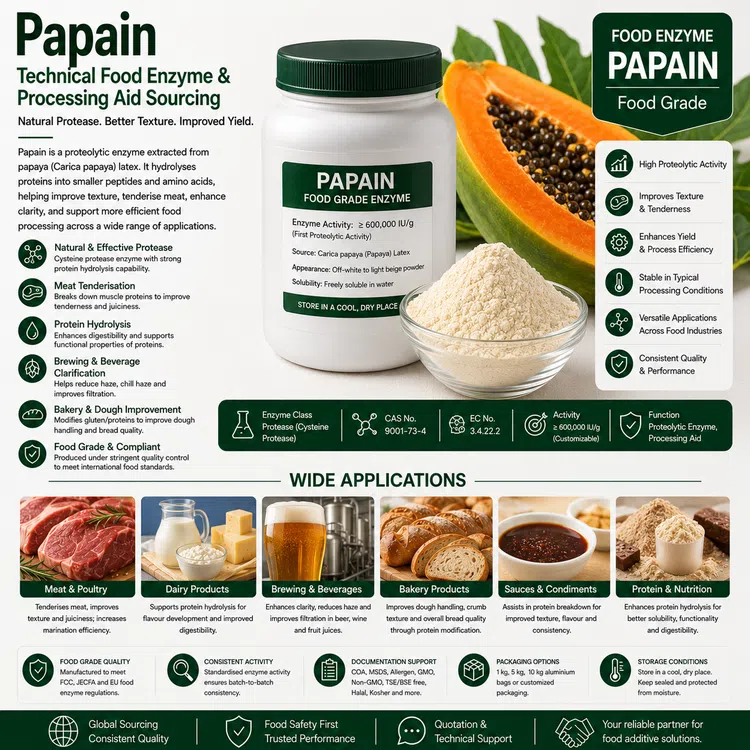
Product identity
| Product | Papain |
|---|---|
| Also known as | Papaya protease, papaya proteinase I, food-grade papain, proteolytic enzyme, cysteine protease |
| Category | Enzymes & Processing Aids |
| Primary function | Food enzyme / processing aid for protein hydrolysis, tenderizing, texture modification, clarification and process performance |
| CAS / identity | 9001-73-4; papain enzyme preparation derived from papaya latex |
| EC number | EC 3.4.22.2, subject to supplier enzyme profile and destination-market confirmation |
| Enzyme class | Cysteine endopeptidase / protease |
| Typical source | Papaya / Carica papaya latex or supplier-defined papaya enzyme preparation |
| Typical form | Enzyme powder, low-dust granulate, tablet, liquid preparation, carrier blend or application-specific enzyme formulation |
| Key purchasing basis | Activity units, assay method, pH and temperature profile, carrier, microbiology, moisture, heavy metals, origin, allergen status, storage stability and documentation |
Application fit
Potential use areas may include:
- Meat tenderizing, marinade systems, injected meat products and restructured meat applications
- Protein hydrolysates, savoury flavour bases, yeast extracts and peptide-rich ingredients
- Brewing, beer clarification and protein haze reduction where technically and legally suitable
- Bakery dough modification, gluten softening and cracker or biscuit texture adjustment
- Seafood processing, collagen-rich materials and texture modification in protein foods
- Dairy protein modification, casein or whey hydrolysis and speciality protein ingredient development
- Starch-containing foods only where protein modification is the target, not starch hydrolysis
Technical profile for manufacturers
Papain is a plant-derived protease that hydrolyses peptide bonds in proteins. In food manufacturing, this can reduce toughness, modify texture, improve extractability, reduce protein haze, create peptides, accelerate flavour development or adjust dough handling. Because enzyme action continues while the enzyme remains active, successful use requires control of dosage, distribution, pH, temperature, contact time and inactivation.
The same Papain grade can produce different results in beef, poultry, seafood, beer, dough, protein hydrolysate or dairy systems. Protein type, salt level, moisture, pH, process temperature, holding time, inhibitor presence and thermal treatment all influence the reaction. Industrial trials should therefore be performed in the actual product matrix rather than in a simplified laboratory solution only.
| Technical factor | Industrial relevance |
|---|---|
| Declared enzyme activity | Defines dosage efficiency and cost-in-use. Activity must be compared using the same assay method and unit definition. |
| Assay method | Different suppliers may use different substrates, units and analytical conditions, so activity numbers are not always directly comparable. |
| pH profile | Protease performance changes with pH. Meat, beer, dough, dairy and hydrolysate systems may require different operating conditions. |
| Temperature profile | Reaction rate increases or decreases with process temperature, and excessive heat can inactivate the enzyme. |
| Contact time | Determines extent of hydrolysis. Excess time can cause over-softening, bitterness, viscosity loss or poor texture. |
| Substrate specificity | Papain hydrolyses proteins broadly, but application results depend on meat proteins, collagen, gluten, casein, whey or other protein substrates. |
| Carrier system | Powder carriers, salts, sugars, maltodextrin or liquid stabilizers affect label declaration, solubility, dosage accuracy and allergen review. |
| Particle form | Fine powder, granulate or liquid form affects dispersion, dusting, operator exposure, dosing accuracy and mixing behaviour. |
| Enzyme inactivation | Thermal or process inactivation is often needed to stop hydrolysis and protect final texture or stability. |
| Microbiological quality | Important for ready-to-eat foods, low-heat processes, protein hydrolysates, nutrition products and sensitive formulations. |
| Occupational handling | Enzyme dust or aerosols can create sensitisation risk. Low-dust forms and appropriate handling controls may be required. |
| Regulatory status | Food enzyme treatment, processing-aid status, labelling and documentation requirements vary by destination market. |
Grade selection guide
Papain grades are commonly differentiated by activity level, physical form, carrier, solubility, dust profile, purification level, microbiological specification and application guidance. The correct grade depends on whether the target is surface tenderizing, injected marinade, protein hydrolysis, beer clarification, bakery modification or a dry blend.
| Grade family | Typical purchasing logic | Common application direction |
|---|---|---|
| Standard food-grade Papain powder | General-purpose protease activity in dry form with broad formulation flexibility. | Meat tenderizers, marinades, protein hydrolysates, bakery blends and dry processing aids. |
| High-activity Papain | Higher enzyme potency for lower dosage and concentrated processing. | Industrial protein hydrolysis, large-scale tenderizing, enzyme blends and cost-in-use optimisation. |
| Low-dust granulated Papain | Improved operator handling, reduced airborne enzyme exposure and better flow. | Meat tenderizer blends, dry premixes, seasoning plants and automated dosing systems. |
| Liquid Papain preparation | Faster incorporation into aqueous marinades, brines, hydrolysate systems and process tanks. | Injected meat systems, tumbling marinades, protein hydrolysis, brewing and liquid enzyme dosing. |
| Tablet or portioned format | Controlled dosing for small batches or specific processing lines. | Small-batch processing, foodservice, pilot production and controlled laboratory trials. |
| Deodorised or refined grade | Reduced plant odour, colour or non-enzyme impurities for sensitive products. | Neutral flavour systems, beverages, hydrolysates, dairy proteins and premium applications. |
| Customized enzyme blend | Papain combined with bromelain, ficin, neutral protease, flavour enzyme or non-protease enzymes. | Meat tenderizing, hydrolysate design, flavour generation, bakery systems and process-specific enzyme platforms. |
Functional roles in food systems
Papain can be used to produce controlled protein breakdown. The desired result may be tenderness, lower viscosity, improved extractability, reduced haze, modified dough strength or peptide generation. The risk is excessive hydrolysis, which can create mushy texture, bitterness, poor yield or inconsistent quality.
| Functional role | What Papain can support | Typical evaluation method |
|---|---|---|
| Meat tenderizing | Breaks down muscle proteins and connective tissue components to improve tenderness. | Warner-Bratzler shear force, texture profile analysis, sensory tenderness, cook yield and purge measurement. |
| Protein hydrolysis | Converts proteins into smaller peptides and amino-acid-rich fractions. | Degree of hydrolysis, soluble nitrogen, peptide profile, bitterness, viscosity and sensory panel. |
| Brewing haze control | Can reduce protein fractions associated with chill haze in selected brewing processes. | Chill haze test, turbidity, foam stability, flavour impact, filtration performance and shelf-life trial. |
| Bakery protein modification | Can soften gluten networks and modify dough handling in selected products. | Dough rheology, extensibility, machinability, bake spread, texture, volume and finished-product bite. |
| Flavour development | Generates peptides and amino acids that can support savoury flavour bases or reaction flavours. | Amino nitrogen, peptide profile, Maillard reaction performance, bitterness and flavour panel. |
| Seafood texture modification | Can adjust texture in collagen-rich or tough seafood materials when carefully dosed. | Texture profile, water retention, sensory bite, cook yield and over-softening check. |
| Dairy protein modification | May hydrolyse casein or whey proteins for specific texture, solubility or peptide-development objectives. | Degree of hydrolysis, bitterness, solubility, viscosity, heat stability and sensory profile. |
| Process efficiency | Can reduce process time or improve yield where protein breakdown is the limiting factor. | Throughput, extract yield, filtration rate, texture endpoint, enzyme cost-in-use and batch consistency. |
Application guidance by industry
Meat tenderizing and marinades
Papain is widely evaluated in meat tenderizing because it can hydrolyse proteins associated with toughness. It may be used in dry seasoning blends, surface applications, injection brines, tumbling marinades or controlled tenderizing systems.
- Key requirements: controlled activity, even distribution, no mushy texture, acceptable cook yield and validated inactivation.
- Common partners: salt, phosphates where permitted, spices, sugars, acids, antioxidants, bromelain, ficin and marinade carriers.
- Critical tests: dosage ladder, contact time, holding temperature, shear force, cook loss, purge, sensory texture and shelf-life impact.
Protein hydrolysates and savoury flavour bases
In hydrolysate production, Papain can generate peptides from animal, plant, yeast, dairy or marine proteins. The resulting flavour and functionality depend on substrate, pH, temperature, enzyme dosage and hydrolysis endpoint.
- Key requirements: controlled degree of hydrolysis, low bitterness, stable viscosity, microbial control and reproducible peptide profile.
- Common partners: neutral proteases, flavour enzymes, carbohydrases, yeast extracts, salt, acids, filtration aids and thermal inactivation.
- Critical tests: soluble nitrogen, amino nitrogen, bitterness, peptide distribution, filtration, pasteurisation and flavour-panel approval.
Brewing and beverage clarification
In brewing, Papain may be used to reduce protein haze risk in selected systems. It should be validated carefully because excessive proteolysis can affect foam, flavour, body and consumer perception.
- Key requirements: haze reduction, minimal flavour impact, stable foam, compatibility with brewing process and legal suitability.
- Common partners: silica gels, tannins, filtration aids, stabilising agents and brewery-specific clarification systems.
- Critical tests: chill haze, turbidity, foam stability, flavour, filtration rate, shelf-life haze and regulatory review.
Bakery and dough modification
In bakery, Papain can modify gluten strength and dough handling. It may be considered for crackers, biscuits, wafers, flatbreads or dough systems where reduced elasticity, improved machinability or texture adjustment is required.
- Key requirements: controlled dough relaxation, no collapse, reproducible texture and compatibility with flour quality.
- Common partners: amylase, xylanase, lipase, emulsifiers, reducing agents, oxidants, fats and dough conditioners.
- Critical tests: farinograph, extensograph, dough handling, bake spread, volume, surface checking, bite and shelf-life texture.
Seafood and collagen-rich foods
Papain can be evaluated for controlled texture modification in seafood, squid, shellfish, collagen-rich by-products and protein recovery systems. Careful dosing is essential because delicate seafood proteins can over-soften quickly.
- Key requirements: improved tenderness, limited protein loss, stable water retention and clean sensory profile.
- Common partners: salt, organic acids, phosphates where permitted, antioxidants, flavour systems and thermal inactivation steps.
- Critical tests: texture, yield, water retention, sensory bite, protein solubilisation and shelf-life quality.
Dairy and speciality protein ingredients
In dairy or nutrition systems, Papain may be used to hydrolyse proteins for texture, solubility, digestibility positioning or peptide generation. Bitterness and allergen-labelling considerations should be reviewed carefully.
- Key requirements: controlled hydrolysis, low bitterness, microbial control, heat stability and finished-product sensory acceptance.
- Common partners: casein, whey proteins, milk protein concentrates, flavour enzymes, filtration systems and pasteurisation.
- Critical tests: degree of hydrolysis, peptide profile, bitterness, solubility, viscosity, heat process and allergen declaration.
Comparison with related proteases
Papain is often compared with bromelain, ficin, microbial neutral proteases, fungal proteases and animal-derived proteases. Selection should be based on substrate, temperature, pH, flavour impact, regulatory status, cost-in-use, label expectations and process endpoint.
| Protease option | Typical distinction | Industrial relevance |
|---|---|---|
| Papain | Plant-derived cysteine protease from papaya, broadly used for meat tenderizing and protein hydrolysis. | Useful where papaya-derived enzyme positioning and broad proteolytic action are acceptable. |
| Bromelain | Plant protease from pineapple with strong protein-hydrolysis and tenderizing applications. | Often compared with Papain for meat tenderizing, hydrolysates and digestive-positioned products. |
| Ficin | Plant protease from fig latex with different substrate behaviour and market availability. | Used in some tenderizing and protein-processing systems where available and permitted. |
| Microbial neutral protease | Protease produced by microbial fermentation, often available with defined activity and controlled processing profile. | Useful for protein hydrolysates, flavour systems, bakery and industrial processes needing fermentation-derived enzymes. |
| Fungal protease | Often active under different pH conditions depending on source and grade. | Useful in bakery, brewing, protein hydrolysis and flavour systems depending on activity profile. |
| Animal-derived proteases | May include enzymes such as pepsin or trypsin, with specific pH and substrate behaviour. | Require careful review for halal, kosher, vegetarian, allergen and label requirements. |
Specification checklist for purchasing
For industrial sourcing, Papain quotations should be compared by activity, assay method, application performance, carrier, handling safety, microbiology and documentation. A lower-priced enzyme may not be economical if its activity is weak, assay is not comparable, dust profile is unsafe, microbiological quality is unsuitable or hydrolysis results are inconsistent.
| Specification area | Recommended buyer requirement |
|---|---|
| Enzyme identity | Confirm Papain, CAS 9001-73-4, EC 3.4.22.2 where applicable, source and food-grade status. |
| Activity units | Request declared activity, unit definition, substrate, pH, temperature and analytical method. |
| Activity tolerance | Confirm minimum activity, target activity, batch-to-batch tolerance and shelf-life activity guarantee. |
| pH and temperature profile | Request supplier guidance for optimum operating range and inactivation conditions for the intended application. |
| Carrier system | Confirm maltodextrin, salt, sugar, starch, glycerol, water, stabilizers or other carriers for label and allergen review. |
| Physical form | Powder, granule, tablet or liquid form should match dosing equipment, dust control, solubility and process needs. |
| Moisture / water activity | Important for shelf life, activity stability, caking and microbial control. |
| Solubility / dispersibility | Relevant for brines, marinades, hydrolysate tanks, brewing additions and liquid processing. |
| Microbiology | Total plate count, yeast and mold, coliforms, E. coli, Salmonella and application-specific limits. |
| Contaminants | Request heavy metals, pesticide residues, mycotoxins where relevant and other destination-market contaminant statements. |
| Origin and source | Confirm papaya source, country of origin, manufacturing site and traceability information. |
| Allergen and dietary declarations | Request allergen statement, carrier allergen status, GMO statement, gluten statement, vegan / vegetarian statement, halal and kosher certificates where required. |
| Occupational safety | Request SDS, dust-control guidance, sensitisation warning, PPE recommendations and low-dust grade options where needed. |
| Packaging and shelf life | Bag, drum, bottle, carton, liner, net weight, pallet configuration, shelf life, storage temperature and retest policy. |
Processing and dosage guidance
Papain performance is controlled by enzyme activity, dosage, distribution, pH, temperature and reaction time. In most industrial applications, the enzyme should be distributed uniformly before the reaction period begins. The process should also define how and when the enzyme activity is stopped or reduced to avoid over-processing.
Recommended trial protocol
- Define the process objective: tenderizing, haze reduction, protein hydrolysis, dough relaxation, flavour generation or texture modification.
- Select candidate grades based on activity unit, physical form, carrier, pH profile, temperature profile and documentation.
- Prepare a control batch without Papain and a dosage ladder using the supplier's recommended starting range.
- Control contact time, product temperature, pH, mixing intensity and distribution method.
- Measure texture, hydrolysis, turbidity, viscosity, flavour, yield or application-specific performance.
- Validate inactivation or process endpoint to prevent continued proteolysis.
- Run pilot-scale trials using real equipment, batch size, storage conditions and packaging.
- Confirm regulatory status, label treatment and documentation before commercial order.
Common process issues
- Over-tenderized or mushy meat due to excessive dosage or long holding time
- Uneven texture from poor enzyme distribution in marinade or dry rub
- Bitterness in hydrolysates caused by uncontrolled peptide formation
- Loss of beer foam or body if protein breakdown is excessive
- Dough collapse or excessive softness from over-modified gluten
- Reduced activity caused by poor storage, expired enzyme or heat exposure
- Batch variation caused by comparing enzyme activity units from different assay methods
- Operator exposure risk from dusty enzyme powders
- Regulatory mismatch between enzyme, processing-aid status and destination-market labelling rules
Food safety, handling and enzyme inactivation considerations
Food enzymes require both food-safety review and occupational-safety review. Papain preparations should be handled according to the supplier SDS and plant safety program. Enzyme dust or aerosols should be controlled through low-dust grades, closed handling, local exhaust ventilation, PPE and staff training where required.
| Control area | Buyer action |
|---|---|
| Enzyme endpoint | Define the reaction endpoint by time, temperature, pH, degree of hydrolysis, texture or haze target. |
| Inactivation step | Request supplier guidance for thermal or process inactivation and validate in the final matrix. |
| Microbial control | Review microbiological specification and final product process, especially in low-heat or ready-to-eat foods. |
| Dust control | Choose granulated or liquid forms where possible and follow SDS precautions for enzyme sensitisation risk. |
| Cross-contact | Confirm carrier ingredients, allergens, gluten, soy, milk, sulfites or other cross-contact risks. |
| Labelling | Verify whether the enzyme is treated as a processing aid or must be declared in the destination market. |
| Claims | Do not assume digestibility, tenderizing or processing claims are permitted without local review and substantiation. |
Regulatory, label and positioning considerations
Papain may be regulated as a food enzyme, processing aid, additive or ingredient depending on jurisdiction, use, residual activity and finished-product labelling rules. Some markets may require enzyme-source disclosure, processing-aid review, allergen review, safety assessment or import documentation. Buyers should confirm the correct local classification before commercial use.
| Regulatory question | Buyer action |
|---|---|
| How should Papain be declared? | Request supplier label guidance and verify whether local rules require “papain,” “enzyme,” “protease,” “processing aid” or no finished-label declaration. |
| Is Papain an additive or processing aid? | Classification depends on destination-market law, technical function, residual activity and final-product use. |
| Is it suitable for vegetarian or vegan products? | Papain is plant-derived, but supplier declaration is still required for carriers, processing aids and cross-contact controls. |
| Are halal or kosher certificates required? | Certification must match the exact enzyme grade, carrier system, manufacturing site and supply chain. |
| Are allergen declarations needed? | Review enzyme source, carrier ingredients and cross-contact statements. Also evaluate occupational enzyme-sensitisation controls. |
| Can enzyme claims be made? | Claims such as “tenderized,” “enzyme processed,” “improved digestibility” or “hydrolysed protein” require market-specific label review. |
| Are import documents needed? | Some markets require enzyme origin, manufacturing process, safety statements, GMO status or microbial production declarations. |
Quality, safety and compliance documents to request
- Product specification or technical data sheet with exact enzyme identity and activity unit
- Certificate of analysis for available batch or representative lot
- Safety data sheet with handling, dust-control and sensitisation guidance
- Food-grade declaration and destination-market compliance statement
- CAS / identity statement and EC number where applicable
- Enzyme activity method, substrate, pH, temperature and unit definition
- Recommended dosage range, pH profile, temperature profile and inactivation guidance
- Carrier declaration for powder, granule, tablet or liquid preparation
- Origin statement, papaya source declaration and traceability information
- Allergen statement, cross-contact statement, GMO statement, gluten statement and vegan / vegetarian statement where required
- Halal, kosher, organic suitability or other certificates when required
- Microbiological specification and lot-specific microbiological results
- Heavy metals, pesticide residues, mycotoxins and other contaminant declarations where required
- Shelf-life statement, storage conditions and retest policy
- Packaging specification, net weight, pallet configuration and container loading information
- Application guidance for meat, brewing, bakery, hydrolysis or protein-processing use where available
Packaging, storage and handling
Papain may be supplied as powder, granulate, tablet or liquid preparation in bags, foil pouches, jars, bottles, drums or cartons depending on grade and supplier. Enzyme activity can decline with heat, moisture, poor sealing and long storage. Dry enzyme powders should be protected from humidity and handled with dust controls. Liquid enzyme preparations may require specific temperature limits and preservative review.
| Common packaging | Typical options may include 1 kg, 5 kg, 10 kg, 20 kg or 25 kg packs, foil pouches, jars, bottles, drums or cartons depending on form and supplier. |
|---|---|
| Storage conditions | Store sealed in a cool, dry, clean and odour-free warehouse. Follow supplier recommendations for temperature, humidity and shelf life. |
| Moisture control | Protect dry enzyme preparations from humidity to reduce caking, activity loss and poor flow. |
| Temperature control | Avoid high heat and temperature abuse because enzyme activity may decline. Refrigerated storage may be required for some liquid preparations. |
| Dust control | Use low-dust forms, local exhaust ventilation, closed handling and PPE according to the SDS and plant safety program. |
| Dosing control | Use calibrated scales or metering systems because small dosage changes can significantly affect hydrolysis and texture. |
| Shelf life | Supplier-specific. Request shelf-life statement, activity guarantee, storage conditions and retest policy before order confirmation. |
| Logistics | Confirm HS code, country of origin, temperature sensitivity, pallet configuration, import documents and destination enzyme regulations. |
Technical purchasing notes
When reviewing Papain, compare the supplier specification against the intended food application, process conditions, target function, label expectations and local rules. For industrial purchasing, the most useful inquiry normally includes enzyme activity, assay method, target application, process pH, process temperature, contact time, physical form, packaging size, quantity, destination and document requirements.
Cost comparison should be based on activity-adjusted cost-in-use and validated application performance rather than price per kilogram alone. A higher-activity or low-dust grade may be more economical if it reduces dosage, improves consistency, lowers occupational exposure, reduces process time and avoids over-processing defects. A cheaper enzyme may become costly if activity is inconsistent, assay methods are unclear or documentation is incomplete.
How to request this product
Send the product name, target enzyme activity, assay method if known, application, process conditions, quantity, destination country, packaging preference, expected shipment date and required documents. If you already purchase Papain, attach or describe your existing specification, certificate of analysis, activity unit, dosage level, process temperature, pH, contact time, label declaration or trial result so supplier options can be compared more accurately.
Recommended RFQ information
- Product name: Papain / Food Grade Papain / Papaya Protease
- Required function: meat tenderizing, protein hydrolysis, brewing haze control, dough modification, flavour development, seafood texture modification or protein-processing aid
- Preferred form: powder, low-dust granule, tablet, liquid preparation, carrier blend or customized enzyme blend
- Application: meat, poultry, seafood, hydrolysate, bakery, brewing, dairy protein, plant protein, savoury flavour base or other use
- Activity requirement: activity units, assay method, minimum activity, target activity and acceptable tolerance
- Process conditions: pH, temperature, contact time, salt level, mixing method, heat treatment, inactivation step and batch size
- Performance target: tenderness, degree of hydrolysis, haze reduction, dough relaxation, peptide profile, flavour development, yield or texture endpoint
- Quality requirements: microbiology, heavy metals, pesticide residues, origin, carrier declaration, allergen, GMO, halal, kosher, vegan / vegetarian or gluten status
- Handling requirements: low-dust form, SDS, PPE guidance, enzyme sensitisation controls, storage temperature and shelf-life activity guarantee
- Regulatory requirement: food enzyme status, processing-aid confirmation, destination-market compliance, label declaration and import documents
- Quantity: sample quantity, first commercial order and annual forecast
- Destination: country, port, incoterm and required import documents
- Packaging: pouch, bag, jar, bottle, drum, carton, pallet format or warehouse handling preference
- Documentation: TDS, COA, SDS, food-grade declaration, enzyme activity method, regulatory statement, origin, microbiology, contaminant declarations, shelf life and packaging details
- Commercial requirement: target price basis, shipment date, payment term and preferred delivery schedule
Useful answers
What is Papain used for in food manufacturing?
Papain is used for protein hydrolysis, meat tenderizing, texture modification, brewing haze control, bakery protein modification, flavour development and selected protein-processing applications. Exact suitability depends on enzyme activity, dosage, pH, temperature, contact time, process controls, regulations and supplier documents.
Is Papain a starch-processing enzyme?
No. Papain is a protease, so it acts on proteins and peptides rather than starch. It may be used in starch-containing foods only when protein modification is the target. For starch hydrolysis, buyers normally evaluate amylases or related starch enzymes.
Can Papain over-tenderize meat?
Yes. Excess dosage, long holding time, warm storage or uneven distribution can cause excessive protein breakdown and soft or mushy texture. Industrial use should be controlled by validated dosage, contact time, temperature and inactivation conditions.
Which grade should I request?
The correct grade depends on application and process. Buyers should request enzyme activity, assay method, pH and temperature profile, physical form, carrier system, dust profile, microbiological limits, heavy metal limits, origin, storage conditions and destination-market documentation.
Can Global Food Additives source Papain?
Global Food Additives can review sourcing options for Papain according to target enzyme activity, grade, application, process conditions, quantity, destination, packaging and required documentation.
Which documents should be requested?
Buyers commonly request a technical data sheet, enzyme activity specification, certificate of analysis, safety data sheet, food-grade declaration, enzyme origin statement, carrier declaration, allergen statement, GMO statement, microbiological limits, shelf-life information, label recommendation and packaging details.
Is this product permitted in every country?
No. Food enzyme permissions, processing-aid treatment, labelling, use level, occupational handling requirements and import documentation depend on destination-market rules and buyer responsibility. Buyers should verify regulatory status and final suitability before commercial use.
Tell us which food additive or ingredient you need.
Send product names, target specifications, quantity, destination country, packaging preference, delivery term, and document requirements. Our team will review your inquiry and respond from orders@foodgradeadditives.com.
Your message has been received. You will be redirected to the home page.