
Pea Protein Isolate
Pea Protein Isolate is a food-grade plant protein ingredient used for protein enrichment, plant-based meat formulation, dairy alternative development, water binding, gelation, emulsification, foaming, texture design and clean-label plant protein positioning. It is commonly produced from yellow peas and supplied as a high-protein powder for industrial food and nutrition applications.
Pea Protein Isolate is not a single universal commodity. Commercial grades vary by protein content, extraction method, solubility, flavor, color, particle size, heat treatment, viscosity, gel strength, water-holding capacity, emulsification performance, microbiology, origin and certification profile. Industrial buyers should define the intended application and processing conditions before comparing quotations.
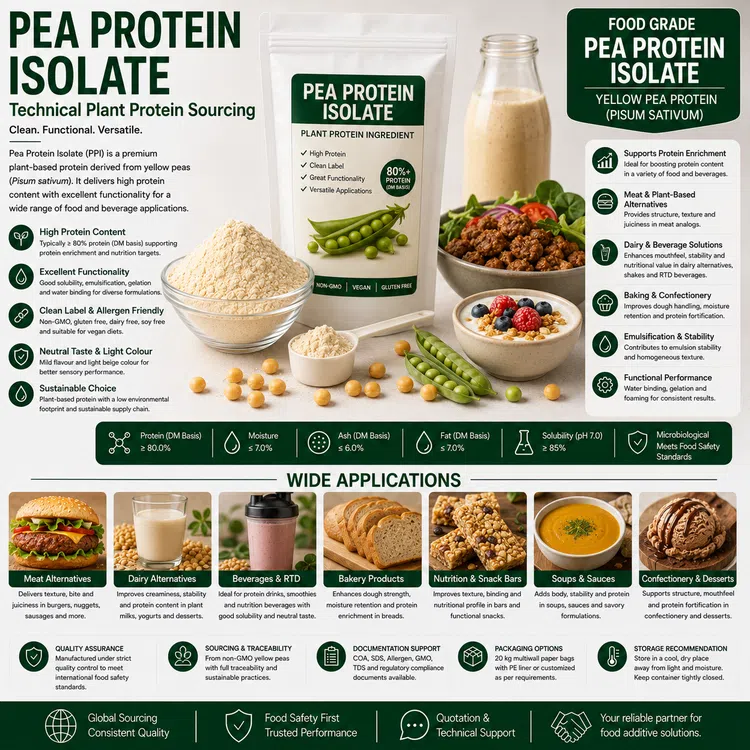
Product identity
| Product | Pea Protein Isolate |
|---|---|
| Common abbreviation | PPI |
| Category | Proteins, Texturizers & Functional Ingredients |
| Primary function | Plant protein ingredient for protein enrichment, texture building, water binding, gelation, emulsification, foaming and nutrition formulation |
| Typical botanical source | Yellow pea / Pisum sativum, depending on supplier origin and crop program |
| Typical protein range | Often specified around 80% to 90% protein, depending on supplier, method and dry-basis calculation |
| E / INS number | Normally handled as a plant protein ingredient rather than a universal E-number additive; confirm by destination market and supplier documentation |
| CAS / identity | Plant protein isolate; exact identity is supplier- and source-specific |
| Typical form | Fine powder, agglomerated instant powder, low-flavor grade, high-solubility grade, texturizing grade or customized dry blend |
| Key purchasing basis | Protein on dry basis, solubility, flavor, color, particle size, water-holding capacity, gel strength, emulsification, microbiology, origin and documentation |
Application fit
Potential use areas may include:
- Plant-based burgers, nuggets, sausages, patties, mince and formed foods
- High-protein beverages, powdered shakes, meal replacements and sports nutrition
- Dairy alternatives, plant-based yogurts, desserts, creamers and frozen products
- Bakery, gluten-free products, high-protein bread, snacks and bars
- Soups, sauces, dressings, fillings, emulsions and savory systems
- Hybrid meat products, processed meats and protein-enriched prepared foods
- Clean-label, vegan, vegetarian, soy-free or dairy-free product platforms where supplier documentation supports the claim
Technical profile for manufacturers
Pea Protein Isolate is a concentrated plant protein ingredient typically obtained by separating protein from pea starch, fiber and other non-protein components. In industrial sourcing, isolates are usually selected when the target is higher protein density, cleaner nutrition labeling and stronger functional performance than pea flour or lower-protein concentrates.
The main functional protein fractions in peas include storage proteins such as globulins and smaller albumin fractions. These proteins can contribute water binding, emulsification, foaming, gelation, viscosity and texture, but their performance depends on extraction conditions, heat history, pH, ionic strength and interaction with other formulation components. This is why two pea protein isolates with similar protein content may behave differently in a beverage, burger, bar or bakery system.
| Technical factor | Industrial relevance |
|---|---|
| Protein content | Defines nutrition contribution, cost-in-use and dosage. Confirm whether protein is reported as-is or on dry basis. |
| Solubility | Critical for beverages, powders, sauces and nutrition systems. Low solubility can cause sediment, chalkiness or processing instability. |
| Water-holding capacity | Important for plant-based meat, bakery, fillings and formed foods where juiciness, yield and texture must be controlled. |
| Emulsification | Supports stabilization of oil-water systems in meat alternatives, sauces, creamers, dressings and beverages. |
| Gelation | Provides structure in heat-processed plant protein systems, formed foods, gels, snacks and high-protein products. |
| Foaming | Relevant for bakery, whipped toppings, aerated desserts and egg-replacement style applications. |
| Particle size | Affects mouthfeel, dispersion, dusting, hydration speed, blend uniformity and powder flow. |
| Flavor profile | Pea protein can carry beany, earthy, green, bitter or astringent notes. Low-flavor grades may be needed for neutral applications. |
| Color | Light color is important for beverages, dairy alternatives, bakery and neutral nutrition powders. Darker grades may be acceptable in savory or chocolate systems. |
| Heat stability | Important for pasteurization, UHT, retort, baking, extrusion and thermal meat-alternative processes. |
| Regulatory and claim profile | Vegan, non-GMO, allergen-friendly, organic, protein, gluten-free and clean-label claims require supplier documents and local regulatory review. |
Grade selection guide
Pea Protein Isolate grades are often differentiated by protein level, flavor, solubility, particle size, heat treatment, functional performance and certification package. Selecting the right grade improves production consistency and reduces reformulation risk.
| Grade family | Typical purchasing logic | Common application direction |
|---|---|---|
| Standard Pea Protein Isolate | General protein enrichment and broad food application use. | Bakery, snacks, bars, powdered blends, meat alternatives and general plant protein systems. |
| High-solubility grade | Improved dispersion and reduced sediment in liquid systems. | Beverages, RTD shakes, plant-based dairy alternatives, soups, sauces and nutritional drinks. |
| Low-flavor / neutral grade | Reduced beany, green, bitter or earthy notes. | Vanilla beverages, dairy alternatives, neutral nutrition powders, bakery, desserts and premium products. |
| Texturizing or high-gel grade | Stronger structure, water binding and thermal gel performance. | Plant-based meat, formed foods, hybrid meat systems, nuggets, patties and extrusion platforms. |
| Instantized / agglomerated grade | Better wetting and easier dispersion in powders and shaker-style products. | Sports nutrition, drink powders, sachets, meal replacements and instant beverage mixes. |
| Fine particle grade | Smoother mouthfeel and improved dispersion where grittiness must be minimized. | Beverages, desserts, sauces, creams, bars and high-protein finished foods. |
| Organic or non-GMO certified grade | Supports specific label positioning and retailer requirements. | Organic nutrition products, clean-label foods, export markets and premium plant-based applications. |
| Customized plant protein blend | Balanced amino acid profile, flavor, texture or cost-in-use through blending. | Pea-rice blends, pea-fava blends, pea-soy blends, meat alternatives, nutrition powders and bars. |
Functional roles in food systems
Pea Protein Isolate is selected not only for protein content but also for its ability to build structure, bind water, stabilize fat, improve mouthfeel and support plant-based positioning. Performance should be measured in the finished product, because lab protein percentage does not predict full application behavior.
| Functional role | What Pea Protein Isolate can support | Typical evaluation method |
|---|---|---|
| Protein enrichment | Raises protein content in powders, beverages, bars, bakery, snacks and prepared foods. | Protein assay, nutrition calculation, serving claim review and sensory evaluation. |
| Water binding | Improves yield, juiciness, reduced purge and moisture control in plant-based meat and bakery systems. | Water-holding capacity, cook yield, purge test, syneresis test and shelf-life texture review. |
| Gelation | Supports structure in heat-treated, extruded, formed or set products. | Gel strength, texture profile analysis, heating curve, bite testing and processing trial. |
| Emulsification | Helps stabilize oil droplets in sauces, creamers, dressings, meat alternatives and high-fat systems. | Droplet size, creaming, oil loss, heat stability, viscosity and storage trial. |
| Foaming | Supports air incorporation in selected bakery, whipped and aerated systems. | Foam overrun, foam stability, batter density, cake volume and cell structure. |
| Texture building | Contributes bite, firmness, chew, opacity, body and structure. | Texture analyzer, rheology, sensory panel, compression test and benchmark comparison. |
| Fat binding | Can help retain oils in plant-based meat and savory systems when combined with the right hydrocolloid and emulsifier system. | Cook loss, oiling-off, centrifuge test, microscopy and reheating behavior. |
| Clean-label positioning | Supports vegan, vegetarian, dairy-free and plant-protein claims where full documentation and formula controls support the claim. | Label review, supplier declarations, cross-contact verification and destination-market compliance check. |
Application guidance by industry
Plant-based meat and formed foods
In plant-based meat systems, Pea Protein Isolate can provide protein, water binding, emulsification, structure and bite. It is often used with texturized vegetable proteins, methylcellulose, starches, fibers, oils, flavors and colors to build a complete meat-alternative matrix.
- Key requirements: water binding, gel strength, fat retention, bite, juiciness, low beany flavor and freeze-thaw stability.
- Common partners: methylcellulose, pea fiber, starch, soy protein, wheat gluten, sunflower oil, coconut oil, canola oil, flavors and color systems.
- Critical tests: cook yield, purge, oil loss, compression, bite, juiciness, grilling behavior, reheating stability and sensory profile.
High-protein beverages and RTD shakes
In beverages, Pea Protein Isolate can support plant-protein claims and dairy-free positioning. The main technical challenges are solubility, sediment, chalky mouthfeel, flavor masking, viscosity drift, heat stability and mineral interaction.
- Key requirements: high solubility, low sediment, low grittiness, neutral flavor, heat stability and controlled viscosity.
- Common partners: stabilizers, pectin, cellulose gum, carrageenan, flavors, sweeteners, buffers, minerals and emulsifiers.
- Critical tests: sediment, centrifuge stability, heat process trial, pH stability, mouthfeel, viscosity over shelf life and flavor stability.
Dairy alternatives and plant-based desserts
In dairy alternative products, Pea Protein Isolate can contribute protein, opacity, body and nutritional positioning. It should be tested carefully with fats, stabilizers, calcium salts, acids, flavors and thermal processes to avoid sediment, astringency or graininess.
- Key requirements: smooth texture, low beany notes, stable suspension, clean aftertaste, good opacity and heat compatibility.
- Common partners: oat base, almond base, coconut fat, sunflower oil, pectin, gellan gum, carrageenan, flavors, vitamins and minerals.
- Critical tests: stability, sediment, phase separation, pH, heat stability, sensory profile and refrigerated or ambient shelf life.
Sports nutrition and powdered blends
In protein powders and meal replacements, Pea Protein Isolate provides plant protein density and vegan positioning. Instantized grades can improve wetting and reduce clumping, while low-flavor grades can improve consumer acceptance.
- Key requirements: protein content, dispersibility, low dust, low grittiness, flavor compatibility and good powder flow.
- Common partners: rice protein, sweeteners, cocoa, flavors, vitamins, minerals, lecithin, fibers and anti-caking systems.
- Critical tests: wettability, dispersibility, shaker-cup sediment, flowability, bulk density, caking, flavor and protein claim compliance.
Bakery, snacks and protein bars
Pea Protein Isolate can improve protein content in bakery, bars, extruded snacks and fillings. It can affect dough hydration, browning, texture, dryness and flavor, so water, fat, fiber and sweetener systems often need adjustment.
- Key requirements: protein enrichment, controlled dryness, acceptable bite, low grittiness, flavor balance and stable texture over shelf life.
- Common partners: wheat flour, gluten-free flours, starches, fibers, syrups, fats, emulsifiers, cocoa, flavors and humectants.
- Critical tests: dough handling, bake volume, water activity, bar hardening, extrusion expansion, texture and sensory profile.
Sauces, soups, dressings and emulsions
In savory systems, Pea Protein Isolate can contribute body, opacity, emulsification and protein enrichment. Its flavor profile may be easier to manage in savory applications than in neutral beverages, but pH, salt and heat must still be validated.
- Key requirements: emulsification, viscosity, low sediment, clean savory flavor, heat stability and storage stability.
- Common partners: starches, xanthan gum, oils, emulsifiers, yeast extracts, flavors, acids, salts and spice systems.
- Critical tests: emulsion stability, viscosity, heat process, phase separation, sediment, flavor release and shelf-life texture.
Comparison with related plant proteins
Pea Protein Isolate is often compared with soy, rice, fava bean, wheat, chickpea and potato proteins. No plant protein is universally superior; the best choice depends on nutrition, allergen profile, flavor, texture, cost, process performance and label strategy.
| Protein ingredient | Typical distinction | Industrial relevance |
|---|---|---|
| Pea Protein Isolate | High-protein plant isolate with broad use in meat alternatives, dairy alternatives and nutrition powders. | Useful where soy-free, dairy-free or vegan positioning is desired, subject to supplier documentation. |
| Soy Protein Isolate | Strong functionality and established use in meat, beverages and emulsified systems, but soy allergen labeling may apply. | Often compared for cost, texture, gelation and emulsification performance. |
| Rice Protein | Often used in blends to balance amino acid profile and allergen positioning. | Useful in plant protein blends, powders and bars, but may have gritty texture if not optimized. |
| Fava Bean Protein | Emerging pulse protein with functional and sustainability appeal. | Can be blended with pea protein for plant-based meat and dairy alternative systems. |
| Wheat Gluten | Strong elastic texture and chew, but gluten labeling applies. | Useful in meat alternatives and bakery, but not suitable for gluten-free claims. |
| Chickpea Protein | Pulse protein with mild taste potential and emulsification functionality depending on grade. | Used in plant-based applications where alternative pulse sources are desired. |
| Potato Protein | High functionality in some foaming and gelation applications, often with distinctive flavor considerations. | Useful in specialty blends, foaming systems and protein functionality optimization. |
Specification checklist for purchasing
For industrial sourcing, Pea Protein Isolate quotations should be compared by composition, functionality, sensory quality, microbiology and documentation. A lower price per kilogram may not be economical if the grade creates strong off-flavor, poor hydration, unstable beverages, weak texture or missing claim documentation.
| Specification area | Recommended buyer requirement |
|---|---|
| Protein content | Request protein percentage, dry-basis calculation, nitrogen conversion factor, analytical method and tolerance. |
| Moisture | Important for shelf life, caking, microbial stability, flowability and commercial comparison. |
| Fat | Affects flavor stability, oxidation risk, nutrition labeling and mouthfeel. |
| Ash / minerals | Relevant for flavor, pH behavior, heat stability, nutrition labeling and beverage compatibility. |
| Carbohydrate / fiber | Important for nutrition labeling, texture, digestive tolerance and clean-label positioning. |
| pH | Useful for protein stability, beverage design, emulsion performance and compatibility with acidic or neutral systems. |
| Particle size | Controls mouthfeel, dusting, dispersion, sedimentation, powder flow and blend uniformity. |
| Solubility / dispersibility | Critical for beverages, powders, sauces and nutrition systems. Request method and application-specific guidance. |
| Water-holding capacity | Important for plant-based meats, bakery, fillings and formed foods. |
| Gelation and texture data | Request gel strength, thermal behavior or application trial data where plant-based meat or structured foods are targeted. |
| Emulsification data | Important for sauces, dressings, creamers and fat-containing foods. |
| Flavor and color | Request sensory description, color values and low-flavor grade options for neutral applications. |
| Microbiology | Total plate count, yeast and mold, coliforms, E. coli, Salmonella, Bacillus spores and application-specific limits. |
| Contaminants | Heavy metals, pesticide residues, mycotoxins where relevant and other destination-market contaminant statements. |
| Anti-nutrients | Request phytic acid, trypsin inhibitor or saponin information where required by the buyer or application. |
| Allergen and claim status | Request allergen statement, pea cross-contact information, gluten status, soy-free statement, dairy-free statement, vegan / vegetarian statement and non-GMO declaration where required. |
| Certifications | Halal, kosher, organic, non-GMO, ISO, FSSC 22000, BRCGS or other certificates depending on buyer and market. |
| Packaging and shelf life | Bag type, liner, net weight, pallet configuration, shelf life, storage conditions and moisture protection. |
Hydration and processing guidance
Pea Protein Isolate requires controlled hydration for best performance. Poor dispersion can create lumps, grittiness, sediment, excessive viscosity or weak structure. The correct method depends on grade, particle size, pH, salt level, shear, temperature, fat level and process order.
Recommended trial protocol
- Define the target function: protein enrichment, beverage stability, meat-alternative bite, water binding, gelation, emulsification or powder dispersibility.
- Select candidate grades based on protein content, solubility, flavor, color, particle size and application guidance.
- Prepare a benchmark formula with the current protein or control system.
- Hydrate pea protein using the supplier's recommended water temperature, shear and holding time.
- Test several dosage levels in the full formula, including salt, fat, starch, hydrocolloids, acids and flavors.
- Apply the real process: mixing, homogenization, heating, extrusion, forming, frying, baking, freezing or UHT processing.
- Measure application-specific results such as sediment, viscosity, cook yield, bite, oil loss, bar hardening, flavor and shelf-life stability.
- Confirm regulatory status, label declaration, allergen positioning and documentation before commercial order.
Common processing issues
- Beany, earthy, green or bitter flavor in neutral applications
- Chalky or gritty mouthfeel from unsuitable particle size or poor hydration
- Sediment in beverages due to low solubility or poor stabilizer design
- Excess viscosity in high-protein formulas
- Weak gel or poor bite in plant-based meat because the grade does not match the process
- Dryness in bars or bakery because water and humectant systems are not adjusted
- Oil loss in meat alternatives due to weak protein-hydrocolloid-emulsifier balance
- Flavor instability from oxidation, storage age or incompatible flavor systems
- Regulatory mismatch between claim language and destination-market requirements
Formulation partners and synergies
Pea Protein Isolate is frequently used with hydrocolloids, starches, fibers, oils, emulsifiers and other proteins. These combinations can improve texture, juiciness, stability, flavor masking and amino acid balance.
| Partner ingredient | Industrial purpose |
|---|---|
| Methylcellulose | Provides hot-set binding and shape retention in plant-based meat while pea protein contributes protein and structure. |
| Pea fiber | Improves water binding, bite, fiber content and texture in meat alternatives and bakery. |
| Starches and modified starches | Support viscosity, water binding, freeze-thaw stability, gel structure and texture in sauces, fillings and formed foods. |
| Xanthan gum, gellan gum or cellulose gum | Support suspension, viscosity and sediment control in beverages and sauces. |
| Rice protein | Common blend partner for balancing amino acid profile and improving plant protein positioning. |
| Fava or chickpea protein | Pulse protein partners that may modify flavor, texture, nutrition and cost-in-use. |
| Vegetable oils and structured fats | Provide juiciness and mouthfeel in meat alternatives and dairy alternatives. |
| Emulsifiers | Improve fat dispersion, emulsion stability and mouthfeel in sauces, beverages and meat alternatives. |
| Flavor systems and masking agents | Reduce beany, earthy, bitter or astringent notes and improve consumer acceptance. |
Regulatory, allergen and labeling considerations
Pea Protein Isolate is often used in vegan, vegetarian, dairy-free, soy-free, gluten-free and non-GMO product development, but final claims depend on the exact supplier declaration, processing aids, manufacturing site, cross-contact controls, formulation and destination-market rules. Pea is not always regulated like the major allergens in every jurisdiction, but pea sensitivity and cross-contact concerns should still be evaluated carefully.
| Regulatory question | Buyer action |
|---|---|
| How should it be declared? | Request supplier label recommendation and verify whether local rules require “pea protein isolate,” “pea protein,” “plant protein” or another accepted declaration. |
| Can vegan or dairy-free claims be made? | Only when supplier declarations, processing aids, cross-contact controls and full formula review support the claim. |
| Can soy-free or gluten-free claims be made? | Claims require supplier statements, cross-contact controls and local threshold review. |
| Can protein claims be made? | Protein claims depend on finished-product protein content, serving size, protein quality method and destination-market nutrition rules. |
| Are allergen statements needed? | Request allergen and cross-contact statements. Pea allergen labeling requirements vary, but customer and retailer policies may be stricter than law. |
| Is novel food review required? | Some markets may treat certain plant protein ingredients, processing methods or claims differently. Confirm local requirements before launch. |
| Are halal or kosher certificates needed? | Certification must match the exact grade, manufacturing site and supply chain. |
Quality, safety and compliance documents to request
- Product specification or technical data sheet with protein content and application guidance
- Certificate of analysis for available batch or representative lot
- Food-grade declaration and destination-market compliance statement
- Safety data sheet where applicable for handling, storage and transport review
- Nutrition data including protein, carbohydrate, fat, ash, moisture, fiber and energy values
- Amino acid profile and protein quality information where required
- Allergen statement, cross-contact statement and pea source declaration
- Non-GMO statement, gluten statement, soy-free statement, dairy-free statement and vegan / vegetarian statement where required
- Country of origin, crop origin, manufacturing site information and traceability documentation
- Microbiological specification and lot-specific microbiological results
- Heavy metals, pesticide residues, mycotoxins and other contaminant declarations where required
- Anti-nutritional factor information where required by customer or application
- Halal, kosher, organic, FSSC 22000, BRCGS, ISO or other certificates when required
- Solubility, particle size, water-holding capacity, gelation or emulsification data where relevant
- Shelf-life statement, storage conditions and retest policy
- Packaging details, net weight, gross weight, pallet configuration and container loading information
- Recommended label declaration and application-specific processing guidance
Packaging, storage and handling
Pea Protein Isolate is normally supplied as a dry powder in food-grade multiwall bags with inner liners, cartons, drums or big bags depending on supplier and volume. Because plant proteins can absorb moisture and odors, warehouse control is important for maintaining flowability, flavor, microbiological quality and shelf life.
| Common packaging | Typically 20 kg or 25 kg bags; smaller packs, cartons, drums or big bags may be available depending on grade and supplier. |
|---|---|
| Storage conditions | Store sealed in a cool, dry, clean and odor-free warehouse. Follow supplier recommendations for temperature and relative humidity. |
| Moisture control | Protect from humidity to reduce caking, lumping, microbial risk, poor flow and reduced dispersibility. |
| Odor control | Keep away from spices, solvents, chemicals and strongly aromatic materials because powders can absorb odors. |
| Dust control | Use appropriate powder-handling practices, local exhaust ventilation where required and protective measures stated in the SDS. |
| Shelf life | Supplier-specific. Request shelf-life statement, retest policy and storage condition limits before order confirmation. |
| Handling | Use hygienic powder handling, calibrated dosing and segregation controls for allergen or claim-sensitive production. |
| Logistics | Confirm HS code, origin, pallet configuration, container loading, humidity protection and destination import requirements. |
Technical purchasing notes
When reviewing Pea Protein Isolate, compare the supplier specification against the intended food application, process conditions, target protein level, label expectations and local rules. For industrial purchasing, the most useful inquiry normally includes target protein content, application, processing method, solubility requirement, flavor requirement, packaging size, quantity, destination and document requirements.
Cost comparison should be based on cost-in-use and finished-product performance rather than price per kilogram alone. A higher-priced grade may be more economical if it improves flavor, reduces sediment, supports stronger texture, improves beverage stability, reduces bar hardening, improves plant-based meat yield or avoids reformulation delays.
How to request this product
Send the product name, target protein percentage, application, target function, quantity, destination country, packaging preference, expected shipment date and required documents. If you already purchase Pea Protein Isolate, attach or describe your existing specification, certificate of analysis, nutrition target, label declaration, hydration method, processing conditions or trial result so supplier options can be compared more accurately.
Recommended RFQ information
- Product name: Pea Protein Isolate / PPI / Yellow Pea Protein Isolate
- Required function: protein enrichment, plant-based meat structure, water binding, emulsification, gelation, beverage solubility, foaming, texture building or powder dispersibility
- Application: plant-based burger, nugget, sausage, beverage, dairy alternative, nutrition powder, bar, bakery, sauce, soup, snack or hybrid food
- Composition requirements: protein, moisture, ash, fat, carbohydrate, fiber, pH and microbiological limits
- Physical requirements: particle size, instantization, bulk density, dispersibility, wettability and solubility behavior
- Functional requirements: water-holding capacity, gel strength, emulsification, foaming, viscosity, heat stability or extrusion suitability
- Processing conditions: hydration temperature, mixing method, homogenization, UHT, baking, frying, extrusion, freezing, pH range or salt level
- Flavor requirements: standard grade, low-flavor grade, neutral grade, color target and masking requirements
- Label requirements: vegan, vegetarian, dairy-free, soy-free, gluten-free, non-GMO, organic, halal, kosher or origin claim
- Quality requirements: heavy metals, pesticide residues, mycotoxins, microbiology, allergen statement, cross-contact statement and traceability
- Quantity: sample quantity, first commercial order and annual forecast
- Destination: country, port, incoterm and import documents required
- Packaging: bag size, big bag requirement, pallet format or warehouse handling preference
- Documentation: TDS, COA, food-grade declaration, allergen, GMO, origin, microbiology, contaminant statements, halal, kosher, shelf life and packaging details
- Commercial requirement: target price basis, shipment date, payment term and preferred delivery schedule
Useful answers
What is Pea Protein Isolate used for in food manufacturing?
Pea Protein Isolate is used for protein enrichment, texture design, water binding, gelation, emulsification, foaming and plant-protein formulation support. It is commonly evaluated in plant-based meats, dairy alternatives, beverages, powders, bars, bakery, snacks, sauces and hybrid foods.
Is Pea Protein Isolate vegan and dairy-free?
Pea Protein Isolate is plant-derived and is commonly used in vegan and dairy-free formulations when supplier documentation and production controls support those claims. Buyers should still verify processing aids, allergen cross-contact and destination-market labeling requirements.
Can Pea Protein Isolate replace soy or dairy protein?
It can replace soy or dairy protein in selected formulations, but it is not a direct one-to-one substitute. Hydration, flavor, amino acid balance, solubility, emulsification, gelation, heat response and texture must be validated in the final product.
Which grade should I request?
The correct grade depends on application. Beverages may require high solubility and low sediment. Meat alternatives may require water binding and gel strength. Powders may require instantization and good flow. Neutral products may require low flavor and light color. Buyers should request protein, solubility, particle size, flavor, color, microbiology and application data.
Can Global Food Additives source Pea Protein Isolate?
Global Food Additives can review sourcing options for Pea Protein Isolate according to target protein specification, application, origin, quantity, destination, packaging and required documentation.
Which documents should be requested?
Buyers commonly request a technical data sheet, product specification, certificate of analysis, food-grade declaration, allergen statement, GMO statement, origin statement, microbiological results, contaminant statements, nutritional information, shelf-life information, label recommendation and packaging details.
Is this product permitted in every country?
No. Ingredient use depends on destination-market rules, food category, protein claims, allergen positioning, import documentation and buyer responsibility. Buyers should verify regulatory status and final suitability before commercial use.
Tell us which food additive or ingredient you need.
Send product names, target specifications, quantity, destination country, packaging preference, delivery term, and document requirements. Our team will review your inquiry and respond from orders@foodgradeadditives.com.
Your message has been received. You will be redirected to the home page.