
Polydextrose E1200
Polydextrose is a food-grade soluble fiber and low-calorie bulking ingredient used by food manufacturers to support sugar reduction, calorie reduction, fiber fortification, moisture control, body, mouthfeel and texture. It is especially useful when sucrose, glucose syrup, fat or other solids are reduced and the formulation needs replacement bulk without excessive sweetness.
This page is prepared for R&D teams, purchasing managers, QA departments, importers and industrial food manufacturers who need a structured technical starting point for grade comparison, specification review, supplier documentation and quotation requests.
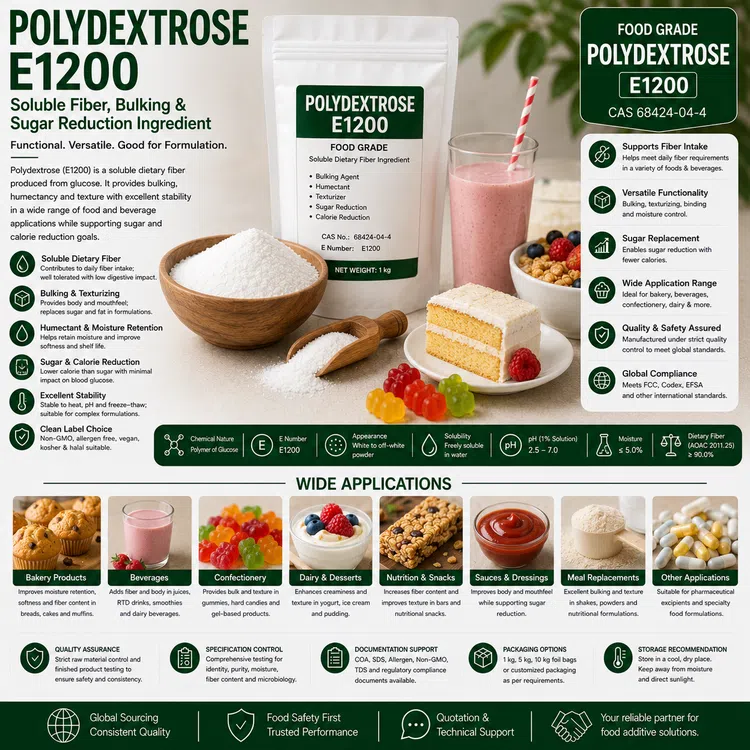
Product identity
| Product | Polydextrose |
|---|---|
| Common references | Polydextrose E1200, INS 1200, soluble fiber bulking ingredient |
| Category | Sweeteners & Polyols |
| Primary function | Soluble fiber, bulking agent, humectant, texturizer and sugar-reduction ingredient |
| E / INS number | E1200 / INS 1200 |
| CAS / identity | 68424-04-4 |
| Chemical nature | Water-soluble, partially metabolizable polymer produced from glucose-based raw materials with permitted catalysts or food-grade process aids depending on regulation and supplier process |
| Typical form | Powder, granule, syrup or liquid grade |
| Typical sensory role | Low sweetness, neutral to mildly sweet profile, useful for rebuilding solids and mouthfeel |
| Key buying issue | Grade, fiber declaration, regulatory status and application performance must be confirmed for each destination market |
Application fit
Potential use areas may include:
- Beverages and powdered drink mixes
- Confectionery and sugar-reduced candies
- Chewing gum and compressed tablets
- Bakery and fine bakery products
- Dairy desserts and frozen desserts
- Nutrition bars and functional foods
- Low-calorie and reduced-sugar formulations
- Fiber-fortified foods and dietary products
Industrial functionality overview
In industrial formulation, Polydextrose is mainly selected when a manufacturer needs bulk, soluble fiber, water management and texture without adding the same level of sweetness or calories as sucrose or glucose syrup. It helps rebuild the mass that is lost when sugar or fat is reduced, while contributing to mouthfeel, solids balance and processing tolerance.
Polydextrose is not a high-intensity sweetener and it is not normally used as the only sweetness solution. In reduced-sugar foods, it is commonly evaluated together with sweeteners, polyols, fibers, acids, flavors, hydrocolloids, proteins, starches and emulsifiers to build a complete sensory and processing profile. The correct grade depends on the application, moisture target, process temperature, pH, desired fiber content, final texture and local labeling rules.
Functional benefits by application
Beverages and drink powders
In beverages, Polydextrose can support soluble fiber enrichment, body, mouthfeel and reduced-sugar positioning. It is especially relevant in powdered drinks, nutritional beverages, meal replacements and flavored beverages where the formulation needs soluble solids without excessive sweetness.
- Supports fiber fortification in liquid or dry beverage systems.
- Can improve body and reduce watery mouthfeel after sugar reduction.
- Requires solubility, clarity, sedimentation and pH-stability testing.
- Should be evaluated with acids, minerals, flavors, colors and heat treatment.
Confectionery and candies
In sugar-reduced confectionery, Polydextrose can help replace sucrose or glucose syrup solids while contributing to chew, body and structure. It may be used in hard candy, chewy candy, jelly systems, fillings and sugar-reduced confectionery formats when the grade and regulatory market are suitable.
- Helps rebuild solids in sugar-reduced recipes.
- Can support chew, body and controlled moisture behavior.
- Often combined with polyols, high-intensity sweeteners and hydrocolloids.
- Requires testing for stickiness, crystallization, hygroscopicity and shelf stability.
Chewing gum and compressed tablets
In chewing gum, tablets and compressed formats, Polydextrose can contribute bulk, compressibility, texture and low-sugar formulation design. It should be reviewed with the complete binder, sweetener, flavor and coating system.
- Supports sugar-reduced or fiber-containing tablet formats.
- Can contribute to bulk and structure in compressed products.
- Requires compatibility testing with flavors, acids, minerals and active ingredients.
- Tablet hardness, friability, dissolution and humidity response should be measured.
Bakery and fine bakery wares
In bakery systems, Polydextrose can support calorie reduction, sugar reduction, moisture retention and texture modification. It may be useful in cakes, cookies, muffins, fillings and breakfast products where reduced sugar changes batter viscosity, spread, browning and softness.
- Helps replace part of the solids lost when sugar is reduced.
- Can contribute to softness and moisture retention.
- Requires adjustment of water, leavening, browning and sweetness balance.
- Should be evaluated for batter viscosity, spread, crumb structure and shelf-life texture.
Dairy desserts and frozen desserts
In dairy desserts, ice cream-style products and frozen desserts, Polydextrose may contribute body, fiber, solids balance and mouthfeel. It can be useful when sugar or fat is reduced, but it must be tested with proteins, stabilizers, emulsifiers and freezing conditions.
- Supports body and solids balance in reduced-sugar systems.
- Can improve mouthfeel in low-calorie dessert formulations.
- Requires review of freezing point, overrun, meltdown and texture.
- Compatibility with milk proteins, vegetable fats and hydrocolloids must be checked.
Nutrition bars and functional foods
In bars, cereals and functional foods, Polydextrose can support fiber fortification, sugar reduction and texture control. It may help manage chewiness, hardness and moisture migration, especially in multi-component products with coatings, inclusions and fillings.
- Useful for fiber-fortified snack and nutrition products.
- Can help manage water activity and texture over shelf life.
- Requires testing for bar hardening, stickiness and flavor release.
- Should be evaluated with proteins, syrups, fats, fibers and minerals.
Technical grade selection criteria
Industrial buyers should compare Polydextrose grades by function and documentation, not only by price. Powder, granule, syrup and liquid grades can behave differently in solubility, dusting, dosing, blending, viscosity, color, flavor impact and moisture management. The best choice depends on process equipment, target food matrix and the buyer’s regulatory market.
| Selection factor | Why it matters |
|---|---|
| Physical form | Powder and granule grades suit dry blending, premixes and tablets; syrup or liquid grades may be easier for beverage, confectionery and continuous dosing systems. |
| Polydextrose content | Important for formulation calculations, fiber declaration, solids contribution and supplier comparison. |
| Moisture and water activity impact | Affects caking, shelf life, texture, chewiness, microbial stability and moisture migration in finished foods. |
| Color and flavor neutrality | Important in clear beverages, light-colored bakery fillings, dairy desserts and delicate flavor systems. |
| pH and acidity | Can influence taste, stability, processing compatibility and interaction with minerals, proteins or hydrocolloids. |
| Particle size and bulk density | Relevant for flowability, dust control, hopper feeding, premix uniformity, tablet compression and dry blending. |
| Viscosity contribution | Important for beverages, syrups, fillings, dairy desserts, pumping, depositing and mouthfeel design. |
| Fiber labeling and claims | Dietary fiber declaration and claim language depend on destination-market regulation and analytical method. |
| Digestive tolerance and warning statements | Serving size, dosage and local labeling rules should be reviewed, especially in high-fiber or high-use formulations. |
Specification points to request
A complete sourcing review should be based on the supplier’s current specification and batch-specific certificate of analysis. Depending on the grade and market, buyers commonly request the following technical parameters:
- Appearance, color, odor and physical form.
- Polydextrose assay or declared content.
- Dietary fiber content and analytical method where relevant.
- Moisture content and water activity impact where available.
- pH, acidity or neutralization status.
- Reducing sugars, glucose, sorbitol and residual low-molecular-weight carbohydrates where specified.
- Ash or residue on ignition.
- Solubility, clarity or turbidity behavior for beverage applications.
- Particle size distribution, bulk density and flowability for powder grades.
- Viscosity or dry substance level for syrup and liquid grades.
- Heavy metals and elemental impurities according to the applicable specification.
- Microbiological limits, especially for dry blends, beverages and ready-to-eat applications.
- Shelf-life, storage conditions, packaging type and pallet configuration.
Formulation and processing guidance
Polydextrose can be used in many different food matrices, but process conditions strongly influence performance. Solubility, sweetness balance, acidity, thermal treatment, solids content, fiber level, water activity and packaging all affect finished-product quality. Plant trials should be performed at the intended production scale before launch.
- Beverages: add with adequate agitation and confirm dissolution, clarity, sedimentation, acid stability and heat-treatment tolerance.
- Confectionery: review cooking temperature, final solids, hygroscopicity, stickiness, glass transition and storage humidity.
- Bakery: adjust water, mixing time, leavening, sweetness, browning and baking profile when replacing sucrose.
- Dairy desserts: evaluate protein compatibility, stabilizer system, viscosity, mouthfeel, syneresis and storage texture.
- Frozen desserts: test freezing point, overrun, meltdown, iciness and stabilizer-emulsifier balance.
- Bars and snacks: check moisture migration, bar hardening, stickiness, flavor release and package barrier performance.
- Dry blends: evaluate bulk density, dusting, segregation, flowability and compatibility with minerals, acids and flavors.
Compatibility with other ingredients
Polydextrose is usually part of a broader sugar-reduction or fiber-fortification system. Its performance should be tested with the complete formulation rather than as an isolated ingredient.
Sweetener systems
Polydextrose provides bulk but limited sweetness, so reduced-sugar products often require high-intensity sweeteners, polyols or natural sweeteners to rebuild the sweetness curve.
- Review sweetness onset and aftertaste.
- Balance with acids, flavors and masking systems.
- Confirm label and claim acceptability.
Hydrocolloids and starches
Hydrocolloids and starches may be needed to rebuild viscosity, suspension, gel structure or freeze-thaw stability after sugar reduction.
- Check viscosity and gel behavior.
- Evaluate syneresis and storage stability.
- Adjust hydration sequence and shear conditions.
Proteins and dairy systems
In dairy and nutrition products, Polydextrose should be tested with milk proteins, plant proteins, minerals and heat treatment to avoid instability.
- Check pH stability and heat tolerance.
- Evaluate sedimentation or phase separation.
- Confirm sensory impact and mouthfeel.
Fats and emulsifiers
In low-fat or reduced-calorie systems, Polydextrose may be used with emulsifiers, fibers and stabilizers to rebuild creaminess or body.
- Review emulsion stability and fat dispersion.
- Test mouthcoating and flavor release.
- Measure texture over shelf life.
Quality, compliance and documentation
For international food manufacturers, documentation quality is as important as technical performance. Polydextrose may be purchased for additive use, fiber fortification, reduced-sugar product development, functional foods or export markets. Each route can require different declarations, analytical support and label review.
Core documents
- Technical data sheet or product specification.
- Certificate of analysis for the available batch or lot.
- Safety data sheet where applicable.
- Manufacturing origin and country-of-origin statement.
- Shelf-life and recommended storage conditions.
- Packaging, net weight and pallet configuration.
Regulatory documents
- Food-grade statement.
- E1200 / INS 1200 declaration where applicable.
- Destination-market compliance statement.
- Dietary fiber declaration and method support where required.
- Label warning guidance where high serving levels may apply.
- Market-specific additive or ingredient declaration.
Customer-standard documents
- Allergen statement.
- GMO status statement where required.
- Halal or kosher certificate if required.
- Vegan or vegetarian suitability statement where applicable.
- Gluten-free statement where required by the customer.
- Contaminant and heavy metal statement where applicable.
Supply-chain review
- Manufacturer identity and approved supplier status.
- Batch coding and lot traceability.
- Food safety certification such as HACCP, ISO 22000, FSSC 22000 or equivalent where available.
- Specification revision control and change notification.
- Lead time, minimum order quantity and sample availability.
- Export documents and import requirements for the destination country.
Storage, handling and packaging considerations
Polydextrose should be stored according to the supplier’s specification in closed original packaging, protected from moisture, contamination, direct sunlight, excessive heat and strong odors. Powder grades may be hygroscopic and should be handled carefully to reduce caking and dust formation. Syrup or liquid grades may require temperature control to maintain pumpability and consistent dry solids.
- Keep bags, drums or containers sealed when not in use.
- Use clean, dry, food-grade handling equipment.
- Apply first-expiry-first-out stock rotation.
- Protect powder grades from humidity and condensation.
- Confirm whether liquid grades require warming, mixing or filtration before use.
- Inspect incoming goods for caking, leakage, discoloration, odor change or packaging damage.
- Verify container loading quantity, pallet type and export packaging before shipment.
Technical purchasing notes
When reviewing Polydextrose, compare the supplier specification against the intended application, process conditions, target function, label expectations and local rules. For industrial purchasing, the most useful inquiry normally includes target grade, fiber declaration requirement, physical form, packaging size, quantity, destination and document requirements.
Buyers should avoid approving Polydextrose only by product name. A better approval process connects the exact supplier grade with the intended food category, target use level, serving size, desired fiber claim, processing method, shelf-life target and destination-market labeling rules.
| Information to include | Example details |
|---|---|
| Application | Beverage, confectionery, chewing gum, bakery, dairy dessert, frozen dessert, bar, powder blend or tablet. |
| Target function | Soluble fiber, sugar replacement, calorie reduction, bulking, humectancy, texturizing, solids replacement or mouthfeel improvement. |
| Grade preference | Powder, granule, syrup, liquid grade or existing supplier reference. |
| Fiber target | Required grams of fiber per serving, claim objective or nutrition-panel target. |
| Process conditions | Dry blending, dissolution, cooking, baking, pasteurization, UHT, freezing, extrusion, compression or depositing. |
| Quantity | Sample, trial quantity, pallet quantity, container quantity, monthly demand or annual contract volume. |
| Destination | Country, port, city, delivery term and import-document requirements. |
| Documents | TDS, specification, COA, SDS, food-grade statement, E1200 declaration, fiber declaration, allergen, GMO, halal, kosher, origin and shelf-life documents. |
Documents to request
- Product specification or technical data sheet.
- Certificate of analysis for available batch or lot.
- Safety data sheet where applicable.
- Food-grade, E1200 / INS 1200 or regulatory status statement where relevant.
- Dietary fiber declaration and analytical method support where required.
- Origin, manufacturer, shelf-life and storage information.
- Allergen, GMO, halal, kosher, vegan or gluten-free statements where required.
- Label-warning guidance where high serving levels may apply.
- Packaging details, net weight and pallet configuration.
- Market-specific declarations required by the destination country.
How to request this product
Send the product name, target grade or reference specification, intended application, target function, desired fiber level, quantity, destination country, packaging preference, expected shipment date and required documents. If you already purchase Polydextrose, attach or describe your existing specification, label, supplier reference or certificate of analysis so available options can be compared more accurately.
Useful technical answers
What is Polydextrose used for in food manufacturing?
Polydextrose is used as a soluble fiber, low-calorie bulking agent, humectant and texturizer. It is commonly reviewed for sugar reduction, calorie reduction, fiber fortification, solids replacement, texture support and moisture management in beverages, confectionery, bakery, dairy desserts, bars and related processed foods.
Is Polydextrose a high-intensity sweetener?
No. Polydextrose provides bulk and limited sweetness. In reduced-sugar products, it is often combined with high-intensity sweeteners, polyols, flavors and acidity systems to rebuild sweetness, mouthfeel and solids balance.
Which Polydextrose grade should I request?
The correct grade depends on the application and process. Powder and granule grades are useful for dry blending, tablets and premixes, while syrup or liquid grades may suit beverages, confectionery and continuous dosing. Send the application, target function, fiber target and existing specification so supplier options can be compared.
Which documents should be requested?
Buyers commonly request a technical data sheet, product specification, certificate of analysis, safety data sheet where applicable, food-grade declaration, E1200 / INS 1200 statement, dietary fiber declaration, origin statement, allergen statement, GMO statement, shelf-life information, storage conditions, packaging details and market-specific compliance declarations.
Can Global Food Additives source Polydextrose?
Global Food Additives can review sourcing options for Polydextrose according to target grade, application, fiber requirement, quantity, destination, packaging preference, delivery term and required documentation.
Is this product permitted in every country?
No. Food additive use, dietary fiber declaration, claims, warning statements and maximum levels depend on destination-market rules, food category, serving size, label requirements and buyer responsibility. Always confirm local regulatory status before commercial use.
Tell us which Polydextrose grade you need.
Send product name, application, target function, fiber target, grade preference, specification, quantity, destination country, packaging preference, delivery term and document requirements. Our team will review your inquiry and respond from [email protected].
Your message has been received. You will be redirected to the home page.