
Potassium Bicarbonate
Potassium Bicarbonate, commonly identified as KHCO3, E501(ii) or INS 501(ii), is a food-grade bicarbonate used as a sodium-free raising agent, carbon dioxide source, bicarbonate buffer, acidity regulator and potassium-contributing ingredient where permitted.
For industrial manufacturers, Potassium Bicarbonate is especially valuable in bakery and dry-mix systems where controlled gas release, sodium reduction and consistent dough or batter aeration are required. It can be evaluated as an alternative to sodium bicarbonate in cakes, biscuits, cookies, pancakes, tortillas, batters, dry bakery premixes, effervescent powders and selected pH-adjustment systems.
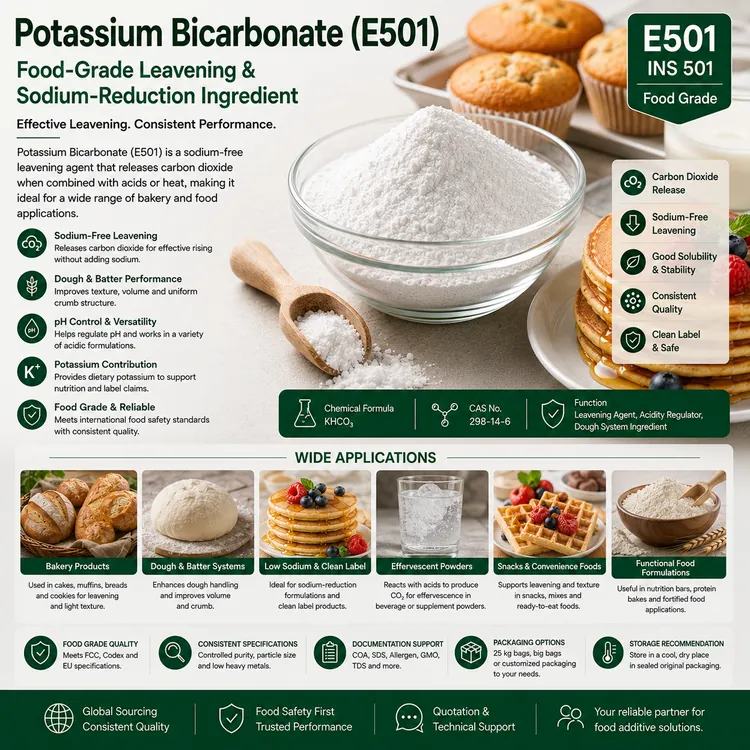
Product identity
| Product name | Potassium Bicarbonate |
|---|---|
| Common names | Potassium hydrogen carbonate, potassium acid carbonate, KHCO3 |
| Category | Leavening, Raising & Dough Systems |
| Function | Sodium-free raising agent, leavening base, carbon dioxide source, acidity regulator, bicarbonate buffer and potassium source where permitted |
| E / INS number | E501(ii) / INS 501(ii) |
| CAS / identity | 298-14-6 |
| Chemical formula | KHCO3 |
| Approximate molecular weight | 100.12 g/mol |
| Approximate potassium contribution | About 39.1% potassium by mass; final calculation should follow supplier assay and moisture basis |
| Approximate bicarbonate contribution | About 60.9% bicarbonate by mass; relevant for neutralization and carbon dioxide release calculations |
| Typical physical form | White crystalline powder, fine powder, crystals or granular grade depending on supplier and specification |
| Functional character | Mild alkaline bicarbonate salt that reacts with food acids to release carbon dioxide and support pH control |
| Handling focus | Moisture protection, caking control, particle-size consistency, clean handling, dust control and accurate dosing |
Application fit
Potential use areas may include the following when permitted by local food law, finished-product specification and label requirements:
- Cakes, muffins, cookies, biscuits and crackers
- Pancake mixes, waffle mixes, batters and dry bakery premixes
- Tortillas, flatbreads and sodium-reduced bakery systems
- Low-sodium or reduced-sodium leavening systems
- Effervescent powders, beverage powders and instant drink tablets where permitted
- Dough systems requiring controlled pH and gas release
- Dry blends using acid-base reaction systems
- Selected pH-adjustment and buffering applications
Technical purchasing notes
When reviewing Potassium Bicarbonate, compare the supplier specification against the intended food application, leavening-acid system, target gas release, final pH, sodium-reduction target, particle-size requirement, sensory expectations, dry-mix stability, label wording and destination-market rules. A technically complete inquiry should include target grade, assay, neutralizing value, bicarbonate basis, potassium contribution, physical form, particle size if relevant, packaging size, quantity, destination country, delivery term and document requirements.
Potassium Bicarbonate is often purchased for sodium-reduced bakery systems, but it is not always a direct one-to-one replacement for sodium bicarbonate. It has a different molecular weight, potassium contribution, neutralizing value and sensory impact. Formulators should rebalance leavening acid, moisture, mixing order, bake temperature, gas-release timing and final product pH through pilot trials before approving a commercial formula.
Industrial formulation considerations
Leavening reaction and gas release
Potassium Bicarbonate reacts with suitable food acids in the presence of moisture to release carbon dioxide. The released gas supports dough and batter expansion, crumb structure, lift and product volume. Reaction rate depends on acid type, particle size, water availability, mixing time, resting time and heat profile.
- Define whether gas release is required during mixing, resting, baking, frying or final heating.
- Balance Potassium Bicarbonate with the selected leavening acid to avoid excess alkalinity or sourness.
- Validate finished-product pH, texture, cell structure, height, spread and colour.
- Control moisture in dry mixes to prevent premature reaction and loss of raising power.
- Use production-scale tests because gas retention can differ between lab batches and industrial mixers.
Sodium reduction and potassium contribution
Potassium Bicarbonate can reduce sodium contribution in formulas that would otherwise use sodium bicarbonate. This is useful in sodium-reduction programs, but the potassium increase and potential label implications must be assessed at finished-product level.
- Calculate potassium contribution from the supplier assay and actual use level.
- Confirm whether sodium-reduction, low-sodium or potassium-related claims are allowed in the destination market.
- Assess taste because potassium salts can contribute mineral, bitter or alkaline notes at higher use levels.
- Check whether potassium warning statements apply to salt substitutes or special consumer groups.
- Use analytical results rather than only theoretical calculations when making nutrition declarations.
Specification parameters to compare
| Parameter | Why it matters for food manufacturers |
|---|---|
| Assay / KHCO3 content | Confirms active Potassium Bicarbonate content used for dosage, cost-in-use comparison, neutralization calculation and batch release. |
| Neutralizing value | Critical for replacing sodium bicarbonate, balancing leavening acids and controlling final product pH. |
| Potassium content | Important for potassium declaration, sodium-reduction positioning and nutrition-panel calculations. |
| Moisture / loss on drying | Affects assay, flowability, caking risk, shelf life and dry-mix stability. |
| Carbonate impurity | Can influence alkalinity, pH response, taste and reaction balance in sensitive formulations. |
| pH of solution | Supports application review for batters, dough systems, beverage powders and acid-base blends. |
| Insoluble matter | Relevant for beverage powders, effervescent systems, solution dosing and filtration-sensitive applications. |
| Chloride, sulphate and related salts | May affect taste, ionic balance and customer specification compliance. |
| Heavy metals / elemental impurities | Required for food safety review, customer specifications and destination-market compliance. |
| Particle size / bulk density | Affects dusting, blending uniformity, reaction rate, segregation, dissolution and packaging performance. |
| Microbiological profile | Usually low risk for mineral salts, but may still be required for dry mixes and nutrition-sensitive categories. |
| Packaging material | Protects against moisture uptake, caking, contamination, premature reaction in dry mixes and transport damage. |
| Shelf life and storage conditions | Supports inventory planning, QA release and long-term leavening performance. |
Food manufacturing applications
Cakes, muffins and batter systems
Potassium Bicarbonate may be used in batter systems where sodium-free or sodium-reduced leavening is required. Formulators should evaluate batter viscosity, gas release, bake height, crumb cell structure, final pH, colour, flavour and shelf-life texture.
Cookies, biscuits and crackers
In low-moisture bakery systems, bicarbonate performance affects spread, surface colour, texture and eating quality. Potassium Bicarbonate should be balanced with the right acid system to avoid alkaline aftertaste, excessive browning or poor lift.
Pancake, waffle and dry bakery mixes
Dry mixes require moisture protection and controlled acid-base separation until use. Application review should include particle-size compatibility, dry-blend uniformity, caking resistance, storage humidity, reaction timing and consumer preparation conditions.
Tortillas and flatbreads
Potassium Bicarbonate can be considered in sodium-reduced tortillas and flatbreads where controlled pH and gas release are required. Trials should monitor dough handling, press performance, bake or griddle expansion, flexibility, colour, flavour and shelf-life softness.
Effervescent powders and beverage powders
Potassium Bicarbonate can react with food acids in effervescent powder systems to release carbon dioxide during reconstitution. Formulation review should include moisture barrier, acid ratio, reaction speed, potassium contribution, taste, sediment, clarity and packaging humidity control.
pH adjustment and buffering systems
In selected process streams or dry blends, Potassium Bicarbonate may be used for mild alkalinity and buffering. Application work should define target pH, acid load, process temperature, flavour impact, preservative performance and final regulatory status.
Leavening system design guidance
Potassium Bicarbonate works best when the full leavening system is designed around the desired gas-release profile. The acid component, bicarbonate dose, particle size, mixing order, moisture level, process temperature and holding time all affect how much carbon dioxide is released and when it becomes available to the dough or batter.
- Define the target finished-product volume, cell size, spread, texture, colour and final pH.
- Choose the leavening acid according to the desired reaction speed and process stage.
- Calculate the bicarbonate-to-acid balance using neutralizing values, then confirm with trials.
- Check whether potassium bicarbonate can fully or partially replace sodium bicarbonate without sensory issues.
- Measure finished-product sodium, potassium and pH where claims or declarations are planned.
- For dry mixes, validate shelf life under expected humidity and storage temperature conditions.
Process engineering and plant handling
Industrial use of Potassium Bicarbonate requires controls for dust, moisture, weighing accuracy and reaction management. Solid grades should be stored in sealed packaging, protected from humidity and transferred through clean handling systems. For solution preparation or liquid dosing, concentration, pH and compatibility with process equipment should be confirmed before production use.
- Use calibrated scales or automated dosing systems where leavening performance or potassium declaration is critical.
- Control dust during bag opening, tipping, dry blending and premix preparation.
- Protect opened bags from humidity to reduce caking, lumping and activity loss.
- Separate bicarbonate and leavening acids in dry mixes when needed to prevent premature reaction.
- Confirm complete dissolution or dispersion before filtration, filling or heat processing in liquid systems.
- Validate premix uniformity through representative sampling and analytical verification.
- Apply FIFO or FEFO inventory control and retain batch documentation for traceability.
Quality, safety and compliance checklist
- Confirm food-grade status and the exact standard referenced by the supplier.
- Request assay, neutralizing value, moisture, pH, carbonate impurity, insoluble matter, particle size and heavy metal limits.
- Check whether the material is potassium bicarbonate E501(ii) rather than potassium carbonate E501(i).
- Verify whether the particle grade is suitable for dry blending, fast reaction, slow reaction, beverage powders or premix use.
- Confirm destination-market rules for E501 / INS 501, food category, use level, additive declaration and label wording.
- Review interaction with leavening acids, citrates, phosphates, cocoa, proteins, starches, flavours, colours and preservatives.
- Validate final-product pH, volume, texture and potassium content when any of these are controlled release parameters.
- Assess sensory impact, including bitterness, mineral taste, alkaline notes, aftertaste and browning.
- Verify lot traceability from manufacturer to exporter, including batch number, production date and expiry or retest date.
- Review the SDS for dust exposure, eye irritation, handling precautions and storage recommendations.
- Request allergen, GMO, vegan, halal, kosher and irradiation statements when required by the buyer or destination market.
- Do not approve sodium-reduction claims, potassium claims or health-related positioning without local regulatory review.
Documents to request
- Product specification or technical data sheet
- Certificate of analysis for the offered batch or lot
- Safety data sheet where applicable
- Food-grade declaration and intended-use statement
- E501 / INS 501 additive-status statement where available
- Country of origin, manufacturer statement and lot traceability declaration
- Shelf-life, retest period and storage-condition statement
- Assay, neutralizing value, bicarbonate-basis and potassium-content declaration
- Heavy metals, elemental impurities and contaminant declaration
- Microbiological specification when required for dry blends or sensitive categories
- Allergen, GMO, vegan, halal, kosher and irradiation statements when required
- Packaging specification, net weight, pallet pattern and container-loading information
- Market-specific declarations required by the destination country or buyer quality system
Packaging, handling and storage
Potassium Bicarbonate should be stored in tightly closed original packaging in a dry, clean and well-ventilated warehouse. The material should be protected from moisture, strong odours, contamination and unnecessary exposure to air. Moisture exposure can cause caking and may reduce dry-mix stability, especially when the bicarbonate is stored near acidic ingredients or blended into reaction-sensitive premixes.
For export shipments, buyers should confirm net weight, packaging type, inner liner, bag or drum specification, pallet configuration, label language, batch marking, container-loading details, moisture protection and whether the receiving warehouse can maintain dry storage conditions. For bakery dry mixes, effervescent powders and sodium-reduction applications, packaging barrier and particle consistency are especially important for QA approval.
Quotation and sourcing variables
| Inquiry item | Information to provide |
|---|---|
| Target grade | Food grade, E501(ii) / INS 501(ii), customer specification, bakery grade, dry-mix grade, effervescent grade or low-sodium application grade. |
| Physical form | Powder, fine powder, crystalline powder, granule, premix-ready form or solution grade. |
| Assay / basis | Required KHCO3 assay, bicarbonate basis, neutralizing value, potassium content, moisture basis and impurity limits. |
| Application | Cake, biscuit, cookie, pancake mix, tortilla, batter, dry bakery mix, effervescent powder, beverage powder or process pH adjustment. |
| Functional target | Gas release, sodium reduction, pH adjustment, dough aeration, batter lift, final pH control or potassium contribution. |
| Process requirements | Target final pH, selected leavening acid, reaction timing, particle size, moisture limit, dry-mix stability or bake/fry process. |
| Quantity | Trial quantity, first commercial order, annual demand and shipment frequency. |
| Destination | Country, port, delivery address, Incoterms preference and import documentation requirements. |
| Packaging | Bag, carton, drum, liner, net weight, pallet requirement and container-loading preference. |
| Documentation | COA, TDS, SDS, food-grade declaration, E501 statement, potassium declaration, origin, shelf life, allergen/GMO/halal/kosher statements and market-specific documents. |
How to request this product
Send the product name, target grade or reference specification, required assay, neutralizing value, moisture limit, physical form, intended application, target leavening function or final pH if applicable, quantity, destination country, preferred packaging, delivery term, expected shipment date and documentation checklist. If you already purchase Potassium Bicarbonate, attach your current specification, certificate of analysis, SDS, process requirement or formulation target so supplier options can be compared more accurately.
Useful answers
What is Potassium Bicarbonate used for in food manufacturing?
Potassium Bicarbonate is used as a sodium-free raising agent, carbon dioxide source, acidity regulator, bicarbonate buffer and potassium-contributing ingredient in permitted applications such as bakery products, biscuits, cookies, pancakes, tortillas, batters, dry mixes and effervescent powders.
How does Potassium Bicarbonate release gas?
It reacts with suitable food acids in the presence of moisture to release carbon dioxide. During heating, the gas expands and helps create lift, aeration and texture in dough and batter systems.
What is the E number for Potassium Bicarbonate?
Potassium Bicarbonate is commonly identified as E501(ii) or INS 501(ii), within the potassium carbonates group. Buyers should confirm whether the required material is potassium bicarbonate rather than potassium carbonate.
Can Potassium Bicarbonate replace Sodium Bicarbonate?
It can partially or fully replace sodium bicarbonate in some formulas, especially where sodium reduction is desired. However, the formula must be recalculated and tested because potassium bicarbonate has different molecular weight, neutralizing value, potassium contribution and sensory profile.
Why is moisture protection important?
Moisture can cause caking and may trigger premature reaction in dry mixes containing acids. Good packaging barrier, dry storage and controlled blending are important for maintaining leavening performance through shelf life.
Can Global Food Additives source Potassium Bicarbonate?
Global Food Additives can review sourcing options according to target specification, food-grade requirement, assay, neutralizing value, particle size, quantity, destination, packaging preference and documentation needs.
Which documents should be requested?
Buyers commonly request a technical data sheet, certificate of analysis, safety data sheet, food-grade declaration, E501 statement, neutralizing-value statement, potassium-content statement, origin statement, shelf-life statement, storage conditions, packaging details, traceability information and market-specific declarations.
Is this product permitted in every country?
No. Food additive use, processing-aid status, maximum levels, potassium declarations, sodium-reduction claims and labelling depend on destination-market rules, food category, use level and buyer responsibility.
Tell us which food additive or ingredient you need.
Send product names, target specifications, quantity, destination country, packaging preference, delivery term and document requirements. Our team will review your inquiry and respond from orders@foodgradeadditives.com.
Your message has been received. You will be redirected to the home page.