
Potassium Iodide
Potassium Iodide, commonly abbreviated as KI, is a concentrated iodine-bearing mineral ingredient used in controlled food fortification systems. In food manufacturing, it is most often evaluated as an iodine source for iodized salt, dry nutrient premixes, enriched cereal systems, nutrition powders and specialist formulations where the destination-market regulation permits its use.
Because iodine dosage is normally very low and highly regulated, industrial purchasing should focus on specification accuracy, assay confirmation, homogeneous premix handling, packaging integrity, moisture protection, lot traceability and market-specific documentation before any commercial use.
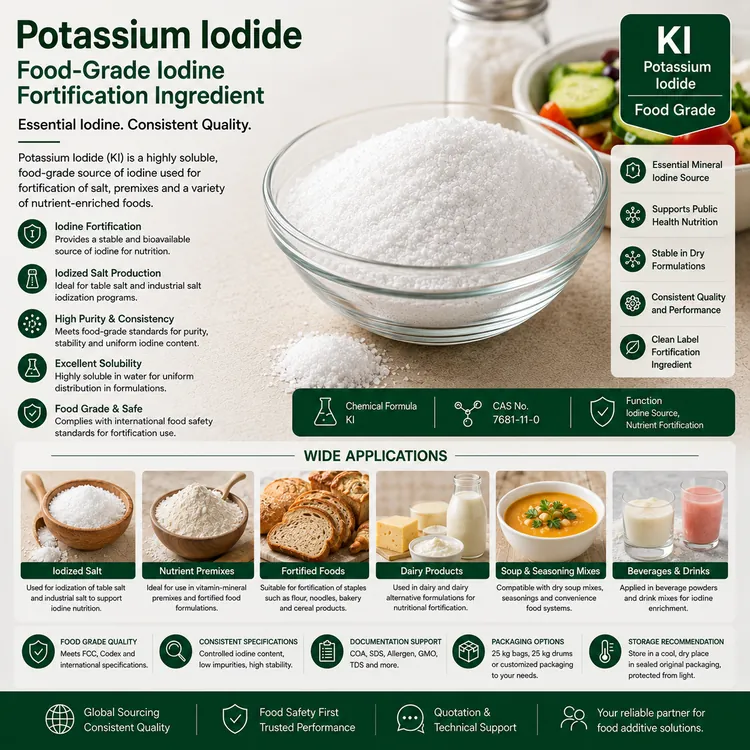
Product identity
| Product name | Potassium Iodide |
|---|---|
| Common abbreviation | KI |
| Category | Fortification Nutrients |
| Function | Source of iodine for permitted nutrient fortification and enrichment systems |
| CAS / identity | 7681-11-0 |
| Chemical formula | KI |
| Approximate molecular weight | 166.00 g/mol |
| Approximate iodine contribution | About 76.4% iodine by mass; final calculation must follow the buyer specification and local regulation |
| E / INS number | Confirm by destination market, food category and supplier documentation |
| Typical physical form | White crystalline powder, fine powder, granular material or premix-ready grade depending on supplier |
| Solubility profile | Highly soluble in water; dissolution behaviour should be confirmed for beverage systems, brines and liquid premix operations |
Application fit
Potential use areas may include the following when permitted by local food law and the finished-product specification:
- Iodized table salt and food-grade salt fortification
- Dry vitamin and mineral premixes for flour, cereals and nutrition powders
- Bakery, cereal and grain enrichment programs
- Dairy, beverage and reconstitution systems requiring a soluble iodine source
- Infant, clinical, medical and special dietary foods where specifically authorized
- Institutional nutrition, humanitarian nutrition and public-health fortification projects
Technical purchasing notes
Potassium Iodide is not normally purchased like a bulk functional additive because the intended use level is small and the nutritional effect is significant. A technically complete inquiry should define the target iodine contribution, the grade standard, the intended carrier, the final food category, the production process, the destination country, the packaging requirement and the documentation package needed for regulatory review.
For industrial buyers, the most important comparison points are assay, purity basis, moisture, insoluble matter, heavy metals, arsenic or lead limits where applicable, particle size, flow behaviour, colour, odour, packaging integrity, shelf life, traceability and whether the supplier can issue food-grade and market-specific declarations. For premix buyers, attention should also be given to blending uniformity, micro-dosing accuracy, segregation risk and compatibility with other minerals, vitamins, antioxidants, salt, sugar, starches or carriers.
Industrial formulation considerations
Fortification design
Potassium Iodide should be evaluated as a concentrated source of iodide, not as a general-purpose mineral filler. Formulation teams should calculate the iodine contribution from KI, define the target finished-product iodine level and validate the dosage through production-scale mixing and analytical verification.
- Confirm whether the regulatory calculation is expressed as iodine, iodide or Potassium Iodide.
- Use calibrated micro-dosing equipment or dilute premixes to reduce dosing error.
- Validate blend uniformity with appropriate sampling points and batch records.
- Control carry-over and cross-contamination when working with low-dose micronutrients.
Compatibility and stability
KI is water soluble and suitable for many dry and liquid systems, but iodide can be sensitive to oxidative conditions. Buyers should review compatibility with moisture, oxygen exposure, acidic systems, oxidizing agents, metal ions, strong light exposure and long storage periods.
- Protect from humidity, heat and direct sunlight during storage and distribution.
- Use sealed packaging and avoid prolonged open-bag handling in humid areas.
- Review compatibility with vitamin C, oxidants, trace metals and aggressive process conditions.
- Request stability data or conduct finished-product shelf-life testing when iodine retention is critical.
Specification parameters to compare
| Parameter | Why it matters for food manufacturers |
|---|---|
| Assay / purity | Confirms the active KI content used for iodine calculation, batch release and label compliance. |
| Identity testing | Verifies that the supplied material matches the declared potassium iodide identity and is not a substitute iodine salt. |
| Iodine contribution | Supports accurate conversion from KI addition rate to iodine level in the final food. |
| Moisture or loss on drying | Important for flowability, storage stability, caking risk and premix performance. |
| Heavy metals and elemental impurities | Required for food safety review, customer specifications and destination-market compliance. |
| Particle size / physical form | Affects blend uniformity, dusting, segregation, dissolution rate and handling in micro-ingredient systems. |
| Microbiological profile | Usually low risk for inorganic salts, but customer and application requirements may still require confirmation. |
| Packaging material | Protects against moisture uptake, contamination, light exposure and transport damage. |
| Shelf life and storage conditions | Supports inventory planning, quality assurance release and retention of declared fortification performance. |
Food manufacturing applications
Iodized salt and salt-based carriers
KI may be evaluated for salt iodization and salt-based nutrient systems where iodide salts are permitted. The salt carrier, mixing system, iodine dosage, packaging barrier and distribution conditions are critical because iodine retention can be affected by humidity, sunlight, storage time and packaging format.
Dry premixes and enrichment blends
For vitamin-mineral premixes, Potassium Iodide is typically handled through dilution into a carrier to improve dosing accuracy. Premix manufacturers should review particle-size compatibility, bulk density, segregation tendency, order of addition and analytical verification of iodine uniformity.
Beverages and liquid systems
KI’s water solubility can be useful in liquid premixes, beverage compounds and reconstitution systems. However, formulation teams should verify pH, oxidation potential, heat treatment, light exposure, flavour impact and iodine retention throughout shelf life.
Infant, clinical and special dietary foods
These applications require stricter specification control, validated dosage, traceability and market-specific compliance. Buyers should request full regulatory documentation and confirm permitted iodine sources, levels and label requirements before commercial approval.
Quality, safety and compliance checklist
- Confirm food-grade status and the applicable standard referenced by the supplier.
- Request a current product specification and compare every limit against the buyer’s internal standard.
- Check whether the assay is reported on an anhydrous, dried or as-is basis.
- Confirm heavy metal limits, arsenic or lead limits where applicable, and country-specific contaminant expectations.
- Verify lot traceability from manufacturer to exporter, including batch number, production date and expiry or retest date.
- Request allergen, GMO, vegan, halal, kosher, irradiation and residual solvent statements when required by the buyer or destination market.
- For low-dose fortification, validate mixing accuracy with finished-product or premix iodine analysis.
- Review storage instructions, packaging type, pallet configuration and humidity protection before shipment.
- Confirm whether the material is suitable for direct food use, premix use or only for industrial processing.
- Do not approve nutrition claims, disease claims or special dietary positioning without destination-market regulatory review.
Documents to request
- Product specification or technical data sheet
- Certificate of analysis for the offered batch or lot
- Safety data sheet where applicable
- Food-grade declaration and intended-use statement
- Country of origin, manufacturer statement and traceability declaration
- Shelf-life, retest period and storage-condition statement
- Allergen, GMO, vegan, halal, kosher and irradiation statements when required
- Heavy metals, elemental impurities or contaminant declaration
- Packaging specification, net weight, pallet pattern and container-loading information
- Market-specific declarations required by the destination country or buyer quality system
Packaging, handling and storage
Potassium Iodide should be handled as a sensitive micronutrient ingredient. Keep the material in tightly closed original packaging, away from moisture, excessive heat, direct sunlight and incompatible oxidizing substances. Once opened, bags or containers should be resealed quickly, clearly identified and protected from warehouse humidity and cross-contamination.
For export shipments, buyers should confirm inner liner type, outer bag or drum type, net weight, palletization, container loading, moisture protection, label language, batch marking and whether the shipment will pass through hot or humid transport conditions. For iodized salt and salt-based applications, packaging selection and storage conditions can be especially important for iodine retention.
How to request this product
Send the product name, target grade or reference specification, required assay, intended application, annual and first-order quantity, destination country, preferred packaging, required shipment date, Incoterms preference and documentation checklist. If you already purchase Potassium Iodide, attach your current specification, certificate of analysis, label or formulation requirement so available supplier options can be compared accurately.
Useful answers
What is Potassium Iodide used for in food manufacturing?
Potassium Iodide is used as a concentrated iodine source in permitted fortification systems. Typical industrial discussions include iodized salt, dry vitamin-mineral premixes, flour and cereal enrichment, nutrition powders, beverages and special dietary foods where permitted.
Is Potassium Iodide the same as iodine?
No. Potassium Iodide is KI, a potassium salt that supplies iodide. Fortification calculations may be expressed as KI, iodide or iodine depending on the regulation and specification, so the calculation basis must be confirmed before production.
Why is micro-dosing control important?
KI contains a high percentage of iodine by mass, and the intended addition rate is usually very small. Accurate weighing, dilution into a carrier, validated mixing and analytical confirmation help reduce under-fortification, over-fortification and batch-to-batch variation.
Can Global Food Additives source Potassium Iodide?
Global Food Additives can review sourcing options according to target specification, food-grade requirement, quantity, destination, packaging preference and documentation needs.
Which documents should be requested?
Buyers commonly request a technical data sheet, certificate of analysis, safety data sheet, food-grade declaration, origin statement, shelf-life statement, storage conditions, packaging details, traceability information and market-specific declarations.
Is this product permitted in every country?
No. Food additive and nutrient-fortification use depends on destination-market rules, food category, use level, label requirements, claims and buyer responsibility. Always confirm the applicable regulation before use.
Tell us which food additive or ingredient you need.
Send product names, target specifications, quantity, destination country, packaging preference, delivery term and document requirements. Our team will review your inquiry and respond from orders@foodgradeadditives.com.
Your message has been received. You will be redirected to the home page.