
Potassium Nitrite E249
Potassium Nitrite is a highly controlled food-grade nitrite curing preservative used in selected cured-meat systems for cured colour development, characteristic cured flavour, oxidative stability and antimicrobial curing support. It is primarily relevant to regulated meat-curing applications and should not be treated as a general-purpose preservative for broad food categories.
This page is prepared for professional meat processors, QA departments, R&D formulators, regulatory teams, purchasing managers and importers who need a technical starting point for nitrite-grade comparison, specification review, residual-level control, supplier documentation and quotation requests.
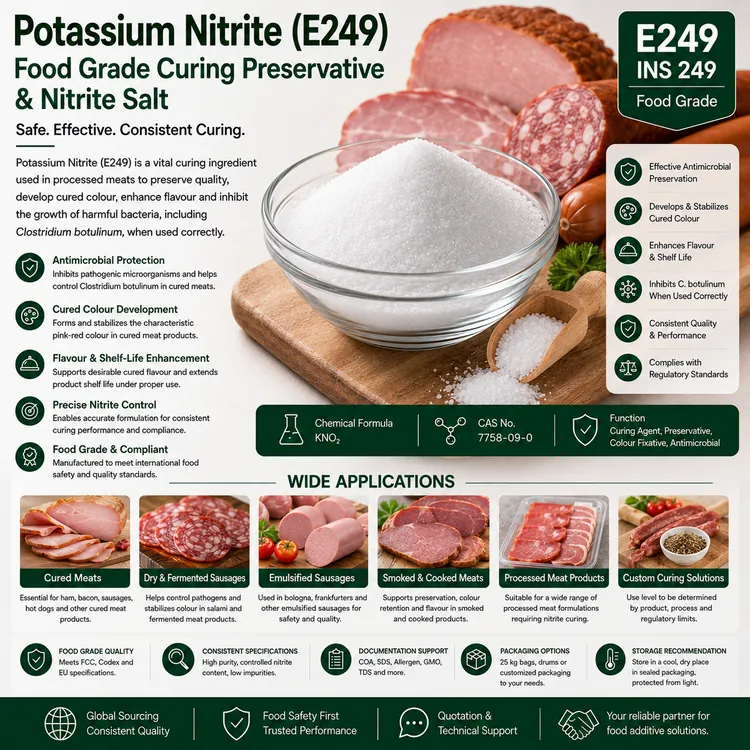
Product identity
| Product | Potassium Nitrite |
|---|---|
| Common references | E249, INS 249, food grade potassium nitrite, potassium nitrite curing salt, potassium salt of nitrous acid |
| Category | Preservatives & Antimicrobials |
| Function | Curing preservative, colour-fixative support, antimicrobial curing ingredient and nitrite salt |
| E / INS number | E249 / INS 249 |
| CAS / identity | 7758-09-0 |
| Chemical formula | KNO2 |
| Chemical nature | Potassium salt of nitrous acid; oxidising nitrite salt requiring strict industrial handling and controlled dosing |
| Theoretical nitrite ion content | Approx. 54.1% nitrite ion by molecular weight for pure KNO2; use supplier assay for exact calculations |
| Theoretical potassium content | Approx. 45.9% potassium by molecular weight for pure KNO2 |
| Typical form | Crystalline powder, granule, diluted curing blend or aqueous solution depending on supplier and market rules |
| Main buying issue | Assay, nitrite level, dilution carrier, blending uniformity, residual nitrite limits and legal food-category permission must be confirmed before approval |
Application fit
Potential use areas may include, subject to strict local regulation and validated controls:
- Cured meat products where E249 is permitted
- Cooked ham, cured sausages and selected processed meats
- Dry-cured and fermented meat systems where approved
- Cured poultry or specialty meat products where locally permitted
- Meat brines and curing blends under controlled industrial dosing
- Low-sodium cured-meat concepts requiring potassium-based nitrite review
- Professional cured-meat systems using ascorbate or erythorbate controls
- Not recommended as a general preservative for bakery, beverages, sauces or cheese unless specifically permitted and validated
Industrial functionality overview
Potassium Nitrite provides nitrite curing chemistry. In cured meat, nitrite can contribute to microbial risk management, cured colour formation, characteristic cured flavour and oxidative stability. Nitrite is transformed through meat-curing reactions into nitric oxide-related species that interact with myoglobin, helping develop the typical cured pink colour after heat treatment.
Potassium Nitrite is used at very low, tightly controlled levels. It is not a substitute for hygienic meat handling, validated heat treatment, refrigeration, water-activity control, salt level, pH control, packaging design or food-safety verification. Nitrite use must be part of an approved curing system with validated process controls, documented calculations and finished-product testing where required.
Functional benefits by application
Cured meat colour development
In cured meat systems, nitrite contributes to the characteristic cured colour by generating nitric oxide-related curing species that bind with meat pigments. Colour development depends on nitrite dose, pH, reducing agents, salt, temperature, meat type, process time and heat treatment.
- Supports cured pink colour formation in approved cured-meat systems.
- Can help stabilise cured colour during cooking and storage.
- Requires controlled use with reducing agents such as ascorbate or erythorbate where required or recommended.
- Must be validated by finished-product colour, residual nitrite and process records.
Antimicrobial curing support
Nitrite is reviewed in cured-meat systems because it contributes to microbial risk control as part of a multi-hurdle process. The final safety strategy depends on product category, heat treatment, salt, pH, water activity, packaging atmosphere, storage temperature and shelf-life design.
- Supports antimicrobial curing strategy in approved meat applications.
- Important in systems where anaerobic or vacuum-packed storage is used.
- Does not replace validated process lethality, refrigeration or sanitation.
- Requires microbiological validation according to the intended product and market.
Oxidative stability and cured flavour
Nitrite can contribute to oxidative stability and characteristic cured-meat flavour. These effects are influenced by fat level, oxygen exposure, smoke process, packaging, antioxidants, heat treatment and storage conditions.
- Can help reduce oxidative rancidity in selected cured-meat systems.
- Supports cured flavour profile when used within approved limits.
- Requires balance with salt, smoke, spices, ascorbate, erythorbate and packaging.
- Sensory impact must be validated through shelf-life trials.
Low-sodium cured meat concepts
Potassium Nitrite may be reviewed where a processor wants nitrite functionality with potassium contribution rather than sodium contribution. This requires sensory evaluation because potassium salts can contribute bitter or mineral notes depending on dosage and formulation.
- Can support sodium-reduction strategy where potassium-based curing is permitted.
- Requires comparison with sodium nitrite and diluted curing-salt systems.
- May need flavour balancing to manage potassium taste impact.
- Nutrition, label and permitted-use implications must be reviewed carefully.
Dry-cured and fermented meat systems
In dry-cured or fermented meat, nitrite and nitrate systems must be selected according to product category, process length, starter culture, pH drop, water-activity reduction and regional regulation. Potassium Nitrite is not automatically suitable for every dry-cured process.
- Requires precise curing system design and regulatory approval.
- Must be evaluated with pH decline, salt level, fermentation and drying profile.
- Residual nitrite and nitrate conversion must be controlled where applicable.
- Finished-product safety depends on the full validated process, not nitrite alone.
Brines, injection and tumbling systems
In industrial brines, Potassium Nitrite must be dissolved or dispersed uniformly to avoid local overdosing or uneven cured colour. Brine preparation, injector performance, tumbling uniformity and batch records are essential for controlled use.
- Requires verified brine concentration and complete dissolution.
- Must be distributed uniformly through injection, tumbling or mixing.
- Needs strict batch calculation, traceability and residue control.
- Should be protected from confusion with salt, sugar or general ingredients.
Nitrite chemistry and curing control
Potassium Nitrite is selected for nitrite ion functionality. In meat systems, nitrite reactions are affected by pH, salt, reducing conditions, heat, oxygen, meat pigment concentration, protein matrix, time and storage. The buyer should therefore compare potassium nitrite by active nitrite contribution and not only by product weight.
| Control point | Technical meaning | Industrial review point |
|---|---|---|
| Nitrite assay | Actual nitrite salt content in the supplied material. | Core value for dosage, certificate review and regulatory calculation. |
| Nitrite ion contribution | Active nitrite contribution based on molecular form and assay. | Use supplier assay and regulatory calculation method for approved formulas. |
| Residual nitrite | Nitrite remaining in the finished product after processing and storage. | Often critical for legal compliance, customer specifications and safety review. |
| pH and reducing conditions | Influence nitrite conversion into curing species. | Important for colour development, residual level and nitrosamine-control strategy. |
| Ascorbate / erythorbate system | Reducing agents used in many cured-meat processes. | Can accelerate colour development and help manage nitrosamine risk where required by regulation or customer standard. |
| Dilution carrier | Salt or other carrier used to reduce handling risk and improve dosing accuracy. | Request full blend composition, uniformity data and label implications. |
Potassium nitrite versus related curing salts
Curing systems are often confused because nitrite and nitrate salts share similar names. Buyers should confirm the exact chemical identity, E number, CAS number and intended curing purpose before approval.
| Curing additive | Typical reference | Industrial distinction |
|---|---|---|
| Potassium Nitrite | E249 / INS 249 / KNO2 | Fast nitrite curing chemistry with potassium contribution; highly controlled and category-specific. |
| Sodium Nitrite | E250 / INS 250 / NaNO2 | Common nitrite curing salt with sodium contribution; different molecular weight and formulation calculation. |
| Potassium Nitrate | E252 / INS 252 / KNO3 | Nitrate salt that may convert to nitrite during long curing; not equivalent to direct nitrite addition. |
| Sodium Nitrate | E251 / INS 251 / NaNO3 | Nitrate curing salt used in specific long-curing systems where permitted. |
| Diluted curing blend | Supplier-specific nitrite blend | May contain salt and other carriers for safe dosing; request composition, nitrite percentage and blend-uniformity data. |
Technical grade selection criteria
Food-grade Potassium Nitrite should be selected by exact identity, assay, nitrite contribution, dilution system, impurity profile, packaging, safety handling and destination-market compliance. The correct grade is the one that matches the approved curing formulation and regulatory limit, not necessarily the lowest price per kilogram.
| Selection factor | Why it matters |
|---|---|
| Assay / purity | Determines active nitrite content, dosage calculation, cost-in-use and certificate acceptance. |
| Nitrite ion calculation | Required for formula approval, residual limit review and comparison with sodium nitrite systems. |
| Potassium content | Relevant for sodium-reduction concepts, nutrition calculations and flavour impact. |
| Nitrate impurity | Important for curing chemistry, residual analysis and regulatory specification. |
| Moisture and stability | Affects flowability, assay stability, caking and shelf life. |
| Particle size | Affects blending, segregation, dissolution and uniform dosing. |
| Diluted blend uniformity | Essential when supplied as a salt blend to reduce local overdosing risk. |
| Impurity profile | Chloride, sulphate, carbonate, heavy metals, arsenic and lead may be required for food-grade approval. |
| Safety classification | Potassium Nitrite is an oxidising and toxic chemical; SDS review and storage segregation are mandatory. |
| Regulatory destination | Permitted meat categories, maximum addition levels, residual limits and label wording vary by market. |
Specification points to request
A complete sourcing review should be based on the supplier’s current technical data sheet and batch-specific certificate of analysis. Depending on grade, form and destination market, buyers commonly request the following parameters:
- Product identity: Potassium Nitrite / E249 / INS 249.
- CAS number, chemical formula and molecular weight.
- Assay or purity, normally expressed on dried basis where applicable.
- Nitrite content, nitrite ion equivalent or calculation basis.
- Potassium content where relevant to sodium-reduction or nutrition calculations.
- Nitrate, chloride, sulphate, carbonate, alkalinity and insoluble matter limits.
- Appearance, colour, odour and physical form.
- pH of aqueous solution at specified concentration.
- Solubility and dissolution behaviour.
- Moisture, loss on drying, caking tendency and assay stability.
- Particle size distribution, bulk density and flowability for powder or granule grades.
- Blend composition and blend-uniformity data for diluted curing blends.
- Heavy metals, arsenic, lead, cadmium and mercury according to applicable standard.
- Microbiological limits where required by customer or application.
- Shelf-life, storage temperature, packaging type and pallet configuration.
- Food-grade, E249 declaration and destination-market compliance statement.
Processing and formulation guidance
Potassium Nitrite must be dosed through controlled industrial systems. Because nitrite salts are potent and highly regulated, formulas should be reviewed by qualified R&D, QA and regulatory personnel before purchasing or production. Any use should be supported by legal category permission, maximum-level calculations and finished-product validation.
- Controlled dosing: calculate by nitrite contribution and approved formulation limit, not by approximate product weight.
- Dilution: use approved diluted blends where required to reduce handling and dosing risk.
- Uniform mixing: ensure complete distribution in brines, tumbling systems, emulsions or dry blends.
- Residual testing: verify residual nitrite where required by regulation, customer specification or internal QA plan.
- Reducing agents: review ascorbate, erythorbate or other curing accelerators according to local rules and product design.
- Thermal process: validate colour, flavour, residual nitrite and safety after cooking, smoking, drying or fermentation.
- Traceability: maintain batch records, lot numbers, weighing logs and approved formula references.
- Segregation: store and weigh nitrite materials separately from ordinary salt, sugar and general ingredients to avoid accidental misuse.
Application-specific process controls
Cured cooked meat control points
- Approved nitrite addition level and residual target.
- Brine concentration, injection rate and tumbling uniformity.
- Salt, pH, ascorbate or erythorbate system.
- Cook schedule, cooling rate and package atmosphere.
- Finished colour, flavour, residual nitrite and microbiological safety.
Sausage and emulsified meat control points
- Uniform distribution in cutter, mixer or emulsifier.
- Meat block temperature and chopping conditions.
- Fat level, protein extraction and salt system.
- Smoke, cook and chill process validation.
- Colour stability and shelf-life monitoring.
Fermented and dry-cured control points
- Starter culture, pH drop and fermentation temperature.
- Salt level, water activity reduction and drying curve.
- Nitrite/nitrate system and conversion profile where applicable.
- Residual nitrite and nitrosamine-control strategy.
- Market-specific category rules and labelling.
Low-sodium cured concept control points
- Potassium contribution and sodium-reduction target.
- Bitterness, mineral note and masking strategy.
- Comparison with sodium nitrite and blended curing salts.
- Nutrition-panel and claim review.
- Consumer sensory and shelf-life validation.
Nitrosamine and risk-control review
Nitrite use in cured meats requires careful risk-control review because nitrosamine formation can be influenced by nitrite level, protein matrix, heating intensity, frying or high-temperature cooking, pH, amines, smoke exposure and antioxidant system. Buyers should coordinate nitrite use with QA, R&D and regulatory teams before commercial approval.
- Use only in food categories where nitrite is specifically permitted.
- Control addition level and residual nitrite according to the destination market.
- Review ascorbate, erythorbate or other approved nitrosamine-control measures where applicable.
- Validate high-temperature cooking risk for products such as bacon-style or fried cured products.
- Maintain analytical data and batch records when required by customer or regulator.
- Review all label wording, warning statements and clean-label claims with the buyer’s regulatory team.
Compatibility with other ingredients
Potassium Nitrite should be evaluated inside the complete cured-meat formulation because salts, proteins, reducing agents, acids, smoke compounds, spices, packaging and heat treatment influence curing performance and safety.
Salt and brine systems
Salt level, injection rate, tumbling and brine pH affect nitrite distribution, protein extraction and cured-meat quality.
- Verify brine strength and mixing order.
- Check injection or tumbling uniformity.
- Monitor purge, yield and cured colour.
Ascorbate and erythorbate
Reducing agents are commonly reviewed in cured-meat systems to support colour development and nitrosamine-control strategy.
- Check legal requirement by market and product type.
- Validate colour development speed.
- Review residual nitrite after processing.
Proteins and phosphates
Meat proteins, binders and phosphates influence water binding, pH, ionic strength and cured-meat texture.
- Review protein extraction and emulsion stability.
- Check pH and water retention.
- Validate texture and sliceability.
Smoke, spices and packaging
Smoke compounds, spices, oxygen exposure and packaging atmosphere influence colour, flavour and shelf-life stability.
- Monitor oxidative stability and flavour.
- Check vacuum or MAP performance.
- Validate colour through shelf life.
Quality, compliance and documentation
For international sourcing, documentation quality is critical because nitrite preservatives are closely reviewed for permitted categories, maximum levels, residual levels, safety handling and final product risk. Global Food Additives can support supplier communication and document collection before purchase and export.
Core documents
- Technical data sheet or product specification.
- Certificate of analysis for the available batch or lot.
- Safety data sheet.
- Manufacturing origin and country-of-origin statement.
- Shelf-life and recommended storage conditions.
- Packaging, net weight and pallet configuration.
Nitrite-specific documents
- E249 / INS 249 declaration.
- CAS number and chemical identity statement.
- Assay, nitrite content and calculation basis.
- Nitrate impurity and related ion profile where required.
- Dilution-carrier and blend-uniformity statement where supplied as a blend.
- Food-grade and destination-market compliance statement.
Customer-standard documents
- Allergen statement.
- GMO status statement where required.
- Halal or kosher certificate if required.
- Vegan or vegetarian suitability statement where applicable.
- Heavy metal and contaminant statement where required.
- Oxidiser classification, transport classification and storage statement.
Supply-chain review
- Manufacturer identity and approved supplier status.
- Batch coding and lot traceability.
- Food safety certification such as HACCP, ISO 22000, FSSC 22000 or equivalent where available.
- Specification revision control and change notification.
- Lead time, minimum order quantity and sample availability.
- Export documents and import requirements for the destination country.
Storage, handling and packaging considerations
Potassium Nitrite should be stored according to the supplier’s safety data sheet and specification in closed original packaging, protected from moisture, contamination, heat, direct sunlight and incompatible materials. It is an oxidising nitrite salt and must be segregated from acids, reducing agents, combustible materials, ammonium compounds and general food ingredients to reduce misuse risk.
- Store in a cool, dry, well-ventilated and access-controlled area.
- Keep containers tightly closed and clearly labelled.
- Segregate from acids, ammonium salts, reducing agents, organic materials and combustibles.
- Do not store next to table salt, sugar, spices or general production ingredients.
- Use trained personnel, controlled weighing systems and documented batch checks.
- Use PPE, dust control and spill procedures according to the SDS.
- Protect from humidity because moisture can affect flowability, assay and caking.
- Inspect incoming goods for damaged packaging, caking, discoloration, leakage or label mismatch.
- Confirm packaging, UN/transport status, pallet pattern and export documentation before shipment.
Technical purchasing notes
When reviewing Potassium Nitrite, compare the supplier specification against the intended cured-meat application, process conditions, target function, label expectations and destination-market rules. For industrial purchasing, the most useful inquiry normally includes assay, nitrite calculation basis, dilution system, physical form, packaging size, quantity, destination and document requirements.
Buyers should avoid approving nitrite preservatives only by product name. A stronger approval process links the exact supplier grade with the intended meat category, legal maximum level, residual nitrite target, process conditions, reducing-agent system, storage controls, labelling and analytical verification plan.
| Information to include | Example details |
|---|---|
| Application | Cooked cured meat, ham, cured sausage, dry-cured meat, fermented meat, poultry product, brine system, injection system or low-sodium cured concept. |
| Target function | Cured colour formation, antimicrobial curing support, oxidative stability, cured flavour, residual nitrite control or sodium-reduction concept. |
| Quality requirement | Assay, nitrite ion contribution, nitrate impurity, particle size, solubility, diluted blend percentage, low heavy metals or customer specification. |
| Formula conditions | Meat category, salt level, pH, ascorbate or erythorbate use, heat process, fermentation, drying, storage temperature and packaging atmosphere. |
| Physical form | Crystal, powder, granule, aqueous solution, diluted salt blend, low-dust grade or existing supplier reference. |
| Validation target | Target residual nitrite, cured colour, microbial safety, shelf-life target, nitrosamine-control review or current formula reference. |
| Quantity | Sample, trial quantity, carton quantity, drum quantity, bag quantity, pallet quantity, container quantity or annual contract volume. |
| Destination | Country, port, city, delivery term and import-document requirements. |
| Documents | TDS, specification, COA, SDS, E249 declaration, assay, nitrite calculation, safety classification, food-grade statement, allergen, GMO, halal, kosher, origin and shelf-life documents. |
Documents to request
- Product specification or technical data sheet.
- Certificate of analysis for available batch or lot.
- Safety data sheet and transport classification.
- Food-grade, E249 / INS 249 or regulatory status statement where relevant.
- Assay, nitrite content, nitrite ion calculation and CAS number declaration.
- Nitrate impurity, chloride, sulphate, alkalinity, pH and moisture information.
- Dilution-carrier, blend-uniformity and anti-confusion colour coding data where supplied as a curing blend.
- Origin, manufacturer, shelf-life and production-route information.
- Allergen, GMO, halal, kosher, vegan or vegetarian statements where required.
- Microbiological, heavy metal and contaminant statements where required.
- Application guidance, use-level guidance or curing-system notes where available.
- Packaging details, net weight, pallet configuration and container loading information.
- Market-specific declarations required by the destination country.
How to request this product
Send the product name, target specification, intended cured-meat application, required assay, nitrite calculation basis, physical form, dilution system, quantity, destination country, packaging preference, expected shipment date and required documents. If you already purchase Potassium Nitrite, attach or describe your existing specification, label, supplier reference, nitrite percentage, carrier system, residual nitrite target or certificate of analysis so supplier options can be compared more accurately.
Useful technical answers
What is Potassium Nitrite used for in food manufacturing?
Potassium Nitrite is used as a highly controlled nitrite curing preservative in selected cured-meat systems. It supports cured colour formation, characteristic cured flavour, oxidative stability and antimicrobial curing strategy. It is not a general preservative for ordinary bakery, beverage, cheese or sauce applications.
Is Potassium Nitrite the same as Sodium Nitrite?
No. Potassium Nitrite is the potassium salt of nitrous acid, while Sodium Nitrite is the sodium salt. Both provide nitrite curing chemistry, but they differ in molecular weight, potassium or sodium contribution, calculation basis, taste impact and regulatory declaration. Substitution requires R&D, QA and regulatory approval.
Why is Potassium Nitrite strictly controlled?
Nitrite salts are potent and can create serious safety and regulatory risks if overdosed, mislabelled or used in the wrong food category. Industrial use requires approved formulas, precise weighing, trained personnel, residual-level control, traceability and market-specific regulatory review.
Can Potassium Nitrite be used in low-sodium cured meats?
It may be reviewed where potassium-based curing is permitted and technically suitable. However, potassium salts can affect taste, nutrition calculations and labelling. Any low-sodium cured-meat concept should be validated for flavour, colour, residual nitrite, microbial safety and legal compliance.
Which documents should be requested?
Buyers commonly request a technical data sheet, product specification, certificate of analysis, safety data sheet, E249 / INS 249 declaration, CAS confirmation, assay, nitrite content, nitrate impurity, safety classification, transport information, allergen statement, GMO statement, halal or kosher certificate, shelf-life information, storage conditions, packaging details and destination-market compliance declarations.
Can Global Food Additives source Potassium Nitrite?
Global Food Additives can review sourcing options for Potassium Nitrite according to target specification, assay, curing application, physical form, dilution system, quantity, destination, packaging preference, delivery term and required documentation.
Is this product permitted in every country?
No. Nitrite preservative use depends on destination-market rules, meat category, use level, residual level, label requirements and buyer responsibility. Always confirm local regulatory status before commercial use.
Tell us which Potassium Nitrite grade you need.
Send product name, curing application, target function, assay, nitrite calculation basis, physical form, dilution carrier, specification, quantity, destination country, packaging preference, delivery term and document requirements. Our team will review your inquiry and respond from orders@foodgradeadditives.com.
Your message has been received. You will be redirected to the home page.