
Shellac E904
Shellac E904 is a food-grade glazing and surface-coating ingredient used where manufacturers need high gloss, controlled moisture barrier, anti-sticking performance, protective film formation and improved visual finish on selected food surfaces. This page is designed for industrial purchasing teams, R&D formulators, QA departments and import coordinators who need a practical starting point for specification review, document collection and quotation requests.
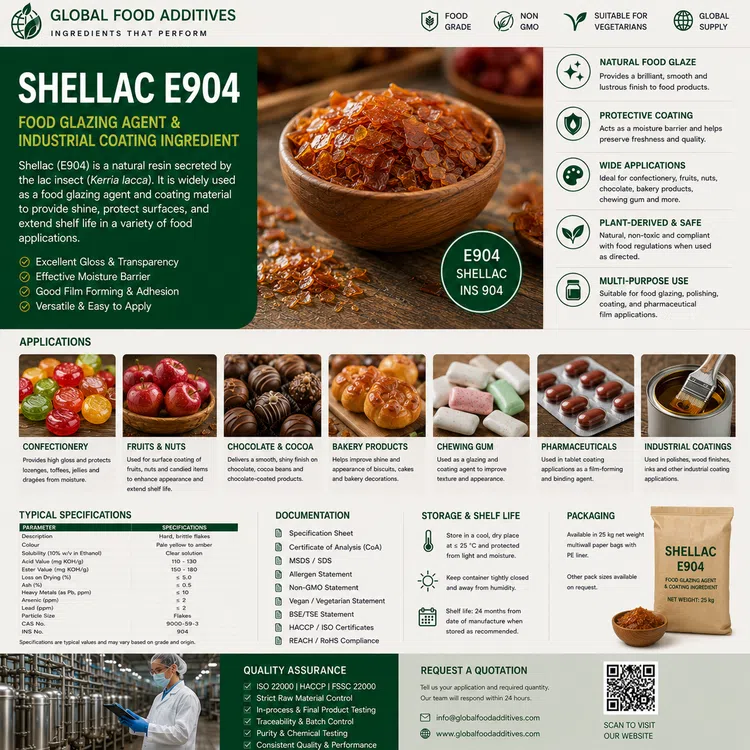
Product identity
| Product | Shellac |
|---|---|
| Common food additive name | Shellac E904 / INS 904 |
| Category | Glazing, Coating & Release Agents |
| Primary function | Glazing agent, surface coating, anti-sticking aid, moisture barrier and protective film former |
| E / INS number | E904 / INS 904 |
| CAS / identity | 9000-59-3 |
| Typical form | Flake, bead, powder, alcoholic solution, aqueous ammoniated solution, emulsion or dispersion grade |
| Typical carrier systems | Ethanol-based, alkaline aqueous, ammoniated aqueous or formulated glaze systems depending on supplier grade |
| Typical positioning | Industrial food glaze for confectionery, chocolate-coated products, fruit, nuts, bakery decoration, chewing gum and tableted products |
Application fit
Potential use areas may include:
- Panned confectionery and sugar-coated sweets
- Chocolate-coated centres and polished chocolate products
- Fresh fruit surface coatings where permitted
- Nut surface treatment and protective finish where permitted
- Chewing gum surface glazing
- Fine bakery decorations, toppings and sweet decorative systems
- Tablets, food supplements and nutraceutical-style coated products
- Coffee bean surface treatment where permitted
Industrial role and performance profile
Shellac is valued in manufacturing because it can form a continuous, glossy and relatively resistant film on the surface of a product. In practical factory use, the ingredient is normally assessed for surface shine, scuff resistance, anti-blocking behaviour, drying time, film uniformity, interaction with colours or flavours, compatibility with waxes or polishing agents, and performance under the product’s expected humidity, temperature and packaging conditions.
Gloss development
Used to improve final appearance on coated sweets, chocolate-coated centres, gum pieces and polished decorative products. Gloss depends on grade, solids level, application rate, tumbling conditions and drying efficiency.
Barrier effect
Creates a surface film that may help slow moisture transfer, reduce tackiness and protect sensitive surfaces during handling, filling, packing, warehousing and distribution.
Anti-sticking performance
Can reduce adhesion between coated pieces, especially where residual surface moisture, sugar syrups, polyols, oils or humid storage conditions create blocking risk.
Process efficiency
Correct grade selection can improve coating uniformity, shorten polishing cycles, reduce rework and support consistent surface finish between batches.
Grade selection guide
Different Shellac grades can behave very differently in production. Before purchasing, confirm the physical form, colour, dewaxed status, solvent system, solids content, carrier declaration, pH where applicable, and whether the grade is intended for direct food glazing, further formulation or industrial processing.
| Grade or format | Industrial relevance | Purchasing note |
|---|---|---|
| Bleached shellac | Preferred where a lighter colour and cleaner visual impact are needed. | Check colour specification, residual bleaching-related parameters where declared, and food additive compliance. |
| Dewaxed shellac | Often selected where clarity, film consistency and reduced wax content are important. | Request wax content or dewaxed declaration and compare against target coating behaviour. |
| Wax-containing shellac | May be relevant where natural wax fraction contributes to polishing, body or surface properties. | Confirm compatibility with the target product, label expectations and customer specification. |
| Flakes, beads or powder | Useful for manufacturers or compounders preparing their own solution or glaze system. | Clarify dissolution method, solvent grade, filtration requirement, particle size and storage sensitivity. |
| Alcoholic solution | Used in fast-drying coating systems where ethanol or permitted alcohol carrier is acceptable. | Verify ethanol quality, solids content, flash point, transport classification, halal/kosher constraints and residual solvent expectations. |
| Aqueous ammoniated solution or dispersion | Can reduce reliance on alcohol systems and may fit specific coating equipment or customer requirements. | Confirm pH, odour, viscosity, preservative system, microbial limits and compatibility with the food surface. |
| Ready-to-use glaze formulation | Suitable when the buyer wants simplified factory handling and consistent coating performance. | Request full composition, additive list, carrier declarations, application instructions and destination-market suitability. |
Key specification parameters to compare
A competitive Shellac offer should not be evaluated by price alone. Industrial buyers should compare the specification, batch data, regulatory documents and practical application support. The parameters below are commonly useful during supplier approval and sample testing.
| Parameter | Why it matters | Recommended buyer action |
|---|---|---|
| Appearance and colour | Influences final shade, clarity and visual consistency on light-coloured coatings. | Request colour range, sample approval and retained reference standard for repeat orders. |
| Solids content or active content | Affects dosage, drying time, film thickness, cost-in-use and process reproducibility. | Compare on delivered active content, not only package price. |
| Wax content / dewaxed status | Impacts clarity, gloss, adhesion, filtration and surface feel. | Specify dewaxed or wax-containing grade according to formulation need. |
| Acid value and saponification value | Useful identity and quality indicators for resin chemistry and batch consistency. | Request values on the specification and confirm lot-to-lot tolerance. |
| Insoluble matter and filtration behaviour | Can affect spray nozzles, coating uniformity and visible defects. | Ask for insoluble matter limits and run an equipment compatibility trial. |
| Moisture / loss on drying | High moisture may affect storage, clumping, dissolution and stability. | Confirm storage condition and shelf-life basis. |
| Heavy metals and contaminants | Critical for food safety, import clearance and customer approval. | Request limits and batch COA values for relevant destination markets. |
| Residual solvents / carrier declaration | Important for labelling, halal review, transport, worker safety and finished product compliance. | Confirm ethanol or other carrier status, SDS classification and residual solvent information. |
| Microbiological profile | Relevant especially for aqueous grades, emulsions and ready-to-use formulations. | Ask for microbial limits if the grade contains water or is used without further heat treatment. |
| Packaging integrity | Protects the product from humidity, contamination, leakage and solvent loss. | Request inner liner, drum type, closure system, pallet configuration and transport classification. |
Application guidance by industry
Confectionery and panned sweets
Shellac can be evaluated for final polishing after sugar panning, chocolate panning or hard-coated confectionery processing. Key factory variables include piece temperature, surface dryness, pan load, air flow, rotation speed, application rate and rest time before packing.
- Useful target: bright finish with reduced sticking.
- Watch point: over-application may create uneven gloss or visible build-up.
- RFQ note: include your current polishing method and target gloss level.
Chocolate-coated products
For chocolate-coated nuts, raisins, lentils or centres, Shellac-based glazes may support shine and handling resistance. Compatibility should be tested with cocoa butter surfaces, vegetable fat coatings and any wax or oil-based finishing system.
- Useful target: clean shine and reduced surface rub-off.
- Watch point: fat bloom, cooling profile and storage temperature affect final appearance.
- RFQ note: provide coating type, centre type and packaging format.
Fruit coatings and nuts
Where permitted, Shellac can be assessed as part of surface coating systems for selected fresh fruit, nuts or seeds. Evaluation should include shine, water vapour barrier, respiration impact, sensory neutrality, drying and market-specific post-harvest regulations.
- Useful target: attractive surface and improved handling protection.
- Watch point: produce coatings require strict regulatory and customer validation.
- RFQ note: specify fruit or nut type and destination country.
Chewing gum and tableted products
Shellac can be considered for polished chewing gum pieces, food supplements and tableted products where surface finish, swallowability, dust control or moisture protection are relevant. Pharmaceutical-style requirements may be stricter than general food requirements.
- Useful target: smooth, glossy and protective surface.
- Watch point: tablet coating claims must match the applicable regulatory category.
- RFQ note: specify whether the product is food, supplement or pharmaceutical.
Bakery decorations and toppings
Shellac may be reviewed for decorative bakery elements, sweet toppings or surface-treated inclusions where shine and reduced tack are needed. Heat exposure, water activity and fat migration should be checked during shelf-life testing.
- Useful target: improved display quality and reduced clumping.
- Watch point: high humidity can reduce coating performance.
- RFQ note: share target shelf life and storage conditions.
Coffee beans and specialty surfaces
Shellac can be considered for specific surface-treatment applications where permitted. For coffee or specialty products, evaluate appearance, aroma neutrality, roast interaction, consumer labelling and export-market expectations.
- Useful target: surface protection and controlled shine.
- Watch point: aroma-sensitive products require sensory testing.
- RFQ note: define whether use is on roasted beans, inclusions or finished pieces.
Processing and formulation notes
Application method
Shellac systems are commonly evaluated in polishing pans, coating drums, spray systems or controlled manual trial methods. Equipment should allow uniform distribution, controlled drying and avoidance of local over-wetting.
Drying and air handling
Air flow, temperature, humidity and solvent evaporation rate strongly influence coating quality. Poor drying can lead to tack, agglomeration, dull finish, streaking or delayed packing readiness.
Layer build
Multiple thin applications usually provide better control than one heavy application. Pilot trials should measure final gloss, piece separation, weight gain, drying time and sensory neutrality.
Compatibility
Check compatibility with colours, flavours, oils, waxes, sugar syrups, polyols, acids, release agents, anti-caking aids, packaging films and any existing glaze system.
Quality, safety and compliance review
For import, factory approval and customer audits, Shellac should be reviewed through both technical and regulatory lenses. A supplier may offer the same product name in different forms, but each form can have different declarations, carrier systems, safety handling requirements and market suitability.
Regulatory status
Confirm whether the grade is permitted for the target country, food category, use level and surface-treatment purpose. Check EU, Codex, FDA, GCC, Turkish, UK, FSANZ or other destination-specific rules as applicable.
Labelling considerations
Review whether the ingredient must be declared as Shellac, E904, glazing agent, coating agent or by another market-specific wording. Carrier solvents and compounded glaze components may also affect the final label.
Dietary and ethical review
Shellac is derived from lac resin of insect origin. Buyers should verify customer requirements for vegan, vegetarian, halal, kosher, allergen, GMO, alcohol carrier and natural-origin claims before approval.
Factory safety
Alcoholic Shellac solutions may require flammable-liquid storage, ventilation, ignition-source control and transport classification review. Always request and follow the current safety data sheet.
Documents to request
- Product specification or technical data sheet with grade name, physical form and intended use.
- Certificate of analysis for the offered batch or representative lot.
- Safety data sheet, especially for alcoholic or formulated liquid grades.
- Food-grade statement and relevant additive compliance declaration.
- Origin statement, manufacturing site information and traceability details.
- Allergen, GMO, irradiation, residual solvent and heavy metal declarations where required.
- Halal, kosher, vegetarian or vegan-positioning statement if relevant to the customer.
- Shelf-life, storage temperature, humidity protection and re-test date information.
- Packaging details, net weight, drum or bag type, pallet configuration and container loading information.
- Market-specific declarations for the importing country or final customer specification.
Packaging, storage and logistics
Shellac flakes, powders and beads should normally be protected from moisture, heat, contamination and direct sunlight. Liquid grades require additional attention to container compatibility, closure integrity, leakage risk, flammability, transport documentation and shelf-life control. For long-distance export shipments, buyers should confirm palletisation, humidity protection, lot coding, certificate availability and whether the product requires dangerous goods handling.
| Packaging question | Why it matters |
|---|---|
| Is the product solid, alcoholic solution, aqueous solution or formulated glaze? | Determines handling, storage, transport classification and factory dosing method. |
| What is the net weight per bag, carton, drum or IBC? | Supports warehouse planning, unit-cost comparison and production batch sizing. |
| Is the product sensitive to humidity or high temperature? | Helps prevent clumping, loss of functionality, solvent loss or reduced shelf life. |
| What is the shelf life and recommended storage condition? | Important for inventory planning, repeat orders and customer audits. |
| Is export documentation available before shipment? | Reduces customs delay and speeds up factory approval. |
How to request this product
Send the product name, intended application, target grade or reference specification, physical form, required documentation, annual and first-order quantity, destination country, packaging preference, Incoterms, expected shipment date and any customer restrictions. If you already purchase Shellac, attach your current specification, COA, SDS or label declaration so supplier options can be compared accurately.
Recommended RFQ checklist
- Product: Shellac E904 / INS 904
- Application: confectionery, fruit coating, chewing gum, bakery decoration, supplement tablet or other
- Required grade: bleached, dewaxed, wax-containing, flake, powder, alcoholic solution, aqueous solution or ready-to-use glaze
- Target solids content or active content if liquid
- Required documents: TDS, COA, SDS, allergen, GMO, origin, halal, kosher, residual solvent, heavy metal declaration
- Destination country and target regulatory market
- Quantity for sample, trial order and commercial order
- Preferred packaging and pallet requirements
- Delivery term, port, airport or warehouse destination
- Any existing approved reference sample or competitor specification
Useful answers
What is Shellac E904 used for in food manufacturing?
Shellac E904 is typically evaluated as a glazing and coating ingredient for surface shine, moisture barrier, anti-sticking performance and protective film formation. It is commonly discussed for confectionery, chocolate products, chewing gum, selected fruit coatings, nuts, bakery decorations and tableted products where permitted.
Is Shellac the same as confectionery glaze?
Shellac can be a key component in confectionery glaze systems, but commercial glaze products may also contain carriers, solvents, waxes, emulsifiers or other formulation components. Buyers should review the full composition, additive status and label declaration for the exact grade being purchased.
Which Shellac grade is best for industrial coating?
The best grade depends on the application. Bleached or dewaxed grades may be preferred for lighter-coloured products and cleaner appearance. Alcoholic solutions may dry quickly, while aqueous systems may fit different processing or customer requirements. Pilot testing is strongly recommended.
Which quality parameters should be compared between suppliers?
Important parameters include appearance, colour, solids content, wax content, acid value, saponification value, insoluble matter, moisture or loss on drying, heavy metals, residual solvents, microbiological profile for aqueous grades, shelf life and packaging integrity.
Can Global Food Additives source Shellac E904?
Global Food Additives can review sourcing options for Shellac E904 according to target specification, application, required documents, quantity, destination, packaging preference and shipment schedule.
Which documents should be requested?
Buyers commonly request a technical data sheet, product specification, certificate of analysis, safety data sheet, origin statement, shelf-life information, storage conditions, allergen statement, GMO statement, residual solvent information, heavy metal declaration, label draft and packing details.
Is Shellac E904 permitted in every country?
No. Food additive permission depends on destination-market rules, food category, use level, surface-treatment restrictions, label requirements and buyer responsibility. Always verify local regulations before commercial use.
Is Shellac suitable for vegan products?
Shellac is derived from lac resin of insect origin. Some customers may not accept it for vegan-positioned products. The buyer should confirm vegan, vegetarian, halal, kosher and customer-specific requirements before approval.
Tell us which Shellac grade or food additive you need.
Send product name, target specification, application, quantity, destination country, packaging preference, delivery term and document requirements. Our team will review your inquiry and respond from [email protected].
Your message has been received. You will be redirected to the home page.