
Sodium Alginate E401
Sodium Alginate is a seaweed-derived food hydrocolloid used by manufacturers for thickening, stabilization, suspension, water binding, calcium gelation, encapsulation, film formation and controlled texture design. It is especially useful in dairy systems, desserts, sauces, beverages, restructured foods, meat alternatives, bakery fillings, fruit preparations and specialty gel systems where viscosity, gel strength, setting behaviour and process control are important. This page is prepared as a detailed technical sourcing guide for purchasing, R&D, QA, production and regulatory teams.
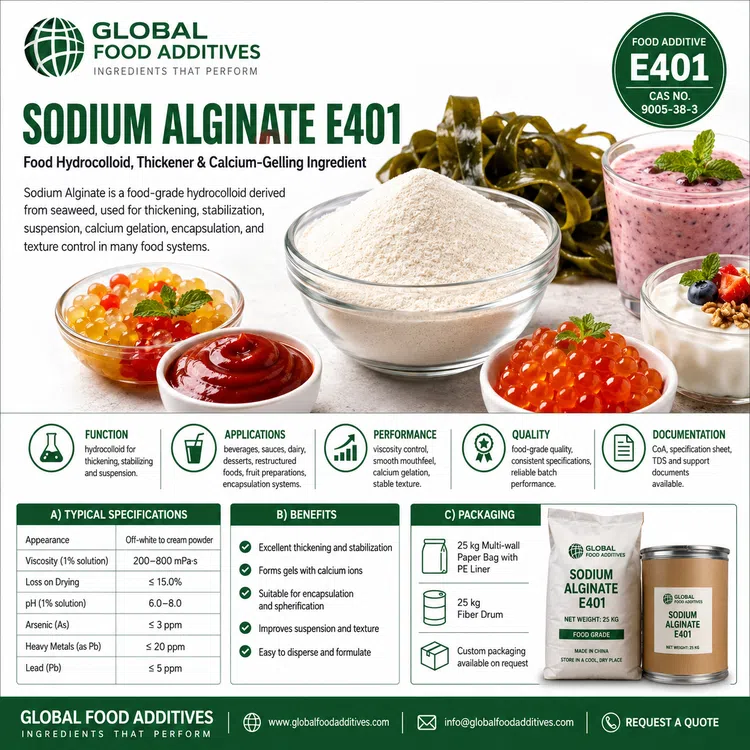
Product identity
| Product | Sodium Alginate |
|---|---|
| Common names | E401; alginate; sodium salt of alginic acid; food-grade sodium alginate |
| Category | Hydrocolloids, Gums & Gelling Agents |
| Function | Thickener, stabilizer, suspension aid, calcium-gelling ingredient, water-binding ingredient and encapsulation support hydrocolloid |
| E / INS number | E401 |
| CAS / identity | 9005-38-3 |
| Typical chemistry | Sodium salt of alginic acid, a brown seaweed-derived polysaccharide composed of mannuronic and guluronic acid blocks |
| Typical source | Brown seaweed species depending on supplier, origin and extraction process |
| Typical form | Fine powder, granular powder, instantized grade or controlled-viscosity grade |
| Functional profile | Cold-water hydration, viscosity build, calcium-triggered gelation, suspension, water binding, film formation and controlled release |
Application fit
Potential use areas may include food systems where controlled viscosity, calcium gelation, suspension or water management is required:
- Dairy desserts, fermented dairy systems, cream fillings and spoonable products
- Fruit preparations, bakery fillings, dessert gels and heat-stable fruit systems
- Sauces, dressings, condiments, savoury systems and culinary preparations
- Beverages, suspension systems, low-pH systems and drinkable textures where suitable
- Meat alternatives, restructured foods, plant-based seafood and formed products
- Encapsulation, spherification, controlled-release systems and gel bead applications
- Coatings, films, edible barriers and specialty texture systems where permitted
Technical overview
Sodium Alginate is produced from alginic acid extracted from brown seaweed and converted into the sodium salt form for food use. It is valued because it can hydrate in water to create viscosity and can form gels when exposed to calcium ions. This combination of thickening and ion-triggered gelation makes Sodium Alginate different from many hydrocolloids that mainly provide viscosity or thermal gelation.
Industrial performance depends on viscosity grade, particle size, hydration behaviour, M/G structure, molecular weight, calcium reactivity, pH, ionic strength, temperature, solids content, shear, order of addition and interaction with other ingredients. A high-viscosity grade for sauce stabilization may not perform like a low-viscosity grade used for encapsulation or a high-guluronic grade selected for strong calcium gels.
Industrial functions
- Thickening: builds viscosity in aqueous systems and supports texture control in sauces, fillings and preparations.
- Calcium gelation: forms gels in the presence of calcium ions for structured products, beads, coatings and reformed foods.
- Suspension: helps suspend particulates, pulp, cocoa, minerals or insoluble ingredients in compatible systems.
- Water binding: helps manage free water, syneresis and moisture migration in selected food matrices.
- Stabilization: contributes body, texture and phase stability in dairy, plant-based and culinary systems.
- Encapsulation: supports bead formation and controlled-release structures through calcium-alginate gel networks.
- Film formation: may support edible films, coatings and surface-barrier applications where technically and legally suitable.
Specification review points
Industrial buyers should compare every offered grade against the intended application and internal quality standard. Common review parameters include:
- Viscosity grade, viscosity method, concentration, temperature and spindle conditions
- Gel strength, calcium reactivity and setting behaviour where relevant
- Mannuronic-to-guluronic acid ratio or G-block information where available
- Particle size, mesh profile, dispersibility and dusting behaviour
- Moisture, ash, pH, insoluble matter and acid-insoluble ash
- Loss on drying, water activity and caking tendency
- Heavy metals, lead, arsenic, cadmium, mercury and iodine where required
- Microbiological limits including total plate count, yeast, mould and pathogens where required
- Source, seaweed origin, extraction process, shelf life and batch traceability
- Allergen, GMO, BSE/TSE, halal, kosher and vegan declarations where required
Hydration and processing behaviour
Sodium Alginate hydrates in water, but poor dispersion can create lumps or “fish-eyes” that are difficult to break down. For dry addition, it is often useful to pre-blend Sodium Alginate with sugar, maltodextrin, salt, starch or other dry ingredients before introducing it to water. For liquid preparation, strong agitation, controlled powder addition and sufficient hydration time are usually required.
Hydration is influenced by particle size, viscosity grade, water temperature, shear, solids content, sugar level, salt level, pH and calcium availability. Premature contact with free calcium can cause localized gel particles or incomplete hydration. In calcium-containing systems, formulators may need to use sequestrants, controlled calcium sources or staged addition methods to manage gelation.
Process and formulation considerations
- Define whether the alginate is used for viscosity, suspension, gelation, encapsulation, film formation or water binding.
- Disperse powder properly before full hydration to avoid lumps and incomplete functionality.
- Control calcium availability, pH, shear, hydration time and addition order in gelled systems.
- Measure viscosity under actual processing conditions, not only at supplier laboratory conditions.
- Evaluate compatibility with proteins, minerals, acids, sugars, starches, gums, salts and preservatives.
- Test heat processing, cooling, freeze-thaw exposure, storage time and packaging interaction where relevant.
- Run pilot trials before changing supplier, viscosity grade, particle size or seaweed-source profile.
Quality assurance checklist
- Confirm supplier, manufacturer, seaweed origin and batch traceability.
- Check Certificate of Analysis values against the approved specification.
- Verify E401 declaration, food additive grade and destination-market suitability.
- Review viscosity method and compare results under the same test conditions.
- Confirm heavy metal, arsenic, cadmium, mercury, lead and microbiological limits where required.
- Check packaging integrity, caking condition, lot coding, expiry or retest date and storage conditions.
Calcium gelation and texture design
The most distinctive functionality of Sodium Alginate is calcium-triggered gelation. When calcium ions interact with alginate chains, a calcium alginate network forms. Gel texture can range from soft and elastic to firm and brittle depending on alginate structure, calcium source, concentration, pH, temperature, solids and mixing method. High-guluronic alginates generally support firmer, more brittle gels, while high-mannuronic grades may provide softer or more elastic textures.
Calcium can be introduced externally, as in dipping or setting baths, or internally through controlled-release calcium salts. Internal gelation systems may also require sequestrants or acid-release strategies to control setting speed. For industrial production, the buyer should define gel strength, setting time, elasticity, cut resistance, syneresis, heat tolerance, freeze-thaw behaviour and sensory texture before approving the grade.
Application-specific purchasing guidance
For dairy desserts and spoonable products, Sodium Alginate may be evaluated for viscosity, body, suspension, gel texture and syneresis control. The formulation team should review calcium level, milk protein interaction, pH, heat process, sugar level, stabilizer system and refrigerated shelf-life stability. Direct substitution with pectin, carrageenan, starch or gelatin may not deliver the same gelation profile.
For fruit preparations, bakery fillings and dessert gels, the main targets are heat stability, freeze-thaw stability, fruit suspension, controlled gel texture, pumpability and syneresis control. Alginate systems can be designed to set with calcium, but the calcium content of fruit, acidity and processing temperature must be reviewed carefully.
For sauces, dressings and savoury systems, Sodium Alginate may provide body, viscosity and suspension. Buyers should evaluate salt level, acidity, oil phase, shear, pasteurization, filling temperature and final mouthfeel. In high-calcium or mineral-rich systems, uncontrolled gelation or graininess can occur if the grade and process are not matched.
For meat alternatives, restructured foods and plant-based seafood, Sodium Alginate can support binding, formed structures and gel networks when calcium setting is controlled. Trials should evaluate bite, elasticity, sliceability, cooking behaviour, purge, freeze-thaw performance and interaction with plant proteins, starches, oils and fibres.
Encapsulation and specialty gel systems
Sodium Alginate is widely evaluated in encapsulation and bead-making systems because calcium alginate gels can form under mild conditions. This may be useful for flavour beads, controlled-release systems, texture inclusions, spherification-style products, nutritional beads or specialty food structures where permitted. Encapsulation performance depends on alginate viscosity, calcium bath concentration, droplet size, contact time, pH and solids content.
For encapsulation projects, buyers should request application data and define the process: droplet formation method, calcium source, desired bead size, gel strength, leakage tolerance, heat exposure, storage medium, pH, osmotic pressure and shelf-life target. Small differences in alginate grade can significantly affect bead formation and finished texture.
Compatibility with other hydrocolloids
Sodium Alginate can be used with starches, pectin, carrageenan, xanthan gum, guar gum, locust bean gum, cellulose derivatives, proteins, fibres and emulsifiers. Blends may be designed for viscosity, gel strength, suspension, pumpability, freeze-thaw stability, heat resistance or mouthfeel. The correct combination depends on the food category and desired texture profile.
It should not automatically be treated as a one-to-one replacement for carrageenan, agar, pectin, gelatin, CMC, xanthan or modified starch. Each hydrocolloid has different hydration, gelation, pH tolerance, ion sensitivity, heat behaviour and sensory impact. The buyer should define the exact texture and process target before approving substitution.
pH, salts and mineral sensitivity
Sodium Alginate performance is sensitive to pH and multivalent ions. Low pH can reduce solubility or affect viscosity, while calcium and other divalent cations can trigger gelation. In mineral-fortified beverages, dairy systems or calcium-rich formulations, alginate grade and process design must be reviewed carefully to avoid premature gelation, precipitation, graininess or viscosity instability.
Sequestrants such as phosphates or citrates may be used in some systems to control calcium availability, subject to regulations and formulation requirements. The choice of sequestrant, calcium source and alginate grade should be validated through bench testing and pilot production.
Storage and handling
Store Sodium Alginate in original, tightly closed packaging in a clean, dry, cool and well-ventilated warehouse. Protect the product from moisture, condensation, direct sunlight, foreign odours, pests and contamination. Alginate powders can absorb moisture and form lumps, so opened packaging should be resealed immediately after use and handled according to the supplier's recommendations.
Before production release, check the product name, batch number, expiry or retest date, packaging condition, appearance, odour and any signs of caking, wetting, foreign matter or contamination. Production teams should follow FIFO or FEFO stock rotation and maintain traceability from warehouse receipt to finished product batch.
Packaging and logistics
Packaging depends on supplier, viscosity grade, bulk density and order quantity. Common industrial formats may include multi-wall paper bags with inner liners, polyethylene-lined bags, cartons, fibre drums or palletized export units. For moisture-sensitive grades, buyers should confirm inner liner quality, resealability, pallet protection and storage instructions before order confirmation.
- Small sample packs for laboratory hydration, viscosity and gelation trials
- Bagged fine powder or granular grades for regular industrial production
- Fibre drums or cartons for sensitive grades or customer-specific packing
- Instantized or low-dust grades for improved plant handling where available
- Palletized export packing with batch labels, moisture protection and handling marks
Regulatory and compliance notes
Sodium Alginate is identified as E401 in food additive contexts, but permitted use, technical function, food category, maximum level and label declaration can differ by country and customer standard. Buyers must verify the regulatory status of the offered grade in the destination market and confirm that it matches the final food category, use level, technical function, label declaration and customer requirements.
For export supply, customers may require halal, kosher, vegan, non-GMO, allergen, BSE/TSE, heavy metal, arsenic, cadmium, mercury, lead, iodine, microbiological, origin, seaweed-source and food safety declarations. The exact document package should be agreed before order confirmation, especially for retailer-controlled, private-label, infant, dairy, beverage, plant-based, vegan, organic or clean-label-positioned products.
Documents to request
- Product specification or technical data sheet
- Certificate of Analysis for the available batch or lot
- Safety Data Sheet and handling guidance
- Food additive grade statement and E401 reference where applicable
- Viscosity method, concentration, temperature and measurement conditions
- Gel strength, calcium reactivity or M/G ratio information where available
- Particle size, moisture, pH, ash, insoluble matter and acid-insoluble ash information
- Origin, seaweed source, manufacturer, shelf-life and storage information
- Allergen, GMO, BSE/TSE, halal, kosher and vegan declarations where required
- Heavy metal, lead, arsenic, cadmium, mercury and iodine information where applicable
- Microbiological specification and pathogen absence statement where required
- Packaging details, pallet configuration and batch traceability information
- Market-specific declarations requested by the destination country or final customer
Commercial sourcing guidance
When reviewing Sodium Alginate, compare the supplier specification against the intended food application, process conditions, target viscosity, gelation requirement, label expectations and local rules. For industrial purchasing, the most useful inquiry normally includes target viscosity grade, application, desired function, particle size, gelation profile, packaging size, quantity, destination, Incoterm, delivery schedule and document requirements.
If the product is used in a technical hydrocolloid system, the buyer should describe the complete application: food category, pH, calcium level, salt level, sugar level, heat process, shear conditions, desired viscosity, desired gel texture, storage temperature, packaging format and shelf-life objective. This helps determine whether Sodium Alginate, calcium alginate, propylene glycol alginate, carrageenan, pectin, CMC, xanthan, agar or another hydrocolloid system should be evaluated.
How to request this product
Send the product name, E number, target viscosity grade, reference specification, application, calcium-gelation requirement, particle-size preference, quantity, destination country, packaging preference, expected shipment date and required documents. If you already purchase Sodium Alginate, attach or describe your existing specification, label, Certificate of Analysis, viscosity target, gel-strength requirement or approved supplier standard so supplier options can be compared more accurately.
Useful answers
What is Sodium Alginate used for in food manufacturing?
Sodium Alginate E401 is typically used for viscosity, suspension, gel texture, water binding, stabilization, encapsulation and calcium-triggered gel formation. Exact suitability depends on grade, viscosity, calcium availability, pH, application, process, dosage, regulations and supplier documents.
Which applications commonly use Sodium Alginate?
It may be evaluated in dairy, desserts, sauces, beverages, fruit preparations, bakery fillings, meat alternatives, plant-based foods, restructured foods, encapsulation systems, edible coatings and specialty gel products where alginate functionality is technically useful and legally permitted.
Which documents should be requested?
Buyers commonly request a technical data sheet or specification, Certificate of Analysis, Safety Data Sheet, food additive grade statement, E401 reference, viscosity data, particle-size data, gelation information where available, origin statement, shelf-life information, storage guidance, impurity information, allergen statement, GMO statement, halal or kosher documents where required, label details and packaging information.
Can Global Food Additives source Sodium Alginate?
Global Food Additives can review sourcing options for Sodium Alginate according to target specification, viscosity grade, gelation profile, application, quantity, destination, packaging and required documentation.
Is this product permitted in every country?
No. Food additive use depends on destination-market rules, food category, thickening or gelling function, use level, label requirements and buyer responsibility. The buyer should verify regulatory status before commercial use.
How should buyers compare Sodium Alginate suppliers?
Buyers should compare viscosity grade, particle size, hydration behaviour, gel strength, calcium reactivity, M/G information where available, Certificate of Analysis values, regulatory documents, heavy metal controls, microbiological limits, packaging, shelf life, minimum order quantity, lead time, origin, price stability and supplier change-control practices.
Tell us which food additive or ingredient you need.
Send product names, target specifications, quantity, destination country, packaging preference, delivery term, and document requirements. Our team will review your inquiry and respond from orders@foodgradeadditives.com.
Your message has been received. You will be redirected to the home page.