
Sodium Carbonate E500(i)
Sodium Carbonate, also known as food-grade soda ash or disodium carbonate, is an alkaline carbonate used in industrial food manufacturing for pH adjustment, acidity regulation, leavening system balance, dough and batter alkalinity control, process buffering and selected processing-aid functions. This page is designed for purchasing teams, R&D technologists, QA departments and import managers who need structured technical information before requesting a quotation.
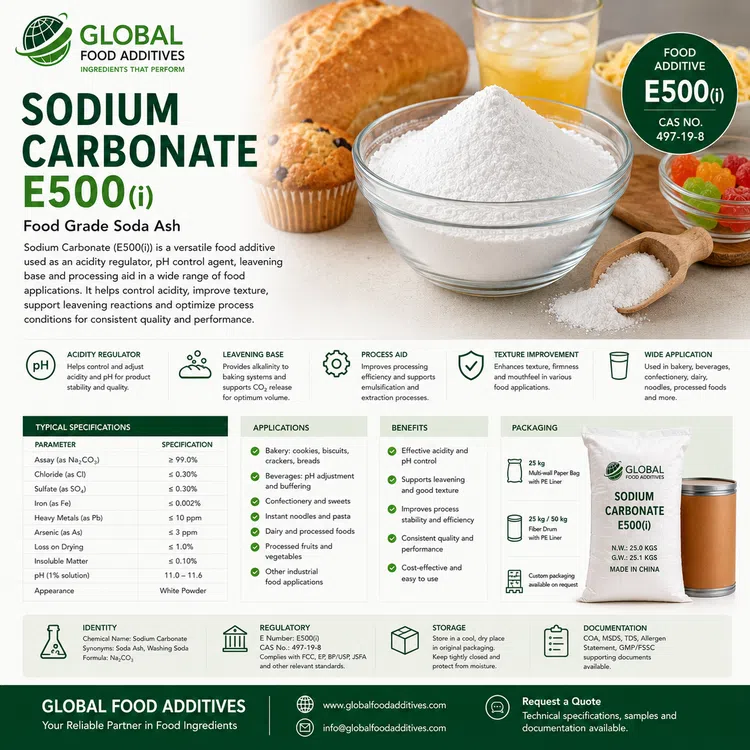
Product identity
| Product name | Sodium Carbonate |
|---|---|
| Common names | Soda ash, disodium carbonate, sodium salt of carbonic acid |
| Chemical formula | Na2CO3 |
| CAS number | 497-19-8 |
| E / INS number | E500(i) / INS 500(i) |
| Category | Leavening, Raising & Dough Systems |
| Primary function | Acidity regulator, pH control agent, leavening base and processing aid |
| Typical appearance | White crystalline powder, granular powder, light soda ash or dense soda ash depending on grade |
| Solubility profile | Water-soluble alkaline salt; insoluble or poorly soluble in many organic solvents |
Application fit
Food-grade Sodium Carbonate may be considered where a stronger alkaline carbonate is needed compared with Sodium Bicarbonate. Typical use areas may include:
- Cakes, biscuits and chemically raised bakery systems
- Pancake, waffle, batter and premix applications
- Tortillas, flatbreads and controlled dough alkalinity systems
- Instant noodle, alkaline noodle and dough texture adjustment systems
- Cocoa, confectionery and alkalized flavor-development processes where permitted
- Dry blends requiring an alkaline component with controlled particle size
Technical overview for industrial buyers
Sodium Carbonate is a highly practical alkaline ingredient for manufacturers that need controlled pH correction, neutralization of acidic components, buffering support or alkaline reaction capacity. In food systems, it is normally evaluated not only by chemical identity, but also by assay, alkalinity, particle size, bulk density, moisture, insoluble matter, heavy metals, origin, packaging integrity and consistency between lots. Compared with Sodium Bicarbonate, Sodium Carbonate provides higher alkalinity and can create a more pronounced pH shift, so it should be tested carefully in pilot batches before commercial scaling.
Functional role in formulation
- pH adjustment: raises pH in acidic or low-pH food matrices and helps set an alkaline processing environment.
- Leavening balance: can act as an alkaline component in chemical leavening systems when matched with suitable food acids.
- Buffering support: contributes carbonate alkalinity that can help moderate pH changes during processing.
- Texture influence: in selected dough and noodle systems, alkalinity can affect protein behavior, starch gelatinization, color and bite.
- Processing aid role: may be evaluated for neutralization, cleaning-interface control or process-water alkalinity where regulations allow.
Key buying parameters
| Grade | Food grade; confirm compliance against destination-market and buyer specification |
|---|---|
| Assay | Request Na2CO3 assay and test method on specification and COA |
| Particle size | Important for dry blending, dispersion speed, dusting behavior and premix homogeneity |
| Bulk density | Relevant for dosing, packaging volume, silo handling and dry mix flow |
| Moisture | Low and controlled moisture supports flowability and storage stability |
| Insoluble matter | Review limits when used in beverages, sauces, brines or clear process solutions |
| Heavy metals | Request lead, arsenic, cadmium, mercury or other market-specific impurity limits where required |
| Packaging | Commonly supplied in multiwall bags, PE-lined bags, big bags or palletized export packaging |
Industrial application notes
In bakery and premix systems, Sodium Carbonate should be evaluated in relation to the total leavening system. The acid-to-alkali ratio, reaction temperature, moisture availability, mixing time, batter viscosity and baking profile all influence gas release, crumb structure and final sensory quality. Excess alkalinity may cause soapy, bitter or mineral notes, excessive browning, color shift or unstable dough behavior. For this reason, R&D teams normally compare Sodium Carbonate with Sodium Bicarbonate, Sodium Acid Pyrophosphate, Monocalcium Phosphate, Glucono Delta Lactone, citric acid or other leavening acids depending on product design.
In noodle and dough systems, carbonate alkalinity may influence yellow color development, firmness, elasticity and cooked texture. Selection between Sodium Carbonate, Potassium Carbonate or blended alkaline salts depends on target bite, regional product standard, flavor tolerance, sodium declaration and local regulations. In cocoa or alkalized processing, carbonate selection must be reviewed carefully because pH, color, flavor, solubility and regulatory permissions are highly application-specific.
Process and handling considerations
- Use dust-control measures during weighing, dumping and dry blending.
- Store in closed packaging away from moisture, condensation and strong acids.
- Confirm compatibility with acids, ammonium salts and moisture-sensitive ingredients.
- For premixes, validate segregation risk when particle size or density differs from other components.
- For solutions, add gradually with agitation and confirm final pH after full dissolution.
- Use corrosion-compatible equipment and verify cleaning procedures for alkaline residues.
Quality control checkpoints
- Appearance, color and foreign matter inspection
- Assay and alkalinity confirmation
- Moisture or loss on drying
- Water-insoluble matter
- Particle size distribution or sieve retention
- Bulk density and flow behavior
- Heavy metals and impurity profile
- Lot traceability, production date and shelf-life review
Regulatory and compliance notes
Sodium Carbonate is commonly referenced under the E500 carbonate family, with Sodium Carbonate identified as E500(i). Regulatory status, permitted food categories, use levels, purity requirements and label declarations may differ between the European Union, United Kingdom, United States, Codex-based markets, GCC countries, Türkiye and other destination markets. Buyers should request the exact grade documentation and verify final suitability with their regulatory team or local consultant before commercial production.
Recommended documents to request
- Product specification or technical data sheet with assay, impurity and physical parameters
- Certificate of analysis for available batch or lot
- Safety data sheet where applicable
- Food-grade declaration and statement of intended food use
- Origin statement and manufacturer information where available
- Allergen, GMO, vegan, halal, kosher or animal-origin declarations when required
- Heavy metals statement and market-specific contaminant compliance where applicable
- Shelf-life, storage condition and handling recommendation
- Label draft, net weight, bag dimensions, pallet configuration and container loading estimate
- Traceability information, batch coding format and recall-support documentation
Specification information useful for quotation
For a faster and more accurate quotation, send the target specification, required grade, annual and first-order quantity, destination country, delivery term, preferred packaging, required certifications, inspection requirements and expected shipment date. If you currently purchase Sodium Carbonate, share the existing COA, product label, technical data sheet or benchmark supplier specification so equivalent options can be compared by assay, particle size, density, origin, documentation and logistics cost.
Packaging and logistics
Industrial Sodium Carbonate is usually quoted according to packaging type, palletization, container loading, port of loading, Incoterms and destination. Moisture protection is important because carbonate powders can cake or lose flowability if exposed to humidity. Export shipments should be reviewed for bag strength, pallet wrapping, container humidity control, documentation deadlines and destination customs requirements.
Commercial evaluation criteria
- Food-grade status and documentation completeness
- Consistency of assay, moisture and physical form
- Lead time, stock position and minimum order quantity
- Packaging suitability for the buyer’s handling system
- Regulatory fit for the destination market
- Total landed cost, not only unit price
How to request this product
Send the product name, grade, reference specification, target function, quantity, destination country, packaging preference, expected shipment date and required documents. If the ingredient will be used in bakery, noodles, cocoa, confectionery, sauces, brines or premixes, include the application category so the supplier review can focus on the most relevant technical parameters.
Useful answers
What is Sodium Carbonate used for in food manufacturing?
Sodium Carbonate is used as an alkaline ingredient for pH control, acidity regulation, leavening system balance, buffering and selected processing-aid functions. It may be evaluated in bakery systems, premixes, noodles, cocoa-related processes and other applications where permitted by local rules.
Is Sodium Carbonate the same as Sodium Bicarbonate?
No. Sodium Carbonate is Na2CO3 and is more alkaline than Sodium Bicarbonate, NaHCO3. Both belong to the E500 family, but they perform differently in pH adjustment, reaction speed, carbon dioxide release and sensory impact.
Which grade should food manufacturers request?
Food manufacturers should request food-grade Sodium Carbonate with a clear product specification, certificate of analysis, food-use declaration, impurity limits, shelf-life information, packaging details and destination-market compliance documents.
Can Global Food Additives source Sodium Carbonate?
Global Food Additives can review sourcing options for Sodium Carbonate according to target specification, grade, quantity, destination, packaging, documentation needs and logistics preference.
Which documents should be requested?
Buyers commonly request a technical data sheet, certificate of analysis, safety data sheet, food-grade declaration, origin statement, allergen statement, GMO status, heavy metal limits, shelf-life and storage information, label details and packing configuration.
Is this product permitted in every country?
No. Food additive use depends on destination-market rules, food category, use level, label requirements and buyer responsibility. Always verify local regulations before commercial use.
Tell us which food additive or ingredient you need.
Send product names, target specifications, quantity, destination country, packaging preference, delivery term, and document requirements. Our team will review your inquiry and respond from orders@foodgradeadditives.com.
Your message has been received. You will be redirected to the home page.