
Sodium Propionate
Sodium Propionate is a food preservative and antimicrobial shelf-life support ingredient used for mold control, rope-spoilage risk reduction, yeast inhibition support and formulation stability in selected food systems where permitted. It is especially relevant for manufacturers that need controlled preservation performance without major changes to flavor, color, texture or processing flow.
In industrial use, Sodium Propionate is not evaluated only as a commodity preservative. Buyers should compare active content, particle size, solubility, moisture level, impurity profile, sodium contribution, packaging integrity, regulatory status and batch documentation. Finished-product performance depends on food matrix, pH, water activity, processing hygiene, packaging system, storage temperature and the target shelf-life profile.
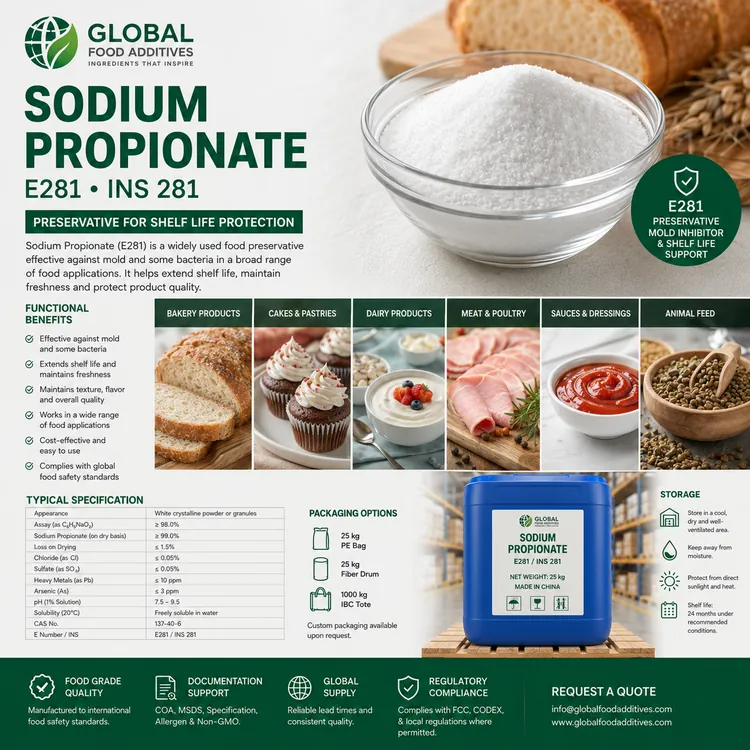
Product identity
| Product | Sodium Propionate |
|---|---|
| Common name | Sodium propanoate |
| Category | Preservatives & Antimicrobials |
| Function | Preservative / antimicrobial shelf-life support |
| E / INS number | E281 / INS 281 |
| CAS / identity | 137-40-6 |
| Chemical formula | C3H5NaO2 |
| Ingredient family | Propionate salt of propionic acid |
| Typical form | White crystalline powder, granule, fine powder or liquid solution depending on product |
| Main technical role | Mold inhibition, microbial stability support and shelf-life extension |
| Use status | Confirm permitted food categories, use levels and label declaration by destination market |
Application fit
Potential use areas may include:
- Bakery products and packaged bread systems
- Cakes, tortillas, flatbreads and sweet baked goods
- Cheese and processed cheese systems where permitted
- Sauces, fillings, dressings and high-moisture prepared foods
- Beverage concentrates and selected acidic liquid systems
- Meat processing and cured-meat systems where permitted
- Premixes and dry blends requiring preservative functionality
- Foodservice and industrial shelf-life extension programs
Industrial function and preservation value
Sodium Propionate belongs to the propionate preservative family and is used to help inhibit mold growth and support shelf-life stability. In practical food manufacturing, its effectiveness is connected to product pH, available moisture, storage conditions, sanitation, packaging atmosphere and total preservative system. It is often considered in applications where mold growth is a primary spoilage risk and where the manufacturer needs a preservative that can be dosed consistently in dry or liquid production systems.
For bakeries and processed-food manufacturers, the commercial value of Sodium Propionate is measured by finished-product shelf-life improvement, waste reduction, route-to-market flexibility, distribution temperature tolerance and reduced spoilage complaints. For purchasing teams, the most important comparison is not only price per kilogram, but also cost-in-use, assay consistency, supplier reliability, documentation strength and compatibility with the finished product's regulatory market.
Technical specification points to compare
Composition and assay
- Assay or purity on the supplier's declared basis
- Propionate content and calculation basis
- Sodium contribution to the finished formulation
- Moisture or loss-on-drying value
- Acidity, alkalinity or pH of solution where specified
- Compliance with food additive, FCC, JECFA, EU or customer-specific standards where required
Impurity and safety controls
- Heavy metals and elemental impurity limits
- Lead, arsenic, mercury and cadmium statements where required
- Residual solvent or process-residue statements where applicable
- Microbiological limits for food-grade applications
- Foreign matter, odor and appearance control
- Allergen, GMO, irradiation and contamination statements where required
Physical properties
- Particle size or mesh distribution
- Bulk density and flowability
- Solubility and dissolution speed
- Dusting tendency and handling behavior
- Color, odor and crystalline appearance
- Hygroscopicity and moisture-protection requirements
Process compatibility
- Suitability for dry blending, dough mixing, syrup preparation or liquid dosing
- Interaction with leavening systems, acids, salts and emulsifiers
- Distribution uniformity at target addition level
- Thermal and process exposure in bakery or sauce systems
- Effect on flavor, sodium declaration and finished-product positioning
- Compatibility with packaging and target shelf-life program
Formulation and application guidance
Sodium Propionate should be selected according to the product matrix and the preservation challenge. In many foods, propionate performance is linked to the presence of propionic acid in the system, which is influenced by pH. Lower-pH systems generally improve the active preservative fraction, while neutral or high-pH systems may require different preservative strategies, stronger hurdle technology or validation testing.
- Bakery systems: evaluate mold inhibition, dough compatibility, yeast performance, crumb structure, flavor impact and uniform distribution throughout the dough or batter.
- Flatbreads and tortillas: consider water activity, package condensation, hot-packing conditions, cooling profile and storage temperature during distribution.
- Cheese and dairy systems: confirm permitted use, pH compatibility, flavor impact, brine or surface-treatment method and interaction with cultures.
- Sauces and fillings: review pH, salt level, soluble solids, heat treatment, preservative synergy and post-process contamination control.
- Beverage concentrates: confirm solubility, clarity, pH, flavor compatibility and label rules for the destination market.
- Meat systems: verify whether the ingredient is permitted in the specific product category and assess interaction with curing systems, sodium limits and label requirements.
Preservative-system design
Sodium Propionate is normally part of a broader shelf-life strategy. A successful preservative system may combine pH control, water activity management, sanitation, thermal processing, packaging design, oxygen control, storage-temperature control and compatible antimicrobial ingredients. The correct system should be validated through challenge testing, accelerated shelf-life trials or real-time storage studies according to the buyer's product risk profile.
Performance drivers
- Product pH and buffering capacity
- Water activity and moisture migration
- Initial microbial load and plant hygiene
- Packaging atmosphere and seal integrity
- Storage temperature and distribution route
- Target shelf life and consumer handling conditions
Common validation work
- Bench-top preservative screening
- Microbial challenge testing where required
- Accelerated and real-time shelf-life studies
- Packaging condensation and mold-risk assessment
- Finished-product sensory checks
- Label and regulatory confirmation before launch
Sodium Propionate vs. other propionates
Sodium Propionate, Calcium Propionate and Potassium Propionate are related preservative salts, but they are not always interchangeable. The best choice depends on the finished product, mineral declaration, sodium or calcium contribution, solubility, flavor expectations, leavening system and local regulations. Calcium Propionate is widely associated with bakery applications, while Sodium Propionate may be preferred when a sodium salt, different solubility behavior or formulation-specific compatibility is desired.
| Ingredient | Typical consideration |
|---|---|
| Sodium Propionate | Useful where sodium salt behavior, solubility, dry blending or liquid dosing compatibility is preferred. |
| Calcium Propionate | Common bakery preservative; contributes calcium and may be preferred in many bread and dough systems. |
| Potassium Propionate | May be considered where potassium contribution or specific formulation behavior is preferred, subject to local rules. |
| Propionic Acid | Active acid form with strong odor and handling considerations; commonly used where acid dosing is practical and permitted. |
Quality and food safety review
A robust Sodium Propionate sourcing review should include more than basic identity and price. Buyers should confirm manufacturing grade, assay, impurity profile, microbiological status, packaging integrity, shelf life, origin, traceability and supplier change-control capability. For audited food, bakery, dairy, sauce and export supply chains, documentation quality is often as important as the product itself.
Before commercial approval, the buyer should compare the supplier specification against the intended product category, process conditions, target shelf life, destination-market additive rules and customer requirements. If the ingredient will be used in a branded export product, regulatory and labeling review should be completed before production scale-up.
Regulatory and labeling considerations
Sodium Propionate is identified with E281 / INS 281, but permitted use depends on destination market, food category and maximum permitted level. Some markets may allow it only in selected applications or may require specific preservative declarations on the ingredient list. The finished-product label may need to declare the ingredient as Sodium Propionate, preservative, E281, INS 281 or another market-specific format.
Global Food Additives can assist with supplier communication and document collection; however, final responsibility for regulatory approval, use level, product claims, finished-product labeling and market placement remains with the buyer, importer, brand owner or manufacturer.
Documents to request
- Product specification or technical data sheet
- Batch-specific certificate of analysis for available lot
- Safety data sheet in the required language or format
- Food-grade or intended-use declaration where available
- Heavy metal and impurity statement
- Microbiological specification where relevant
- Allergen, GMO, vegan, halal or kosher statements where required
- Origin, manufacturer, shelf-life and storage information
- Label draft, packaging details and pallet configuration
- Manufacturing site certification such as GMP, HACCP, ISO or FSSC where available
- Market-specific declarations requested by the destination country, customer or importer
- Change-control, traceability and recall-support information for audited supply chains
Packaging, storage and logistics
Sodium Propionate is commonly supplied in sealed bags, cartons, drums or other supplier-specific packaging systems designed to protect the product from moisture, contamination and handling damage. Packaging should be matched to the customer's production scale, dosing system, warehouse conditions and documentation requirements.
- Packaging size: confirm net weight per bag, carton or drum and whether small-pack options are available for pilot production or low-volume users.
- Moisture protection: request information on inner liner, sealing method, pallet wrapping and storage humidity recommendations.
- Handling: review dusting tendency, PPE recommendations and safe weighing procedures for dry preservative ingredients.
- Transport: confirm HS code guidance, labeling requirements, country-specific import documents and any special transport classification.
- Traceability: ensure each package is clearly labeled with product name, batch number, net weight, shelf life and supplier identification.
Commercial purchasing notes
For industrial purchasing, quotation accuracy depends on the quality of the inquiry. The most useful request normally includes target grade, reference specification, required assay, quantity, destination country, Incoterms preference, packaging size, required documents and expected shipment date. If the buyer already uses Sodium Propionate, sharing an existing COA, label, TDS or internal specification helps compare alternative suppliers more accurately.
Best-fit inquiry details
- Product name: Sodium Propionate
- Required food grade and intended application
- E281 / INS 281 declaration requirement
- Assay, moisture and particle-size expectations
- Powder, granule or liquid format preference
- Quantity, annual forecast and repeat-order potential
- Destination country and delivery term
- Preferred packaging and labeling language
- Required certificates and declarations
What we can coordinate
- Supplier specification comparison
- Document collection and pre-shipment review
- Packaging and logistics communication
- Export-ready quotation support
- Alternative propionate or preservative-system discussion
- Customer-specific documentation requests
How to request this product
Send the product name, target grade or reference specification, quantity, destination country, packaging preference, expected shipment date and required documents. If you already purchase Sodium Propionate, attach or describe your existing specification, label or certificate of analysis so supplier options can be compared more accurately.
Useful answers
What is Sodium Propionate used for in food manufacturing?
Sodium Propionate is used as a preservative and antimicrobial support ingredient, especially for mold inhibition and shelf-life design in selected bakery, cheese, sauce, beverage and processed food systems where permitted.
Is Sodium Propionate mainly a mold inhibitor?
Yes, it is commonly selected for mold-control support. However, finished-product performance depends on pH, water activity, microbial load, hygiene, packaging and storage conditions.
Can Global Food Additives source Sodium Propionate?
Global Food Additives can review sourcing options for Sodium Propionate according to target specification, quantity, destination, packaging and required documentation.
Is Sodium Propionate interchangeable with Calcium Propionate?
Not always. Both are propionate preservatives, but they differ in mineral contribution, solubility, formulation behavior and application preference. The correct choice should be confirmed by formulation trials and regulatory review.
Which documents should be requested?
Buyers commonly request a technical data sheet or specification, certificate of analysis, safety data sheet, origin statement, shelf-life information, label and packing details, impurity statements and market-specific declarations.
Is this product permitted in every country?
No. Food additive use depends on destination-market rules, food category, maximum permitted level, preservative declaration, label requirements and buyer responsibility.
Tell us which food additive or ingredient you need.
Send product names, target specifications, quantity, destination country, packaging preference, delivery term, and document requirements. Our team will review your inquiry and respond from orders@foodgradeadditives.com.
Your message has been received. You will be redirected to the home page.