
Sorbitan Monooleate E494
Sorbitan Monooleate is a food-grade, lipophilic, nonionic emulsifier used in industrial food manufacturing where water-in-oil emulsification, fat-phase dispersion, wetting, aeration support, texture control, chocolate flow and processing tolerance are important. It is especially relevant for manufacturers working with fat-rich systems, margarine, spreads, bakery products, confectionery fillings, icings, creams, toppings, frozen desserts, beverage systems and selected food emulsions.
For professional purchasing, Sorbitan Monooleate should be reviewed as a functional processing ingredient rather than only as a commodity additive. Supplier comparison should include E / INS identity, CAS identity, fatty acid profile, acid value, hydroxyl value, saponification value, iodine value, viscosity, colour, odour, food-grade status, regulatory declarations, packaging suitability, batch traceability and application-specific performance trials.
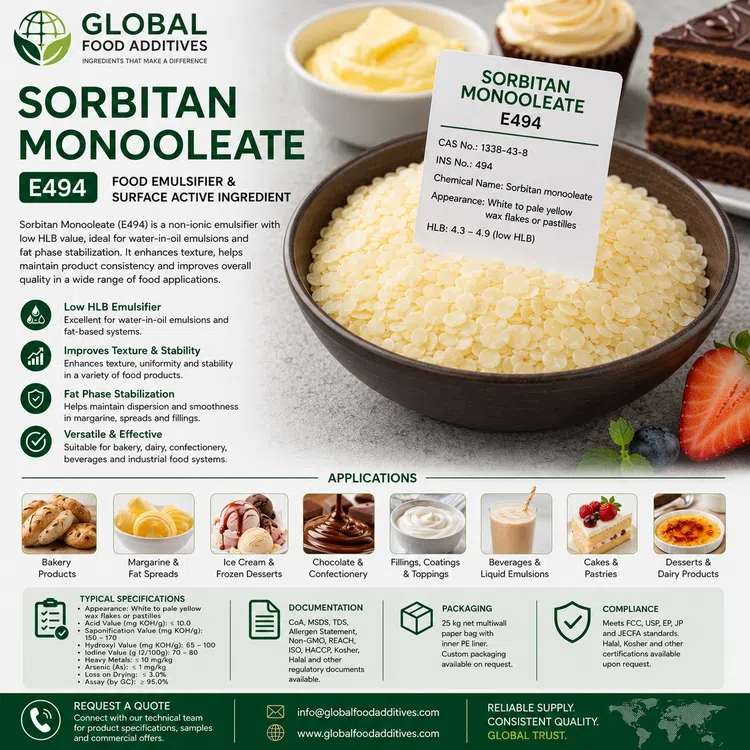
Product identity
| Product | Sorbitan Monooleate |
|---|---|
| Category | Emulsifiers & Surface Active Ingredients |
| Function | Low-HLB emulsifier / water-in-oil emulsifier / surface-active food ingredient / dispersion aid |
| E / INS number | E494 / INS 494 |
| CAS / identity | 1338-43-8 |
| Common synonyms | Sorbitan oleate, sorbitan monooleate, Span 80 |
| Chemical family | Sorbitan fatty acid ester produced from sorbitan and oleic-acid-rich fatty acid sources |
| Molecular formula | C24H44O6 |
| Typical form | Yellow to amber viscous liquid, oily liquid or paste-like grade depending on supplier and storage temperature |
| Technical character | Lipophilic, nonionic, low-HLB emulsifier suitable for fat-rich and water-in-oil oriented systems |
Application fit
Potential use areas may include:
- Margarine, shortenings and fat spreads
- Bakery products, cakes and sponge systems
- Ice cream and frozen dessert systems
- Chocolate, compound coatings and confectionery systems
- Icings, whipped toppings and aerated dessert creams
- Fat-based fillings, creams and pastes
- Beverage systems, beverage clouds and oil-phase dispersions where permitted
- Food emulsions requiring lipophilic wetting or water-in-oil stabilization
Industrial functionality
Sorbitan Monooleate is selected when a formulation needs controlled interaction between oil, fat, water, air, powders, starches, proteins, cocoa solids, flavours or other dispersed phases. Its lipophilic character makes it useful in systems where the emulsifier must preferentially locate in the fat phase, reduce interfacial tension, support wetting of hydrophobic particles, improve dispersion and assist the formation or stabilization of water-in-oil structures.
Functional contribution
- Water-in-oil emulsification: supports emulsion structure in fat-continuous systems such as spreads, shortenings, fillings and selected creams.
- Fat-phase dispersion: helps distribute oils, fats, cocoa solids, colours, flavours and other hydrophobic components more uniformly.
- Wetting and processing aid: can improve incorporation of powders into oil or fat systems and reduce local agglomeration.
- Texture control: contributes to smoother mouthfeel, spreadability, plasticity and reduced oiling-out in suitable fat-containing products.
- Aeration support: can assist air incorporation and foam structure in selected whipped, bakery and dessert systems when used with the right co-emulsifiers.
- Process tolerance: helps maintain repeatable behaviour during mixing, heating, cooling, whipping, depositing, enrobing, filling or homogenization.
Application engineering notes
- Margarine and spreads: review water droplet distribution, plasticity, spreadability, emulsion stability, oiling-out and melting profile.
- Bakery systems: evaluate batter aeration, specific gravity, cake volume, crumb structure, softness retention and staling behaviour.
- Chocolate and coatings: check viscosity, yield value, particle wetting, coating thickness, gloss, surface quality and bloom tendency.
- Icings and fillings: test fat separation, crystallization, smoothness, spreadability, aeration, gloss and temperature stability.
- Frozen desserts: validate overrun, meltdown, fat destabilization, mouthfeel and compatibility with proteins, stabilizers and other emulsifiers.
- Beverage systems: evaluate oil-phase dispersion, flavour-cloud stability, turbidity, ring formation, homogenization conditions and label compliance.
Typical specification points to compare
Exact limits vary by manufacturer, grade and applicable food-additive standard. The following parameters are practical checkpoints for procurement, R&D and QA teams when comparing suppliers or approving a new Sorbitan Monooleate grade.
| Parameter | Why it matters industrially |
|---|---|
| Appearance, colour and odour | Indicates grade consistency and helps identify oxidation, contamination, overheating or unsuitable storage exposure. |
| Physical form | Viscous liquid, oily liquid or paste-like behaviour affects pumping, dosing, drum handling, premix design and cleaning. |
| Acid value | Helps assess free fatty acid content and potential influence on flavour, odour, stability and specification compliance. |
| Saponification value | Supports confirmation of ester composition and supplier batch consistency. |
| Hydroxyl value | Provides information about residual hydroxyl functionality and degree of esterification. |
| Iodine value | Useful for oleate-rich materials because unsaturation level can influence oxidative stability and functional behaviour. |
| Moisture / water content | Important for storage stability, hydrolysis control, microbial risk management and fat-system compatibility. |
| Fatty acid profile | Oleic, linoleic, palmitic, stearic and related fatty acids influence liquid character, HLB behaviour and performance. |
| Viscosity and density | Relevant for pumping, dosing accuracy, heated transfer, metering systems and batch-to-batch processing repeatability. |
| Peroxide value | Useful where oxidative status of fatty components may affect odour, flavour or shelf-life quality. |
| Heavy metals and arsenic | Required for food safety, customer approval and destination-market compliance. |
| Microbiological limits | Important for ready-to-eat applications, hygiene programs and supplier approval. |
| Food-grade declarations | Confirms suitability for food use and supports regulatory and customer documentation review. |
Formulation and processing considerations
Sorbitan Monooleate is usually incorporated through the fat phase, oil phase, emulsifier premix or a controlled liquid dosing step depending on formulation and plant equipment. Because it is viscous and lipophilic, manufacturers should confirm pumping temperature, transfer method, mixing intensity, addition point, holding conditions and compatibility with fats, oils, flavours, colours, proteins, starches, hydrocolloids and other emulsifiers. Poor dispersion can cause unstable viscosity, phase separation, inconsistent aeration, oiling-out, ring formation in beverages, uneven coating behaviour or reduced shelf-life performance.
Production checkpoints
- Confirm whether the material should be added directly, warmed gently, pre-blended into oil or dispersed in a fat-phase premix.
- Validate incorporation temperature, mixing speed, shear level and holding time with the supplier’s technical guidance.
- Check compatibility with vegetable oils, palm fractions, butterfat, cocoa butter, shortenings and specialty fats.
- Assess interaction with lecithin, mono- and diglycerides, PGPR, polysorbates, SSL, DATEM or hydrocolloid stabilizers.
- Monitor viscosity, droplet size, aeration, emulsion stability, fat crystallization and sensory impact during pilot trials.
- Review whether the ingredient affects finished-product gloss, snap, spreadability, mouthcoating, foam stability, flavour release or oiling-out.
Quality-control checkpoints
- Compare each COA against the approved internal specification before release to production.
- Keep lot traceability from goods receipt through finished product batches.
- Inspect packaging integrity, foreign matter risk, odour, colour and signs of oxidation, leakage or contamination.
- Record storage conditions and avoid prolonged exposure to excessive heat, moisture or strong odours.
- Use retention samples for supplier-change investigations and shelf-life troubleshooting.
- Request trend data if the ingredient is critical to emulsion stability, oil dispersion, coating flow or beverage-cloud stability.
Application-specific value
The value of Sorbitan Monooleate depends on the surrounding formulation. In fat spreads and margarines, it may support water-in-oil emulsion structure and plasticity. In bakery and whipped systems, it may assist aeration and texture when used with compatible emulsifiers. In chocolate, coatings and fillings, it may help wet hydrophobic particles and support fat-phase dispersion. In beverage or flavour systems, it may be evaluated as part of an oil-phase dispersion strategy where permitted by regulation and customer specification.
| Application | Technical objective | Trial focus |
|---|---|---|
| Margarine and fat spreads | Assist water-in-oil emulsion stability, water distribution and plastic texture. | Water droplet distribution, oiling-out, spreadability, melting profile, emulsion stability and storage behaviour. |
| Cakes and bakery | Support batter aeration, fat dispersion, crumb grain, softness and processing tolerance. | Specific gravity, cake volume, crumb structure, softness, staling profile and sensory quality. |
| Chocolate and compound coatings | Improve oil-phase wetting, dispersion and coating consistency. | Viscosity, yield value, particle wetting, tempering response, bloom, gloss, snap and coating thickness. |
| Confectionery fillings | Support smoothness, fat distribution and shelf-life stability. | Oil separation, crystallization, mouthfeel, spreadability, flavour release and storage texture. |
| Icings and toppings | Support aeration, gloss, structure and fat-water stability. | Overrun, spreadability, syneresis, foam stability, storage stability and freeze-thaw behaviour. |
| Frozen desserts | Support fat destabilization, controlled meltdown and texture. | Overrun, meltdown rate, ice crystal perception, stabilizer compatibility and mouthfeel. |
| Beverage systems | Support oil-phase dispersion and cloud or flavour delivery where approved. | Droplet size, turbidity, ring formation, sedimentation, homogenization conditions and storage stability. |
Regulatory and label review
Sorbitan Monooleate is associated with E494 / INS 494, but approval and permitted use are not identical in every country, every food category or every formulation. Before commercial production, buyers should verify destination-market legislation, food category permissions, maximum use levels where applicable, carry-over rules, ingredient declaration requirements, customer restricted-substance policies and any special claims such as halal, kosher, vegan, non-GMO or allergen-free positioning.
- Destination-market approval: check the final country of sale, not only the country of manufacture.
- Food category: confirm that the additive is permitted in the specific product category and at the planned use level.
- Label declaration: verify whether the product must be declared as Sorbitan Monooleate, E494, emulsifier or according to local naming rules.
- Use-level responsibility: ensure final dosage complies with the relevant food standard and customer specification.
- Claims and certifications: validate halal, kosher, vegan, allergen, GMO and sustainability statements using supplier-issued documents.
- Food safety system: request available certificates such as FSSC 22000, ISO 22000, BRCGS, IFS, HACCP, GMP or equivalent where required.
Documents to request
For industrial procurement, the best supplier approval process combines product identity documents, batch documents, regulatory declarations and logistics information. Document availability can vary by manufacturer and market, so buyers should list mandatory documents at the inquiry stage.
- Product specification or technical data sheet
- Certificate of analysis for the offered batch or a recent representative lot
- Safety data sheet where applicable
- Food-grade statement and intended-use declaration
- Origin statement and manufacturing-site information where available
- Allergen statement, GMO statement, vegan statement, halal certificate and kosher certificate when required
- Heavy metals, arsenic, microbiology and contaminant declarations
- Fatty acid profile, acid value, hydroxyl value, saponification value, iodine value, moisture, peroxide value and viscosity specification
- Residual solvent, pesticide, PAH, mineral oil or other market-specific declarations where required
- Shelf-life, storage and handling information
- Packaging specification, label draft, net weight, gross weight and pallet configuration
- Export documents, customs documents and legalization requirements for the destination country
Packaging, storage and logistics
Sorbitan Monooleate may be supplied in drums, pails, cans, IBCs or other manufacturer-specific packaging depending on grade, viscosity and order volume. Because it is a viscous liquid or oily paste, buyers should consider temperature exposure during transport, pumpability, unloading method, leakage prevention, warehouse hygiene and ease of dosing at the production site.
Packaging questions
- What is the standard net weight per drum, pail, can, IBC or pallet?
- Is the container food-grade, sealed and suitable for viscous liquid handling?
- Can the supplier provide batch coding on each unit and pallet?
- Is the product prone to viscosity increase, phase haze or handling difficulty at low temperature?
- What are the recommended loading quantity and container conditions?
- Are sample, partial pallet, mixed container or full-container options available?
Storage guidance
- Store in closed original packaging in a clean, dry, food-grade warehouse.
- Protect from moisture, direct sunlight, excessive heat, freezing conditions and strong odours.
- Keep away from non-food chemicals and materials that may create taint or contamination risk.
- Apply FIFO or FEFO stock rotation according to the declared shelf life.
- Seal opened packaging carefully and avoid foreign matter or water contamination.
- Confirm supplier recommendations before warming, pumping, filtering or reprocessing material with changed viscosity.
Commercial sourcing checklist
When requesting Sorbitan Monooleate, provide enough technical and commercial detail to avoid unsuitable offers. The same product name can correspond to different supplier grades, viscosity ranges, fatty acid profiles, packaging formats, compliance documents and application performance.
| Quotation item | Recommended buyer input |
|---|---|
| Target grade | Food grade, E494 / INS 494, supplier reference grade or buyer specification. |
| Application | Margarine, fat spread, bakery, cake, chocolate, coating, icing, filling, cream, topping, frozen dessert, beverage or other use. |
| Required specification | Acid value, hydroxyl value, saponification value, iodine value, moisture, peroxide value, colour, viscosity and required compliance limits. |
| Quantity | Sample, trial order, drum quantity, pallet quantity, container quantity, annual demand or call-off schedule. |
| Packaging | Drum, pail, can, IBC, pallet format or site-specific handling preference. |
| Destination | Country, port, city, warehouse address and import-document requirements. |
| Delivery term | EXW, FCA, FOB, CFR, CIF, DAP or another requested Incoterms basis. |
| Documentation | COA, TDS, SDS, origin, halal, kosher, allergen, GMO, food-grade and regulatory declarations. |
| Timing | Required shipment date, target lead time, validity period and expected repeat demand. |
Supplier comparison checklist
When approving a new source, compare technical performance and documentation reliability, not only price per kilogram. Sorbitan Monooleate may be a small part of the formula, but it can have a significant effect on product stability, processing repeatability and customer acceptance.
- Does the offered grade match your approved E494 / INS 494 requirement?
- Are CAS identity, composition and food-grade status clearly documented?
- Do acid value, saponification value, hydroxyl value, iodine value, moisture and viscosity match your specification?
- Is the physical form suitable for your dosing, pumping, premixing and cleaning process?
- Does the material perform correctly in your fat system, oil phase, process temperature and mixing sequence?
- Does the supplier provide batch-specific COA data and traceable lot numbers?
- Are allergen, GMO, halal, kosher, origin and regulatory declarations available when required?
- Can packaging, palletization, lead time and freight terms support your production schedule?
- Has the ingredient been tested in pilot production before commercial supplier change?
How to request this product
Send the product name, target grade or reference specification, application, required quantity, destination country, packaging preference, expected shipment date, delivery term and required documents. If you already purchase Sorbitan Monooleate, attach or describe your current specification, supplier grade, COA, label declaration or customer document checklist so available sourcing options can be compared more accurately.
Useful answers
What is Sorbitan Monooleate used for in food manufacturing?
Sorbitan Monooleate is typically used as a nonionic, low-HLB emulsifier and surface-active food ingredient. It is evaluated for water-in-oil emulsification, emulsion stability, wetting, fat dispersion, aeration support, chocolate flow, coating performance, texture control and processing tolerance. Exact suitability depends on grade, application, process, regulations and supplier documents.
Why is Sorbitan Monooleate useful in fat-rich systems?
Its lipophilic character makes it relevant where oil-phase distribution, water-in-oil structure, interfacial stability, wetting, texture and processing consistency are important. It may support margarine, spreads, fillings, coatings, whipped systems and selected beverage dispersions when used with the correct formulation and process.
Which specification parameters should buyers compare?
Buyers commonly compare appearance, colour, odour, acid value, saponification value, hydroxyl value, iodine value, moisture, viscosity, density, fatty acid profile, peroxide value, heavy metals, arsenic, microbiology, shelf life, storage conditions and food-grade declarations.
Can Global Food Additives source Sorbitan Monooleate?
Global Food Additives can review sourcing options for Sorbitan Monooleate according to target specification, application, quantity, destination, packaging preference, delivery term and required documentation.
Which documents should be requested?
Buyers commonly request a technical data sheet, product specification, certificate of analysis, safety data sheet where applicable, food-grade statement, origin statement, shelf-life information, storage guidance, allergen declaration, GMO statement, halal or kosher certificate where required, packaging details and market-specific regulatory declarations.
Is this product permitted in every country?
No. Food additive use depends on destination-market rules, food category, use level, label requirements and buyer responsibility. Buyers should verify regulatory status and final suitability for the intended application before commercial production.
Tell us which food additive or ingredient you need.
Send product names, target specifications, quantity, destination country, packaging preference, delivery term, and document requirements. Our team will review your inquiry and respond from orders@foodgradeadditives.com.
Your message has been received. You will be redirected to the home page.