
Sorbitol E420
Sorbitol is a food-grade polyol sweetener used by industrial food manufacturers for sugar replacement, humectancy, moisture retention, texture support, bulking, crystallization control and sweetness design. It is available as crystalline sorbitol, powder, granule and sorbitol syrup grades, allowing formulators to select the right physical form for confectionery, chewing gum, bakery fillings, soft cakes, syrups, fruit preparations, dairy desserts, beverages and nutrition systems. This page is prepared for purchasing teams, R&D technologists, QA departments, regulatory teams and import managers who need structured technical information before requesting a quotation.
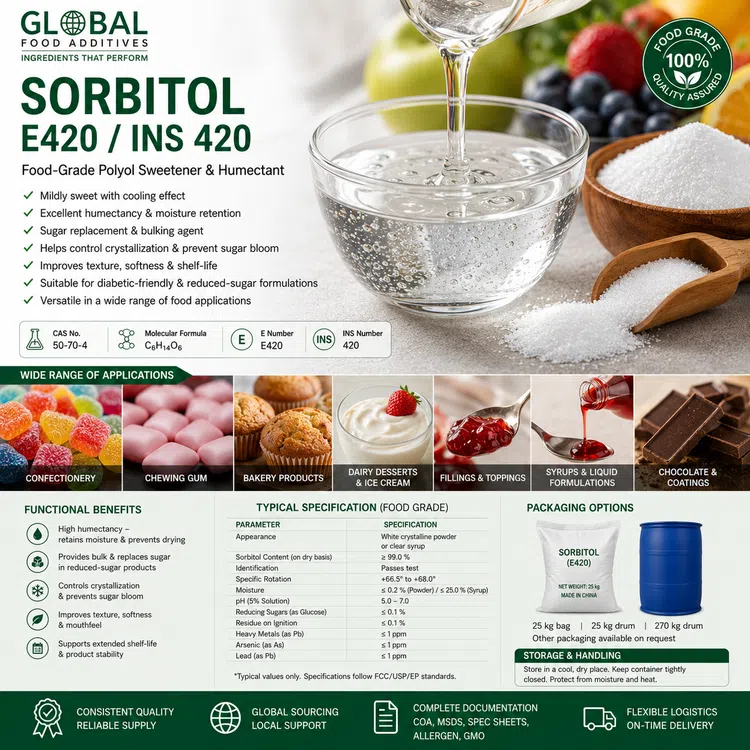
Product identity
| Product name | Sorbitol |
|---|---|
| Common names | Sorbitol E420, D-sorbitol, glucitol, sorbitol syrup, crystalline sorbitol, INS 420 |
| Chemical formula | C6H14O6 |
| CAS number | 50-70-4 |
| E / INS number | E420 / INS 420 |
| Category | Sweeteners & Polyols |
| Primary function | Polyol sweetener, humectant, bulking sweetener, sugar-replacement ingredient, texture modifier and moisture-control agent |
| Typical source | Commonly produced by catalytic hydrogenation of glucose or glucose syrup from starch sources; exact botanical source depends on supplier documentation |
| Typical appearance | White crystalline powder or granule; clear viscous liquid for syrup grades |
| Typical handling form | Crystalline powder, granule, fine powder, sorbitol syrup, liquid grade or application-specific polyol blend |
Application fit
Sorbitol is evaluated where controlled sweetness, solids, body, moisture retention or sugar-replacement performance is required. Potential use areas may include:
- Sugar-free and reduced-sugar confectionery, hard candy, soft candy, gummies, jellies and fondants
- Chewing gum, compressed tablets, lozenges, mints and oral-care confectionery where permitted
- Bakery fillings, soft cakes, muffins, sponge cakes, icings, glazes and cream-style fillings
- Fruit preparations, jams, syrups, toppings, sauces and sweet spreads
- Dairy desserts, frozen desserts, yogurts, puddings and plant-based dessert systems
- Beverages, nutrition products, protein bars, meal replacements and specialty reduced-sugar formulations
Technical overview for industrial buyers
Sorbitol is a six-carbon sugar alcohol that provides sweetness, bulk, humectancy and body. Unlike high-intensity sweeteners, Sorbitol contributes solids and texture to the formulation. This makes it useful in reduced-sugar systems where the manufacturer must replace some of the physical functions of sucrose, not only its sweetness. It can help retain moisture, reduce drying, soften texture, control crystallization and improve mouthfeel in selected applications.
For industrial procurement, Sorbitol should be evaluated by physical form, sorbitol assay, dry substance for syrup grades, moisture or water content, reducing sugars, dextrose, mannitol and related polyols, pH, conductivity, ash, color, clarity, viscosity, particle size for dry grades, microbiological quality, heavy metals, catalyst residue where specified, origin, shelf-life, packaging integrity and documentation completeness. The correct choice between syrup and crystalline Sorbitol depends on the buyer’s process, water balance, dry solids target, storage system, dosing equipment and finished-product texture.
Functional role in formulation
- Sweetness contribution: provides mild sweetness and can be blended with high-intensity sweeteners for target sweetness.
- Humectancy: helps retain moisture and reduce drying in soft confectionery, bakery fillings and cakes.
- Bulking: contributes solids and body in reduced-sugar and sugar-free formulations.
- Texture support: improves softness, chew, smoothness and mouthfeel in selected food systems.
- Crystallization control: helps manage sugar crystallization, graining and texture in confectionery and syrups.
- Water activity management: can influence water binding and shelf-life design when used with other ingredients.
- Freezing-point effect: may affect frozen-dessert texture and scoopability depending on dosage and total solids.
- Carrier function: can be used in syrups, flavours, colour preparations, tablets, fillings and specialty blends.
Key buying parameters
| Grade | Food grade; confirm E420 / INS 420 identity and destination-market compliance |
|---|---|
| Physical form | Crystalline powder, granule, fine powder, syrup, liquid grade or polyol blend |
| Sorbitol assay | Request assay, dry basis if applicable, test method and COA value |
| Dry substance | Critical for sorbitol syrup grades; affects solids, viscosity, cost-in-use and water balance |
| Reducing sugars | Important for colour stability, browning risk, microbial stability and specification control |
| Related polyols | Review mannitol, maltitol, hydrogenated saccharides or other polyols depending on grade |
| pH and conductivity | Useful for quality control, process compatibility and syrup consistency |
| Particle size | Important for dry blending, tablet compression, dissolution, dusting and texture |
| Microbiology | Important for syrups, low-heat processes, dairy desserts, beverages and nutrition products |
| Packaging | Bags, drums, IBCs, bulk tankers or palletized export packaging depending on form and volume |
Industrial application notes
In confectionery, Sorbitol can help control moisture, texture and crystallization in sugar-free candies, soft sweets, gums, jellies, fondants and fillings. Crystalline Sorbitol may be preferred for dry blends, tablets and chewing gum, while syrup grades can be useful in soft confectionery and liquid systems. Product developers should evaluate water activity, hygroscopicity, stickiness, graining, cooling sensation, sweetness balance, polyol blend, flavour release and packaging barrier properties.
In chewing gum and compressed confectionery, Sorbitol is valued for bulk, sweetness, texture and compatibility with other polyols. It may be used with xylitol, maltitol, mannitol, isomalt, erythritol or high-intensity sweeteners depending on sweetness target and label requirements. For tablets and mints, particle size, flowability, compressibility, dusting, hardness, friability, dissolution and sensory profile should be tested under the buyer’s equipment conditions.
In bakery and fillings, Sorbitol can help retain moisture and maintain softness in cakes, muffins, sponge products, icings, glazes, creams and fruit fillings. Because Sorbitol does not provide the same browning and yeast-fermentation behavior as sucrose, formulas may require adjustment of reducing sugars, leavening, emulsifiers, humectants, water level and bake profile. Finished products should be evaluated for softness, stickiness, water activity, microbial stability and shelf-life sensory quality.
In dairy desserts, frozen desserts and beverages, Sorbitol can provide sweetness, solids and mouthfeel. Frozen systems should be tested for freezing-point effect, ice crystal control, scoopability, sweetness and total solids balance. Beverage systems should be evaluated for clarity, viscosity, sweetness, pH, preservative compatibility and digestive-tolerance labeling requirements where relevant. In nutrition products and bars, Sorbitol may help retain moisture and soften texture, but polyol levels must be reviewed for label and consumer tolerance.
Grade selection guide
- Crystalline powder: selected for dry blends, compressed tablets, chewing gum, powdered mixes and controlled dissolution.
- Granular grades: useful for easier handling, lower dusting and improved flow in industrial dosing systems.
- Fine powder grades: useful where fast dissolution, smooth texture or homogeneous dry blending is required.
- Sorbitol syrup: selected for liquid processing, soft confectionery, fillings, syrups, fruit preparations and humectancy.
- High-solids syrup grades: useful where water addition must be controlled and higher solids delivery is needed.
- Non-crystallizing syrup blends: evaluated where crystallization control and smooth texture are priorities.
- Custom polyol blends: used when Sorbitol is combined with maltitol, glycerol, xylitol, mannitol or high-intensity sweeteners.
Process and handling considerations
- Confirm whether the process requires crystalline Sorbitol, syrup grade, high-solids syrup or a non-crystallizing blend.
- For syrup grades, verify viscosity, pumpability, tank heating requirement, filtration and microbial control.
- For dry grades, manage moisture pickup, caking, dusting and segregation during blending and transport.
- Adjust formula water balance when replacing sucrose with Sorbitol syrup or crystalline Sorbitol.
- Validate compatibility with acids, flavours, colours, hydrocolloids, starches, proteins and preservatives.
- Protect dry Sorbitol from humid storage and protect syrups from contamination and temperature abuse.
- Maintain lot traceability from raw material receipt through finished product batch records.
Quality control checkpoints
Food manufacturers normally evaluate Sorbitol through chemical purity, physical form and application performance. Because Sorbitol is used both as a sweetener and a functional solids or moisture-management ingredient, incoming QC should confirm that the purchased grade matches the approved formulation. Syrup concentration and dry-grade particle size can strongly influence production performance, dosing accuracy and final texture.
Typical laboratory checks
- Appearance, colour, odour and foreign matter inspection
- Identification as Sorbitol / E420
- Sorbitol assay and related polyol profile where specified
- Dry substance, refractive index or solids for syrup grades
- Moisture or water content for crystalline grades
- Reducing sugars, dextrose, mannitol or other related carbohydrates where specified
- pH, conductivity, ash and sulphated ash where required
- Solution colour, clarity and insoluble matter for syrup grades
- Particle size, bulk density, flowability and compressibility for dry grades
- Nickel, catalyst residue, lead, arsenic, mercury, cadmium or other metals according to specification
- Total plate count, yeast, mould, coliforms and pathogen indicators where required
- Lot number, manufacturing date and shelf-life verification
Functional performance checks
- Sweetness balance and blend performance with other polyols or high-intensity sweeteners
- Moisture retention, softness and water activity in bakery and fillings
- Crystallization control, graining and texture in confectionery and syrups
- Stickiness, hygroscopicity and packaging barrier performance during shelf life
- Tablet hardness, friability, dissolution and flowability for compressed products
- Chewing gum texture, sweetness release and compatibility with gum base
- Viscosity, pumpability and dosing accuracy for syrup grades
- Packaging seal integrity and pallet condition on receipt
Regulatory and compliance notes
Sorbitol is commonly identified as E420 or INS 420. Some markets distinguish between sorbitol and sorbitol syrup in additive lists or specifications, and label wording may differ by destination country. Permitted uses, maximum levels, sweetener declarations, polyol declarations, nutrition claims and warning statements vary by market and final food category. Buyers should verify the exact grade and application before commercial use.
Polyols, including Sorbitol, may require specific labeling related to excessive consumption, laxative effects or digestive tolerance in some jurisdictions when used above defined levels or in certain product categories. Claims such as sugar-free, no added sugar, reduced sugar, reduced calorie, tooth-friendly or diabetic-friendly should be reviewed against the complete formulation, nutrition panel, serving size and local regulation. These claims should not be assumed from Sorbitol use alone.
Recommended documents to request
- Product specification or technical data sheet with assay, physical and functional parameters
- Certificate of analysis for available batch or lot
- Safety data sheet where applicable
- Food-grade declaration and statement of intended food use
- E420 / INS 420 identity confirmation and label-support information
- Sorbitol assay, dry substance, reducing sugars, pH, color, clarity and microbiological specification
- Particle size, bulk density and flowability for crystalline or powder grades where required
- Source statement, such as corn, wheat, tapioca or other starch origin, where available
- GMO status, allergen, gluten-free, vegan, halal, kosher or animal-origin declarations when required
- Heavy metals, nickel or catalyst residue statement where required by customer specification
- Origin statement, manufacturer information and traceability support
- Shelf-life, storage condition, humidity protection and handling recommendation
- Label draft, net weight, bag, drum, pail, IBC, tanker or container dimensions, pallet configuration and container loading estimate
- Batch coding format, recall-support documentation and change-control statement where available
Specification information useful for quotation
For a faster and more accurate quotation, provide the target specification, required physical form, crystalline or syrup grade, assay, solids target, application, annual and first-order quantity, destination country, delivery term, packaging preference, required certifications, inspection requirements and expected shipment date. If you already purchase Sorbitol, share the existing COA, technical data sheet, product label, approved sample, solids level, particle size requirement, syrup viscosity target or benchmark supplier specification so equivalent options can be compared by functionality, quality parameters, source, documentation and logistics cost.
Packaging and logistics
Industrial Sorbitol is usually quoted according to physical form, net weight, packaging type, palletization, container loading, port of loading, Incoterms and destination. Crystalline Sorbitol is commonly supplied in lined bags, cartons, drums or palletized export packaging and must be protected from moisture. Sorbitol syrup may be supplied in drums, IBCs, flexitanks or bulk tankers, depending on volume and route. Syrup shipments should be reviewed for tank cleanliness, microbial control, temperature exposure, viscosity, pumpability, shelf-life remaining and destination customs requirements.
Commercial evaluation criteria
- Food-grade status and documentation completeness
- Correct E420 identity, physical form and destination-market regulatory fit
- Consistency of assay, dry substance, moisture, reducing sugars, pH, colour and microbiology
- Suitability for confectionery, chewing gum, bakery, dairy desserts, syrups, beverages or nutrition products
- Availability of source, GMO, allergen, gluten-free, halal, kosher, vegan and origin documentation when required
- Packaging suitability for powder handling, syrup pumping, IBC storage or bulk tanker delivery
- Lead time, stock position and minimum order quantity
- Supplier change-control and batch traceability support
- Total landed cost and cost-in-use, not only unit price
How to request this product
Send the product name, E number, required physical form, crystalline or syrup grade, assay or solids target, application, quantity, destination country, packaging preference, expected shipment date and required documents. If the ingredient will be used in confectionery, chewing gum, tablets, bakery fillings, cakes, syrups, dairy desserts, beverages, nutrition products or reduced-sugar systems, include the application category and key performance target such as sweetness, humectancy, water activity, crystallization control, softness, chew, tablet compression, viscosity or sugar-reduction claim support.
Useful answers
What is Sorbitol used for in food manufacturing?
Sorbitol is used as a polyol sweetener, humectant, bulking ingredient, sugar-replacement ingredient, texture modifier and moisture-control agent. It is commonly evaluated in sugar-free confectionery, chewing gum, bakery fillings, soft cakes, syrups, fruit preparations, dairy desserts, beverages and nutrition products.
What is the difference between sorbitol syrup and crystalline sorbitol?
Sorbitol syrup is a liquid polyol system specified by dry substance, sorbitol content, viscosity, pH, color and clarity. Crystalline sorbitol is a dry powder or granule used where low water addition, dry blending, tablet compression or powder handling is required.
Is Sorbitol a high-intensity sweetener?
No. Sorbitol is a bulk polyol sweetener, not a high-intensity sweetener. It contributes sweetness, solids, body, humectancy and texture. It may be combined with high-intensity sweeteners when stronger sweetness is required.
Does Sorbitol replace sugar one-for-one?
Not automatically. Sorbitol can replace some sugar functions such as bulk, humectancy and sweetness, but it differs from sucrose in sweetness intensity, crystallization, browning, fermentation, water activity and digestive tolerance. Product trials are required.
Which applications commonly use Sorbitol?
Common application areas include sugar-free confectionery, chewing gum, tablets, mints, lozenges, bakery fillings, soft cakes, icings, fruit preparations, syrups, dairy desserts, frozen desserts, beverages, nutrition products and reduced-sugar formulations.
Which specification parameters matter most?
Important parameters include sorbitol assay, dry substance for syrup grades, water content or moisture, reducing sugars, dextrose, mannitol and other polyols, pH, conductivity, ash, color, clarity, particle size for powders, microbiological limits, heavy metals and catalyst residue where specified.
Does Sorbitol require special labeling?
In many markets, polyols may require specific label wording or warnings related to excessive consumption and laxative effects, depending on use level and product category. Buyers should verify destination-market rules before commercial use.
Can Global Food Additives source Sorbitol?
Global Food Additives can review sourcing options for Sorbitol according to target specification, physical form, crystalline or syrup grade, application, quantity, destination, packaging, certification needs and required documentation.
Which documents should be requested?
Buyers commonly request a technical data sheet, certificate of analysis, safety data sheet, food-grade declaration, origin statement, source statement, GMO status, allergen statement, halal or kosher certificate, shelf-life and storage information, label details and packing configuration.
Is this product permitted in every country?
No. Food additive use depends on destination-market rules, food category, use level, polyol labeling, nutrition claims, warning statements and buyer responsibility. Always verify local regulations before commercial use.
Tell us which food additive or ingredient you need.
Send product names, target specifications, quantity, destination country, packaging preference, delivery term, and document requirements. Our team will review your inquiry and respond from orders@foodgradeadditives.com.
Your message has been received. You will be redirected to the home page.