
Sourdough Starter Cultures
Sourdough Starter Cultures are food-grade bakery fermentation systems used by industrial bakeries and food manufacturers for sourdough flavour development, controlled acidification, aroma formation, dough performance, fermentation repeatability and selected shelf-life support. Depending on the supplier, they may contain lactic acid bacteria, sourdough yeasts, carrier ingredients or fermented sourdough preparations designed for active fermentation or flavour standardisation. This page is prepared for purchasing teams, R&D bakers, QA departments, regulatory teams and import managers who need structured technical information before requesting a quotation.
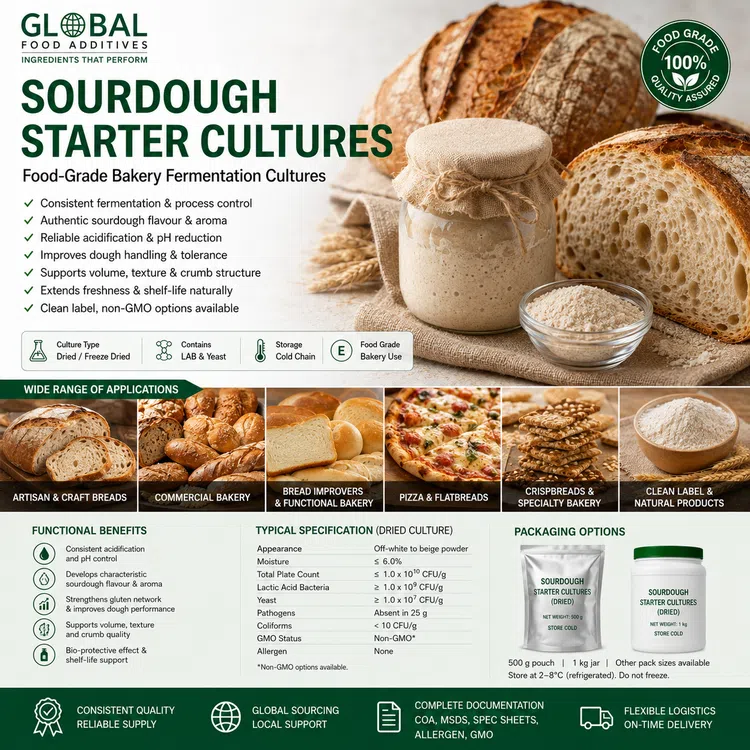
Product identity
| Product name | Sourdough Starter Cultures |
|---|---|
| Common names | Bakery sourdough culture, sourdough culture blend, sourdough fermentation starter, lactic acid bacteria and yeast starter |
| Culture identity | Supplier-specific blend of lactic acid bacteria, yeasts, culture metabolites or fermented cereal ingredients depending on product design |
| Typical microorganisms | May include selected Lactobacillaceae species, sourdough-associated lactic acid bacteria and bakery-compatible yeasts depending on supplier documentation |
| E / INS number | Not typically managed as an E-number additive; confirm ingredient or culture status by destination market and supplier documentation |
| CAS / identity | Culture blend; supplier-specific strain and carrier system |
| Category | Fermentation, Cultures & Bio-Protective Ingredients |
| Primary function | Bakery fermentation starter, sourdough flavour developer, acidification tool, dough-performance support and selected bio-protective culture system |
| Typical appearance | Freeze-dried powder, frozen pellets, granule, sourdough powder, cereal-based blend or concentrated culture format |
| Typical handling form | Active culture for fermentation, frozen or freeze-dried starter, inactive sourdough flavour ingredient, or application-specific bakery blend |
Application fit
Sourdough Starter Cultures are evaluated where controlled bakery fermentation, flavour, acidity, dough handling or shelf-life support is required. Potential use areas may include:
- Artisan-style bread, industrial sourdough bread, pan bread, baguettes and rustic loaves
- Pizza bases, flatbreads, focaccia, ciabatta, rolls, buns and laminated bakery systems
- Rye bread, wholegrain bread, high-fibre bread and seeded bakery products
- Crackers, crispbread, fermented dough snacks and savoury bakery applications
- Dry sourdough blends, bakery improvers, flour mixes and premix systems
- Clean-label bakery projects requiring fermentation-derived flavour, acidity or process differentiation
Technical overview for industrial buyers
Sourdough Starter Cultures are used to bring controlled microbial fermentation into bakery production. In traditional sourdough, lactic acid bacteria and yeasts ferment flour and water to produce organic acids, carbon dioxide, ethanol, aroma compounds and fermentation metabolites. In industrial bakeries, starter cultures help standardise this process so sourdough flavour, acidity, dough behaviour and finished product quality can be repeated from batch to batch.
For procurement, it is important to distinguish between active sourdough cultures, dried sourdough ingredients, fermented sourdough powders and bio-protective culture systems. Active cultures are intended to grow and acidify a dough, sponge or liquid starter under controlled time and temperature. Inactive sourdough powders mainly contribute flavour, acidity and label character but may not provide live fermentation. Bio-protective sourdough culture systems may be selected for their ability to support shelf-life through fermentation-derived acidity and metabolites, but they still require product-specific validation.
Functional role in bakery formulation
- Acidification: supports controlled development of lactic and acetic acidity, influencing flavour, dough rheology and microbial stability.
- Flavour development: contributes sourdough aroma, cereal complexity, fermented notes and longer flavour perception.
- Dough performance: can affect extensibility, gas retention, mixing tolerance, crumb structure and crust characteristics.
- Fermentation standardisation: improves repeatability versus uncontrolled back-slopping or wild fermentation.
- Leavening support: culture blends containing yeast may contribute gas formation, while many industrial formulas also use baker’s yeast.
- Shelf-life support: selected cultures may help reduce spoilage risk through acidification and fermentation metabolites when validated.
- Clean-label differentiation: supports bakery positioning based on traditional fermentation, sourdough character and process transparency.
Key buying parameters
| Culture type | Active starter, frozen culture, freeze-dried culture, inactive sourdough powder, fermented flour or bio-protective blend |
|---|---|
| Strain identity | Request strain list, genus/species information or confidential strain declaration as supplier policy allows |
| Viable count | Important for active cultures; confirm CFU/g, target dosage and count at end of shelf life |
| Acidification profile | Review pH drop, titratable acidity, fermentation time and target temperature range |
| Flavour profile | Evaluate mild, aromatic, tangy, acetic, rye-style, wheat-style or traditional sourdough character |
| Carrier system | Confirm flour, cereal, maltodextrin, starch, dairy, yeast extract or other carriers for allergen and label impact |
| Physical form | Freeze-dried powder, frozen pellet, liquid starter, powder blend, granule or dried sourdough ingredient |
| Storage | Confirm ambient, chilled, frozen or cold-chain requirement and shelf-life remaining at delivery |
| Microbiological purity | Request absence of pathogens and limits for yeast, mould and contaminants according to product type |
| Documentation | Food-grade status, strain safety, GMO status, allergen statement, origin and handling documentation should be reviewed |
Industrial application notes
In wheat sourdough bread, starter cultures can be used to create controlled acidity and flavour while maintaining dough strength and processing tolerance. The correct dosage and fermentation schedule depend on flour protein, ash content, hydration, salt, yeast level, enzymes, mixing intensity, bulk fermentation time and proofing conditions. Industrial bakeries should track pH, titratable acidity, dough temperature, fermentation time, loaf volume, crumb structure, crust colour, flavour and shelf-life performance.
In rye and wholegrain systems, sourdough fermentation can be particularly important because acidity influences starch and pentosan behaviour, dough viscosity, crumb setting and flavour. Rye sourdough cultures may be selected for stronger acidification and distinctive cereal aroma. Product developers should evaluate flour ash, wholegrain content, hydration, enzyme activity, fermentation temperature, final pH, crumb stickiness, slicing quality and shelf-life stability.
In pizza bases, flatbreads and fermented dough snacks, sourdough cultures can contribute flavour complexity, extensibility, browning, aroma and dough maturation. The culture must be matched to the processing window: a frozen pizza base, par-baked crust or chilled dough may require different acidification speed and yeast activity. Developers should test dough handling, sheeting, gas formation, bake colour, blistering, freezing tolerance and post-bake texture.
In premixes and bakery improvers, inactive sourdough powders or dried fermented ingredients can help standardise sourdough flavour without live fermentation management. Active culture inclusion in dry blends requires careful evaluation of water activity, packaging, storage temperature and cell survival. The supplier should clearly state whether the product is intended as an active fermenting culture or as an inactive sourdough flavour and acidity ingredient.
Fermentation system design
- Define the target: flavour development, acidification, dough performance, shelf-life support or label differentiation.
- Choose the process format: sponge, liquid sourdough, stiff sourdough, back-slopped starter, direct addition or premix system.
- Set fermentation parameters: inoculation rate, hydration, flour type, temperature, time, pH and titratable acidity target.
- Decide whether baker’s yeast will be used separately for leavening speed and volume control.
- Measure pH and titratable acidity during trials rather than judging sourdough only by flavour.
- Validate finished product quality after baking, cooling, slicing, packing, transport and shelf-life storage.
Process and handling considerations
- Follow supplier instructions for rehydration, inoculation, water temperature and fermentation time.
- Protect active cultures from heat, moisture, oxygen and long exposure outside recommended storage conditions.
- For frozen cultures, maintain frozen logistics and avoid repeated freeze-thaw cycles.
- For freeze-dried cultures, reseal containers quickly and avoid humid batching rooms where possible.
- Use hygienic handling to prevent contamination of starter tanks, sponges and fermentation vessels.
- Clean and separate starter equipment to prevent uncontrolled microbial carryover between products.
- Maintain lot traceability from culture receipt through sourdough batch and finished product batch records.
Quality control checkpoints
Food manufacturers normally evaluate Sourdough Starter Cultures through microbiological identity, fermentation activity and finished-product performance. Because culture products are living systems when active, storage, transport and handling can affect performance. Incoming checks should be linked with process monitoring so production can confirm that the culture performs as expected under plant conditions.
Typical laboratory checks
- Appearance, colour, odour and packaging condition
- Culture identity or strain declaration according to supplier policy
- Viable count for lactic acid bacteria and yeast where applicable
- Absence of specified pathogens such as Salmonella and other required indicators
- Yeast, mould, coliforms and contaminant limits according to product type
- Moisture and water activity for dry culture products
- pH and titratable acidity performance in standard fermentation test
- Carrier identification and allergen-relevant composition check
- GMO status, origin and lot traceability verification
- Storage temperature record, manufacturing date, expiry date and shelf-life remaining
Functional performance checks
- pH drop and titratable acidity over the intended fermentation schedule
- Dough aroma, acidity balance and sourdough flavour profile
- Dough rheology, extensibility, stickiness and gas retention
- Loaf volume, crust colour, crumb grain, slicing quality and texture
- Compatibility with flour type, salt, yeast, enzymes, emulsifiers, fats, seeds and inclusions
- Shelf-life performance, mould-spoilage trend and sensory quality where relevant
- Consistency across multiple batches and production shifts
- Packaging seal integrity and cold-chain or storage-condition compliance on receipt
Regulatory and compliance notes
Sourdough Starter Cultures are usually handled as food cultures or bakery ingredients rather than typical E-number additives, but regulatory status, strain acceptance, processing-aid interpretation, live-culture declaration, organic suitability, allergen declaration and label wording vary by country and final application. Buyers should confirm whether the finished label should declare starter culture, sourdough culture, fermented wheat flour, fermented cereal, lactic acid bacteria, yeast, sourdough powder or another market-specific wording.
Documentation is especially important for culture products because buyers may need evidence of strain safety, microbial purity, absence of pathogens, GMO status, allergen status, carrier identity, origin, storage condition and shelf-life. If the culture is marketed as bio-protective or shelf-life supporting, the claim must be validated in the buyer’s own formulation and packaging system. Such cultures should not be treated as a substitute for hygienic production, validated heat treatment, correct packaging or regulatory review.
Recommended documents to request
- Product specification or technical data sheet with culture type, dosage and application guidance
- Certificate of analysis for available batch or lot
- Safety data sheet where applicable
- Food-grade declaration and statement of intended food use
- Strain identity, genus/species statement or confidential strain safety documentation where available
- Viable count, acidification profile and fermentation activity data for active cultures
- Carrier declaration and label-support information
- Microbiological specification, pathogen absence statement and contaminant limits
- Allergen, gluten, GMO, vegan, halal, kosher or animal-origin declarations when required
- Origin statement, manufacturer information and traceability support
- Storage condition, cold-chain requirement, shelf life and handling recommendation
- Organic suitability, clean-label or bio-protective support documentation where required
- Packaging details, net weight, sachet, bag, pouch, carton or frozen pack configuration, pallet information and shipment temperature requirement
- Batch coding format, recall-support documentation and change-control statement where available
Specification information useful for quotation
For a faster and more accurate quotation, provide the target bakery application, required culture type, active or inactive format, desired flavour profile, fermentation time, process temperature, flour type, dosage target, annual and first-order quantity, destination country, delivery term, packaging preference, storage capacity, required certifications and expected shipment date. If you already purchase Sourdough Starter Cultures, share the existing COA, technical data sheet, fermentation schedule, pH target, titratable acidity target, approved sample or benchmark supplier specification so equivalent options can be compared by culture performance, flavour, storage needs, documentation and logistics cost.
Packaging and logistics
Industrial Sourdough Starter Cultures are quoted according to culture type, storage requirement, package size, shipment temperature, shelf-life remaining, palletization, transport route, Incoterms and destination. Freeze-dried products may be shipped in sealed sachets, foil pouches, bags or cartons with moisture protection. Frozen cultures require cold-chain planning and temperature monitoring. Export shipments should be reviewed for documentation deadlines, customs requirements, storage capability at destination, transit time and product viability risk.
Commercial evaluation criteria
- Food-grade status and documentation completeness
- Correct active or inactive culture positioning for the buyer’s process
- Consistency of viable count, acidification profile, flavour and fermentation performance
- Suitability for wheat bread, rye bread, wholegrain bread, pizza, flatbread, premix or industrial sourdough systems
- Availability of allergen, gluten, GMO, halal, kosher, vegan, organic or origin documentation when required
- Storage requirement, cold-chain reliability and shelf-life remaining at delivery
- Lead time, stock position and minimum order quantity
- Supplier change-control and batch traceability support
- Total landed cost and cost-in-use, not only unit price
How to request this product
Send the product name, active or inactive format, target application, flour type, fermentation process, desired flavour profile, required storage condition, quantity, destination country, packaging preference, expected shipment date and required documents. If the culture will be used in sourdough bread, rye bread, wholegrain bread, pizza bases, flatbreads, bakery improvers, dry premixes or shelf-life-support bakery systems, include target pH, titratable acidity, fermentation time, temperature, dosage and label requirements so the supplier review can focus on the most relevant technical and compliance parameters.
Useful answers
What are Sourdough Starter Cultures used for in food manufacturing?
Sourdough Starter Cultures are used in bakery manufacturing for controlled fermentation, sourdough flavour development, acidification, aroma formation, dough performance, process standardisation and selected shelf-life support. Exact suitability depends on culture composition, flour system, fermentation schedule, process, regulations and supplier documentation.
Are Sourdough Starter Cultures the same as instant yeast?
No. Instant yeast is mainly used for leavening through carbon dioxide production. Sourdough Starter Cultures may contain lactic acid bacteria, yeasts or culture metabolites designed for acidification, flavour complexity, fermentation control and sourdough character. Many industrial bakeries use both sourdough cultures and baker’s yeast.
What is the difference between active and inactive sourdough products?
Active sourdough starter cultures contain viable microorganisms intended to ferment under controlled conditions. Inactive sourdough powders or fermented ingredients mainly provide flavour, acidity and label character but do not perform the same live fermentation role.
Which applications commonly use Sourdough Starter Cultures?
Common application areas include sourdough bread, rye bread, wholegrain bread, pan bread, baguettes, ciabatta, rolls, pizza bases, flatbreads, crackers, fermented snacks, dry sourdough blends and bakery improver systems.
Which specification parameters matter most?
Important parameters include strain identity, viable count, acidification rate, pH and titratable acidity profile, fermentation temperature range, dosage, carrier system, moisture, water activity, microbiological purity, allergen status, GMO status, storage temperature, shelf life and application performance.
Can Sourdough Starter Cultures replace preservatives?
Some sourdough cultures may support shelf-life or mould-spoilage management through acidification and fermentation metabolites, but they are not a universal preservative replacement. Hygiene, formulation, packaging, water activity, pH, process control and shelf-life validation remain necessary.
Can Global Food Additives source Sourdough Starter Cultures?
Global Food Additives can review sourcing options for Sourdough Starter Cultures according to target specification, active or inactive format, application, fermentation process, quantity, destination, packaging, certification needs and required documentation.
Which documents should be requested?
Buyers commonly request a technical data sheet, certificate of analysis, food-grade declaration, strain or culture identity information, viable count, acidification data, carrier declaration, allergen statement, GMO status, halal or kosher certificate, microbiological specification, shelf-life and storage information, label details and packing configuration.
Is this product permitted in every country?
No. Culture use, strain acceptance, ingredient declaration, organic or clean-label positioning, allergen declaration and documentation requirements vary by country and final application. Always verify local regulations before commercial use.
Tell us which food additive or ingredient you need.
Send product names, target specifications, quantity, destination country, packaging preference, delivery term, and document requirements. Our team will review your inquiry and respond from [email protected].
Your message has been received. You will be redirected to the home page.