
Spirulina Extract
Spirulina Extract is a food-grade blue colour ingredient derived from spirulina biomass and standardised around phycocyanin colour performance. It is used by industrial food and beverage manufacturers for natural blue shade development, turquoise and green shade systems, colour standardisation and clean-label colour positioning where permitted. Because phycocyanin is more sensitive to heat, acidity, light and oxidation than many synthetic colours, successful use depends on correct grade selection, product-matrix testing, processing conditions and storage design. This page is prepared for purchasing teams, R&D technologists, QA departments, regulatory teams and import managers who need structured technical information before requesting a quotation.
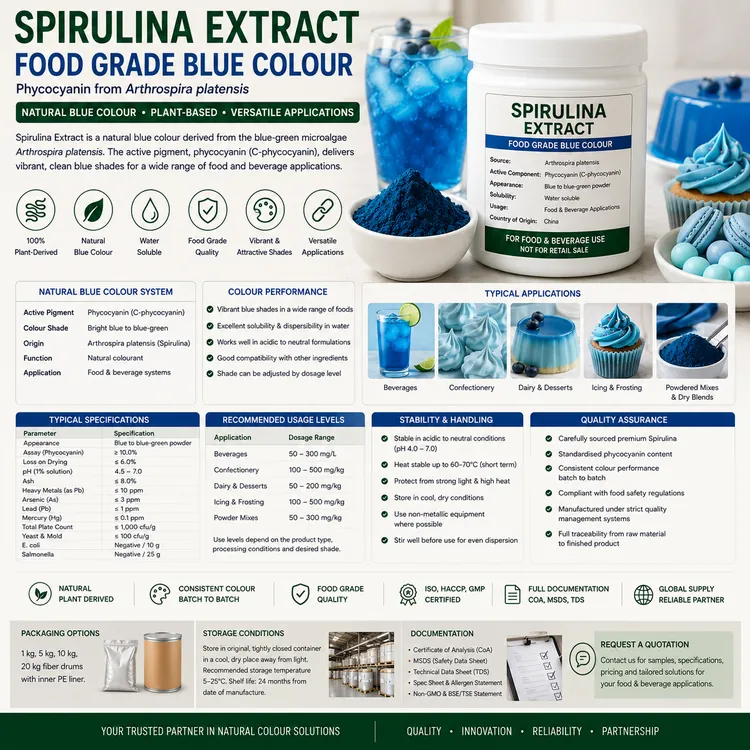
Product identity
| Product name | Spirulina Extract |
|---|---|
| Common names | Spirulina blue, phycocyanin colour, C-phycocyanin, spirulina-derived blue colour, natural blue colour |
| Source | Typically prepared from dried biomass of Arthrospira platensis, commonly known commercially as spirulina |
| Principal colour components | Phycocyanins, especially C-phycocyanin, depending on extraction and standardisation method |
| E / INS number | Confirm by destination market and supplier documentation |
| CAS / identity | Spirulina-derived phycocyanin extract or spirulina colour preparation depending on grade |
| Category | Colours & Colouring Foods |
| Primary function | Blue food colour, natural colour system, shade standardisation ingredient and visual identity support |
| Typical shade | Blue to blue-green; green shades can be developed through blending with yellow colour systems where permitted |
| Typical form | Water-soluble powder, liquid concentrate, granule, dispersion or carrier-standardised blend |
Application fit
Spirulina Extract is evaluated where a natural blue, blue-green or green shade is required and the product matrix is compatible with phycocyanin stability. Potential use areas may include:
- Confectionery, gummies, hard candy, chewing gum, fondants, coatings and decorative systems
- Ice cream, frozen desserts, non-dairy frozen desserts and dessert toppings
- Yogurts, dairy desserts, puddings, custards and plant-based dairy alternatives
- Beverage powders, instant drink mixes, dry blends and nutritional powders
- Icings, frostings, bakery decorations, fillings and dessert coatings
- Seasoning mixes, snack coatings, cereals and specialty dry applications where permitted
Technical overview for industrial buyers
Spirulina Extract is valued because it offers a naturally derived blue colour option in a category where stable natural blue systems are limited. The main colouring proteins, phycocyanins, provide a bright blue hue but are sensitive to formulation and processing stress. Key variables include pH, heat exposure, light exposure, oxygen, oxidising agents, water activity, metal ions, preservatives, packaging transparency, storage temperature and interaction with other colours or ingredients.
For industrial procurement, buyers should compare more than the product name. Important parameters include phycocyanin content, colour value, absorbance profile, shade, purity ratio, solubility, pH range, heat stability, light stability, carrier system, moisture, particle size, microbiological limits, microcystin status, heavy metal limits, pesticide statement where required, allergen status, GMO status, origin, shelf-life and packaging protection. A grade that performs well in dry confectionery or frozen dessert may not be suitable for acidic beverages, hot-filled products or long-light-exposure applications.
Functional role in formulation
- Natural blue shade: provides blue to blue-green colour where a spirulina-derived colour system is suitable.
- Green shade development: can be blended with yellow colours or colouring foods to create green tones.
- Colour standardisation: helps control visual identity across production batches when colour strength is standardised.
- Clean-label positioning: supports formulations seeking naturally derived colour alternatives, subject to local label rules.
- Dry mix colour support: can provide stable visual colour in selected powders, dry blends and low-moisture systems.
- Frozen dessert colour: may perform well in cold-chain applications when pH and light exposure are controlled.
Key buying parameters
| Grade | Food grade; confirm destination-market colour additive or colouring-food status |
|---|---|
| Colour strength | Request colour value, absorbance data or supplier-standardised phycocyanin strength |
| Phycocyanin content | Important for dosage calculation, shade comparison and cost-in-use evaluation |
| Shade profile | Evaluate blue tone, green undertone, brightness, clarity and blend compatibility |
| pH stability | Critical for beverages, yogurts, acidic confectionery and fruit-flavoured systems |
| Heat stability | Important for pasteurisation, hot preparation, bakery decoration and process hold conditions |
| Light stability | Important for transparent packaging, retail display and long shelf-life products |
| Carrier system | Review maltodextrin, sugar, starch, gum, salt or other carriers for label and allergen impact |
| Microbiology | Important for powders, dairy systems, beverages, low-heat products and international trade |
| Packaging | Requires moisture, oxygen and light protection suitable for colour-sensitive material |
Industrial application notes
In confectionery, Spirulina Extract can be used for blue, turquoise and green colours in gummies, hard candy, chewing gum, tablets, coatings and decorative systems. Product developers should evaluate pH, cooking temperature, acid addition timing, water activity, sugar or polyol system, flavour interaction and packaging light exposure. For high-temperature confectionery, colour addition after cooking or into a cooled mass may improve retention, but process validation is required.
In frozen desserts and dairy systems, Spirulina Extract may provide attractive blue and green shades in ice cream, non-dairy frozen desserts, yogurts, puddings and dessert toppings. Cold-chain applications can be favourable, but acidity, live cultures, fruit preparations, light exposure and storage time can still affect colour. Manufacturers should evaluate colour migration, shade drift, protein interaction, stabilizer system, pH and consumer-visible colour after distribution.
In beverages and beverage powders, Spirulina Extract must be selected carefully. Dry beverage powders and instant mixes may be more practical than highly acidic ready-to-drink beverages. For liquid beverages, formulators should test pH, pasteurisation, hot-fill conditions, oxygen, preservatives, light exposure, package type, storage temperature and sediment risk. If a green beverage shade is required, the full blue-yellow blend must be tested as a system.
In bakery decorations, icings and frostings, Spirulina Extract can support blue or green shades where heat exposure is limited. It is generally better suited to post-bake decorations, coatings, fillings and toppings than to high-temperature baked dough or batter systems. Product developers should evaluate pH, sugar concentration, fat content, water activity, light exposure and colour bleed into surrounding components.
Colour system design
- Define the target shade using a physical standard, approved product sample or instrumental colour measurement.
- Confirm whether the target is blue, blue-green, turquoise or a green shade made by blending with yellow colour.
- Test the colour in the real product matrix, not only in water.
- Evaluate pH, heat process, light exposure, oxygen level, preservative system, packaging and shelf life.
- Measure colour change after processing, after transport simulation and at the end of intended shelf life.
- Validate dosage against legal limits, label requirements, customer specifications and cost-in-use targets.
Process and handling considerations
- Add Spirulina Extract under controlled mixing to avoid streaks, specks or incomplete dispersion.
- For powder grades, pre-blend with dry carriers when needed to improve distribution in premixes.
- For liquid grades, protect the solution from unnecessary heat, light and air exposure.
- Use compatible water quality and avoid conditions that destabilise phycocyanin.
- Manage dusting, moisture uptake and colour carryover during weighing and transfer.
- Store tightly closed in cool, dry, light-protected conditions according to supplier recommendation.
- Maintain lot traceability from raw material receipt through finished product batch records.
Quality control checkpoints
Food manufacturers normally evaluate Spirulina Extract through both colour-strength specification and application testing. Because colour performance depends on the product matrix, a passing certificate of analysis does not guarantee shade stability in every process. Incoming QC should confirm that each lot matches the approved shade standard, phycocyanin strength and microbiological and contaminant requirements.
Typical laboratory checks
- Appearance, colour, odour and foreign matter inspection
- Identification as Spirulina Extract or spirulina-derived phycocyanin colour
- Colour value, absorbance profile or phycocyanin content
- Shade comparison against approved reference standard
- Moisture or loss on drying for powder grades
- pH, solubility, solution clarity and insoluble matter where specified
- Particle size, bulk density and flowability for dry grades
- Microcystin toxin statement or test result where required
- Lead, arsenic, mercury, cadmium or other heavy metals according to destination rules
- Total plate count, yeast, mould, coliforms and pathogen indicators where required
- Pesticide residue or environmental contaminant statements where required
- Lot number, manufacturing date and shelf-life verification
Functional performance checks
- Shade match at intended dosage in the finished product
- Colour retention after processing and throughout shelf life
- Heat, light, oxygen and pH stability in the final matrix
- Compatibility with acids, preservatives, dairy proteins, gums, minerals and other colours
- Green shade performance when blended with yellow colours or colouring foods
- Solubility, dispersion, specking, sedimentation and colour bleed behavior
- Flavour, aroma or off-note contribution at intended dosage
- Packaging seal integrity and pallet condition on receipt
Regulatory and compliance notes
Spirulina Extract regulatory status varies by market. In some jurisdictions it may be treated as a colour additive, while in others it may be considered under colouring foods, natural colours or other market-specific categories. The acceptable source organism, extraction process, diluents, carriers, purity criteria, food categories, maximum use levels, colour declaration wording and label terminology should be confirmed for the destination country before commercial use.
Because spirulina is an aquatic biomass-derived ingredient, buyers should request documentation that supports food safety and contamination control. Important declarations may include source organism, cultivation conditions, extraction method, carrier system, microcystin status, heavy metals, microbiology, pesticide or environmental contaminant statement, allergen status, GMO status, vegan status, halal or kosher status, origin and traceability. These claims should not be assumed from the product name alone.
Recommended documents to request
- Product specification or technical data sheet with colour strength, physical and chemical parameters
- Certificate of analysis for available batch or lot
- Safety data sheet where applicable
- Food-grade declaration and statement of intended food use
- Source organism and extraction-process statement where available
- Phycocyanin content, colour value, absorbance profile or shade-standard information
- Carrier system declaration and label-support information
- Microcystin toxin statement or negative test result where required
- Heavy metals statement and market-specific contaminant compliance where applicable
- Microbiological specification and pathogen statement where required
- Origin statement and manufacturer information where available
- Allergen, GMO, vegan, halal, kosher or animal-origin declarations when required
- Stability information for pH, heat, light and storage conditions when available
- Shelf-life, storage condition, humidity protection and light-protection recommendation
- Label draft, net weight, bag, bottle, drum, carton or container dimensions, pallet configuration and container loading estimate
- Traceability information, batch coding format and recall-support documentation
Specification information useful for quotation
For a faster and more accurate quotation, provide the target shade, required colour strength, application, physical form, carrier preference, annual and first-order quantity, destination country, delivery term, packaging preference, required certifications, inspection requirements and expected shipment date. If you already purchase Spirulina Extract, share the existing COA, technical data sheet, product label, approved shade standard, dosage, pH range, process temperature or benchmark supplier specification so equivalent options can be compared by phycocyanin content, shade, stability, carrier system, origin, documentation and logistics cost.
Packaging and logistics
Industrial Spirulina Extract is usually quoted according to product form, net weight, packaging type, palletization, container loading, port of loading, Incoterms and destination. Powder grades require moisture and light protection to maintain flowability and colour strength. Liquid grades should be reviewed for temperature exposure, microbial control, leakage protection, container compatibility and shelf-life remaining. Export shipments should be checked for documentation deadlines, pallet wrapping, cold-chain or cool-storage needs where required, and destination customs requirements.
Commercial evaluation criteria
- Food-grade status and documentation completeness
- Destination-market regulatory fit and label declaration support
- Consistency of shade, phycocyanin content, colour strength and solubility
- Suitability for confectionery, frozen desserts, dairy systems, beverages, powders, icings or decorations
- Availability of microcystin, heavy metal, microbiology, allergen, GMO, vegan, halal, kosher and origin documentation when required
- Stability under the buyer’s pH, heat, light, oxygen and packaging conditions
- Lead time, stock position and minimum order quantity
- Packaging suitability for moisture-sensitive and light-sensitive colour material
- Total landed cost and cost-in-use, not only unit price
How to request this product
Send the product name, target shade, colour strength if known, phycocyanin requirement if known, physical form, application, quantity, destination country, packaging preference, expected shipment date and required documents. If the colour will be used in confectionery, frozen desserts, dairy products, beverage powders, ready-to-drink beverages, icings, frostings, snack coatings or dry mixes, include the application category, pH, heat process, packaging format, shelf-life target and approved shade reference so the supplier review can focus on the most relevant technical and regulatory parameters.
Useful answers
What is Spirulina Extract used for in food manufacturing?
Spirulina Extract is used as a blue colour ingredient for visual identity, shade development, natural colour positioning and colour standardisation in approved food and beverage applications such as confectionery, frozen desserts, icings, beverage powders, dairy desserts, dry mixes and selected beverages.
What gives Spirulina Extract its blue colour?
The main blue colouring components are phycocyanins, especially C-phycocyanin. Colour strength and shade depend on phycocyanin content, extraction method, carrier system, pH, processing conditions and storage.
Is Spirulina Extract heat stable?
Spirulina-derived phycocyanin is generally more sensitive to heat, low pH, light and oxidising conditions than many synthetic colours. The buyer should test the colour in the final product matrix before commercial approval.
Can Spirulina Extract be used for green shades?
Yes. Spirulina Extract can be blended with yellow colours or yellow colouring foods to create green shades, provided that the complete colour system is suitable for the application, processing conditions and destination-market rules.
Which applications commonly use Spirulina Extract?
Common application areas include confectionery, chewing gum, frostings, icings, frozen desserts, yogurts, dessert toppings, beverage powders, dry mixes, snack seasonings and specialty colour systems where permitted by local regulations.
Which specification parameters matter most?
Important parameters include colour strength, phycocyanin content, absorbance profile, shade, solubility, pH stability, heat stability, light stability, carrier system, moisture, microbiology, microcystin status, heavy metals, origin, shelf life and packaging protection.
Can Global Food Additives source Spirulina Extract?
Global Food Additives can review sourcing options for Spirulina Extract according to target shade, colour strength, physical form, application, quantity, destination, packaging, certification needs and required documentation.
Which documents should be requested?
Buyers commonly request a technical data sheet, certificate of analysis, safety data sheet, food-grade declaration, origin statement, phycocyanin or colour-strength data, carrier declaration, microcystin statement, allergen statement, GMO status, halal or kosher certificate, shelf-life and storage information, label details and packing configuration.
Is this product permitted in every country?
No. Food colour use depends on destination-market rules, food category, colour additive status, use level, label wording and buyer responsibility. Always verify local regulations before commercial use.
Tell us which food additive or ingredient you need.
Send product names, target specifications, quantity, destination country, packaging preference, delivery term, and document requirements. Our team will review your inquiry and respond from orders@foodgradeadditives.com.
Your message has been received. You will be redirected to the home page.