
Sunflower Lecithin E322
Sunflower Lecithin is a food-grade phospholipid-based emulsifier used by industrial food manufacturers for emulsion stability, fat dispersion, chocolate flow improvement, bakery softness, powder wetting, instantization and processing efficiency. It is often selected where a non-soy emulsifier, non-GMO sourcing expectation or allergen-conscious formulation strategy is required. This page is prepared for purchasing teams, R&D technologists, QA departments and import managers who need structured technical information before requesting a quotation.
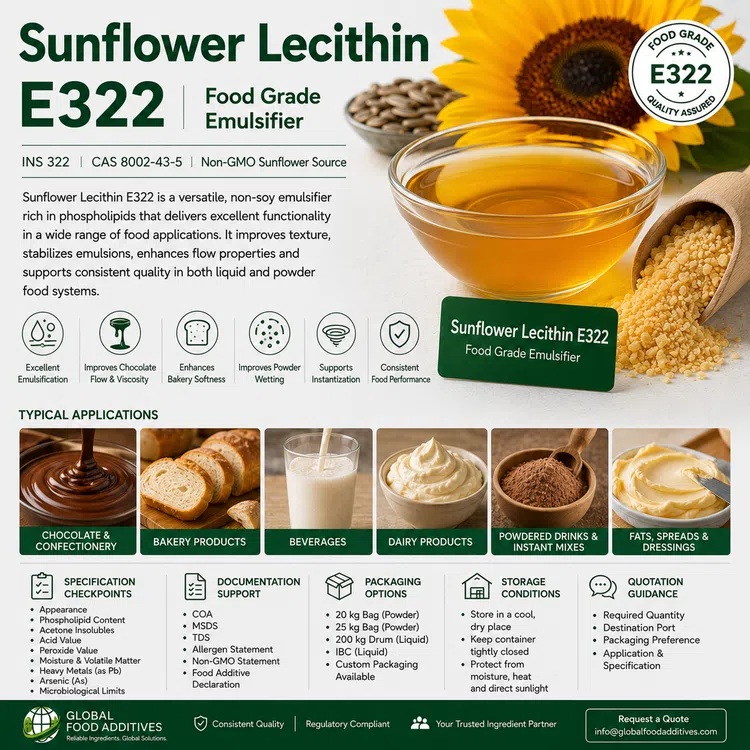
Product identity
| Product name | Sunflower Lecithin |
|---|---|
| Common names | Sunflower Lecithin E322, sunflower-derived lecithin, sunflower phospholipids, non-soy lecithin |
| Source | Derived from sunflower seed oil processing streams, then refined or standardized depending on grade |
| CAS number | 8002-43-5 |
| E / INS number | E322 / INS 322 |
| Category | Emulsifiers & Surface Active Ingredients |
| Primary function | Emulsifier, dispersing aid, wetting agent, flow improver and surface-active food ingredient |
| Typical composition | Mixture of phospholipids such as phosphatidylcholine, phosphatidylethanolamine, phosphatidylinositol and phosphatidic acid, plus neutral oil depending on grade |
| Typical forms | Liquid lecithin, fluidized lecithin, deoiled powder, granule, flake, paste or specialty blend |
| Typical handling form | Viscous liquid, pourable heated liquid, powder or granule depending on production line and application |
Application fit
Sunflower Lecithin is evaluated in applications where surface activity, fat-water interaction, wetting, dispersion or viscosity control is required. Potential use areas may include:
- Chocolate, compound coatings, cocoa spreads and confectionery fillings
- Bakery products, cake mixes, biscuits, crackers and dough systems
- Margarine, shortenings, spreads, dressings and oil-based emulsions
- Ice cream, dairy desserts, plant-based dairy alternatives and cream systems
- Instant powders, beverage powders, protein blends and nutritional mixes
- Snack seasonings, release agents, sauces and processed-food systems
Technical overview for industrial buyers
Sunflower Lecithin is a multifunctional emulsifier made up of naturally occurring phospholipids with both hydrophilic and lipophilic regions. This amphiphilic structure allows lecithin to position itself at oil-water, fat-solid and air-liquid interfaces, improving dispersion, reducing interfacial tension and supporting more uniform product structure. In practical manufacturing, it can improve emulsion stability, reduce chocolate viscosity, improve powder wetting, support dough handling, assist aeration and improve fat distribution.
For industrial procurement, Sunflower Lecithin should be evaluated by more than product name and E number. Important parameters include acetone insoluble matter, phospholipid profile, viscosity, moisture, acid value, peroxide value, color, odor, residual solvent status where applicable, insoluble impurities, microbiological status, packaging integrity, traceability and declaration support. The best grade depends on the application: chocolate manufacturers may prioritize viscosity reduction and flow behavior, while powder-blend producers may need deoiled lecithin with good dispersibility and low caking risk.
Functional role in formulation
- Emulsification: supports oil-water dispersion in spreads, sauces, dressings, dairy systems and plant-based products.
- Chocolate flow: helps reduce apparent viscosity and yield value, improving pumping, moulding, coating and enrobing behavior.
- Wetting and instantization: improves water penetration into powders such as cocoa, protein blends, drink mixes and nutritional powders.
- Fat dispersion: promotes more uniform distribution of fats and oils in bakery, confectionery and dry-mix systems.
- Texture support: may contribute to crumb softness, dough tolerance, aeration and smoother mouthfeel depending on formulation.
- Processing aid effect: can reduce sticking, improve release, support mixing efficiency and stabilize intermediate processing steps.
Key buying parameters
| Grade | Food grade; confirm compliance with buyer specification and destination-market rules |
|---|---|
| Form | Liquid, fluidized, deoiled powder, granule, paste or custom blend depending on application |
| Acetone insoluble matter | Common indicator of phospholipid content and emulsifying value |
| Viscosity | Critical for liquid lecithin pumping, dosing, heating and handling |
| Moisture | Important for shelf life, flowability, microbial control and caking resistance |
| Acid value | Useful for assessing hydrolysis level and oil quality behavior |
| Peroxide value | Important for oxidation status, flavor quality and storage stability |
| Color and odor | Relevant for chocolate, bakery, dairy, plant-based and flavor-sensitive products |
| Packaging | Commonly supplied in drums, IBCs, pails, cartons, bags or palletized export packaging depending on form |
Industrial application notes
In chocolate and compound coatings, Sunflower Lecithin is mainly evaluated for its ability to improve flow behavior. It can reduce viscosity, support coating uniformity, improve mould filling, assist enrobing and help reduce processing stress. The dosage, addition point and compatibility with cocoa butter, vegetable fats, sugar particle size, milk solids and other emulsifiers must be validated. Excessive use may negatively affect yield value, texture, flavor release or thickening behavior, so pilot testing is recommended before supplier or grade changes.
In bakery systems, Sunflower Lecithin can support fat dispersion, dough handling, crumb softness, volume, shelf-life quality and emulsification of shortening or oil phases. It may be used in breads, cakes, biscuits, crackers, laminated products and dry bakery mixes. Performance depends on flour quality, fat type, water absorption, sugar level, mixing energy, proofing conditions and baking profile. For powdered bakery mixes, deoiled lecithin powder can be easier to blend than viscous liquid lecithin.
In instant powders and nutritional blends, lecithin improves wetting and dispersibility by reducing the surface tension between hydrophobic powder particles and water. This is valuable for cocoa powders, protein powders, beverage premixes, coffee creamers, infant or adult nutrition mixes and plant-based powders. The selected grade should be tested for wettability, dispersibility, dusting, flavor impact, particle distribution and packaging stability.
In emulsions such as dressings, sauces, spreads, dairy alternatives and margarine systems, lecithin can help stabilize fat-water interfaces and improve mouthfeel. It may also interact with mono- and diglycerides, polyglycerol esters, hydrocolloids, proteins and starches. The correct emulsifier system depends on oil phase, pH, salt, heat process, shear conditions, homogenization, storage temperature and target shelf life.
Grade selection guide
- Liquid lecithin: suitable for chocolate, coatings, oil systems, release agents and processes with liquid dosing capability.
- Deoiled powder: useful for dry blends, instant powders, bakery premixes and applications requiring better powder flow.
- Fluidized lecithin: selected when lower viscosity and easier pumping are needed compared with standard liquid grades.
- Hydrolyzed lecithin: may offer modified emulsifying behavior in selected systems where permitted and documented.
- Custom blends: used when lecithin is combined with carriers, oils or other emulsifiers for a defined process target.
Process and handling considerations
- Liquid lecithin may require warming or controlled storage temperature to improve pumpability and dosing accuracy.
- Protect from oxidation, heat abuse, moisture and strong odors during storage and transport.
- Use food-grade hoses, pumps and containers suitable for viscous lipid-based ingredients.
- For powder grades, manage dusting, caking and segregation during dry blending and conveying.
- Validate addition point because lecithin performance can change depending on whether it is added to fat, water or dry phase.
- Maintain strict lot traceability, especially when claims involve sunflower origin, non-GMO status or soy avoidance.
Quality control checkpoints
Food manufacturers typically evaluate Sunflower Lecithin through a combination of chemical, sensory and functional performance tests. Because lecithin is a complex natural ingredient, batch consistency is especially important. A technically strong supplier should be able to provide repeatable phospholipid content, controlled oxidation values, stable viscosity and complete documentation for each lot.
Typical laboratory checks
- Appearance, color, odor and foreign matter inspection
- Acetone insoluble matter or phospholipid content
- Moisture or loss on drying
- Acid value and peroxide value
- Viscosity for liquid and fluid lecithin grades
- Hexane insoluble matter or insoluble impurities where specified
- Heavy metals according to buyer and destination-market requirements
- Microbiological status where required by application and specification
- Lot number, manufacturing date and shelf-life verification
Functional performance checks
- Chocolate viscosity, yield value and flow behavior
- Emulsion stability under heat, shear and storage conditions
- Powder wetting time and dispersibility in the buyer’s process water or milk system
- Dry blend homogeneity and segregation risk
- Bakery dough handling, volume, crumb softness and shelf-life performance
- Flavor neutrality, odor impact and oxidation stability in finished product
- Pumpability, dosing accuracy and cleanability in plant equipment
- Packaging seal integrity and pallet condition on receipt
Regulatory and compliance notes
Sunflower Lecithin is commonly declared under the lecithins category, identified as E322 or INS 322 where applicable. Regulatory status, additive naming, permitted food categories, purity criteria and label declarations may differ by country and final application. Buyers should confirm whether the product will be declared as lecithin, sunflower lecithin, emulsifier, E322 or another market-specific wording.
Because Sunflower Lecithin is often used for positioning claims, documentation should be reviewed before purchase. Non-GMO, allergen, soy-free, vegan, halal, kosher, organic, solvent-free or sustainability claims should never be assumed from the product name alone. They should be supported by valid supplier declarations, certificates, traceability records and destination-market labeling review.
Recommended documents to request
- Product specification or technical data sheet with physical, chemical and functional parameters
- Certificate of analysis for available batch or lot
- Safety data sheet where applicable
- Food-grade declaration and statement of intended food use
- Origin statement and sunflower-source declaration where available
- Allergen, soy-free, GMO, vegan, halal, kosher or animal-origin declarations when required
- Acetone insoluble matter, acid value, peroxide value, moisture and viscosity information
- Residual solvent statement where applicable to the production route
- Heavy metals statement and market-specific contaminant compliance where applicable
- Shelf-life, storage condition, temperature and oxidation-protection recommendation
- Label draft, net weight, drum, IBC, pail, carton or bag dimensions, pallet configuration and container loading estimate
- Traceability information, batch coding format and recall-support documentation
Specification information useful for quotation
For a faster and more accurate quotation, provide the target specification, required form, application, annual and first-order quantity, destination country, delivery term, packaging preference, required certifications, inspection requirements and expected shipment date. If you already purchase Sunflower Lecithin, share the existing COA, technical data sheet, product label, approved sample, viscosity range or benchmark supplier specification so equivalent options can be compared by phospholipid level, acetone insoluble matter, acid value, peroxide value, viscosity, origin, documentation and logistics cost.
Packaging and logistics
Industrial Sunflower Lecithin is usually quoted according to product form, net weight, packaging type, palletization, container loading, port of loading, Incoterms and destination. Liquid lecithin may be supplied in drums, pails, IBCs or bulk formats, while deoiled powder may be supplied in lined bags, cartons or fiber drums. Export shipments should be reviewed for temperature exposure, oxidation protection, packaging seal integrity, pallet wrapping, documentation deadlines and destination customs requirements.
Commercial evaluation criteria
- Food-grade status and documentation completeness
- Consistency of phospholipid content, viscosity, acid value and peroxide value
- Suitability for chocolate, bakery, powder, emulsion or fat-based applications
- Availability of non-GMO, allergen, soy-free, halal, kosher or organic documentation when required
- Lead time, stock position and minimum order quantity
- Packaging suitability for manual, semi-automatic or automated handling
- Regulatory fit for the destination market
- Total landed cost, not only unit price
How to request this product
Send the product name, target form, grade, application, quantity, destination country, packaging preference, expected shipment date and required documents. If the ingredient will be used in chocolate, confectionery, bakery, instant powders, beverages, plant-based dairy, sauces, margarine or release systems, include the application category and key performance target such as viscosity reduction, powder wetting, emulsion stability, crumb softness or soy-free positioning.
Useful answers
What is Sunflower Lecithin used for in food manufacturing?
Sunflower Lecithin is used as an emulsifier, wetting agent, dispersing aid and processing support ingredient. It is commonly evaluated for chocolate flow, emulsion stability, fat dispersion, bakery softness, powder wetting, instantization and smoother processing.
Why do manufacturers choose Sunflower Lecithin instead of Soy Lecithin?
Manufacturers may choose Sunflower Lecithin for soy-free positioning, non-GMO sourcing expectations, allergen-management programs or customer preference. Final claims must be supported by supplier declarations, traceability documents and local labeling rules.
What is the difference between liquid and deoiled Sunflower Lecithin?
Liquid Sunflower Lecithin contains phospholipids with oil and is often used in chocolate, coatings, fat systems and liquid dosing processes. Deoiled Sunflower Lecithin is a powder or granule with reduced oil content, making it useful for dry blends, instant powders and premixes.
Which specification parameters matter most?
Important parameters include acetone insoluble matter, phospholipid content, viscosity, moisture, acid value, peroxide value, color, odor, insoluble impurities, microbiological status where required, and documentation for origin, allergen and GMO status.
Can Global Food Additives source Sunflower Lecithin?
Global Food Additives can review sourcing options for Sunflower Lecithin according to target specification, physical form, application, quantity, destination, packaging, certification needs and required documentation.
Which documents should be requested?
Buyers commonly request a technical data sheet, certificate of analysis, safety data sheet, food-grade declaration, origin statement, allergen statement, GMO status, soy-free statement where required, halal or kosher certificate, shelf-life and storage information, label details and packing configuration.
Is this product permitted in every country?
No. Food additive use depends on destination-market rules, food category, use level, label requirements and buyer responsibility. Always verify local regulations before commercial use.
Tell us which food additive or ingredient you need.
Send product names, target specifications, quantity, destination country, packaging preference, delivery term, and document requirements. Our team will review your inquiry and respond from orders@foodgradeadditives.com.
Your message has been received. You will be redirected to the home page.