
Tetrasodium Pyrophosphate
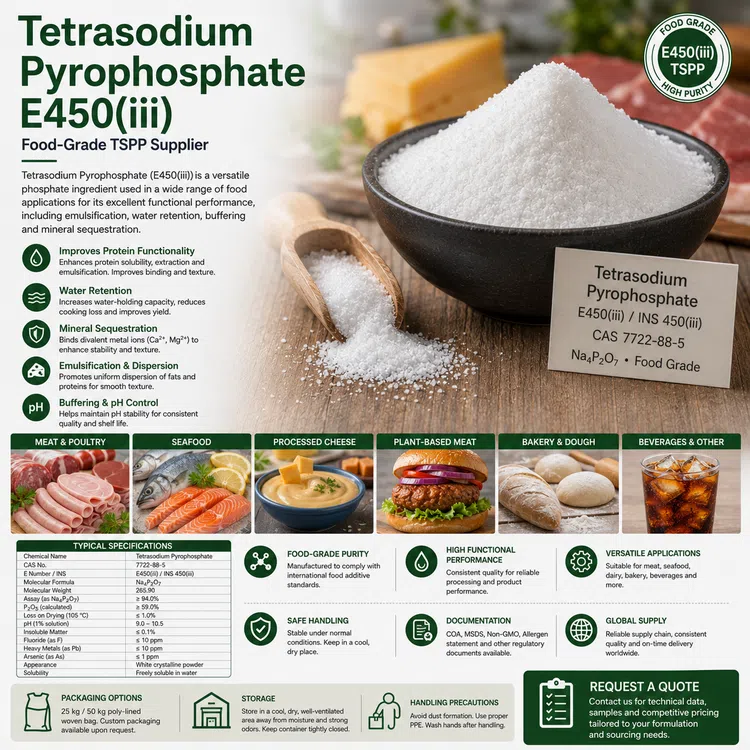
Tetrasodium Pyrophosphate, commonly abbreviated as TSPP, is an alkaline condensed phosphate used in regulated food applications for buffering, metal-ion sequestration, protein functionality, emulsifying-salt action, water-retention support and mineral management.
Chemically identified as Na4P2O7, TSPP contributes sodium ions and the pyrophosphate anion to a food system. Its functional effect depends on concentration, pH, ionic strength, processing temperature, contact time, mineral content, protein type and interactions with other phosphates or salts.
Industrial buyers should specify whether an anhydrous or hydrated grade is required, together with the applicable food-grade standard, assay, particle size, solubility, contaminant limits, packaging and destination-market documentation.
Product identity
| Product name | Tetrasodium Pyrophosphate |
|---|---|
| Common abbreviation | TSPP |
| Alternative names | Tetrasodium diphosphate, sodium pyrophosphate and tetrapotassium-free sodium pyrophosphate |
| Product category | Condensed phosphate, emulsifying salt, sequestrant and buffering ingredient |
| E number | E450(iii) |
| INS number | INS 450(iii) |
| CAS number | 7722-88-5 |
| Chemical formula | Na4P2O7 for the anhydrous form |
| Molar mass | Approximately 265.90 g/mol for anhydrous TSPP |
| Typical appearance | White, free-flowing powder, crystalline powder or granular material |
| Solution character | Alkaline; exact pH depends on concentration, temperature and supplier specification |
| Commercial forms | Anhydrous powder, granular grade and hydrated grades where commercially available |
| Primary functions | Buffering, sequestration, protein extraction, emulsification, water-retention support and mineral control |
Primary industrial functions
- Raises and stabilizes pH in suitable formulations
- Sequesters calcium, magnesium, iron and other metal ions
- Supports extraction and hydration of functional meat proteins
- Improves emulsion formation in selected protein systems
- Supports water binding and processing yield
- Helps control mineral-protein interactions
- Acts as an emulsifying salt in processed cheese systems
- Supports texture and consistency in seafood processing
- Can reduce metal-catalyzed quality deterioration
- Contributes to phosphate-blend functionality
How TSPP functions in food systems
TSPP dissociates in water to provide sodium ions and pyrophosphate species. The pyrophosphate anion can interact with polyvalent metal ions and food proteins, while the sodium contribution and alkaline character influence pH and ionic strength.
Its effectiveness is not determined by dosage alone. Water quality, calcium and magnesium concentration, product pH, salt content, temperature, processing time and other phosphate species can all alter performance.
Metal-ion sequestration
Pyrophosphate can bind polyvalent ions such as calcium, magnesium and iron. This can reduce unwanted mineral interactions, support protein hydration and help limit certain metal-catalyzed quality changes.
Sequestration capacity should be evaluated in the actual water and food matrix because ion concentration and competing ingredients influence the result.
Protein functionality
In selected meat, poultry and seafood systems, TSPP can support the solubilization or extraction of salt-soluble proteins. These proteins contribute to binding, emulsion stability, water retention and cooked-product structure.
Performance is often influenced by sodium chloride, temperature, mixing energy, protein condition and the presence of other phosphates.
Buffering and alkalinity
TSPP can increase product pH and provide alkaline buffering. A controlled pH increase may improve protein hydration and water retention, but excessive alkalinity can negatively affect flavor, color, texture or regulatory compliance.
Emulsifying-salt action
In processed cheese and related systems, pyrophosphate can sequester calcium from the protein matrix and help convert aggregated casein into a more hydrated, emulsifying form.
The final effect depends on cheese age, calcium level, moisture, fat, pH, heating profile and the complete emulsifying-salt blend.
Technical parameters to evaluate
Food-grade TSPP should be purchased against a signed specification linked to the required regulatory or compendial standard. Exact limits differ by supplier, country and standard, so the values below are presented as specification categories rather than universal acceptance limits.
| Parameter | Industrial significance | Purchasing guidance |
|---|---|---|
| Assay | Confirms the concentration of Tetrasodium Pyrophosphate in the commercial product. | Specify the minimum and maximum assay, reporting basis and analytical method required by the applicable food-grade standard. |
| Phosphate content | May be reported as pyrophosphate, phosphorus or P2O5 equivalent. | Confirm the reporting convention before comparing supplier certificates. |
| Hydration state | Anhydrous and hydrated products have different molecular weights, assay calculations and commercial yields. | State whether an anhydrous or hydrated grade is required and verify the basis of assay. |
| pH | Indicates alkaline strength and influences application performance. | Specify solution concentration, water quality, temperature and test method because pH results are method dependent. |
| Loss on drying | Indicates moisture or hydration-related mass loss. | Confirm the drying temperature, duration and acceptance limit appropriate to the grade. |
| Water-insoluble matter | Affects solution clarity, filtration, injector reliability and visible sediment. | Use a low insoluble-matter limit for clear brines, beverages or sensitive dosing systems. |
| Solubility | Affects preparation time, solution concentration and process reliability. | Evaluate under actual water temperature, hardness, salt level and target concentration. |
| Particle size | Influences dissolution speed, dusting, flow and dosing consistency. | Specify powder or granular grade, screen distribution and acceptable fines. |
| Bulk density | Affects bag volume, hopper capacity, feeder calibration and freight efficiency. | Confirm whether loose or tapped bulk density is required. |
| Flowability | Influences storage, conveying and automatic dosing. | Request flow or caking information for humid environments and bulk-handling systems. |
| Heavy metals | Supports food-safety and regulatory compliance. | Define limits according to the destination market and required compendial standard. |
| Lead | A critical elemental-contaminant parameter for food-grade phosphates. | Include a specific maximum limit and approved analytical method. |
| Arsenic | May be controlled separately from total heavy metals. | Confirm the applicable market or customer limit. |
| Fluoride | Can be a phosphate-raw-material-related impurity. | Include a limit where required by the relevant food-grade standard. |
| Identification tests | Confirm sodium and pyrophosphate identity. | Request compliance with the required pharmacopoeial, compendial or food-additive test procedures. |
| Microbiological status | Inorganic salts generally present a low microbial-growth risk, but hygienic manufacturing and packaging remain important. | Include microbiological limits when required by customer policy or the intended food category. |
Commercial forms and performance differences
Anhydrous powder
Anhydrous TSPP provides a high active-phosphate concentration per unit weight. Fine powder grades can dissolve relatively quickly under suitable conditions but may generate more dust and require controlled handling.
Granular grade
Granular products may offer improved flow, reduced dust and more consistent feeding in automated systems. Dissolution speed should be verified against the required batch preparation time.
Hydrated grade
Hydrated forms contain chemically associated water and therefore have a different molecular weight and active-content basis from anhydrous TSPP. Direct price-per-kilogram comparisons can be misleading unless active content is normalized.
Customized phosphate blends
TSPP may be combined with sodium tripolyphosphate, sodium hexametaphosphate, orthophosphates or other permitted salts to balance pH, solubility, sequestration, protein functionality and application-specific performance.
Dissolution and addition guidance
TSPP should be incorporated using a validated addition sequence. Poor dissolution can create undissolved particles, localized high pH, inconsistent functionality, injector blockage or batch-to-batch variation.
- Confirm water quality. Hardness, calcium, magnesium, iron and temperature can affect dissolution and sequestration demand.
- Use sufficient process water. Highly concentrated phosphate solutions can be difficult to prepare and may become unstable when additional salts are introduced.
- Establish effective agitation. Create strong circulation without excessive air incorporation.
- Add phosphate gradually. Avoid dumping the entire quantity into one area, where agglomerates or localized high concentration can form.
- Dissolve phosphate before high salt loading. In many brine systems, sodium chloride and other dissolved solids reduce phosphate dissolution efficiency. The optimized sequence should be established through plant trials.
- Control water temperature. Moderately warm water may improve dissolution, but temperature must remain compatible with the formulation, equipment and food-safety plan.
- Allow complete dissolution. Verify visual clarity or filtration performance before the solution enters injectors, dosing pumps or fine screens.
- Add sensitive ingredients afterward. Proteins, hydrocolloids, calcium salts or acids may interact with concentrated phosphate and should be added according to a validated process sequence.
- Monitor final pH. Confirm that the complete formulation remains within the technical, sensory and regulatory target.
Hydrolysis and phosphate conversion
Pyrophosphate can gradually hydrolyze to shorter-chain phosphate species, including orthophosphate. Hydrolysis rate is influenced by pH, temperature, time, water activity, enzymes and the surrounding food matrix.
Extended storage of prepared solutions, especially under warm or acidic conditions, can reduce the amount of functional pyrophosphate remaining. Where consistent performance is critical, phosphate solutions should be prepared and used within a validated holding period.
Buyers should also distinguish between the chemical assay of the dry ingredient and the phosphate profile present after processing or storage in the finished food.
Industrial food applications
Processed meat and poultry
- Injected meat and poultry products
- Tumbled or marinated products
- Comminuted sausages
- Formed meat products
- Cooked hams and poultry rolls
- Emulsified meat systems
TSPP may support myofibrillar protein extraction, water binding, emulsion stability and cooked yield. Performance depends on salt, pH, protein condition, mixing energy, temperature and total phosphate level.
Seafood processing
- Fish fillets
- Shrimp and crustacean products
- Scallops and molluscan products
- Formed seafood products
- Frozen seafood systems
In permitted applications, phosphate systems may support moisture retention, texture and freeze-thaw performance. Excessive treatment can create surface residues, unnatural texture, high pickup or undesirable alkaline flavor.
Processed cheese
- Processed cheese blocks
- Cheese slices
- Cheese spreads
- Cheese sauces
- Cheese-based fillings
TSPP can participate in calcium sequestration and casein hydration. It is often evaluated as part of an emulsifying-salt system rather than as a stand-alone solution.
Dairy and protein systems
- Protein dispersions
- Recombined dairy systems
- Mineral-sensitive formulations
- Selected dairy analogues
The alkaline and calcium-binding effects of TSPP can significantly alter protein stability. Pilot testing is required to avoid over-sequestration, excessive pH or precipitation.
Beverage and liquid systems
- Mineral-control applications
- Process-water treatment within permitted use
- Selected protein beverages
- Cloud or suspension management systems
Solution clarity, insoluble matter, mineral profile, pH and labeling requirements are especially important in beverages.
Bakery and cereal systems
- pH adjustment in selected formulations
- Mineral-control applications
- Phosphate blends for specialized processing
TSPP is alkaline and is not a direct replacement for acidic leavening phosphates. Any bakery use should be supported by a specific formulation purpose and local regulatory permission.
Protein extraction, water retention and yield
In meat and poultry systems, functional proteins such as myosin play an important role in binding meat particles, stabilizing fat and retaining water. An appropriately designed phosphate and salt system can support extraction and hydration of these proteins.
TSPP may contribute through pH adjustment, ionic effects and interactions with actomyosin. The practical result can include better brine distribution, improved bind, lower cooking loss and more consistent texture.
The result is highly process dependent. Phosphate cannot compensate for poor raw-material quality, excessive temperature, inadequate mixing, uncontrolled brine pickup or an unsuitable cooking schedule.
| Process variable | Why it matters |
|---|---|
| Raw-material temperature | Affects protein extraction, emulsion stability and microbial control. |
| Salt concentration | Influences salt-soluble protein extraction and phosphate dissolution. |
| Mixing or tumbling energy | Determines protein extraction and brine distribution. |
| Vacuum | May affect brine penetration, air removal and product structure. |
| Holding time | Influences equilibration, phosphate interaction and process scheduling. |
| Final pH | Affects water binding, color, flavor, microbial behavior and regulatory compliance. |
| Cooking profile | Determines protein setting, moisture loss and finished texture. |
| Total phosphate level | Must remain functional, sensory acceptable and legally compliant. |
Emulsifying-salt performance
Natural cheese contains calcium-associated casein structures that do not automatically form a stable, homogeneous processed cheese emulsion. Emulsifying salts help redistribute calcium and hydrate the protein matrix so it can emulsify fat and water during heating.
TSPP can provide strong calcium-sequestering and alkalizing effects. Depending on the formulation, this may support emulsification, firmness and body. Excessive TSPP can create overly high pH, a brittle or excessively firm texture, alkaline flavor or reduced melt.
Processed cheese systems commonly use blends of phosphates and citrates to achieve the required balance of melt, sliceability, spreadability, firmness, flavor and shelf stability.
- Confirm natural-cheese age and mineral composition.
- Measure incoming cheese moisture, fat and pH.
- Define the required melt and cooling behavior.
- Evaluate TSPP within the complete emulsifying-salt blend.
- Control cooking temperature, shear and residence time.
- Verify hot-fill behavior and cooled texture.
- Monitor pH, oiling-off and water separation during shelf life.
Interactions with other formulation components
| Component | Potential interaction | Evaluation point |
|---|---|---|
| Calcium and magnesium | Can be sequestered by pyrophosphate. | High mineral loads can consume phosphate functionality or cause precipitation. |
| Iron and copper | Metal binding may reduce some catalytic oxidation pathways. | TSPP is not a replacement for a complete oxidation-control system. |
| Sodium chloride | Can work with phosphate to support protein extraction. | High salt concentration may reduce phosphate dissolution during brine preparation. |
| Proteins | pH and mineral changes can improve or destabilize protein hydration. | Evaluate solubility, viscosity, emulsion stability and thermal behavior. |
| Acids | Neutralize alkalinity and accelerate conversion to other phosphate species. | Avoid direct concentrated contact and validate addition order. |
| Hydrocolloids | Ionic conditions can alter viscosity and gel formation. | Confirm hydration sequence and final texture. |
| Starches | pH and mineral balance can affect swelling and pasting. | Evaluate viscosity through the complete heating and cooling cycle. |
| Other phosphates | Can modify pH, sequestration, solubility and protein functionality. | Compare blends on an active-phosphate and cost-in-use basis. |
| Calcium fortification salts | May react with pyrophosphate and form poorly soluble compounds. | Test solution stability, sediment and bioavailability claims. |
Recommended industrial trial measurements
| Trial stage | Measurements to consider |
|---|---|
| Incoming-material inspection | Appearance, odor, particle size, caking, bag condition, lot coding and certificate-of-analysis review. |
| Solution preparation | Dissolution time, clarity, sediment, foam, temperature, pH and filterability. |
| Brine preparation | Ingredient-addition sequence, salt compatibility, final pH, solids content and holding stability. |
| Protein processing | Extraction, viscosity, brine uptake, bind, emulsion stability and process temperature. |
| Cooking trial | Cooking yield, purge, shrinkage, texture, color, flavor and phosphate-related sensory effects. |
| Cheese trial | Emulsion formation, oiling-off, melt, firmness, spreadability, pH and cooling behavior. |
| Seafood trial | Pickup, retained moisture, drip loss, texture, surface appearance, flavor and freeze-thaw performance. |
| Shelf-life assessment | pH drift, purge, oxidation, mineral precipitation, texture and sensory stability. |
| Equipment assessment | Injector blockage, pump performance, filter loading, scale formation and cleanability. |
| Compliance review | Final phosphate level, sodium contribution, ingredient declaration and destination-market use conditions. |
Common processing observations
| Observation | Possible causes | Areas to investigate |
|---|---|---|
| Undissolved phosphate | Cold water, insufficient agitation, excessive concentration, early salt addition or coarse particles. | Adjust temperature, mixing, concentration, particle size and addition sequence. |
| Brine sediment | Hard water, calcium or magnesium interaction, insoluble matter or incompatible salts. | Review water quality, filtration, formulation order and phosphate blend. |
| Excessively high pH | Overdosing, inaccurate weighing or unsuitable phosphate blend. | Verify scales, formulation, active content and final product pH. |
| Alkaline or soapy flavor | Excessive TSPP, poor distribution or inadequate formulation balance. | Reduce dosage, improve dissolution and evaluate a blended phosphate system. |
| Low meat-product yield | Poor raw material, insufficient extraction, incorrect salt, high temperature or unsuitable cooking. | Review the entire process rather than phosphate dosage alone. |
| Soft or pasty texture | Excessive water, excessive phosphate effect or overprocessing. | Rebalance water, mixing, phosphate blend and thermal process. |
| Cheese becomes too firm | Strong calcium sequestration, high pH or excessive TSPP. | Adjust the emulsifying-salt blend, moisture and cooking profile. |
| Cheese oils off | Insufficient protein hydration, incorrect salt blend or unsuitable shear and temperature. | Review cheese composition, phosphate balance and cooking conditions. |
| Seafood surface residue | Excessive treatment concentration, poor draining or incomplete dissolution. | Review solution preparation, pickup, contact time and handling. |
| Caking in storage | Moisture exposure, damaged liners, humid storage or temperature cycling. | Improve packaging integrity, warehouse control and stock rotation. |
Regulatory and quality-control requirements
TSPP use is controlled by destination-market food-additive regulations. Permitted food categories, maximum levels, carry-over provisions, labeling names and phosphate calculations can differ substantially between jurisdictions.
Some regulations express phosphate limits as phosphorus, P2O5, total phosphate or the amount of the additive itself. The buyer should confirm the correct calculation basis before setting formulation limits.
Regulatory review
- Destination-country additive permission
- Permitted food category
- Maximum use level or quantum-satis status
- Calculation basis for total phosphate
- Ingredient-list naming
- Nutrition and sodium-labeling impact
- Carry-over and processing-aid considerations
Supplier compliance
- Food-grade manufacturing standard
- Current specification and test methods
- Lot-specific certificate of analysis
- Traceability and recall capability
- Change-notification system
- Food-defense and food-fraud programs
- Applicable third-party certification
Elemental contaminants
- Lead
- Arsenic
- Cadmium where required
- Mercury where required
- Total heavy metals where still specified
- Fluoride
Identity and claim controls
- Country of origin
- Manufacturing location
- GMO status where relevant
- Allergen and cross-contact statement
- Halal and kosher certification
- Vegan or vegetarian suitability
- Irradiation or nanomaterial statement where requested
Powder handling precautions
Although food-grade TSPP is intended for controlled food manufacturing, concentrated powder and dust are alkaline and can irritate the eyes, skin and respiratory system. Workplace handling should follow the supplier's current Safety Data Sheet.
- Minimize airborne dust during bag opening and transfer.
- Use suitable local exhaust ventilation where dust can form.
- Wear eye protection and appropriate work gloves.
- Use respiratory protection where required by risk assessment.
- Avoid direct contact with eyes and prolonged skin exposure.
- Provide access to washing and eye-rinsing facilities.
- Clean spills using methods that avoid dispersing dry dust.
- Keep the material separate from incompatible acids and moisture.
Documents to request before approval
- Current signed product specification
- Technical data sheet
- Lot-specific certificate of analysis
- Safety Data Sheet
- Food-grade compliance declaration
- Applicable E-number or INS declaration
- Country-of-origin statement
- Manufacturing-site statement
- Allergen and cross-contact declaration
- GMO statement where requested
- Heavy-metal and elemental-contaminant limits
- Analytical methods or referenced compendial standard
- Halal and kosher certificates where required
- Vegan or vegetarian suitability statement
- Food-safety certification and audit scope
- Packaging and food-contact compliance declaration
- Shelf-life and storage statement
- Traceability and recall procedure
- Change-notification policy
- Statement regarding irradiation where required
- Statement regarding nanomaterials where required
Industrial packing, storage and shipment
| Common packaging | Multiwall paper bags or woven bags with a sealed food-grade inner liner are commonly used. Exact net weight and construction depend on the supplier. |
|---|---|
| Typical commercial pack | Industrial bag sizes such as 20 kg or 25 kg may be available, but the final format must be confirmed with the supplier. |
| Bag labeling | Product name, grade, lot, net weight, production date, best-before date, storage conditions and manufacturer or responsible supplier should be identifiable. |
| Palletization | Request bags per pallet, pallet dimensions, net and gross weight, pallet material, stretch wrapping and stacking limits. |
| Storage | Store tightly closed in a cool, dry, clean and ventilated area, protected from moisture, acids, contamination and strong odors. |
| Moisture protection | TSPP can cake or lose flowability after moisture exposure. Bag liners should remain intact until use. |
| Shelf life | Shelf life depends on grade, moisture, packaging and storage. Confirm the supplier's declared period and required remaining shelf life at delivery. |
| Transport | Containers and vehicles should be dry, clean, covered, odor-free and suitable for food ingredients. Water ingress and condensation should be prevented. |
| Stock rotation | Use first-expired, first-out controls and maintain full lot traceability. |
| Opened bags | Reseal promptly, identify the lot and protect the remaining material from humidity and cross-contamination. |
Phosphate loss and wastewater control
Phosphate-containing product, brine and wash water should be managed to minimize unnecessary discharge. High phosphate loading can contribute to wastewater-treatment demand and nutrient enrichment in receiving environments.
- Use calibrated dosing equipment to prevent overuse.
- Reduce dry-powder spills and product loss.
- Optimize brine preparation and recovery procedures.
- Separate concentrated waste streams where practical.
- Monitor phosphate loading in process wastewater.
- Follow local discharge permits and wastewater requirements.
- Train operators in spill prevention and accurate batch control.
Compare active value and process performance
Purchase price per kilogram does not provide a complete comparison between TSPP suppliers. Hydration state, assay, particle size, insoluble matter, dissolution rate, packaging, freight and batch consistency can all affect cost-in-use.
A complete commercial comparison may include:
- Delivered price per kilogram
- Assay and active-content basis
- Anhydrous versus hydrated form
- Cost per kilogram of active TSPP
- Dissolution time and labor requirement
- Solution clarity and filtration loss
- Dust, caking and handling loss
- Bulk density and freight efficiency
- Process yield achieved in the target application
- Need for blending with other phosphates
- Batch-to-batch consistency
- Minimum order quantity
- Production and shipment lead time
- Supplier documentation quality
- Supply continuity and alternative-origin options
Information to include in a sourcing request
A detailed inquiry enables suppliers to identify the correct food-grade TSPP and provide a commercially meaningful quotation.
- Product name: Tetrasodium Pyrophosphate
- Required designation: E450(iii) or INS 450(iii)
- Required food-grade or compendial standard
- Anhydrous or hydrated form
- Minimum and maximum assay
- Required pH range and test concentration
- Maximum water-insoluble matter
- Particle-size or granular-grade requirement
- Bulk-density or flowability requirement
- Lead, arsenic, fluoride and other contaminant limits
- Intended food application
- Expected use level or phosphate-blend composition
- Required dissolution time or solution concentration
- Packaging format and net bag weight
- Trial quantity and annual demand
- Destination country and delivery location
- Preferred Incoterm
- Required shipment date
- Minimum remaining shelf life
- Required certificates and declarations
Recommended qualification workflow
- Define the required food-grade standard and destination-market use.
- Issue a target chemical and physical specification.
- Review the supplier's technical, regulatory and safety documents.
- Obtain a representative commercial-grade sample.
- Confirm identity, assay, pH and physical form.
- Test dissolution under actual plant-water conditions.
- Evaluate compatibility with salt, protein, calcium and other ingredients.
- Conduct pilot-scale application testing.
- Measure yield, texture, pH, flavor and processing performance.
- Verify final additive level and regulatory compliance.
- Approve the product specification, packaging and labeling.
- Compare the first commercial lot with the approved sample.
- Establish routine certificate review and periodic verification testing.
Frequently asked questions
What is Tetrasodium Pyrophosphate used for in food manufacturing?
TSPP is used as an alkaline condensed phosphate, sequestrant and emulsifying salt. Depending on the food category and local regulations, it may support protein extraction, water retention, emulsion stability, buffering, mineral control and process consistency.
What is the E number for Tetrasodium Pyrophosphate?
Tetrasodium Pyrophosphate is commonly identified as E450(iii) in the European additive numbering system and INS 450(iii) in the International Numbering System.
What is the chemical formula of TSPP?
The anhydrous chemical formula is Na4P2O7. Hydrated commercial forms contain additional water of crystallization and therefore have a different molecular weight and assay basis.
Is TSPP the same as Sodium Acid Pyrophosphate?
No. TSPP is alkaline, while Sodium Acid Pyrophosphate is acidic. They have different pH effects and industrial functions and should not be substituted without technical reformulation.
Why is TSPP used in meat and poultry products?
TSPP can support pH adjustment, protein extraction, water binding and emulsion stability. Its effect depends on salt, raw-material quality, process temperature, mixing, total phosphate level and the rest of the formulation.
Why is TSPP used in processed cheese?
TSPP can sequester calcium and support casein hydration, allowing the protein matrix to emulsify fat and water more effectively. It is commonly evaluated as part of a balanced emulsifying-salt system.
How should TSPP be dissolved?
TSPP is commonly added gradually to agitated water before high levels of salt or other solids are introduced. Water temperature, hardness, concentration and mixing time should be validated for the selected grade.
Can TSPP be added directly to acidic ingredients?
Direct concentrated contact is generally undesirable because rapid local neutralization can reduce functionality or cause precipitation. Controlled dilution and addition order should be established through application testing.
Is TSPP soluble in water?
TSPP is water soluble, but practical dissolution rate depends on particle size, grade, water temperature, hardness, agitation, concentration and the presence of other dissolved salts.
Does TSPP increase sodium in the finished food?
Yes. TSPP contains sodium and contributes to the total sodium content of the formulation. Its contribution should be included in nutrition calculations and sodium-reduction work.
Which documents should be requested?
Buyers commonly request a signed specification, certificate of analysis, Safety Data Sheet, food-grade compliance declaration, origin statement, contaminant limits, packaging specification, shelf-life statement, allergen declaration and relevant certifications.
Can Global Food Additives source customized TSPP grades?
Global Food Additives can review powder, granular, anhydrous, hydrated or specification-controlled options according to the required standard, application, quantity, destination, packaging and documentation requirements.
Send your Tetrasodium Pyrophosphate specification.
Include the required food-grade standard, hydration form, assay, pH, particle size, contaminant limits, application, quantity, destination, packaging preference, delivery term and document requirements. Our team will review your inquiry and respond from orders@foodgradeadditives.com .
Your message has been received. You will be redirected to the home page.