
Titanium Dioxide — TiO2
Titanium Dioxide is a fine, white, practically insoluble inorganic pigment with a high refractive index. In markets where qualifying food-grade material remains authorized, it may be used to increase whiteness, brightness, opacity, color coverage and pastel-shade development.
Titanium Dioxide does not dissolve in the food matrix. It functions by dispersing microscopic solid pigment particles that scatter and reflect visible light. Performance therefore depends not only on chemical purity but also on crystal form, primary-particle distribution, aggregate structure, surface treatment, undertone, wetting, deagglomeration, suspension and the optical properties of the surrounding food phase.
Regulatory treatment differs substantially between markets. The buyer must identify the destination country, food category and intended use before requesting a sample, specification or quotation.
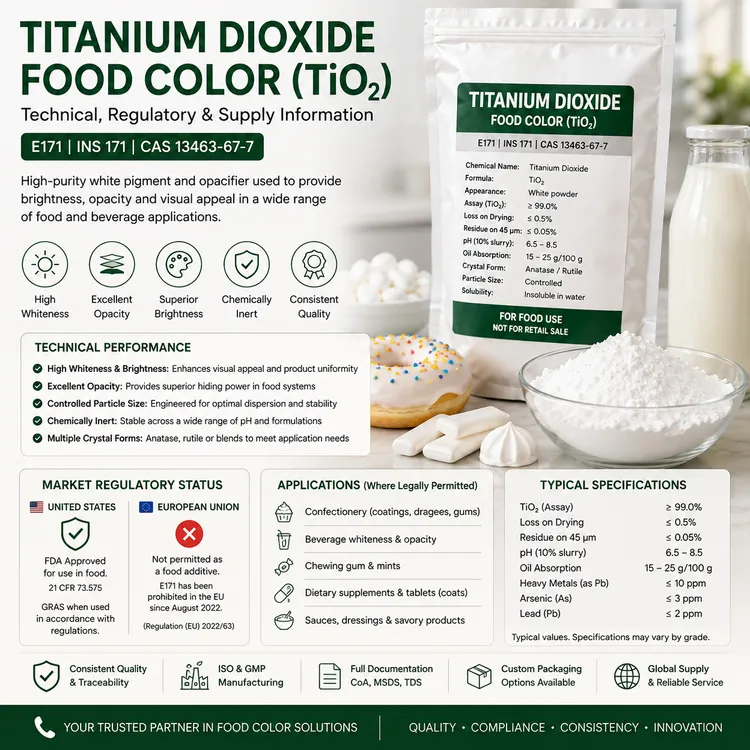
Product identity
| Product name | Titanium Dioxide |
|---|---|
| Chemical name | Titanium(IV) Oxide |
| Common synonyms | Titania, Titanium White, TiO2 |
| Chemical formula | TiO2 |
| Molecular weight | Approximately 79.87 g/mol |
| CAS number | 13463-67-7 |
| Historical EU food-additive number | E 171 — no longer authorized for use in foods in the European Union |
| International identifier | INS 171, subject to destination-country authorization and conditions |
| Chemical family | Inorganic metal oxide pigment |
| Typical crystal forms | Anatase, rutile or a supplier-declared crystalline profile |
| Typical appearance | Fine white powder |
| Water solubility | Practically insoluble |
| Oil solubility | Insoluble; requires particle wetting and dispersion in the oil phase |
| Primary technical function | White pigment, opacifier, whitening color and shade standardizer |
| Typical commercial forms | Dry pigment powder or formulated aqueous, glycerol, syrup, oil or application-specific dispersion |
Primary optical functions
- Whitening: increases visual lightness in compatible formulations.
- Opacity: reduces transmission of light through coatings, fillings and other pigmented phases.
- Color coverage: can mask the natural beige, yellow, grey or brown tone of a base material.
- Pastel shade development: dilutes the apparent intensity of other pigments and colors.
- Batch color standardization: may reduce visible variation caused by raw materials and processing.
- Surface brightness: can improve the visual brightness of coatings and decorative layers.
- Contrast: creates a lighter background that may increase the apparent contrast of printed, coated or multicolored features.
How Titanium Dioxide creates whiteness and opacity
Whiteness is generated principally by scattering visible light at the interface between Titanium Dioxide particles and the surrounding food medium. The larger the difference between the refractive index of the pigment and that of the continuous phase, the greater the potential light-scattering contrast.
Refractive-index contrast
Titanium Dioxide has a substantially higher refractive index than water, sugar syrups, fats, gums, starches and most food matrices. This difference allows properly dispersed particles to redirect visible light efficiently.
Optical efficiency changes when the surrounding phase changes. The same pigment dose may produce different whiteness in water, sugar glass, fat, chocolate coating, starch gel or dry powder.
Particle-size relationship
Light scattering is affected by particle dimensions relative to visible wavelengths. Particles that are too small may transmit more light, while oversized agglomerates may create specks, settling, roughness and inefficient coverage.
The optimum particle distribution is application-specific and should not be defined solely by a single median particle-size value.
Dispersion efficiency
Agglomerated pigment behaves optically like a smaller number of oversized particles. Deagglomeration can expose more effective scattering surface and improve tinting strength at the same dose.
Poor wetting may create white specks, floating pigment, sediment, streaking or incomplete shade development.
Pigment crowding
At higher concentration, pigment particles can become so closely packed that additional material gives progressively less improvement. This is sometimes described as optical crowding or a diminishing-return region.
Commercial optimization should identify the lowest dose that achieves the required instrumental and visual result.
Anatase, rutile, primary particles and agglomerates
| Characteristic | Meaning | Purchasing significance |
|---|---|---|
| Crystal form | The mineral lattice of the Titanium Dioxide, commonly anatase or rutile | Influences refractive index, undertone, surface behavior and application performance |
| Primary particle | Individual pigment crystallite or fundamental particle | Relevant to optical behavior and particle-size characterization |
| Aggregate | Strongly bonded group of primary particles | May not be fully separated during normal food processing |
| Agglomerate | More loosely associated cluster of particles or aggregates | Can often be reduced through wetting, shear and milling |
| Hydrodynamic size | Apparent dispersed size measured in a liquid medium | Depends on dispersion method, medium, surfactant and instrument |
| Number-based distribution | Particle distribution in which each detected particle has equal count weight | Can reveal small-particle fractions that are understated in mass- or volume-based results |
| Mass- or volume-based distribution | Larger particles contribute disproportionately to the result | Useful for processing and sedimentation but does not replace number-based characterization |
| Surface treatment | Declared inorganic or permitted processing layer on the pigment surface | Influences wetting, dispersion, compatibility, impurities and legal identity |
| Undertone | Slight blue, neutral, cream or warm visual tendency within the white shade | Affects matching in coatings, confectionery and pastel shades |
Regulatory status must be confirmed before sourcing
| Market | Current high-level position | Commercial action |
|---|---|---|
| European Union / EEA food | E 171 is not authorized for use as a food additive | Do not formulate, quote or supply Titanium Dioxide for EU food use |
| United States — federal food regulation | Qualifying Titanium Dioxide remains listed as a color additive for foods generally, subject to 21 CFR 73.575 | Confirm the grade, food category, maximum level, labeling and any applicable state requirements |
| Other countries | Authorization, specifications, category permissions and labeling vary | Obtain written confirmation for the destination country before purchase |
| Pharmaceutical, cosmetic or non-food use | Controlled by separate legislation and product specifications | Do not rely on a food-color document for another regulated application |
European Union
Commission Regulation (EU) 2022/63 removed the authorization to use Titanium Dioxide E 171 in foods. Foods produced under the previous rules could be placed on the market only during the stated transitional period ending August 7, 2022.
The regulation records that the European Food Safety Authority could not rule out a concern for genotoxicity and concluded that E 171 could no longer be considered safe when used as a food additive.
Reference: Commission Regulation (EU) 2022/63
United States — 21 CFR 73.575
Current U.S. federal regulation defines food-color Titanium Dioxide as synthetically prepared TiO2. Color-additive mixtures may contain suitable listed diluents and up to 2% total silicon dioxide and/or aluminum oxide as dispersing aids.
The color additive may be used for coloring foods generally when the quantity does not exceed 1% by weight of the food. It may not color a standardized food unless added color is authorized by the applicable standard of identity.
Reference: 21 CFR 73.575 — Titanium Dioxide
21 CFR 73.575 identity and purity requirements
The following values summarize the current U.S. federal food-color specification. A commercial specification may impose tighter chemical and physical requirements.
| Parameter | U.S. federal requirement | Industrial interpretation |
|---|---|---|
| Identity | Synthetically prepared TiO2, free from admixture with other substances | Confirm exact grade identity and any permitted formulated mixture |
| Titanium Dioxide assay | Not less than 99.0% after drying for 3 hours at 105 °C | Applies to the qualifying pigment, not necessarily the total active content of a formulated dispersion |
| Lead | Not more than 10 mg/kg | Customers may require a substantially tighter internal limit |
| Arsenic | Not more than 1 mg/kg | Confirm the current method, reporting limit and destination-market requirements |
| Antimony | Not more than 2 mg/kg | |
| Mercury | Not more than 1 mg/kg | |
| Loss on ignition | Not more than 0.5% at 800 °C after drying for 3 hours at 105 °C | |
| Water-soluble substances | Not more than 0.3% | Supports control of soluble salts and processing residues |
| Acid-soluble substances | Not more than 0.5% | Supports control of acid-extractable impurities |
| Permitted dispersing aids in mixtures | Silicon dioxide and/or aluminum oxide, not more than 2% total | Exact surface treatment and total mixture composition should be declared |
| Maximum use level | Not more than 1% by weight of the food | This is a legal ceiling, not an automatic formulation recommendation |
| Batch certification | Exempt from certification | Exemption does not remove specification, traceability or labeling duties |
Additional industrial specification parameters
| Parameter | Why it matters | Recommended control |
|---|---|---|
| Crystal form | Influences optical strength, undertone, density and surface behavior | Require an anatase, rutile or supplier-defined phase declaration |
| Primary-particle distribution | Relevant to optical performance and regulatory characterization | Request method, sample preparation and number-based reporting where required |
| Agglomerate distribution | Affects dispersion, specking, settling and processing | Control through laser diffraction, sieve residue or application testing |
| Surface treatment | Changes wetting and compatibility | Require complete qualitative and quantitative composition |
| Whiteness / L* value | Supports visual consistency in white products | Measure under defined preparation and instrument conditions |
| Tinting strength | Indicates comparative whitening efficiency | Use an agreed food-relevant reference system |
| Undertone | Affects neutral, cool or warm white shade matching | Compare against an approved reference sample |
| Oil absorption | Influences wetting, paste viscosity and carrier demand | Include where used in fat, oil or coating systems |
| Bulk density | Affects feeding, packaging, dusting and storage volume | Define loose and/or tapped density methods |
| Moisture | Affects caking, flow, formulation water and powder handling | Set a supplier-controlled maximum |
| Sieve residue | Detects coarse particles and hard agglomerates | Select a sieve suited to the finished-food smoothness target |
| Dispersibility | Determines process time and risk of visible specks | Use a defined slurry or application test |
| Sedimentation | Important for liquid concentrates and prepared dispersions | Define storage temperature, time and redispersibility criterion |
| Microbiological quality | Particularly relevant to water-containing formulated dispersions | Specify counts, pathogens and preservative system where applicable |
Dry pigment and formulated dispersion options
| Commercial form | Primary characteristics | Key purchasing questions |
|---|---|---|
| Dry pigment powder | Highest pigment concentration and lowest carrier freight | Dust control, dispersion equipment, particle profile, permitted treatment and assay |
| Aqueous dispersion | Pre-wetted pigment designed for water-based formulations | TiO2 content, stabilizers, preservatives, pH, viscosity, microbiology and freeze-thaw stability |
| Glycerol or syrup dispersion | Liquid preparation compatible with selected confectionery, icing or filling systems | Carrier identity, water activity, active content, viscosity, allergens and labeling |
| Oil dispersion | Pre-dispersed pigment for fat coatings, fillings and oil phases | Carrier-oil origin, oxidation quality, GMO status, sedimentation and active content |
| Dry premix | Pigment blended with sugar, starch, minerals or another dry carrier | Homogeneity, dilution ratio, segregation, complete composition and active calculation |
| Application-specific color system | Titanium Dioxide combined with other colors or functional ingredients | Full formula, legal status of every component, shade standard and carrier declaration |
Wetting, deagglomeration and suspension
Titanium Dioxide is a dense, insoluble pigment. Successful use depends on separating agglomerates, coating particles with the continuous phase and preventing rapid settling or reagglomeration.
Recommended dispersion sequence
- Confirm legal suitability. Approve the market, food category, grade and maximum use before running formulation work.
- Define the target. Establish instrumental L*, opacity, contrast or approved visual shade.
- Select the carrier phase. Use water, syrup, glycerol, oil or another compatible medium.
- Pre-wet the pigment. Introduce the powder into sufficient liquid to coat particles without forming a dry floating layer.
- Apply controlled shear. Use rotor-stator mixing, colloid milling, bead milling or another validated dispersion method.
- Control air entrainment. Excess vortexing can create foam and false lightness readings.
- Dilute into the batch. Add the uniform concentrate to an active mixing zone.
- Stabilize the suspension. Adjust viscosity, yield stress or solids distribution where needed.
- Measure after processing. Evaluate color, specks, sediment and package stability after the complete process.
Dry preblending
- Can separate pigment before contact with liquid.
- May improve low-dose distribution in powders.
- Requires density and particle-size matching.
- Can segregate during vibration and conveying.
- Does not fully deagglomerate hard pigment clusters.
- Requires dust containment.
Liquid slurry preparation
- Provides controlled wetting before batch addition.
- Allows filtration or screening of coarse material.
- Requires sufficient mixer power.
- Requires microbiological control in water-based systems.
- May sediment during holding.
- Should be homogenized before metering.
High-shear limitations
- More energy does not always create better optical performance.
- Excess heat may affect flavors, fats or carrier ingredients.
- Air entrainment can distort density and color measurements.
- Equipment wear may introduce metal contamination.
- Laboratory and production energy density should be compared.
Suspension control
- Increase low-shear viscosity where sensory limits permit.
- Use suitable hydrocolloids or suspension agents.
- Reduce hard agglomerates before stabilization.
- Control storage temperature and vibration.
- Define acceptable sediment and redispersibility.
- Agitate bulk dispersions before use where required.
Active-pigment and batch-dose calculations
Dry pigment addition
Titanium Dioxide mass, kg = batch mass, kg × addition level, % ÷ 100
The legal maximum and the technical optimum are different. Formulation should use the lowest effective level within all applicable restrictions.
Dispersion addition
Required dispersion mass = target TiO2 mass ÷ TiO2 active fraction
A dispersion containing 40% TiO2 has an active fraction of 0.40.
Active contribution
TiO2 in food, % = dispersion addition, % × active pigment fraction
Include all indirect contributions from premixes, colors, decorations, coatings and compound ingredients.
Cost-in-use
Pigment-system cost per tonne = product price per kg × required kg per tonne
Compare effective whiteness, dispersion time, waste, sediment, cleaning, carrier freight and package stability—not price per kilogram alone.
Potential food applications where legally authorized
The following are technical evaluation areas only. They are not statements of permission for the EU, every U.S. state, every country or every standardized food.
| Application | Potential optical purpose | Critical validation points |
|---|---|---|
| Confectionery coatings | White coverage, brightness and pastel shade development | Fat compatibility, dispersion, viscosity, cracking, migration and market authorization |
| Sugar decorations and sprinkles | White base shade and coverage of natural sugar color | Dry distribution, dusting, color transfer, moisture and legal status |
| Icings and frostings | Whiteness, opacity and masking of fat or syrup undertone | Particle smoothness, air incorporation, fat phase, specks and storage |
| Chewing gum coatings | Bright white shell and pastel-color foundation | Suspension, coating uniformity, drying, cracking and jurisdiction |
| Compound coatings | Whiteness and color standardization in fat-continuous systems | Oil wetting, refining, viscosity, particle perception and bloom |
| Cream fillings | Lightness, masking and visual standardization | Fat and sugar phase, dispersion, mouthfeel, oxidation and legality |
| Powdered drink or dessert mixes | Dry whiteness and opacity after reconstitution | Segregation, dusting, sediment, drinking texture and market status |
| Sauces and dressings | Whitening and opacity in creamy systems | Suspension, emulsion, pH, homogenisation, package sediment and authorization |
| Dairy-style and plant-based desserts | Shade correction and masking of yellow or grey undertone | Protein interaction, sediment, heat treatment, homogenisation and legality |
| Tablets and compressed foods | White appearance or coating opacity | Regulatory category, powder flow, compression, coating and labeling |
| Flavor and color preparations | White base, cloud or pastel shade system | Carry-over rules, dispersion, sediment, complete composition and destination |
| Pet foods and animal nutrition | Market-specific visual standardization | Separate feed legislation, species, product category and local approval |
Formulation and process interactions
| Component or condition | Potential interaction | Recommended evaluation |
|---|---|---|
| Fats and oils | Require effective surface wetting and deagglomeration | Measure paste viscosity, specks, tinting strength and sediment |
| Water-based systems | Dense particles can settle rapidly without suspension structure | Evaluate low-shear rheology, storage and redispersibility |
| Sugar syrups | High viscosity may help suspension but make deagglomeration difficult | Prepare a lower-viscosity concentrate before final-solids adjustment |
| Hydrocolloids | Can improve suspension but may trap undispersed pigment clusters | Disperse pigment before full hydrocolloid hydration where practical |
| Proteins | Protein adsorption can change particle stability and viscosity | Test at actual pH, salt, heat treatment and homogenisation |
| Acids and bases | TiO2 is generally insoluble, but dispersion stabilizers may be pH sensitive | Evaluate the complete formulated grade, not only pure pigment |
| Other colors | Titanium Dioxide reduces saturation and changes apparent hue | Establish shade curves across the full color-dose range |
| Light and UV exposure | Crystal form and surface treatment may influence interactions with light-sensitive components | Conduct packaged light-stability testing where relevant |
| High-temperature processing | Pigment is thermally robust, while carriers and stabilizers may not be | Test the complete dispersion through baking, retort or extrusion |
| Metal-detection and X-ray systems | High-density mineral content may influence product effect or settings | Revalidate inspection equipment with the finished formulation |
| Packaging | Settling, vibration and temperature cycling can create uneven appearance | Complete transport simulation and packaged shelf-life testing |
Titanium Dioxide replacement strategies
There is no universal drop-in replacement for the refractive index and opacity of Titanium Dioxide. Reformulation normally combines several optical, structural and process changes.
| Alternative strategy | Potential contribution | Key limitation |
|---|---|---|
| Calcium carbonate | Whiteness, mineral body and opacity where legally permitted | Lower optical strength, acid reactivity, sediment and chalky mouthfeel |
| Calcium phosphates | Mineral whiteness and dry-powder opacity | Lower tinting strength, insolubility, sediment and nutrition impact |
| Starch systems | Light scattering, body and surface whiteness | Hydration, viscosity, cooking behavior and lower opacity |
| Rice-derived or cereal powders | Pale appearance and particulate light scattering | Flavor, allergen policy, sediment, label impact and batch variation |
| White emulsions | Light scattering through controlled oil-droplet or air-cell structures | Physical stability, oxidation, package life and process sensitivity |
| Air incorporation | Increased lightness through microbubbles or aerated structure | Density, oxidation, collapse, texture and package-volume effects |
| Fat crystallization | Whiter visual appearance through controlled crystal structure | Temperature sensitivity, bloom, texture and storage cycling |
| Color redesign | Removes the need for a brilliant white or pastel base | Brand acceptance, packaging artwork and consumer expectations |
| Layer or coating redesign | Moves opacity into a thicker or structurally different layer | Added process complexity, cost, drying and texture impact |
Recommended replacement-development sequence
- Define the original pigment’s actual function.
- Measure L*, a*, b*, opacity, contrast ratio and visual coverage.
- Separate whitening requirements from texture and processing requirements.
- Screen several alternative mechanisms rather than one powder.
- Optimize particle size, carrier, hydrocolloid and processing together.
- Evaluate taste, mouthfeel, sediment and label impact.
- Test heat, light, freeze-thaw and package stability.
- Confirm market authorization and consumer communication.
Incoming quality control and COA review
Identity and chemical purity
- Product and chemical name
- CAS number
- Applicable regulatory standard
- TiO2 assay
- Crystal-form declaration
- Surface-treatment composition
- Loss on ignition
- Water-soluble substances
- Acid-soluble substances
- Lead, arsenic, antimony and mercury
Particle and optical properties
- Primary-particle characterization
- Agglomerate-size distribution
- Sieve residue
- Whiteness or L* value
- Tinting strength
- Undertone
- Oil absorption
- Bulk density
- Dispersibility
- Approved-reference comparison
Formulated dispersion controls
- Active TiO2 concentration
- Complete carrier composition
- pH
- Viscosity
- Density
- Preservative system
- Microbiological limits
- Sedimentation
- Redispersibility
- Freeze-thaw or temperature-cycle stability
Lot traceability
- Manufacturer and approved production site
- Country of origin and manufacture
- Batch or lot number
- Manufacturing date
- Expiry, best-before or retest date
- COA issue date and approval
- Specification revision
- Package identification
- Purchase-order reference
Typical pigment manufacturing and finishing stages
Industrial Titanium Dioxide can be produced through different manufacturing routes. Food-color suitability depends on the selected raw materials, purification, crystal development, surface treatment, finishing and compliance controls.
- Titanium raw-material qualification: titanium-bearing feedstock is selected and tested.
- Chemical digestion or chlorination: titanium is converted into a process intermediate using the manufacturer’s production route.
- Purification: iron and other mineral impurities are separated.
- Hydrolysis or oxidation: purified titanium intermediate is converted toward hydrated or crystalline Titanium Dioxide.
- Calcination: thermal treatment develops crystal structure and pigment properties.
- Milling: particles and agglomerates are reduced toward the target distribution.
- Surface treatment: permitted treatment may be applied for dispersion and stability.
- Washing and purification: soluble salts and process residues are controlled.
- Drying and micronization: moisture and final powder characteristics are adjusted.
- Foreign-material control: screens, magnets and other controls are applied.
- Quality release: identity, purity, particle and optical results are reviewed.
Manufacturing and compliance controls to review
Quality-system controls
- Recognized food-safety or quality certification
- Food-color regulatory compliance program
- Raw-material approval and traceability
- Grade-segregation controls
- Surface-treatment control
- Laboratory method validation
- Foreign-material prevention
- Change-control notification
- Recall and mass-balance capability
Declarations and evidence
- Exact destination-market compliance statement
- Crystal-form declaration
- Particle-size characterization
- Surface-treatment declaration
- Nanomaterial-position statement with supporting method
- Heavy-metal and purity declaration
- Allergen and GMO statement for formulated grades
- Food-contact packaging declaration
- Country-of-origin statement
Dust control and operator protection
Fine Titanium Dioxide powder can generate airborne dust. Food-color status does not remove the need for occupational exposure controls. Handling must follow the current supplier Safety Data Sheet, local workplace limits and the site risk assessment.
Engineering controls
- Use enclosed transfer where practical.
- Provide effective local exhaust ventilation.
- Use low-dust or liquid dispersion grades where appropriate.
- Avoid uncontrolled pouring from height.
- Prevent powder accumulation on structures.
- Avoid compressed-air cleanup.
- Use approved industrial vacuum equipment.
- Maintain filters and dust collectors.
Operator and hygiene controls
- Follow respiratory-protection requirements in the SDS.
- Use suitable eye and protective clothing where required.
- Prevent transfer from work clothing into clean areas.
- Wash exposed skin after handling.
- Control spills before applying water.
- Train operators in pigment-specific cleanup.
- Do not eat or drink in pigment-handling areas.
- Document significant exposure incidents.
Packaging, storage and logistics
Dry pigment packaging
Dry grades may be supplied in lined multiwall bags, sealed polyethylene-lined bags, fibre drums, cartons with inner liners or other moisture- and contamination-resistant systems.
- Net weight per package
- Primary food-contact liner
- Dust-tight closure
- Tamper-evidence system
- Bags or drums per pallet
- Pallet dimensions and construction
- Stretch wrap and top-sheet protection
- Lot and regulatory label
- Container-loading quantity
Dispersion packaging
Liquid grades may be supplied in pails, drums, IBCs or other approved containers compatible with the carrier and preservative system.
- Active pigment concentration
- Container and liner composition
- Valve or discharge connection
- Agitation requirement before use
- Freeze protection
- Microbiological and preservative controls
- Maximum stacking condition
- Container return or disposal requirements
Storage controls
- Store in sealed packaging in a clean, dry area.
- Protect dry powder from moisture and contamination.
- Protect formulated dispersions from freezing or overheating.
- Keep away from foreign odors and non-food chemicals.
- Prevent package damage and dust leakage.
- Reseal partial packs immediately.
- Agitate dispersions according to supplier instructions.
- Apply FEFO or the stated rotation system.
- Follow the supplier’s shelf life and storage temperature.
Documents to request before approval
Core technical documents
- Current Product Specification
- Technical Data Sheet
- Lot-specific Certificate of Analysis
- Safety Data Sheet
- Crystal-form declaration
- Particle-size characterization
- Surface-treatment composition
- Dispersion and application guidance
- Packaging specification
- Shelf-life and storage statement
Regulatory documents
- Destination-market food-color compliance statement
- 21 CFR 73.575 statement where applicable
- Confirmation that the product is not proposed for EU food use
- Heavy-metal and purity declaration
- Nanomaterial or particle-status statement
- Complete composition for formulated grades
- Allergen and GMO statement
- Food-contact packaging declaration
- Country-of-origin statement
Application-supporting data
- Whiteness or L* value
- Tinting-strength method
- Undertone comparison
- Oil-absorption data
- Dispersibility test
- Sedimentation and redispersibility data
- Heat- and light-stability information
- Approved-reference comparison
- Recommended mixer and addition sequence
International trade documents
- Commercial invoice
- Packing list
- Certificate of origin
- Health or free-sale certificate where required
- Legalized or chamber-certified COA where required
- Transport-classification statement
- ISPM 15 declaration where applicable
- Importer-specific registration documents
Information required before quotation
| Inquiry field | Information to provide |
|---|---|
| Destination market | Country, state or province and final sales territory |
| Food category | Exact finished-food type and any applicable standard of identity |
| Regulatory basis | Applicable national authorization, customer standard or existing approval |
| Product form | Dry powder, aqueous dispersion, glycerol dispersion, syrup dispersion, oil dispersion or premix |
| Optical objective | Whiteness, opacity, coverage, pastel shade, brightness or batch-color correction |
| Technical target | Target L*, a*, b*, opacity, contrast ratio or approved reference |
| Formulation | Water, fat, sugar, protein, starch, hydrocolloid, pH and solids profile |
| Process | Mixing, milling, homogenisation, baking, extrusion, retort, cooling and filling conditions |
| Particle requirements | Crystal form, primary-particle information, agglomerate size and surface-treatment restrictions |
| Current product | Existing specification, COA, approved sample or competitor grade |
| Quantity | Sample, pilot trial, regular order and annual forecast |
| Packaging | Bag, drum, pail, IBC, liner, pallet and private-label requirement |
| Destination | Delivery city, port and country |
| Commercial terms | Requested Incoterm, currency, payment preference and shipment window |
| Required documents | Regulatory statement, COA, particle data, SDS, origin, certifications and import documents |
Frequently asked questions
Is Titanium Dioxide E171 permitted in EU food?
No. E 171 is no longer authorized as a food additive in the European Union. It should not be sourced or formulated for EU food use.
Is Titanium Dioxide permitted in U.S. food?
Current U.S. federal regulation permits qualifying Titanium Dioxide in foods generally at up to 1% by food weight, subject to the conditions in 21 CFR 73.575 and any other applicable restrictions.
What does Titanium Dioxide do?
It scatters visible light and can increase whiteness, opacity, brightness, coverage and pastel-color development.
Is Titanium Dioxide a natural color?
It is an inorganic pigment. It should not be described as a coloring food, plant extract or fruit-and-vegetable color.
Does it dissolve in water?
No. It remains as solid pigment particles and must be wetted, dispersed and suspended.
Why do white specks appear?
Common causes include incomplete wetting, hard agglomerates, insufficient shear, adding pigment after thickener hydration or using an incompatible carrier.
Why does a liquid dispersion settle?
Titanium Dioxide has a high particle density. Settling occurs when particle size, dispersion stability and low-shear structure are not sufficient to maintain suspension.
What is the difference between anatase and rutile?
They are different crystalline forms of TiO2. They have different refractive indices, surface behavior and optical characteristics. The supplied form should be declared.
What is primary-particle size?
It describes the individual pigment crystallites, which may be clustered into much larger aggregates and agglomerates.
Does a 200-mesh result prove the product contains no nanoparticles?
No. Mesh testing measures coarse powder and agglomerates. It does not characterize the primary-particle distribution.
Can paint-grade Titanium Dioxide be used in food?
No. Industrial grades may have different impurities, coatings and processing aids. Only an appropriately authorized and documented food-color grade may be evaluated.
Does more pigment always give better whiteness?
No. Poor dispersion and pigment crowding can create diminishing returns. A dose series should identify the lowest effective level.
Can Titanium Dioxide be added directly to water?
Direct addition can cause floating powder and lumps. A controlled slurry, powder-induction system or gradual addition under suitable shear generally gives better dispersion.
Can Titanium Dioxide be used in a clear beverage?
No, not while retaining clarity. It is an opaque particulate pigment and will create haze, whiteness or sediment unless kept in a stable cloud or dispersion.
What can replace Titanium Dioxide?
Possible approaches include permitted calcium minerals, starches, rice-derived powders, white emulsions, air incorporation, fat-crystal engineering, thicker coatings or redesign of the target shade.
Is calcium carbonate a direct replacement?
No. It normally has lower optical strength and can react with acid, settle or create chalky mouthfeel. It must be reformulated and legally reviewed.
Which COA values should buyers compare?
Compare assay, lead, arsenic, antimony, mercury, loss on ignition, soluble substances, crystal form, particle data, whiteness, tinting strength, sieve residue and surface treatment.
Can Global Food Additives review a market-specific requirement?
Yes. The inquiry must identify the destination market, food category, regulatory basis, required grade, quantity and supporting documentation before sourcing options are assessed.
Tell us the destination market and exact Titanium Dioxide requirement.
Titanium Dioxide is not authorized for EU food use. For another destination, provide the country, food category, regulatory basis, required grade, optical target, particle requirements, quantity, packaging and documentation.
Existing specifications, COAs, particle reports, approved samples or reference shades can be described in your message. Our team will review the inquiry and respond from orders@foodgradeadditives.com .
Your market-specific inquiry has been received. You will be redirected to the home page.