
Tocopherol-Rich Extract — E 306
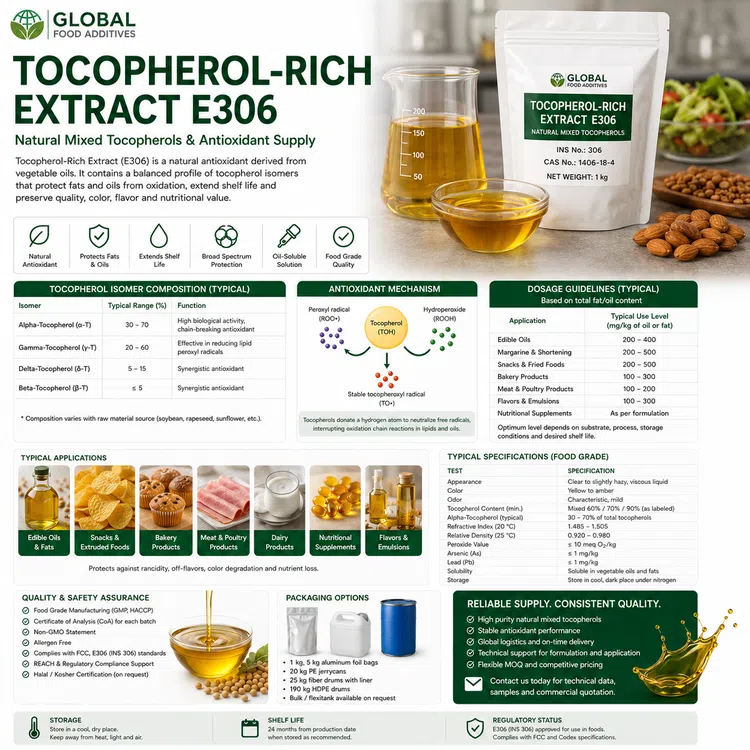
Tocopherol-Rich Extract is a natural, oil-soluble antioxidant preparation containing concentrated tocopherols recovered from edible vegetable-oil processing streams. Commercial E 306 products commonly contain alpha-, beta-, gamma- and delta-tocopherols in source-dependent proportions and may also contain tocotrienols, sterols, carrier oil and other naturally occurring lipid components.
Free tocopherols act as chain-breaking antioxidants in fats and oils. They react with lipid peroxyl radicals during the propagation stage of autoxidation, delaying the development of rancid odor, undesirable flavor, color deterioration, viscosity change and loss of oxidation-sensitive nutrients.
Antioxidant performance cannot be predicted from total tocopherol concentration alone. The result depends on the isomer profile, carrier system, lipid composition, degree of unsaturation, initial oil quality, oxygen exposure, light, heat, iron, copper, processing, packaging and the presence of synergists or competing antioxidants.
Product identity
| Product name | Tocopherol-Rich Extract |
|---|---|
| Common commercial names | Natural mixed tocopherols, mixed tocopherol concentrate, tocopherols concentrate |
| Food additive identity | E 306 / INS 306 |
| Ingredient family | Natural tocopherols and related vegetable-oil unsaponifiable components |
| Principal homologues | Alpha-, beta-, gamma- and delta-tocopherol |
| Possible related components | Tocotrienols, phytosterols, squalene, carrier oil and other source-dependent lipid constituents |
| Single molecular formula | Not applicable; E 306 is a natural mixture rather than one chemically pure molecule |
| Single CAS number | Not universally applicable to the complete natural mixture; individual tocopherol isomers have separate identifiers |
| Typical raw-material origin | Supplier-specific edible vegetable-oil processing streams |
| Potential source oils | Soybean, rapeseed or canola, sunflower, corn and other approved edible vegetable oils |
| Typical appearance | Clear to slightly hazy, viscous yellow, amber, reddish-brown or brown oil |
| Typical odor | Mild and characteristic; should be free from rancid, burnt, solvent-like or otherwise objectionable odor |
| Water solubility | Practically insoluble |
| Oil behavior | Oil soluble or readily dispersible in compatible lipid phases |
| Primary function | Lipid-phase antioxidant and oxidation-control ingredient |
| Typical commercial forms | High-concentration liquid, standardized liquid, carrier-oil dilution, emulsion, microencapsulated powder or dry premix |
Primary technical functions
- Chain-breaking antioxidant: interrupts propagation of lipid free-radical reactions.
- Rancidity delay: can extend the time before objectionable oxidized odor and flavor develop.
- Oil-quality protection: helps limit peroxide formation and secondary oxidation products.
- Flavor protection: may reduce oxidative loss or transformation of susceptible flavor components.
- Color protection: may help preserve carotenoids and other oxidation-sensitive natural colors.
- Nutrient protection: can reduce oxidative degradation of selected fat-soluble nutrients.
- Shelf-life support: can contribute to a complete oxidation-control system when combined with suitable processing and packaging.
- Natural-source positioning: may support formulation strategies seeking plant-derived antioxidant systems.
Tocopherol isomers and profile selection
Tocopherols share a chromanol-ring structure and a saturated phytyl side chain. Their alpha, beta, gamma and delta designations reflect different methyl-substitution patterns on the chromanol ring.
| Tocopherol | Representative formula | Approximate molecular weight | Industrial interpretation |
|---|---|---|---|
| Alpha-tocopherol | C29H50O2 | 430.71 g/mol | Highest recognized vitamin E activity among natural tocopherols; antioxidant behavior depends on the lipid system and concentration |
| Beta-tocopherol | C28H48O2 | 416.69 g/mol | Usually a smaller component of natural mixed-tocopherol profiles |
| Gamma-tocopherol | C28H48O2 | 416.69 g/mol | Commonly abundant in concentrates derived from soybean and certain other vegetable oils |
| Delta-tocopherol | C27H46O2 | 402.66 g/mol | Often commercially valued as part of gamma- and delta-rich antioxidant profiles |
Mixed-tocopherol profile
E 306 products may be sold by total tocopherol concentration, but two products with the same total can contain substantially different alpha-, beta-, gamma- and delta-tocopherol proportions.
The purchase specification should state whether the required profile is unrestricted, source-typical, high-gamma, high-delta, alpha-enriched or matched to an approved reference product.
Antioxidant versus nutritional objective
Antioxidant selection and vitamin E fortification are related but different formulation objectives. Nutritional declarations focus primarily on recognized alpha-tocopherol activity, while oil stabilization may benefit from a broader natural tocopherol profile.
A product should not be purchased for a vitamin E claim solely on the basis of total mixed tocopherols.
Chain-breaking antioxidant mechanism
Lipid autoxidation is commonly described through initiation, propagation and termination. Tocopherols act principally during propagation by reacting with lipid peroxyl radicals.
Simplified reaction sequence
Lipid radical formation: LH → L•
Oxygen addition: L• + O2 → LOO•
Chain propagation: LOO• + LH → LOOH + L•
Tocopherol intervention: LOO• + TocOH → LOOH + TocO•
TocOH represents a free tocopherol molecule. The resulting tocopheroxyl radical is substantially less reactive toward lipid propagation than the original lipid peroxyl radical.
Primary oxidation
Early oxidation produces lipid hydroperoxides. These products may have little odor initially but are unstable and can decompose into volatile aldehydes, ketones and other compounds.
Peroxide value is useful during the early stages, but it should not be used alone to characterize advanced oxidation.
Secondary oxidation
Hydroperoxide decomposition generates compounds responsible for painty, cardboard-like, grassy, metallic, fishy or rancid sensory notes.
p-Anisidine value, volatile aldehydes, hexanal and sensory testing are often used to follow secondary oxidation.
E 306 regulatory and commercial specification framework
Regulatory identity and purity provide a baseline. Commercial qualification should additionally control the isomer profile, carrier, source oil and oxidation condition of the supplied concentrate.
| Parameter | Specification consideration | Industrial importance |
|---|---|---|
| Definition | Tocopherol-rich natural extract obtained from approved edible vegetable-oil processing materials | Distinguishes natural mixed tocopherols from synthetic single-isomer products and tocopheryl esters. |
| Total tocopherols | Regulatory minimum where applicable and a tighter contracted commercial concentration | Determines active antioxidant content and dosage conversion. |
| Individual tocopherols | Alpha, beta, gamma and delta profile by a defined chromatographic method | Supports performance, nutrition and supplier-equivalence assessment. |
| Tocotrienols | Reported where present or where source-dependent composition matters | Contributes to total tocochromanol composition but should not be included ambiguously in a tocopherol-only assay. |
| Appearance | Clear to slightly hazy viscous oil within an approved color range | Haze or waxy separation may occur in some natural concentrates, especially at lower temperature. |
| Odor | Mild and characteristic; free from rancid or objectionable odor | Essential for flavors, oils and lightly flavored finished foods. |
| Water | Supplier-controlled maximum | Supports storage stability and reduces risk of phase separation or hydrolytic deterioration of other components. |
| Acid value / free fatty acids | Controlled maximum using a defined method | Indicates source-oil refining, purification and storage condition. |
| Peroxide value | Low maximum at release | Confirms that the concentrate and carrier oil have not already undergone substantial primary oxidation. |
| p-Anisidine value | Optional or application-specific maximum | Supports control of accumulated secondary oxidation products. |
| Unsaponifiable matter | Informational or controlled according to product concentration and manufacturing route | May include sterols, hydrocarbons and other source-oil components. |
| Carrier oil | Full identity, percentage and specification | Changes active content, allergen/GMO status, flavor and oxidation stability. |
| Color | Visual, Gardner, Lovibond or another defined method | Important for light-colored oils, beverages, coatings and flavors. |
| Relative density | Typical or controlled range at a stated temperature | Used for volumetric metering and inventory conversion. |
| Viscosity | Typical or controlled at a stated temperature | Affects pumping, spraying, blending and cold-weather handling. |
| Sulfated ash | Complies with the applicable E 306 purity specification | Supports control of inorganic processing residues. |
| Elemental impurities | Arsenic, lead, mercury and other applicable limits | Required for destination-market and customer compliance. |
| Residual solvents | Controlled according to the extraction and purification process | Important where solvents are used during concentration or purification. |
Concentrates, diluted liquids, emulsions and powders
| Commercial form | Typical characteristics | Key purchasing questions |
|---|---|---|
| High-concentration liquid | Viscous natural mixed-tocopherol concentrate with minimal dilution | Total tocopherols, isomer profile, cold flow, source oil, odor and oxidation values |
| Standardized liquid | Concentrate adjusted to a target active level with a compatible carrier | Carrier identity, active percentage, density, GMO status and shelf life |
| High-gamma or gamma-delta grade | Profile selected or concentrated for higher gamma- and/or delta content | Individual isomer limits, total assay and application-performance data |
| Oil-specific dilution | Tocopherols diluted in sunflower, soybean, rapeseed, MCT or another declared edible oil | Carrier-oil origin, allergen/GMO status, fatty-acid profile and oxidation quality |
| Water-dispersible emulsion | Tocopherols combined with emulsifiers and an aqueous or multi-phase delivery system | Active content, droplet size, preservative, microbiology, dilution stability and complete composition |
| Encapsulated powder | Tocopherols immobilized in a carbohydrate, protein, starch, gum or other encapsulating matrix | Active content, surface oil, carrier, allergen, moisture, particle size and release behavior |
| Dry antioxidant premix | Tocopherol preparation combined with other antioxidants, synergists or dry carriers | Full composition, legal identity of each component and homogeneity of low-dose distribution |
Active-tocopherol dosage calculations
Supplier dosage should be converted from product weight to active tocopherol concentration. A 30%, 50%, 70% and 90% product cannot be compared at the same product addition rate.
Product-dose calculation
Required product, mg/kg = target active tocopherols, mg/kg ÷ product active fraction
For a product containing 70% total tocopherols, the active fraction used in the equation is 0.70.
Active contribution
Active tocopherols, mg/kg = product addition, mg/kg × active fraction
When the preparation contains several active antioxidants, each component should be calculated separately.
Batch addition
Product mass, kg = batch mass, kg × product addition, mg/kg ÷ 1,000,000
Low addition levels require a suitable metering system or a controlled antioxidant premix.
Cost-in-use comparison
Cost per tonne of food = product price per kg × required kg per tonne
Commercial comparison should also consider active concentration, effective shelf-life extension, packaging, handling loss and supplier consistency.
Factors controlling antioxidant performance
| Factor | Effect on oxidation | Control strategy |
|---|---|---|
| Fatty-acid unsaturation | Greater unsaturation generally increases susceptibility to oxidation | Characterize the complete lipid profile and test the actual oil blend |
| Initial peroxide level | High starting oxidation reduces the useful protection period | Purchase fresh oils and define incoming peroxide-value limits |
| Oxygen | Dissolved and headspace oxygen support oxidation | Minimize aeration, use nitrogen where appropriate and control package oxygen |
| Light | Light can initiate or accelerate photooxidation | Use light-protective processing, storage and packaging |
| Temperature | Higher temperature accelerates reaction rates and antioxidant depletion | Reduce unnecessary heat exposure and validate hot-process retention |
| Iron and copper | Trace metals catalyse hydroperoxide decomposition | Control raw materials, water, equipment contact and metal chelation |
| Oil-water interface | Oxidation may be concentrated at interfaces in emulsified foods | Evaluate antioxidant location, emulsifier system and interfacial distribution |
| Processing shear | Mixing and homogenisation can introduce oxygen and change interfacial area | Control vortexing, transfer, homogenisation and deaeration |
| Packaging permeability | Oxygen transmission can continue throughout shelf life | Select an appropriate barrier and verify seals and closures |
| Storage time | Tocopherols are consumed as they intercept radicals | Measure retained tocopherols and oxidation markers through shelf life |
Synergists and complementary controls
Tocopherols are often most effective as one component of a complete antioxidant system. Potential complementary ingredients and controls must be legally permitted and compatible with the product.
| Complementary component | Potential role | Validation point |
|---|---|---|
| Ascorbyl palmitate | Oil-compatible antioxidant that may interact synergistically with tocopherol systems | Solubility, heat, precipitation, dosage and regulatory status |
| Ascorbic acid or ascorbate | Water-phase reducing agent that may support antioxidant cycling in selected emulsions | Phase location, metals, pH and risk of pro-oxidant behavior |
| Citric acid and citrate | May reduce metal-catalysed oxidation through acidification or complexation | Phase distribution, taste, pH and metal-binding effectiveness |
| Phosphates or chelators | Can reduce catalytic availability of selected metals | Legal use, total phosphate, flavor and mineral interaction |
| Rosemary extract | Provides phenolic antioxidant compounds with a different activity profile | Flavor, color, active composition, legal identity and compatibility |
| Nitrogen flushing | Reduces oxygen in tanks, lines or package headspace | Residual oxygen, seal integrity and process repeatability |
| High-barrier packaging | Limits oxygen and light exposure during storage | Oxygen-transmission rate, closure leakage and actual distribution conditions |
| Metal control | Prevents contact with catalytic iron or copper contamination | Equipment materials, raw ingredients, water and analytical monitoring |
Addition point, mixing and process integration
Recommended development sequence
- Characterize the lipid. Record oil type, fatty-acid composition, peroxide value, p-anisidine value, metals and existing antioxidants.
- Define the shelf-life failure mode. Identify whether the limiting factor is rancid flavor, color loss, nutrient degradation, odor or another oxidation marker.
- Select candidate profiles. Compare total tocopherols, gamma/delta content, carrier and physical form.
- Create an active-dose series. Compare treatments on an equal active-tocopherol basis.
- Optimize addition order. Add the concentrate where it can dissolve and distribute uniformly while minimizing air and heat exposure.
- Apply the full production process. Include refining, frying, baking, extrusion, homogenisation, cooling or other relevant stages.
- Pack under realistic conditions. Reproduce headspace oxygen, package barrier, fill temperature and light exposure.
- Complete accelerated and real-time testing. Use analytical and sensory endpoints relevant to the food.
Oil-phase addition
- Warm the carrier oil only as much as needed for easy handling.
- Add into an active but non-aerating mixing zone.
- Allow sufficient circulation for uniform distribution.
- Avoid concentrated contact with metal contamination.
- Minimize exposure to open air and direct light.
- Verify homogeneity before transferring or filling.
Low-dose premixing
- Dilute the concentrate in a compatible portion of the formulation oil.
- Use a clean, oxidation-controlled premix vessel.
- Record carrier and dilution ratio.
- Use the premix promptly.
- Avoid repeated heating and cooling.
- Confirm uniform active concentration before batch dosing.
Heat, frying, baking and extrusion considerations
High-temperature processing
Tocopherols can be consumed or degraded during prolonged heating, especially in the presence of oxygen, metals and highly unsaturated lipids. Retention depends on temperature, time, surface area, oil turnover and replenishment.
- Measure tocopherols before and after processing.
- Track primary and secondary oxidation.
- Evaluate actual product temperature and residence time.
- Include oxygen introduced during mixing or transfer.
- Assess whether post-process supplementation is permitted and practical.
Frying systems
Frying exposes oil to heat, air, moisture, food particles and repeated turnover. Tocopherol depletion is only one part of overall frying-oil deterioration.
- Monitor polar compounds and polymerisation where required.
- Control oil turnover and fresh-oil replenishment.
- Remove food particles and avoid copper or iron contact.
- Do not use antioxidants to extend oil beyond legal or quality limits.
- Confirm sensory effects in the fried food, not only the fryer oil.
Baking and snacks
The antioxidant must distribute through the shortening, oil, seasoning or coating phase. Localized addition can leave unprotected lipid zones.
- Evaluate oven loss and finished-product retention.
- Include seasoning oils and topical fats.
- Test package oxygen after sealing.
- Monitor hexanal and sensory rancidity.
- Evaluate light exposure in retail packaging.
Extrusion
Extrusion combines heat, pressure, shear and rapid expansion. Tocopherol retention and lipid oxidation may vary with feed moisture, barrel temperature and residence time.
- Compare pre-extrusion and post-extrusion addition.
- Measure finished-product tocopherol retention.
- Include post-extrusion oil sprays in the antioxidant plan.
- Test the final packaged snack through shelf life.
Potential food-manufacturing applications
Suitability depends on the antioxidant grade, lipid phase, destination market, food category, processing conditions and target shelf life. The following are technical evaluation areas rather than universal permissions or dosage recommendations.
| Application | Potential purpose | Critical validation points |
|---|---|---|
| Refined edible oils | Restore or supplement antioxidant protection after refining | Oil type, deodorisation loss, initial oxidation, metals, packaging and target storage life |
| Specialty oil blends | Protect oils containing omega-3 or other highly unsaturated lipids | Fatty-acid profile, fishy volatiles, oxygen, light, chelation and sensory limits |
| Margarine and spreads | Protect the fat phase and oxidation-sensitive flavors or colors | Emulsion interface, aqueous metals, pH, process heat and package oxygen |
| Shortening and bakery fats | Reduce oxidative deterioration during storage and baking | Fat composition, baking retention, flavor, finished-product moisture and packaging |
| Fried snacks | Protect frying oil, absorbed oil and topical seasoning oils | Frying temperature, oil turnover, salt, seasoning metals, oxygen and package barrier |
| Nuts and nut products | Protect naturally unsaturated oils from rancidity | Roasting, grinding, particle surface area, oxygen, light and package headspace |
| Meat and poultry products | Support control of lipid oxidation, warmed-over flavor and color deterioration | Fat type, heme iron, salt, cooking, oxygen exposure and distribution in the matrix |
| Fish and seafood products | Protect highly unsaturated marine lipids | Raw-material freshness, heme proteins, frozen storage, oxygen, flavor and antioxidant distribution |
| Flavor oils and oleoresins | Protect oxidation-sensitive aroma compounds, pigments and carrier oils | Flavor polarity, light, headspace, dilution, processing and sensory neutrality |
| Natural colors | Support protection of carotenoids and other oil-soluble pigments | Light, oxygen, metal contamination, emulsion structure and color measurement |
| Chocolate and compound coatings | Protect fats, nuts and flavor components during storage | Cocoa butter compatibility, tempering, flavor, nuts, packaging and bloom evaluation |
| Cereal and nutrition bars | Protect nuts, seeds, oils, coatings and fat-soluble nutrients | Water activity, iron fortification, exposed surface area, packaging and flavor shelf life |
| Powdered food systems | Protect encapsulated oils, flavors, vitamins or fat-containing powders | Tocopherol delivery form, surface oil, oxygen, moisture, encapsulation and powder packaging |
| Beverage emulsions | Protect flavor oils, colors and lipid-soluble nutrients | Emulsion droplet location, water-phase metals, pH, pasteurisation, light and package oxygen |
| Plant-based foods | Protect vegetable oils, flavors, colors and lipid-soluble nutrients | Protein interactions, iron fortification, homogenisation, heat, oxygen and frozen or chilled storage |
Emulsions, beverages and powdered delivery systems
Neat Tocopherol-Rich Extract is not water soluble. In water-continuous foods, antioxidant performance depends on how the tocopherols are delivered to the dispersed lipid phase or oil-water interface.
Emulsified liquid systems
- Dissolve tocopherols in the oil phase before emulsification.
- Confirm compatibility with the emulsifier system.
- Control droplet size and interfacial composition.
- Evaluate water-phase iron and copper.
- Measure both physical and oxidative stability.
- Include pasteurisation and shelf-life temperature cycles.
Powdered systems
- Use a formulated or encapsulated tocopherol preparation.
- Confirm active content on an as-is basis.
- Review surface oil and encapsulation efficiency.
- Control powder moisture and oxygen exposure.
- Assess release into the finished food.
- Confirm carrier allergens and label requirements.
Oxidation and shelf-life testing
| Test | What it indicates | Key limitation |
|---|---|---|
| Peroxide value | Primary lipid hydroperoxides | Peroxides may later decompose, so a declining result does not necessarily mean improved oil quality |
| p-Anisidine value | Selected secondary aldehydic oxidation products | Response varies with oil type and interfering compounds |
| TOTOX value | Combined index commonly calculated from peroxide and p-anisidine values | It remains an analytical index and does not replace sensory analysis |
| Conjugated dienes | Early structural changes in unsaturated fatty acids | Natural pigments and other components may interfere |
| Hexanal | Volatile secondary marker often associated with oxidation of linoleic-rich lipids | The most relevant volatile marker depends on the fatty-acid profile |
| Rancimat / oxidative stability index | Accelerated oxidation induction time | High-temperature ranking may not perfectly predict ambient shelf life |
| Schaal oven test | Accelerated storage under elevated temperature | Temperature can alter reaction pathways compared with normal storage |
| Oxygen consumption | Rate of oxygen uptake by the food or package system | Requires controlled headspace and suitable instrumentation |
| Tocopherol retention | Consumption or degradation of antioxidant during processing and storage | Depletion does not directly define the sensory failure point |
| Sensory evaluation | Actual odor, flavor and consumer-relevant deterioration | Requires trained assessors, controls and blinded sample handling |
| Real-time packaged shelf life | Performance under intended commercial conditions | Requires the longest study time but provides the most relevant confirmation |
Typical recovery and concentration process
Manufacturing routes vary by supplier and source oil. Natural mixed tocopherols are commonly recovered from tocopherol-containing vegetable-oil refining streams and concentrated through controlled physical and purification operations.
- Source-oil qualification: vegetable-oil origin, GMO status, oxidation condition and contaminant controls are reviewed.
- Collection of tocopherol-containing fractions: suitable edible-oil refining or deodorisation streams are separated.
- Removal of volatile and fatty components: free fatty acids, moisture and selected volatile materials are reduced.
- Concentration: vacuum or molecular-distillation techniques may be used to enrich the tocopherol fraction.
- Purification: supplier-specific operations reduce unwanted color, odor, oxidation products and process residues.
- Profile adjustment: fractionation or blending may be used to achieve a target total and isomer distribution.
- Standardisation: the concentrate may be adjusted with a declared edible carrier oil.
- Polishing filtration: waxes, particulates and insoluble material are controlled.
- Protective handling: nitrogen, reduced oxygen, limited light and controlled temperature may be used during storage and filling.
- Quality release: composition, oxidation quality, purity and physical parameters are reviewed before packaging.
Incoming quality control and COA review
Composition and identity
- Product name and E 306 identity
- Total tocopherols
- Alpha-tocopherol
- Beta-tocopherol
- Gamma-tocopherol
- Delta-tocopherol
- Tocotrienols where relevant
- Source-oil declaration
- Carrier identity and percentage
- Chromatographic method
Physical and sensory quality
- Appearance and clarity
- Color
- Odor
- Relative density
- Viscosity at a stated temperature
- Cold-flow behavior
- Waxy separation where relevant
- Visible foreign matter
- Package and seal condition
Oxidation and chemical quality
- Peroxide value
- Acid value or free fatty acids
- p-Anisidine value where specified
- Moisture
- Sulfated ash
- Residual solvents where applicable
- Arsenic
- Lead
- Mercury and other required metals
Source and compliance controls
- Country of origin
- Country of manufacture
- Vegetable-oil source
- GMO status
- Allergen status
- Animal-origin status
- Halal and Kosher status
- Traceability to production lot
- Change-notification commitment
Vegetable origin, allergens and GMO status
Source-oil information
The term “natural mixed tocopherols” does not identify the original vegetable source. Buyers should request the actual oil source or source range used by the manufacturer.
- Soybean-derived
- Rapeseed- or canola-derived
- Sunflower-derived
- Corn-derived
- Blended vegetable sources
- Other approved edible vegetable sources
Allergen and GMO assessment
Highly refined oil-derived materials may contain very low protein, but allergen and GMO declarations must still be based on the supplier’s raw materials, processing, analytical data and destination-market requirements.
- Complete source-oil declaration
- Residual protein information where required
- Soy allergen statement
- GMO raw-material statement
- Identity-preserved or non-GMO documentation
- Shared-equipment cross-contact statement
Packaging, storage and logistics
Typical liquid packaging
Commercial formats may include opaque or internally coated drums, food-grade polyethylene drums, pails, IBCs, isotanks or other approved liquid systems.
- Net weight per container
- Food-contact material and internal coating
- Light and oxygen protection
- Closure and tamper-evidence system
- Nitrogen headspace where specified
- Valve and discharge connection
- Pallet configuration
- Maximum stacking condition
- Container or IBC return requirements
Typical powder packaging
Powder preparations may be supplied in foil-laminate bags, sealed inner bags, pails, fibre drums or cartons designed to control oxygen, light and moisture.
- Active content per kilogram
- Carrier and encapsulant composition
- Moisture barrier
- Oxygen barrier
- Pack size
- Particle protection and compression limits
- Desiccant or oxygen absorber where applicable
- Resealing instructions
Storage controls
- Store in tightly sealed, compatible food-grade packaging.
- Protect from air, direct light and unnecessary heat.
- Maintain the supplier’s recommended storage temperature.
- Keep away from iron, copper and oxidizing chemicals.
- Avoid repeated warming and cooling.
- Minimize headspace after opening.
- Use dry nitrogen for opened bulk systems where appropriate.
- Reseal partial containers immediately.
- Apply FEFO stock rotation.
- Assess significant storage or transport excursions.
Liquid transfer, metering and equipment controls
Liquid handling
- Verify product, lot and seal before unloading.
- Use clean, dry and compatible food-grade transfer equipment.
- Protect open connections from light and contamination.
- Avoid vigorous splashing and air entrainment.
- Use a calibrated mass-flow meter, load cell or dosing pump.
- Flush lines only with an approved compatible food oil.
- Account for hose and container heel losses.
- Record actual transferred mass.
Equipment materials
- Use suitable food-grade stainless steel where practical.
- Avoid unprotected copper or iron contact.
- Confirm hose, gasket, seal and liner compatibility.
- Use opaque or covered day tanks.
- Minimize dead legs and retained product.
- Validate cleaning and final-rinse removal.
- Protect pumps from running dry with viscous concentrates.
Regulatory and labeling considerations
European Union
Tocopherol-Rich Extract is identified as E 306. Compliance with its compositional specification and legal permission in a finished-food category are separate requirements. The intended food category, maximum level or quantum-satis condition, carry-over route and label declaration must be reviewed.
- Commission Regulation (EU) No 231/2012 — food-additive specifications
- Regulation (EC) No 1333/2008 — authorized uses and conditions
Antioxidant use under E 306 should also be distinguished from addition of alpha-tocopherol for vitamin E fortification or a nutrition claim.
United States
Tocopherols are listed in 21 CFR 182.3890 as generally recognized as safe when used according to good manufacturing practice. Finished-food standards, nutrition labeling, claims, ingredient naming and any application-specific requirements must still be reviewed.
Reference: 21 CFR 182.3890 — Tocopherols
Other destination markets
- Confirm the recognized additive identity.
- Confirm the permitted food category.
- Confirm the maximum use level or GMP condition.
- Determine whether the use is direct or through carry-over.
- Confirm the required ingredient or additive name.
- Review vitamin E fortification rules separately.
- Confirm how mixed tocopherols contribute to nutrition calculations.
- Review source-oil, GMO and allergen requirements.
- Check import registration and certificate requirements.
Manufacturing and food-safety controls to review
Quality-system review
- Recognized food-safety certification
- HACCP or preventive-control program
- Approved vegetable-oil suppliers
- Source-oil traceability
- Refining-stream and process controls
- Solvent-control program where applicable
- Laboratory method validation
- Tank, line and tanker cleaning controls
- Change-control notification
- Recall and mass-balance capability
Declarations and certifications
- Food-grade and E 306 compliance declaration
- Vegetable-source declaration
- Country-of-origin statement
- Allergen and cross-contact statement
- GMO statement
- Residual-solvent statement
- Animal-origin, vegan and vegetarian statement
- Halal certificate where required
- Kosher certificate where required
- Primary-packaging food-contact compliance
By-product recovery and process efficiency
Resource-recovery value
Natural mixed tocopherols can be recovered from valuable components present in edible vegetable-oil refining streams. Concentration allows these compounds to be used as functional antioxidants rather than being lost in lower-value material.
- Recovery of naturally occurring oil components
- Higher-value use of refining side streams
- Potential reduction of avoidable food oxidation and waste
- Extended useful life of oxidation-sensitive products
Efficient industrial use
- Use the minimum effective active dose.
- Compare suppliers on active-content basis.
- Control low-dose metering and transfer losses.
- Minimize product heel in drums, IBCs and lines.
- Protect opened material from oxidation.
- Select package sizes that reduce partial-container storage.
- Include avoided product waste in cost-in-use analysis.
Documents to request before approval
Core technical documents
- Current Product Specification
- Technical Data Sheet
- Lot-specific Certificate of Analysis
- Chromatographic tocopherol profile
- Total-tocopherol calculation method
- Safety Data Sheet
- Carrier-oil composition
- Packaging specification
- Shelf-life and storage statement
Source and compliance documents
- Vegetable-oil source declaration
- Country of origin and manufacture
- Food-grade or E 306 compliance declaration
- Allergen and cross-contact declaration
- GMO and identity-preserved status
- Residual-solvent declaration
- Animal-origin, vegan and vegetarian statement
- Halal and Kosher certificates where required
- Food-safety system certificate
Application-supporting data
- Recommended active dosage range
- Performance in representative oils or fats
- Rancimat or oxidative-stability data
- Heat-retention data
- Compatibility with ascorbyl palmitate or other synergists
- Emulsion or powder-delivery guidance
- Comparison with an approved reference grade
- Cold-flow and handling information
International trade documents
- Commercial invoice
- Packing list
- Certificate of origin
- Health or free-sale certificate where required
- Legalized or chamber-certified COA where required
- Transport-classification statement
- Previous-cargo and cleaning declaration for bulk delivery
- Importer-specific registration documents
Information required for an accurate quotation
| Inquiry field | Information to provide |
|---|---|
| Product identity | Tocopherol-Rich Extract, natural mixed tocopherols or E 306 |
| Required form | High-concentration liquid, standardized liquid, carrier-oil dilution, emulsion or encapsulated powder |
| Application | Edible oil, shortening, snack, meat, seafood, flavor, color, beverage emulsion, nutrition bar or another food |
| Antioxidant objective | Rancidity delay, flavor protection, color protection, nutrient retention or processing stability |
| Total tocopherols | Required minimum or target active concentration |
| Isomer profile | Required alpha, beta, gamma and delta proportions or reference profile |
| Source restrictions | Soybean, sunflower, rapeseed, corn, mixed vegetable source, non-GMO or identity-preserved requirement |
| Process conditions | Maximum temperature, heating time, frying, baking, extrusion, homogenisation or spray drying |
| Packaging and shelf life | Package type, headspace, oxygen barrier, light exposure, storage temperature and target life |
| Critical quality limits | Peroxide value, acidity, color, odor, carrier, water, residual solvents and elemental impurities |
| Regulatory market | Destination country and finished-food category |
| Quantity | Sample, laboratory trial, drum, pallet, IBC, bulk quantity and annual forecast |
| Commercial terms | Delivery city or port, requested Incoterm, currency, shipment window and payment preference |
| Reference material | Existing specification, COA, chromatogram, approved sample, formulation or competitor grade |
Frequently asked questions
What is Tocopherol-Rich Extract?
It is a natural oil-soluble concentrate containing mixed tocopherols recovered from edible vegetable-oil processing materials. Its food-additive identity is E 306.
Is E 306 the same as vitamin E?
E 306 contains vitamin E-related compounds, but its primary use as a food additive is often antioxidant protection. Nutritional vitamin E calculations depend mainly on eligible alpha-tocopherol content and applicable labeling rules.
Is E 306 the same as E 307?
No. E 306 is a tocopherol-rich natural mixed extract. E 307 is the separate additive identity for alpha-tocopherol.
How do tocopherols slow oxidation?
They donate hydrogen to lipid peroxyl radicals, interrupting the propagation stage of lipid autoxidation.
Can tocopherols reverse rancidity?
No. They cannot remove existing oxidation products or restore degraded flavor. They are most effective when used preventively in fresh, high-quality lipids.
Is Tocopherol-Rich Extract water soluble?
No. Neat E 306 is oil soluble and practically insoluble in water. Water-based applications require an emulsion, dispersion or encapsulated delivery form.
Which isomer profile should be selected?
The optimum profile depends on the lipid, temperature, oxygen, metals, package and shelf-life objective. Total tocopherols alone do not define performance.
Are gamma- and delta-tocopherols vitamin E?
They belong to the tocopherol family, but recognized nutritional vitamin E activity and antioxidant behavior differ among the isomers. Nutrition calculations should follow applicable rules.
Is tocopheryl acetate the same as free tocopherol?
No. Tocopheryl acetate has its phenolic hydroxyl group esterified. It is more stable for fortification but is much less effective as an immediate chain-breaking antioxidant.
Does a higher dose always work better?
No. Tocopherol performance normally has an optimum range. Additional product above that range may provide limited benefit and can sometimes reduce efficiency under particular conditions.
When should the antioxidant be added?
It should normally be dissolved uniformly in the lipid phase before major oxidation occurs while avoiding unnecessary heat, air and light exposure.
Can E 306 be used in beverages?
It can protect beverage flavor oils or lipid-soluble components when delivered through a suitable emulsion or encapsulated system. Neat tocopherol concentrate cannot simply be dissolved in water.
Can E 306 be used during frying?
It may be evaluated in frying-oil systems, but high heat, oxygen, moisture and food residues consume antioxidants. Oil turnover and legal frying-quality limits remain essential.
Which tests show whether it works?
Use a combination of peroxide value, p-anisidine, TOTOX, volatile markers, induction time, retained tocopherols, sensory assessment and real-time packaged shelf-life testing.
Can soybean-derived material be allergen-free?
Allergen status depends on processing, residual protein, supplier evidence and local regulation. Obtain a written source and allergen declaration rather than assuming status.
Why can the concentrate become cloudy at low temperature?
Natural waxes, sterols or other high-melting components may separate reversibly. Follow supplier warming and homogenisation instructions before use.
Is E 306 permitted in every country and food?
No. Food categories, use levels, GMP provisions, carry-over and labeling rules vary by jurisdiction.
Can Global Food Additives compare an existing grade?
Yes. Buyers can provide a specification, chromatogram, COA, approved sample, source requirement or competitor product for technical and commercial comparison.
Tell us the tocopherol concentration, profile and application you require.
Include the lipid or finished-food application, total tocopherol target, preferred isomer profile, source restrictions, process temperature, packaging, quantity, destination and required documents.
Existing specifications, chromatograms, COAs, approved samples or oxidation-test results can be described in your message. Our team will review the inquiry and respond from orders@foodgradeadditives.com .
Your technical inquiry has been received. You will be redirected to the home page.