
Transglutaminase Food Enzyme
Transglutaminase is a protein-modifying enzyme used to create covalent cross-links within or between compatible food proteins. The enzyme transfers the acyl group of a protein-bound glutamine residue to a suitable primary amine, commonly the epsilon-amino group of a protein-bound lysine residue, forming a stable epsilon-(gamma-glutamyl)lysine bond.
In industrial food systems, controlled cross-linking can improve binding, gel strength, elasticity, viscosity, sliceability, water-holding performance, emulsion stability and structural integrity. Results depend on the enzyme source, declared activity, protein composition, substrate accessibility, dosage, temperature, pH, salt, water activity, mixing, holding time and thermal process.
Commercial products are normally enzyme preparations rather than pure enzyme protein. The preparation may contain a standardising carrier, processing aid, salt, carbohydrate or protein component. Buyers should therefore qualify both the active enzyme and every non-enzyme component in the preparation.
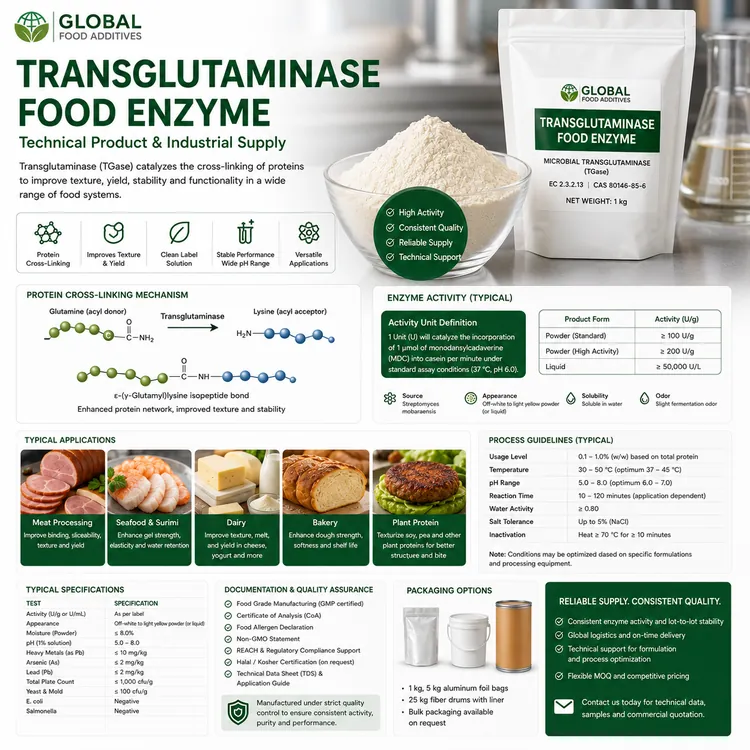
Product identity
| Product name | Transglutaminase |
|---|---|
| Common commercial name | Microbial Transglutaminase or MTGase |
| Systematic enzyme name | Protein-glutamine gamma-glutamyltransferase |
| Enzyme Commission number | EC 2.3.2.13 |
| CAS number | 80146-85-6 |
| Enzyme class | Transferase; aminoacyltransferase acting on protein-bound glutamine residues |
| Primary function | Covalent cross-linking of suitable food proteins |
| Typical commercial source | Microbial fermentation; the source organism, production strain and genetic status are supplier-specific |
| Commonly referenced microbial source | Streptomyces mobaraensis or another approved production organism |
| Cofactor profile | Common commercial microbial preparations are generally calcium-independent; confirm the specific enzyme documentation |
| E / INS number | No universal E or INS number for all Transglutaminase preparations; confirm regulatory classification by source, intended use and destination market |
| Typical physical form | Standardised powder, low-dust granulate or another supplier-specific enzyme preparation |
| Activity declaration | Units per gram of preparation using a defined supplier assay |
| Typical carrier system | Supplier-specific; may include carbohydrate, salt or protein-based standardising materials |
| Primary market category | Food enzyme and/or processing aid, subject to local law |
Primary technical effects
- Protein binding: develops covalent connections between compatible protein molecules.
- Gel strengthening: can increase gel firmness, elasticity and resistance to mechanical damage.
- Texture modification: may improve bite, chew, cohesiveness, sliceability and shape retention.
- Water retention: a stronger protein network may reduce purge, syneresis or cooking loss.
- Emulsion support: cross-linked interfacial proteins may improve stability in selected systems.
- Viscosity development: may increase apparent viscosity or network formation before final setting.
- Protein restructuring: can bind smaller protein-rich pieces into a controlled product structure.
- Ingredient optimisation: may support reformulation with different protein sources or reduced reliance on selected texturising ingredients.
Protein cross-linking mechanism
The principal food-structuring reaction can be represented schematically as:
Protein-Gln-CONH2 + H2N-Lys-Protein → Protein-Gln-CO-NH-Lys-Protein + NH3
The reaction forms an epsilon-(gamma-glutamyl)lysine isopeptide bond. The bond may be formed between two different protein molecules or between accessible regions within the same protein molecule.
Intermolecular cross-linking
Intermolecular bonding connects separate protein molecules and can produce larger protein networks. This pathway is particularly important for binding, gel strengthening, restructuring and viscosity development.
Excessive cross-linking can produce over-firm, rubbery, brittle or poorly processable structures. The target is normally an optimised network rather than maximum possible reaction.
Intramolecular cross-linking
Intramolecular bonding can alter the conformation of an individual protein molecule. This may change solubility, hydration, susceptibility to aggregation and interfacial behaviour.
The balance between intra- and intermolecular reactions depends on protein concentration, molecular mobility, substrate accessibility and the surrounding food matrix.
Acyl transfer to other amines
The enzyme can transfer the glutamyl acyl group to suitable primary amines when they are accessible in the system. The practical significance depends on formulation composition and enzyme specificity.
Deamidation pathway
When a suitable amine acceptor is unavailable, water may act as the acceptor, converting selected glutamine residues toward glutamate. Process conditions and substrate availability influence the balance between cross-linking and deamidation.
Technical specification framework
Transglutaminase preparations cannot be qualified by product name alone. The activity method, production organism, carrier composition, microbiological quality and physical performance must be defined in the purchase specification.
| Parameter | Purchasing requirement | Industrial significance |
|---|---|---|
| Enzyme identity | Transglutaminase, EC 2.3.2.13, with supplier-declared source | Prevents substitution with a different enzyme or animal-derived binding system. |
| Source organism | Full taxonomic identification of the production organism | Required for safety assessment, regulatory review, GMO status and customer approval. |
| Production strain | Strain designation and modification status where disclosure is required | Regulatory authorisation can be specific to the production strain. |
| Enzyme activity | Minimum or controlled activity in defined units per gram | Determines active dosage and supplier-to-supplier conversion. |
| Activity method | Substrate, buffer, pH, temperature, reaction time and endpoint | Numerical activity values are not comparable without equivalent methods. |
| Activity tolerance | Contracted minimum, target and/or release range | Protects batch consistency and formulation accuracy. |
| Carrier composition | Complete qualitative and, where needed, quantitative composition | Affects allergens, claims, dose, dispersion, nutrition and labelling. |
| Moisture | Supplier-controlled maximum | Influences enzyme stability, caking, activity retention and shelf life. |
| Particle size | Powder or granulate profile suited to the dosing system | Affects dusting, dispersion, segregation and operator exposure. |
| Bulk density | Typical or controlled range | Relevant to volumetric feeding, package filling and warehouse planning. |
| Side enzyme activities | Protease or other activity controlled where application-sensitive | Side activities may weaken proteins, change flavour or reduce yield. |
| Microbiological quality | Defined limits for total count, indicator organisms and pathogens | Required for food-enzyme preparation qualification. |
| Viable production organism | Absence or compliance according to the regulatory basis | Important for fermentation-derived enzyme preparations. |
| Production-organism DNA | Declaration or analytical status where required | Relevant to genetically modified production systems and local rules. |
| Heavy metals and impurities | Compliance with the applicable enzyme-preparation specification | Supports destination-market and customer food-safety requirements. |
| Shelf life | Defined storage condition and minimum retained activity | Enzyme shelf life must be linked to activity, not appearance alone. |
Understanding enzyme activity units
Commercial Transglutaminase preparations are standardised by catalytic activity rather than by total powder mass alone. Activity may be reported using a hydroxamate method, colorimetric method, substrate-specific method or a proprietary supplier method.
Why activity methods differ
- Different glutamine-containing test substrates
- Different amine acceptors
- Different buffer composition and ionic strength
- Different assay pH
- Different reaction temperature
- Different incubation time
- Different analytical endpoint
- Different definition of one activity unit
Information required on the COA
- Declared activity result
- Units per gram of preparation
- Referenced analytical method
- Minimum release specification
- Manufacturing lot number
- Activity basis: as-is or dry basis
- Storage condition used before testing
- Laboratory approval or release authorisation
Activity-based dosage conversion
Where the target is expressed as activity per kilogram of finished product:
Required enzyme preparation, kg = batch mass, kg × target activity, U/kg ÷ (preparation activity, U/g × 1,000)
Where the target is expressed relative to protein:
Required enzyme preparation, g = protein mass, g × target activity, U/g protein ÷ preparation activity, U/g
These calculations establish an activity-equivalent starting point. They do not eliminate the need for application trials because two enzyme preparations can differ in carrier, side activity, stability and effective substrate access.
Substrate accessibility and protein response
Transglutaminase does not react equally with every protein. The number and accessibility of suitable glutamine and lysine residues determine whether an effective network can form.
| Protein system | Potential response | Critical variables |
|---|---|---|
| Myofibrillar meat proteins | Binding, firmness, sliceability, water retention and cook stability | Protein extraction, salt, mixing, particle contact, fat, temperature and holding time |
| Fish and surimi proteins | Gel-strength development, elasticity and structural cohesion | Species, freshness, washing, cryoprotectants, salt, endogenous enzymes and heating profile |
| Casein and milk proteins | Gel strengthening, viscosity development and reduced syneresis | Heat history, casein-to-whey ratio, fermentation sequence, pH and homogenisation |
| Whey proteins | Network formation may improve after controlled unfolding | Heat denaturation, protein concentration, pH and accessibility |
| Egg proteins | Gel modification, binding, firmness and water-holding changes | Albumen composition, heat treatment, pH and enzyme contact time |
| Wheat gluten | Dough strengthening, elasticity and structural reinforcement | Flour strength, hydration, mixing energy, reducing agents and fermentation process |
| Soy proteins | Gel strength, bite, cohesion and water retention | Isolate or concentrate type, heat treatment, solubility and lysine accessibility |
| Pea, faba and other pulse proteins | Potential network strengthening and improved plant-based texture | Protein purity, denaturation, residual starch, fibre, antinutrients and pH |
| Mixed animal and plant proteins | Hybrid network formation and improved composite structure | Protein ratio, hydration sequence, phase distribution and substrate compatibility |
| Hydrolysed proteins | Response may be reduced if peptides are too small or lack suitable reactive sites | Degree of hydrolysis, peptide size and free-amine concentration |
Variables that control cross-linking
Protein variables
- Total protein concentration
- Glutamine and lysine accessibility
- Protein molecular structure
- Degree of denaturation
- Particle size and surface exposure
- Protein extraction and solubility
- Presence of competing proteins or peptides
- Previous proteolysis or chemical modification
Process variables
- Enzyme activity dose
- Reaction temperature
- Reaction pH
- Holding time
- Mixing intensity
- Addition order
- Water activity and moisture
- Thermal inactivation profile
Formulation variables
- Salt concentration
- Phosphate system
- Fat and oil phase
- Hydrocolloids
- Reducing and oxidising ingredients
- Acids and bases
- Minerals and chelating agents
- Preservatives and other enzymes
Storage variables
- Time before heat treatment
- Chilled holding temperature
- Frozen or thawed protein condition
- Packaging pressure and product contact
- Moisture migration
- Residual enzyme activity
- Post-process proteolysis
- Mechanical handling after setting
Potential food-manufacturing applications
The following applications are technical evaluation areas rather than universal permissions or dose recommendations. Regulatory status, enzyme source, preparation composition, food category and labelling must be reviewed separately.
| Application | Potential technical purpose | Critical validation points |
|---|---|---|
| Restructured meat products | Binding of protein surfaces, portion formation, improved sliceability and structural integrity | Surface hygiene, contact pressure, salt, fat, reaction time, cook validation, labelling and consumer presentation |
| Processed meat and poultry | Texture development, water retention, firmness and reduced purge | Protein extraction, brine composition, injection, tumbling, thermal process and sensory quality |
| Fish and seafood products | Binding, gel strengthening, elasticity and shape retention | Species, freshness, endogenous proteases, salt, washing, freezing history and heating profile |
| Surimi and seafood analogues | Increased gel strength, bite, resilience and structural stability | Surimi grade, cryoprotectants, setting stage, salt, starch and final cooking process |
| Yogurt and fermented dairy | Increased viscosity, stronger gel and reduced whey separation | Enzyme addition before or after heat treatment, starter compatibility, fermentation time, pH and mouthfeel |
| Cheese and cheese analogues | Protein-network modification, yield support, firmness and water retention | Milk composition, rennet sequence, acidification, calcium, pressing, melt and maturation |
| Recombined dairy systems | Structure reinforcement and improved stability in protein-rich systems | Powder hydration, whey denaturation, homogenisation and heat stability |
| Bakery dough | Gluten-network strengthening, improved dough handling and shape retention | Flour strength, mixing, fermentation, loaf volume, crumb firmness and risk of over-tight dough |
| Noodles and pasta systems | Increased firmness, elasticity and cooking tolerance | Flour or protein type, hydration, sheeting, drying, cooking loss and bite |
| Egg-based products | Gel-strength and binding modification | Egg fraction, pH, heat treatment, syneresis and final texture |
| Plant-based meat analogues | Improved cohesion, bite, juiciness retention and protein-network stability | Protein source, extrusion history, hydration, fat distribution, colour, flavour and thermal setting |
| Plant-based dairy alternatives | Gel strengthening, viscosity and reduced phase separation | Protein solubility, calcium, pH, fermentation, heat treatment and sensory quality |
| Protein films and coatings | Covalent network development and improved mechanical strength | Film-former type, flexibility, brittleness, permeability, drying and regulatory suitability |
Hygiene and cooking requirements for bonded products
Transglutaminase is not an antimicrobial treatment. When separate pieces of meat, poultry or seafood are joined, previously external surfaces may become internal parts of the finished portion. The food safety plan must account for this change in product geometry and risk.
Raw-material controls
- Approved suppliers and raw-material specifications
- Cold-chain control
- Surface microbiological quality
- Sanitary cutting and trimming
- Time outside temperature control
- Prevention of environmental contamination
- Traceability of all combined pieces
Process controls
- Sanitary enzyme application
- Controlled reaction time and temperature
- Validated forming and packaging process
- Control of rework
- Validated cooking instructions
- Product identification and labelling
- Consumer handling information where required
Process integration and addition sequence
Recommended development sequence
- Define the texture objective. Establish measurable targets for firmness, binding, yield, viscosity, syneresis, cooking loss or sliceability.
- Characterise the protein system. Record protein type, concentration, solubility, heat history, particle size, pH, salt and moisture.
- Qualify the enzyme preparation. Confirm activity method, carrier composition, source organism, allergens and regulatory status.
- Create an activity-based dose series. Test several activity levels rather than only several powder percentages.
- Optimise addition order. Compare dry addition, slurry addition, brine addition, surface application or preblending as appropriate.
- Control reaction conditions. Standardise temperature, pH, mixing, contact, pressure and holding time.
- Validate enzyme inactivation. Demonstrate that the planned thermal process provides the required activity reduction.
- Complete shelf-life testing. Measure texture, purge, syneresis, flavour, package stability and microbiological quality.
Dry addition
- Suitable for compatible dry premixes and dry ingredient systems.
- Requires rapid and uniform distribution.
- May create enzyme dust if not controlled.
- Can segregate when carrier density differs from the food powder.
- Should not be applied in concentrated pockets.
- Requires validated blending time and sampling.
Slurry or liquid premix
- Can improve distribution in selected wet processes.
- Use potable or specification-compliant water.
- Prepare only the amount required for immediate processing.
- Avoid prolonged warm holding before use.
- Confirm that the enzyme remains active in the premix conditions.
- Control microbial contamination and clean the system after use.
Surface application
- Used where bonding is required at a defined protein interface.
- Requires uniform coverage.
- Requires good physical contact between surfaces.
- Excess free water can weaken contact.
- Fat-rich or connective surfaces may respond poorly.
- Reaction time and chilled holding must be controlled.
Brine or marinade application
- Requires compatibility with salt, phosphate and other ingredients.
- Activity retention in the brine should be confirmed.
- Injection distribution must be validated.
- Tumbling can improve protein extraction and enzyme contact.
- Foaming and dust exposure should be avoided during preparation.
- Unused enzyme-containing brine requires controlled handling.
Enzyme inactivation and residual activity
Transglutaminase is a protein and loses catalytic activity when sufficiently denatured. However, there is no single universal inactivation temperature that applies to every preparation and food. Matrix composition, heating rate, moisture, pH, enzyme source and residence time all influence the result.
Inactivation study design
- Use the actual enzyme preparation.
- Use the actual food formulation.
- Reproduce the coldest product location.
- Record product temperature, not only oven or water temperature.
- Evaluate realistic heating rates.
- Measure residual activity using a suitable method.
- Confirm the effect of post-process holding and cooling.
Why residual activity matters
- Texture may continue developing during storage.
- Viscosity may continue increasing.
- Product may become excessively firm.
- Processing lines may become harder to clean.
- Fermentation behaviour may change.
- Finished-product consistency may vary with storage time.
- Regulatory classification may consider residual activity.
Signs of insufficient or excessive cross-linking
| Condition | Possible symptoms | Corrective investigation |
|---|---|---|
| Insufficient activity | Weak binding, poor sliceability, low gel strength or continued syneresis | Verify activity dose, product age, storage, dispersion and COA result. |
| Insufficient substrate access | Little response despite adequate declared enzyme activity | Review protein type, denaturation, hydration, salt and mixing. |
| Short reaction time | Variable or incomplete network development | Review temperature history, line speed and holding time. |
| Uneven distribution | Hard and soft zones, weak seams or inconsistent viscosity | Improve premixing, spraying, tumbling or injection uniformity. |
| Excessive activity | Rubbery bite, excessive firmness, poor extensibility or brittle gel | Reduce activity dose, reaction time or reaction temperature. |
| Delayed inactivation | Texture continues changing after production | Review heating, cooling and storage conditions. |
| Protease contamination or side activity | Network weakening, bitterness or loss of yield | Review side-activity specification and supplier consistency. |
| Protein dilution | Weak structure at the expected enzyme dose | Review water, fat, starch and hydrocolloid ratio relative to protein. |
Ingredient and process interactions
| Component | Potential interaction | Recommended evaluation |
|---|---|---|
| Salt | Can improve extraction of selected proteins but may also alter enzyme activity and water distribution | Test the actual salt concentration and addition order. |
| Phosphates | Influence pH, ionic strength, protein extraction and water holding | Optimise the complete phosphate-enzyme system rather than each ingredient separately. |
| Proteases | Can expose new sites but may also destroy the protein network | Control sequence, dose and reaction time carefully. |
| Reducing agents | May alter protein conformation and substrate accessibility | Evaluate dough or protein-network strength through processing. |
| Oxidising agents | Can create competing protein-network changes | Compare texture, handling and final quality in a factorial trial. |
| Hydrocolloids | Change water distribution, viscosity and protein mobility | Confirm whether the hydrocolloid limits enzyme-substrate contact. |
| Fat | High fat may physically separate proteins or reduce surface contact | Evaluate fat particle size, emulsification and protein continuity. |
| Acids and fermentation | Changing pH alters enzyme activity and protein aggregation | Define whether reaction occurs before, during or after acidification. |
| Heat treatment | Can expose protein sites, set the protein network or inactivate the enzyme | Optimise preheating, reaction and final heating as one process. |
| Free primary amines | May compete with protein-bound lysine as acyl acceptors | Review formulation composition where high concentrations are present. |
Typical enzyme-production and finishing stages
Supplier manufacturing processes differ, but microbial Transglutaminase preparations are generally produced by controlled fermentation followed by enzyme recovery, purification or concentration, standardisation and food-grade packaging.
- Production-strain control: the microbial strain is identified, maintained and controlled under an approved seed programme.
- Fermentation-medium preparation: carbon, nitrogen, minerals and processing aids are prepared under controlled conditions.
- Fermentation: temperature, pH, aeration, agitation and nutrient addition are controlled to produce the enzyme.
- Biomass separation: production-organism cells and fermentation solids are removed.
- Enzyme recovery: the enzyme-containing liquid is concentrated and purified to the required production standard.
- Activation or maturation: supplier-specific processing may convert a precursor enzyme into its active form.
- Standardisation: the enzyme concentrate is blended with approved carriers to achieve a defined activity per gram.
- Drying or granulation: the preparation is converted into a stable physical form where applicable.
- Sieving and foreign-material control: screens, magnets and other controls are applied according to the food-safety plan.
- Quality release: activity, microbiology, moisture, composition and purity are reviewed before packaging.
Incoming quality control and COA review
Identity and activity
- Product and enzyme name
- EC number
- Source organism
- Production-strain reference
- Activity in declared units per gram
- Activity test method
- Activity basis and tolerance
- Physical form
- Carrier composition
Physical and chemical quality
- Appearance
- Colour
- Odour
- Moisture
- Particle-size distribution
- Bulk density
- Dispersibility
- Side enzyme activities
- Relevant contaminants and heavy metals
Microbiological quality
- Total aerobic count
- Yeasts and moulds where specified
- Coliforms or Enterobacteriaceae
- Escherichia coli
- Salmonella
- Staphylococcus aureus where required
- Absence of antimicrobial activity where required
- Viable production-organism status
Lot traceability
- Manufacturer and production site
- Country of origin and manufacture
- Batch or lot number
- Manufacturing date
- Expiry or best-before date
- COA issue date and approval
- Specification revision
- Package and pallet identification
- Purchase-order reference
Allergen, gluten, GMO and certification review
Carrier and formulation allergens
The enzyme preparation may contain carrier or standardising ingredients in addition to the enzyme protein. Buyers should obtain the complete composition and allergen status rather than evaluating the enzyme name alone.
- Milk or caseinate components
- Wheat-derived or other cereal-derived carriers
- Soy-derived components
- Egg-derived components
- Animal-derived proteins or gelatin
- Shared-equipment cross-contact
Claims and certification
- GMO production-organism status
- Production-organism DNA status where required
- Animal-origin statement
- Vegan and vegetarian suitability
- Halal certification
- Kosher certification
- BSE/TSE statement where relevant
- Irradiation status
- Organic-processing suitability where applicable
Enzyme dust and operator protection
Enzymes are proteins and repeated inhalation of airborne enzyme dust can create occupational sensitisation risk. Food safety for the consumer and occupational safety for the operator are separate assessments.
Engineering controls
- Prefer low-dust granulated preparations where suitable.
- Use enclosed bag opening and transfer where practical.
- Provide effective local exhaust ventilation.
- Avoid compressed-air cleaning.
- Use approved industrial vacuum systems.
- Prevent powder accumulation on equipment and structures.
- Maintain filters and extraction systems.
Operator controls
- Follow the current supplier Safety Data Sheet.
- Use respiratory protection defined by the risk assessment.
- Use eye and skin protection where required.
- Avoid creating aerosols from liquid enzyme premixes.
- Wash exposed skin after handling.
- Report respiratory symptoms promptly.
- Train operators in enzyme-specific spill cleanup.
Packaging, storage and activity retention
Commercial packaging
Packaging depends on activity, physical form, order size and supplier. Common formats may include sealed foil-laminate bags, lined food-grade bags, pails, fibre drums, cartons containing inner bags or other moisture-resistant packaging.
- Net weight per package
- Primary food-contact packaging material
- Moisture and oxygen barrier
- Tamper-evidence system
- Bag or container closure
- Secondary carton or drum
- Pallet configuration
- Lot and expiry marking
- Temperature-control requirements
Storage controls
- Follow the supplier’s specified temperature range.
- Keep packaging tightly sealed.
- Protect from humidity and condensation.
- Protect from direct heat and sunlight.
- Avoid repeated warm-cold cycling.
- Prevent contamination and foreign odour pickup.
- Reseal partially used packs immediately.
- Apply FEFO stock rotation.
- Record storage-temperature deviations.
- Evaluate activity after significant excursions.
Activity-retention factors
| Temperature | Elevated storage temperature can accelerate activity loss. |
|---|---|
| Moisture | Humidity can promote caking and reduce enzyme stability. |
| Package opening | Repeated opening increases moisture and contamination exposure. |
| Storage time | Activity should remain above the contracted minimum through the declared shelf life. |
| Premix storage | Diluted enzyme preparations may be less stable than the unopened commercial product. |
| Transport excursions | Significant temperature or moisture events require documented assessment. |
Regulatory and labelling considerations
European Union
Food enzymes are regulated separately from conventional food additives. The regulatory assessment is linked to the enzyme, production organism, manufacturing process, intended technological function and proposed food uses.
Buyers should review the current food-enzyme framework, relevant application status, national transitional measures, finished-food labelling rules and any requirements relating to genetically modified production organisms.
United States
The regulatory basis may include a supplier’s GRAS conclusion, an FDA GRAS notice response, an applicable food-additive regulation or another lawful basis. The conclusion can be specific to the enzyme source, production strain, manufacturing process, specifications and intended uses.
Buyers should request the supplier’s exact U.S. regulatory rationale and confirm that the proposed use falls within its stated conditions.
Reference: U.S. FDA — GRAS Notice Inventory
Other destination markets
- Confirm the approved enzyme source and production strain.
- Confirm the permitted food categories and technical functions.
- Determine processing-aid or ingredient status.
- Review residual-activity requirements.
- Confirm label declaration and consumer-information rules.
- Review restructured-meat or reformed-food labelling.
- Check GMO-production-organism requirements.
- Confirm carrier and allergen declarations.
- Review import registration and certificate requirements.
Documents to request before approval
Core technical documents
- Current Product Specification
- Technical Data Sheet
- Lot-specific Certificate of Analysis
- Activity-unit definition and analytical method
- Safety Data Sheet
- Application and dosage guidance
- Inactivation guidance
- Packaging specification
- Shelf-life and storage statement
Source and manufacturing documents
- Source-organism identification
- Production-strain designation
- Genetic-modification status
- Manufacturing-flow summary
- Carrier and full composition statement
- Viable production-organism statement
- Production-organism DNA statement where relevant
- Country of origin
- Manufacturing-site declaration
Food-safety documents
- Food-enzyme compliance declaration
- Microbiological specification
- Heavy-metal and purity declaration
- Allergen and cross-contact statement
- Gluten status
- GMO statement
- Animal-origin and BSE/TSE statement
- Halal and Kosher certificates where required
- Food-safety certification
Regulatory and trade documents
- Destination-market regulatory basis
- GRAS notice or conclusion where applicable
- EU food-enzyme application or status documentation
- Certificate of origin
- Health or free-sale certificate where required
- Commercial invoice and packing list
- Transport classification statement
- Importer-registration support documents
Yield, resource and waste considerations
Potential efficiency benefits
- Improved utilisation of smaller protein pieces
- Reduced purge or syneresis in suitable products
- Improved slicing and portion yield
- Reduced structural breakage during handling
- Potential optimisation of protein blends
- Lower use of selected texturising ingredients where validated
- Improved product consistency
Responsible-use controls
- Use the minimum effective activity dose.
- Avoid unnecessary product discard from over-cross-linking.
- Prepare only the enzyme premix required for the batch.
- Prevent enzyme powder from entering drains.
- Control protein-rich wastewater from cleaning.
- Use package sizes that minimise partial packs.
- Track yield benefits against total process cost.
Information required for an accurate quotation
| Inquiry field | Information to provide |
|---|---|
| Product | Transglutaminase / Microbial Transglutaminase |
| Required application | Meat, poultry, seafood, dairy, bakery, noodles, egg, plant protein or another protein system |
| Technical objective | Binding, gel strength, viscosity, water retention, reduced syneresis, sliceability or structural stability |
| Protein system | Protein source, protein percentage, fat, moisture, salt and pH |
| Required activity | Target units per gram, units per kilogram of food or equivalent approved reference product |
| Process conditions | Addition method, mixing, reaction temperature, holding time and thermal process |
| Regulatory market | Destination country and finished-food category |
| Composition requirements | Carrier restrictions, allergen requirements, GMO status, vegan, Halal or Kosher requirements |
| Quantity | Sample, laboratory trial, pilot trial, regular order and annual forecast |
| Packaging | Required pack size, inner bag, drum, carton and pallet configuration |
| Destination | Delivery city, port and country |
| Commercial terms | Requested Incoterm, currency, shipment window and payment preference |
| Reference material | Existing specification, COA, approved sample, formulation, activity method or competitor grade |
Frequently asked questions
What does Transglutaminase do?
It catalyses covalent bonds between suitable protein-bound glutamine and lysine residues. This can modify protein binding, gel strength, elasticity, viscosity, water retention and structural stability.
What is microbial Transglutaminase?
It is Transglutaminase produced through microbial fermentation. Commercial food preparations are commonly standardised to a defined activity using an approved carrier.
Does it have an E number?
There is no universal E number covering every Transglutaminase preparation. Regulatory classification depends on the enzyme source, production strain, application and destination market.
Is microbial Transglutaminase calcium dependent?
Common commercial microbial preparations are generally selected for calcium-independent activity. The specific supplier documentation should still be checked.
Can activity units from different suppliers be compared?
Only when the unit definition and assay conditions are equivalent. The substrate, pH, temperature, time and analytical endpoint must all be compared.
Which proteins respond best?
Potential substrates include meat and fish proteins, casein, selected whey proteins, egg proteins, gluten and several plant proteins. Accessibility of glutamine and lysine residues is critical.
Why might an enzyme show little effect?
Possible causes include low activity, poor storage, insufficient protein, inaccessible substrate sites, unsuitable pH, short reaction time, poor dispersion or early thermal inactivation.
Can too much enzyme be used?
Yes. Excess activity or excessive reaction time can create rubbery, overly firm, brittle or poorly extensible textures.
Does it replace cooking or pasteurisation?
No. It is a structure-modifying enzyme and does not replace validated pathogen-control, cooking, sanitation or cold-chain measures.
How is the enzyme inactivated?
Sufficient heat denatures the enzyme, but the required process is preparation- and matrix-specific. Inactivation must be validated in the actual food.
Do formed bonds disappear after heating?
No. Heating can stop further enzyme activity, but protein cross-links already formed generally remain.
Can it be added as a dry powder?
Yes, when the process provides safe handling and uniform dispersion. Low-dust granulates or controlled premixes may reduce segregation and occupational dust exposure.
Can it be added in water?
A short-life slurry or premix may be suitable in some processes. Water quality, temperature, holding time, microbial control and activity retention must be managed.
Can it make wheat products gluten-free?
No. Transglutaminase treatment does not make wheat or gluten-containing ingredients gluten-free.
Can the enzyme preparation contain allergens?
The carrier or other standardising components may contain allergenic ingredients. Buyers should request the complete composition and allergen declaration.
Why is enzyme dust control important?
Enzymes are proteins, and inhaled enzyme dust may cause occupational sensitisation. Enclosed handling, extraction and suitable personal protection are important.
Is Transglutaminase permitted everywhere?
No. Approval, processing-aid classification, use conditions and labelling vary by source, application and destination market.
Can Global Food Additives compare an existing product?
Yes. Buyers can provide an existing specification, activity method, COA, approved sample, formulation or competitor product for technical and commercial comparison.
Tell us the Transglutaminase activity and application you require.
For an accurate review, include the protein system, required technical effect, current activity or reference product, process conditions, quantity, destination market, packaging and documentation requirements.
Existing specifications, COAs, activity methods, formulations or approved samples can be described in your message. Our team will review the inquiry and respond from orders@foodgradeadditives.com .
Your technical inquiry has been received. You will be redirected to the home page.