
Food-Grade Xylanase Enzyme
Xylanase is a glycoside-hydrolase enzyme used to cleave internal beta-1,4-xylosidic linkages in xylan and arabinoxylan structures. Application-specific food-enzyme preparations can improve dough handling, redistribute water in cereal systems, reduce process viscosity, support filtration, increase extraction efficiency and modify plant-cell-wall materials. Industrial selection must consider activity method, substrate specificity, production organism, side activities, pH and temperature profile, thermal inactivation, formulation format and the exact regulatory status of the commercial preparation.
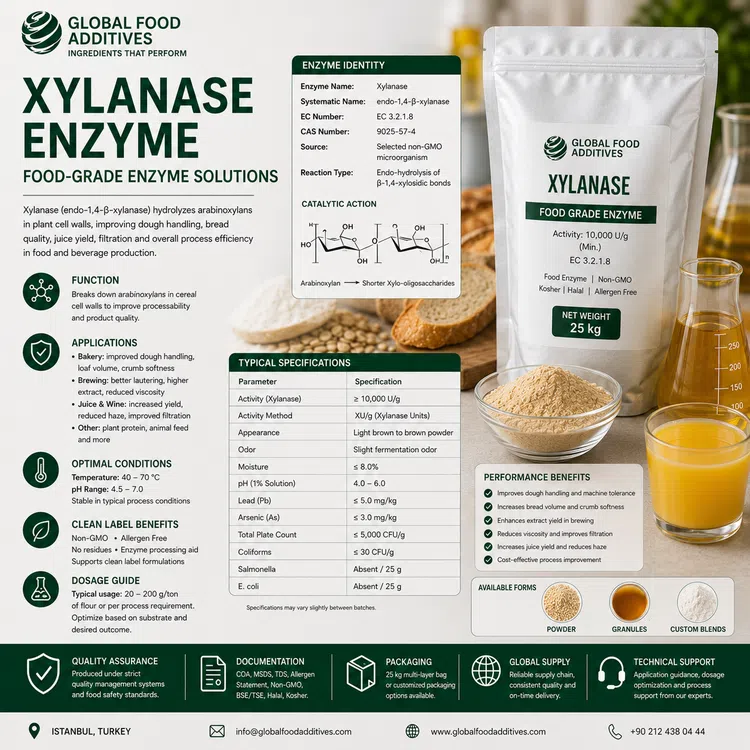
Enzyme identity
| Accepted name | Endo-1,4-beta-xylanase |
|---|---|
| EC number | EC 3.2.1.8 |
| CAS number | 9025-57-4 |
| Enzyme class | Glycoside hydrolase |
| Catalytic action | Endohydrolysis of beta-1,4-D-xylosidic linkages within xylans |
| Principal food substrate | Xylan and arabinoxylan structures in cereal and plant cell walls |
| Typical production sources | Selected fungal or bacterial production microorganisms; organism and strain are product specific |
| Typical formats | Standardized powder, low-dust granule, microgranule or liquid preparation |
| Activity expression | Supplier-specific units per gram or milliliter under a defined analytical method |
| E / INS number | No universal conventional E or INS number should be assumed; verify classification for each market and use |
Potential application fit
Subject to product-specific authorization and process validation, Xylanase may be evaluated for:
- Bread, rolls and fermented bakery products
- Flatbread, tortilla and pizza-dough systems
- Biscuits, crackers and laminated dough
- Wholegrain, bran-rich and high-fiber bakery products
- Wheat, rye, barley and mixed-cereal processing
- Brewing, distilling and cereal-beverage production
- Fruit and vegetable juice extraction
- Plant-based beverage and protein processing
- Starch, gluten and cereal-fraction processing
- Coffee, botanical and plant-material extraction
- Viscosity reduction in xylan-rich process streams
- Xylo-oligosaccharide process development
Substrate chemistry and mode of action
Xylan is a major hemicellulose component of plant cell walls. Its backbone contains beta-1,4-linked xylose units and may carry arabinose, glucuronic acid, acetyl, feruloyl or other substituents. Wheat and rye flour contain arabinoxylans that strongly influence water distribution, dough rheology, gas-cell stability and finished-product texture.
Endo-Xylanase cleaves internal points in the xylan backbone, producing shorter soluble or partially soluble fragments. The exact products depend on enzyme family, substrate structure, degree of substitution, process conditions and reaction time. A commercial Xylanase should therefore be selected for the target raw material rather than only for high activity against a laboratory xylan.
| Substrate fraction | Industrial behavior | Potential Xylanase effect |
|---|---|---|
| Water-unextractable arabinoxylan | Binds water and can physically interfere with gluten and gas-cell development | Controlled hydrolysis can improve solubilization and release water into the dough phase |
| Water-extractable arabinoxylan | Influences dough viscosity, water distribution and interfacial properties | Moderate modification may support gas retention; excessive depolymerization can reduce beneficial viscosity |
| Bran-associated arabinoxylan | Contributes to high water absorption and can weaken dough continuity | Targeted treatment may improve handling in wholegrain and fiber-enriched products |
| Rye pentosans | Strongly control viscosity and structure in rye dough | Requires careful dosage because excessive breakdown can damage structure |
| Plant-cell-wall xylan | Restricts liquid release and extraction of intracellular material | Hydrolysis may improve pressing, extraction and filtration when combined with suitable enzyme systems |
Enzyme-family and specificity considerations
Commercial Xylanases may belong to different glycoside-hydrolase families and can vary in molecular structure, substrate access, product profile, pH response and thermostability. Family designation can be useful, but application trials remain more important than family name alone.
GH10-type characteristics
- Often display broader action on differently substituted xylan regions.
- May produce a product distribution different from narrower substrate-cleft enzymes.
- Can be useful where accessibility to complex plant xylan is important.
- Actual food performance remains strain, sequence and preparation specific.
GH11-type characteristics
- Commonly represented among commercial fungal and bacterial Xylanases.
- Frequently evaluated for cereal arabinoxylan and bakery applications.
- May provide high apparent activity at relatively low protein dosage.
- Performance cannot be inferred from GH family without the assay and flour trial.
Activity units and assay comparability
Xylanase activity is commonly stated as units per gram or milliliter, but there is no single universally interchangeable commercial unit. Suppliers may use XU, BXU, FXU, AXU, EXU or proprietary designations. The same product can produce different numerical activity results when the assay substrate or conditions change.
| Assay variable | Why it changes the result | Information to request |
|---|---|---|
| Substrate | Birchwood xylan, beechwood xylan, wheat arabinoxylan and dyed substrates have different accessibility | Exact substrate identity and supplier |
| Substrate concentration | Changes reaction rate and apparent enzyme saturation | Concentration and preparation method |
| pH and buffer | Enzyme activity is strongly affected by ionization and buffer composition | Buffer identity, concentration and pH |
| Temperature | Higher temperature can increase reaction rate until instability becomes important | Exact assay temperature and pre-equilibration |
| Reaction time | Product accumulation may not remain linear indefinitely | Incubation time and linearity criteria |
| Detection method | Reducing-sugar, colorimetric, viscosimetric and chromogenic methods measure different endpoints | Analytical principle and calibration standard |
| Unit definition | One unit may refer to different amounts of released product or viscosity change | Full written definition of one activity unit |
| Reporting basis | Values may be stated per gram of preparation, protein or total organic solids | Exact denominator and dilution basis |
Bakery mechanism and performance
In wheat dough, arabinoxylans compete for water and interact with gluten, starch and gas-cell interfaces. A correctly selected Xylanase can convert part of the water-unextractable fraction into more soluble fragments, making water available for gluten development and improving processing consistency.
Potential bakery benefits
- Improved dough extensibility and machinability
- Reduced excessive dough firmness
- Better water distribution
- Improved gas retention during proofing
- Increased loaf volume
- More uniform crumb-cell structure
- Reduced sensitivity to flour variation
- Improved performance in bran-rich formulations
- Potential support for softer crumb texture
Possible overdose symptoms
- Sticky or excessively slack dough
- Reduced dough tolerance during mixing or proofing
- Weak gas-cell structure
- Difficulty during dividing, rounding or molding
- Excessive spread in rolls or flat products
- Coarse or irregular crumb
- Collapsed sidewalls or reduced loaf symmetry
- Unstable performance after flour changes
Bakery dosage development
Xylanase dosage should be expressed both as commercial preparation and as enzyme activity per unit of flour. A dose stated only in grams per metric ton cannot be transferred between products with different activity concentrations.
Commercial dose must be established with the supplier assay and validated using the target flour, recipe, mixing system, fermentation time and oven profile.
- Characterize the control flour, including protein, ash, damaged starch, water absorption and relevant arabinoxylan behavior.
- Define the primary objective: machinability, volume, crumb, fiber tolerance or process consistency.
- Conduct a dose-response series around the supplier's recommended range.
- Keep water addition constant during initial screening, then optimize water after identifying the useful enzyme range.
- Measure mixing time, dough temperature, stickiness, extensibility, proofing and machinability.
- Evaluate loaf volume, shape, crumb structure, firmness and shelf life.
- Repeat the trial with representative low- and high-variation flour lots.
- Confirm performance at commercial mixer, divider, proofer and oven scale.
Interaction with other bakery enzymes
Xylanase is frequently used in multi-enzyme systems. Enzyme interactions can be synergistic, neutral or antagonistic, and the optimum dose of one enzyme may change when another is added.
| Co-enzyme | Potential combined objective | Risk to control |
|---|---|---|
| Alpha-amylase | Fermentable sugar generation, volume and crumb-softness support | Excessive combined softening, gummy crumb or poor slicing |
| Maltogenic amylase | Extended crumb softness | Finished-product texture can become overly soft or resilient |
| Lipase or phospholipase | Gas-cell stabilization and crumb structure | Dough tightening or excessive process sensitivity |
| Glucose oxidase | Dough strengthening and tolerance | Strong oxidation may counteract the desired extensibility |
| Cellulase | Fiber modification in wholegrain products | Excessive cell-wall breakdown and sticky dough |
| Beta-glucanase | Viscosity reduction in barley, oat or mixed-cereal systems | Loss of desired soluble-fiber functionality |
| Protease | Extensibility in crackers, biscuits or specialized dough | Severe weakening when protease and Xylanase effects accumulate |
| Transglutaminase | Protein-network modification | Regulatory status and excessive firmness require review |
Flour-treatment and premix engineering
The active enzyme quantity in a flour improver can be extremely small relative to the batch. Direct addition of concentrated enzyme may produce unacceptable distribution and operator-exposure risk.
- Use a validated carrier and geometric-dilution procedure for powdered premixes.
- Match particle size and bulk density to reduce segregation.
- Select low-dust granulated preparations where practical.
- Verify homogeneity using an appropriate tracer, activity test or process validation.
- Avoid excessive mixing or vibration that can separate fine enzyme particles from the carrier.
- Control humidity because carriers and enzyme preparations may cake or lose activity.
- Confirm compatibility with oxidants, acids, minerals and other premix components.
- Revalidate dosage whenever enzyme potency or premix carrier changes.
Brewing and cereal-beverage applications
Arabinoxylans and related cell-wall polysaccharides can increase mash or wort viscosity, restrict extract release and slow filtration. A suitable Xylanase may support raw-material utilization and process flow, particularly in high-adjunct, wholegrain or non-traditional cereal systems.
Potential process benefits
- Reduced mash viscosity
- Improved extract release
- Faster lautering or filtration
- Improved handling of wheat, rye or high-fiber adjuncts
- Reduced process-water demand in selected systems
- More consistent throughput across raw-material lots
Parameters to validate
- Mash pH and temperature profile
- Enzyme addition stage
- Residence time before thermal inactivation
- Wort viscosity and filtration time
- Extract yield and fermentability
- Haze, foam and sensory performance
- Residual oligosaccharide profile
- Interaction with beta-glucanase and amylase
Juice and plant-material processing
Xylanase may be used as part of a cell-wall-degrading enzyme system in fruit, vegetable, botanical or coffee processing. It is normally selected in combination with pectinase, cellulase, beta-glucanase or other activities according to the plant material.
| Process objective | Potential Xylanase contribution | Validation requirement |
|---|---|---|
| Extraction yield | Opens xylan-containing cell-wall structures | Measure liquid yield, soluble solids and target-compound recovery |
| Viscosity reduction | Reduces molecular size of xylan-rich polymers | Monitor viscosity under the actual process temperature and pH |
| Pressing efficiency | Supports liquid release from plant tissue | Compare press yield, cake moisture and cycle time |
| Clarification | May improve filtration when xylan contributes to turbidity | Check haze, sediment and filter performance |
| Color extraction | Can increase release of cell-associated components | Confirm that desired and undesired color compounds are controlled |
| Flavor extraction | Can alter release of aroma precursors and phenolic compounds | Conduct sensory and chemical comparison through shelf life |
Plant-based food and protein processing
Xylanase can be evaluated in oat, wheat, cereal-bran, pulse and other plant-based systems where arabinoxylan contributes to viscosity, sediment, extraction losses or process difficulty. It should not be assumed to solve every plant-cell-wall problem because cellulose, beta-glucan, pectin, starch and protein may dominate the matrix.
- Characterize the principal non-starch polysaccharides before selecting the enzyme.
- Confirm whether the target is lower viscosity, higher yield, improved filtration or modified fiber.
- Test interaction with cellulase, beta-glucanase, pectinase and protease.
- Measure protein yield and functionality after treatment.
- Evaluate sedimentation, mouthfeel and beverage stability.
- Check whether hydrolysis increases fermentable sugars or microbial susceptibility.
- Verify nutrition-label consequences when fiber composition changes.
- Confirm that the enzyme is adequately inactivated or otherwise managed in the final process.
Xylo-oligosaccharide process development
Controlled xylan hydrolysis can generate shorter xylo-oligosaccharides, but a general food-processing Xylanase is not automatically suitable for manufacturing a defined oligosaccharide ingredient. Product distribution depends on enzyme specificity, xylan source, pretreatment, side activities and reaction endpoint.
Critical process variables
- Xylan source and degree of substitution
- Raw-material pretreatment
- Enzyme family and product profile
- Beta-xylosidase side activity
- Enzyme dose and reaction time
- pH and temperature
- Solids concentration and mixing
- Thermal inactivation and purification
Finished-ingredient controls
- Degree of polymerization distribution
- Xylose and monosaccharide content
- Residual enzyme activity
- Color and flavor
- Ash and process residues
- Microbiological quality
- Regulatory identity
- Nutrition and claim substantiation
pH and temperature process window
There is no universal optimum pH or temperature for Xylanase. Fungal and bacterial enzymes can have materially different operating profiles. Supplier values are usually obtained under laboratory assay conditions and may not predict activity in dough, mash, juice or concentrated plant material.
| Performance term | Meaning | Purchasing interpretation |
|---|---|---|
| Optimum pH | pH producing maximum measured activity in a specific assay | Does not define the complete useful pH range or stability |
| pH stability | Ability to retain activity after exposure to a pH condition | Request exposure time, temperature and residual-activity method |
| Optimum temperature | Temperature producing maximum short-term assay activity | May be above the temperature at which long-term stability is acceptable |
| Thermal stability | Retention of activity after a defined heat exposure | Request time, pH, matrix and residual-activity details |
| Inactivation temperature | Process condition intended to reduce activity to an acceptable level | Must be validated in the actual food, not only buffer |
| Half-life | Time required for activity to decrease by half under stated conditions | Useful only when the complete conditions are reported |
Thermal inactivation and residual activity
In bakery products, Xylanase normally acts during mixing, resting and proofing and then loses activity as the dough heats. In beverages, brewing or extraction processes, the enzyme may remain active until a deliberate pasteurization or inactivation stage.
- Determine the time-temperature history at the coldest point in the product.
- Validate inactivation at the actual pH, solids and moisture content.
- Consider that dry or low-moisture regions may protect enzyme activity.
- Confirm whether residual activity could change viscosity, fiber or texture during storage.
- Use a validated residual-activity method where inactivation is critical.
- Do not infer complete inactivation from product temperature alone.
- Review whether the enzyme remains a processing aid or has a continuing technical function in the final food.
Side-activity profile
Commercial enzyme preparations may contain activities other than the declared principal Xylanase. These can originate from the production organism, purification process or intentional formulation.
| Possible side activity | Potential benefit | Potential risk |
|---|---|---|
| Beta-xylosidase | Further conversion of xylo-oligosaccharides | Excess monosaccharide formation where oligosaccharides are desired |
| Cellulase | Additional plant-cell-wall breakdown | Excessive fiber degradation or dough weakening |
| Beta-glucanase | Viscosity reduction in barley or oat systems | Loss of desired beta-glucan functionality or claim value |
| Alpha-amylase | Additional starch conversion in baking or brewing | Sticky crumb, excessive fermentable sugars or process variation |
| Protease | Potential extensibility in specialized dough | Gluten weakening and reduced process tolerance |
| Pectinase | Improved plant-juice extraction | Unwanted cloud loss or excessive maceration |
| Feruloyl esterase | Release of ferulate-linked structures | Changes in phenolic profile, color or oxidative stability |
Production organism and manufacturing route
Food-grade Xylanase is normally produced through controlled fermentation using a selected microorganism. The enzyme is recovered from the fermentation broth, clarified, concentrated, standardized and formulated. The exact production organism and strain are central to regulatory and safety assessment.
| Manufacturing stage | Control objective | Buyer relevance |
|---|---|---|
| Production-strain control | Maintain identity, purity and genetic stability | Exact strain must match the regulatory dossier and specification |
| Seed fermentation | Build a controlled inoculum | Reduces contamination and lot-to-lot variation |
| Production fermentation | Generate the target enzyme activity | Substrate, pH, aeration and process controls influence impurity profile |
| Biomass separation | Remove production-organism cells | Important for purity and absence-of-organism requirements |
| Clarification and concentration | Remove insolubles and increase enzyme potency | Influences total organic solids and side activities |
| Purification where applicable | Reduce unwanted fermentation components | Level of purification differs among commercial products |
| Standardization | Adjust each lot to the declared commercial activity | Carrier and diluent identity must be disclosed |
| Formulation | Improve stability, handling and dosing | May include carriers, stabilizers or preservatives |
| Final release | Confirm activity, purity, microbiology and package integrity | Batch CoA should represent the shipped lot |
Non-modified and genetically modified production strains
Xylanase may be produced by conventionally selected or genetically modified microorganisms. The production method does not by itself determine finished-enzyme safety or labeling. Evaluation must address the exact production organism, introduced genetic material, manufacturing controls, absence of viable production organism and any requirements concerning residual production-organism DNA.
- Request the full taxonomic identity of the production organism.
- Confirm the strain designation used in the regulatory documentation.
- Request a clear GMO or genetic-modification statement for the production strain.
- Confirm whether viable production organisms are absent from the commercial preparation.
- Request information on residual production-organism DNA where required.
- Verify destination-market labeling and customer-policy requirements.
- Do not infer non-GMO status solely because the enzyme protein is purified.
Commercial preparation formats
| Format | Advantages | Control requirements |
|---|---|---|
| Standard powder | Easy incorporation into dry premixes and flour systems | Dust, segregation, humidity and operator exposure require control |
| Low-dust granulate | Improved occupational handling and reduced airborne enzyme | Granule integrity and distribution in the final premix |
| Microgranule | Controlled particle size and improved flow | Avoid crushing during mixing or pneumatic transfer |
| Liquid concentrate | Accurate metering and reduced dry-enzyme dust | Pump calibration, microbial preservation and temperature control |
| Stabilized liquid | Improved activity retention during storage | Stabilizers and preservatives affect declaration and compatibility |
| Application blend | Combines Xylanase with other enzymes for a defined process | Each activity, carrier and processing aid should be disclosed |
Liquid dosing-system engineering
- Confirm the relationship between volume, density and declared activity.
- Size pumps for the supplier's viscosity range at operating temperature.
- Prevent long dead legs and stagnant product in dosing lines.
- Verify compatibility of seals, hoses and tanks with the enzyme formulation.
- Use hygienic connections and a validated cleaning program.
- Avoid recirculation conditions that create excessive foam or aerosol.
- Calibrate the dosing system using activity-equivalent output, not only pump speed.
- Control dilution-water quality where the enzyme is prediluted.
- Define maximum diluted-enzyme holding time and temperature.
Industrial specification review matrix
A Xylanase specification should define the exact enzyme preparation, not only the enzyme name. Mandatory release criteria should be separated from typical application information.
| Control area | What to specify or verify | Industrial importance |
|---|---|---|
| Enzyme identity | Accepted name, EC number and principal catalytic activity | Confirms that the correct enzyme type is supplied |
| Production organism | Genus, species and strain designation | Central to safety, regulatory status and change control |
| Activity | Minimum or controlled activity using a defined method | Drives dosage and cost comparison |
| Activity-unit definition | Substrate, pH, temperature, time, detection method and calculation | Required for reproducible testing and supplier comparison |
| Activity tolerance | Minimum, target and permitted upper range | Excess potency can create overdose risk at a fixed mass dose |
| Total organic solids | Declared TOS or method for calculation where relevant | Supports exposure assessment and regulatory documentation |
| Side activities | Relevant cellulase, amylase, protease, beta-glucanase or other limits | Prevents unintended changes in the food process |
| Physical form | Powder, granulate, microgranule or liquid | Determines handling, dust and dosing-system design |
| Carrier or diluent | Identity and approximate composition where required | Affects labels, allergens, dosing and customer acceptance |
| Preservatives and stabilizers | Identity and concentration in liquid preparations | Supports compatibility and regulatory review |
| Moisture or dry matter | Controlled range and test method | Influences stability and activity per unit mass |
| Density or bulk density | Liquid density or powder bulk density | Required for pump and feeder calibration |
| pH | pH of the commercial liquid or defined solution | Supports lot consistency and equipment compatibility |
| Particle size | Sieve or distribution limits for powder and granulate | Controls dust, flow and premix segregation |
| Microbiological quality | Total count, coliforms, Enterobacteriaceae, yeast, mold and pathogen criteria | Supports food-grade release |
| Production-organism absence | Test or documented manufacturing control where required | Supports regulatory and customer requirements |
| Mycotoxins | Relevant limits for fungal fermentation products | Supports safety assessment and supplier qualification |
| Antimicrobial activity | Absence or applicable test where required | Supports enzyme-preparation purity requirements |
| Elemental impurities | Lead, arsenic, cadmium, mercury or applicable limits | Supports food-safety and regulatory compliance |
Analytical and batch-release considerations
Activity testing
- Use the approved substrate and buffer.
- Control incubation temperature and reaction time.
- Verify linearity across the tested dilution range.
- Use the specified reference standard or calibration material.
- Report units on the approved preparation basis.
- Control sample storage and preparation before analysis.
- Establish inter-laboratory comparability before dispute testing.
Certificate-of-analysis review
- Confirm the exact commercial product code.
- Match the lot number to every package.
- Review activity result and specification range.
- Confirm the activity method or internal-method reference.
- Check production, release and expiry dates.
- Review physical and microbiological results.
- Confirm authorized quality approval.
- Verify that the CoA represents the shipped lot.
Supplier qualification
Enzyme supplier approval should cover strain control, fermentation, downstream processing, activity standardization, contamination prevention and change management. A certificate showing acceptable activity is not sufficient by itself.
Manufacturing and quality information
- Legal manufacturer and enzyme-production site
- Production organism and strain designation
- Strain-bank and seed-lot control
- Genetic-modification status
- Fermentation and contamination controls
- Biomass-removal and purification steps
- Activity-standardization procedure
- Food-safety plan and HACCP controls
- Applicable ISO or GFSI-recognized certification
- Traceability and recall capability
- Deviation, complaint and CAPA system
- Change-notification policy
Common declarations
- Food-enzyme and intended-use statement
- Production-organism statement
- GMO or non-GMO process statement
- Carrier, diluent and preservative declaration
- Allergen and cross-contact statement
- Gluten statement
- Animal-origin and BSE/TSE statement
- Irradiation statement
- Country-of-origin declaration
- Halal and Kosher certificates where required
- Regulatory status for each destination market
Documents to request before commercial approval
- Current product specification or technical data sheet
- Representative certificate of analysis
- Batch-specific certificate of analysis for every shipment
- Current safety data sheet
- Complete enzyme-activity method and unit definition
- Production-organism and strain statement
- Manufacturing-process summary
- GMO or genetic-modification statement
- Production-organism and residual-DNA statements where required
- Carrier, diluent, stabilizer and preservative declaration
- Side-activity information
- Microbiological specification
- Mycotoxin and antimicrobial-activity statements where applicable
- Elemental-impurity data
- Allergen and cross-contact declaration
- Gluten, animal-origin and irradiation statements
- Halal and Kosher certificates where required
- Shelf-life, storage and transport statement
- Packaging specification
- Destination-market regulatory declaration
- Change-control and advance-notification commitment
Occupational enzyme safety
Enzymes are proteins. Repeated inhalation of airborne enzyme dust or aerosol can cause respiratory sensitization, and sensitized workers may react to low future exposures. Skin and eye exposure should also be minimized.
Preferred engineering controls
- Low-dust granulated enzyme formats
- Closed transfer and dosing
- Local exhaust ventilation
- Enclosed premix manufacture
- Controlled bag-opening stations
- HEPA-filtered vacuum cleaning
- Aerosol control for liquid enzymes
- Preventive equipment maintenance
Operational controls
- Follow the current safety data sheet.
- Avoid compressed-air cleaning.
- Do not dry sweep enzyme spills.
- Use suitable respiratory protection where required.
- Use eye and skin protection during exposure-risk tasks.
- Train workers in enzyme sensitization risks.
- Document spill and exposure response.
- Keep work clothing out of non-production areas.
Regulatory and labeling positioning
Food-enzyme status is preparation specific. Safety and legality depend on the enzyme activity, production organism, strain, manufacturing process, total organic solids, intended food process, use level and expected dietary exposure.
European Union
Food enzymes are governed principally by Regulation (EC) No 1332/2008. The exact Xylanase preparation and intended uses should be supported by the relevant application, safety evaluation and current market status.
The European Commission describes food enzymes as proteins used to perform technological functions in food manufacture and notes that only enzymes whose proposed uses are considered safe are intended for the Union list.
Processing-aid status, ingredient declaration and allergen labeling must be assessed under the finished-food conditions and applicable national and EU rules.
United States
U.S. status should be confirmed for the exact enzyme preparation, production organism and intended conditions of use. Some enzyme preparations are addressed through specific regulations, while others may be supported through a GRAS conclusion or GRAS notice.
A regulatory status established for one production strain, manufacturing process or food use should not automatically be applied to a different Xylanase preparation.
The responsible food manufacturer should review the applicable CFR provisions, FDA GRAS information and supplier documentation before commercial use.
Packaging and industrial logistics
Xylanase preparations may be supplied in lined bags, sealed cartons, drums, pails or intermediate bulk containers. Package design must protect activity from moisture, temperature abuse, contamination and physical damage.
| Logistics parameter | Information to confirm |
|---|---|
| Commercial format | Powder, granulate, microgranule or liquid |
| Primary packaging | Bag, carton, drum, pail or IBC construction |
| Inner liner | Material, seal, moisture barrier and food-contact compliance |
| Net weight or volume | Package size and filling tolerance |
| Pallet configuration | Units per pallet, dimensions, gross weight and pallet type |
| Transport temperature | Permitted range and excursion conditions |
| Freeze protection | Whether a liquid grade can tolerate freezing and thawing |
| Humidity protection | Requirements for powder and granulated products |
| Label information | Product code, activity, lot, net content, dates and storage instructions |
| Export documentation | Invoice, packing list, CoA, origin and destination-specific certificates |
| Delivery term | Incoterm and precisely named destination |
Storage and activity retention
Enzyme activity normally declines gradually during storage. The declared shelf life assumes the supplier's specified package and storage conditions. Higher temperature, moisture exposure, repeated opening or contamination can accelerate activity loss.
- Store unopened product at the exact supplier-specified temperature.
- Keep powder and granulate dry and protect them from condensation.
- Do not freeze liquid preparations unless supplier data permit it.
- Avoid repeated warm-cold cycling during warehouse handling.
- Apply FEFO inventory rotation using the stated expiry date.
- Reseal opened packages immediately and minimize humid-air exposure.
- Use clean, dedicated utensils and prevent microbial contamination of liquid products.
- Record storage excursions and obtain supplier assessment before release.
- Do not compensate automatically for aged enzyme by increasing dosage without activity verification.
Shelf-life verification
Supplier stability data
- Initial activity
- Minimum expiry activity
- Storage temperature
- Package configuration
- Accelerated-stability conditions
- Temperature-excursion data
- Opened-package guidance
- Freeze-thaw information for liquids
Customer verification
- Incoming activity trend
- Package integrity
- Moisture or physical change
- Density or flow behavior
- Application performance
- Storage-temperature records
- Retained-sample activity
- Lot-to-lot process consistency
Commercial comparison method
Enzyme quotations should be compared using usable activity, recommended process dose and value created in the finished operation. A highly concentrated product can be less economical if the assay is not relevant to the application or if it requires difficult dilution and exposure controls.
Cost per metric ton treated: delivered price per kilogram × enzyme dose in kilograms per metric ton of flour or process material.
| Comparison factor | Commercial question |
|---|---|
| Activity method | Are supplier activities based on equivalent tests? |
| Recommended dose | What dose is required in the actual flour or process substrate? |
| Activity tolerance | Can lot potency vary enough to cause under- or over-treatment? |
| Side activities | Are additional activities beneficial or a process risk? |
| Format | Does the powder, granulate or liquid fit the plant's dosing system? |
| Worker protection | Will the grade require additional dust or aerosol controls? |
| Process benefit | Does it improve volume, yield, filtration, throughput or consistency? |
| Incoming testing | Is activity verification required for every lot? |
| Storage loss | How much activity remains at the end of shelf life? |
| Packaging | Does pack size match consumption and opened-package stability? |
| Technical support | Are flour trials, process troubleshooting and analytical support available? |
| Supply continuity | Are alternate lots, production sites and emergency supply available? |
Recommended sample and approval workflow
- Define the raw material, application, process conditions and primary technical objective.
- Review the production organism, regulatory status, activity method and side-activity profile.
- Obtain a representative sample from the intended commercial production site.
- Confirm activity using the supplier method or an agreed comparative method.
- Conduct a controlled dose-response trial against an untreated control.
- Measure application-specific performance rather than activity alone.
- Evaluate overdose behavior and the width of the useful dosage window.
- Test interaction with all other enzymes, oxidants and process aids.
- Validate the commercial dosing and mixing system.
- Confirm thermal inactivation or residual activity where relevant.
- Complete shelf-life or process-stability evaluation as appropriate.
- Approve the manufacturer, site, product code, specification, dose and package before routine purchasing.
RFQ information required for an accurate quotation
| RFQ category | Recommended information |
|---|---|
| Application | Bread, flour improver, brewing, juice, cereal, extraction or other process |
| Raw material | Wheat, rye, barley, bran, fruit, vegetable or other substrate |
| Target benefit | Dough handling, loaf volume, viscosity reduction, yield, filtration or fiber modification |
| Process pH | Starting, operating and final pH range |
| Process temperature | Temperature profile and residence time |
| Current dosage | Existing product dose, activity and assay method where available |
| Required activity | Activity concentration and acceptable assay method |
| Side activities | Required, permitted or restricted additional activities |
| Physical form | Powder, low-dust granulate, microgranule or liquid |
| Production-organism policy | Permitted organism, strain, GMO status or customer restriction |
| Quantity | Sample, trial order, commercial order and annual requirement |
| Packaging | Required bag, carton, drum, pail or IBC size |
| Storage capability | Ambient, cool or refrigerated storage available at the plant |
| Destination | Country, port, terminal or full delivery location |
| Delivery term | Requested Incoterm and named place |
| Documents | CoA, specification, SDS, activity method, organism, GMO, regulatory, allergen and certification documents |
| Approval requirements | Application trial, third-party testing, audit or pre-shipment sample |
How to request Xylanase
Send the intended food process, raw material, target improvement, process pH and temperature, current enzyme or benchmark, required activity method, physical form, side-activity restrictions, production-organism policy, quantity, packaging, destination, Incoterm, shipment timing and required documents. Where available, include the current specification, certificate of analysis, flour data or process-performance results.
Frequently asked questions
What is Xylanase?
Xylanase is a glycoside-hydrolase enzyme that cleaves internal beta-1,4 linkages in xylan. The commonly referenced endo-Xylanase is EC 3.2.1.8 and CAS 9025-57-4.
What does Xylanase do in bread?
It modifies flour arabinoxylans and can redistribute water, improve dough handling, support gas retention and improve loaf volume or crumb structure. Performance depends on the flour and dosage.
Can too much Xylanase damage dough?
Yes. Excessive hydrolysis can create sticky, slack or weak dough, reduce processing tolerance and produce irregular shape or crumb. Dose-response and overdose trials are important.
Are all Xylanase activity units equivalent?
No. Commercial activity units may use different substrates, pH, temperature, reaction time and detection methods. Unit names and numerical values should not be compared without the complete method.
How is Xylanase dosage calculated?
Multiply the commercial-preparation dose by its declared activity to calculate activity per kilogram of flour or process material. Final dosage must then be confirmed through application trials.
What is the difference between fungal and bacterial Xylanase?
They may differ in pH response, temperature profile, thermostability, substrate specificity and side activities. Source category alone does not predict performance; the exact enzyme and preparation must be tested.
What do GH10 and GH11 mean?
They are glycoside-hydrolase family classifications. They can provide information about enzyme structure and general substrate behavior, but they do not replace application testing or an activity method.
Is Xylanase active after baking?
Most conventional bakery Xylanases lose activity as temperature rises, but inactivation depends on the specific enzyme, moisture, pH, product geometry and oven profile. Validate residual activity when it matters.
What are Xylanase side activities?
They are additional enzyme activities such as cellulase, beta-glucanase, amylase or protease within the preparation. They can improve or damage process performance depending on the application.
Can Xylanase improve juice extraction?
It may improve extraction and viscosity when xylan is a relevant cell-wall component, usually as part of a broader pectinase, cellulase or hemicellulase system.
Is Xylanase used in dairy products?
Xylanase is not a primary lactose- or milk-protein-processing enzyme. It may be relevant in plant-based dairy alternatives or cereal ingredients used with dairy, subject to process need and regulatory review.
Is Xylanase an allergen?
Enzymes are proteins, and inhaled enzyme dust or aerosol can cause occupational respiratory sensitization. Low-dust formats, containment, ventilation and trained handling are important.
Does Xylanase have an E number?
A universal conventional E or INS number should not be assumed. Food-enzyme authorization and labeling depend on the exact preparation, production organism, intended use and destination market.
Which specification values are most important?
Key parameters include enzyme identity, production organism, activity, activity method, activity tolerance, side activities, total organic solids, formulation ingredients, physical properties, microbiological quality and storage stability.
How should two Xylanase offers be compared?
Compare assay method, activity-equivalent process dose, useful dosage window, side activities, worker-exposure controls, application performance, storage stability, documentation and cost per metric ton treated.
Can Global Food Additives source a specific Xylanase grade?
Global Food Additives can review bakery, brewing, cereal-processing, beverage, fungal, bacterial, thermostable, liquid, powder and low-dust-granulated grades against the requested process and specification.
Send your Xylanase process and performance requirements.
For an accurate recommendation, include the application, raw material, target benefit, process pH and temperature, required activity method, physical form, side-activity restrictions, production-organism policy, quantity, destination, packaging, Incoterm and document list. Our team will review your inquiry and respond from orders@foodgradeadditives.com .
Your message has been received. You will be redirected to the home page.