
Food-Grade Zinc Gluconate
Zinc Gluconate is a water-soluble organic zinc salt used as a source of elemental zinc in approved food fortification, nutritional premixes, supplements, beverages and specialized nutrition applications. The anhydrous chemical formula contains approximately 14.35% theoretical elemental zinc. Commercial products may contain water of hydration or be supplied as granulated, carrier-based or premix preparations, making actual zinc assay, moisture basis, particle properties and formulation performance essential parts of industrial purchasing and dosage calculation.
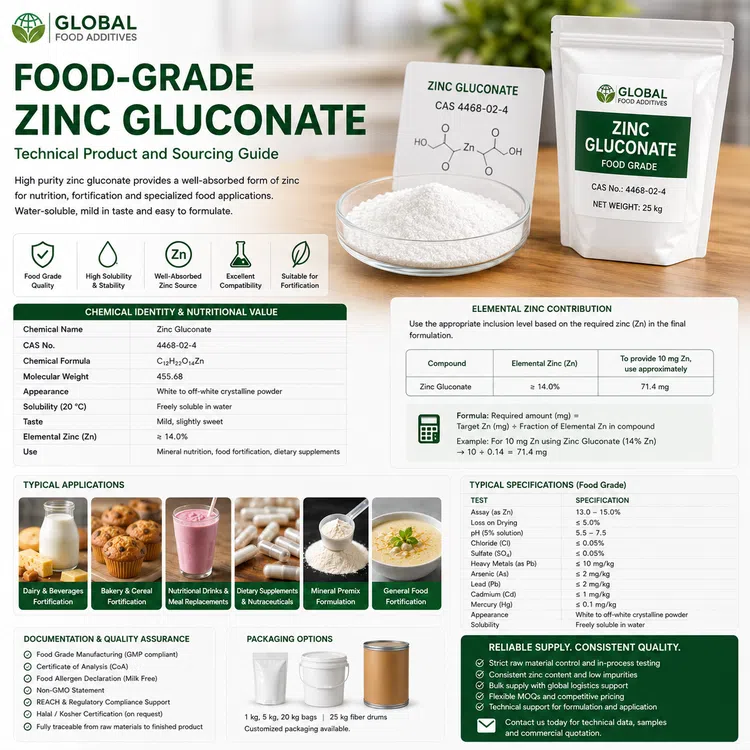
Product identity
| Product name | Zinc Gluconate |
|---|---|
| Chemical description | Zinc salt of gluconic acid, normally containing two gluconate anions for each zinc ion |
| Anhydrous formula | C12H22O14Zn |
| CAS number | 4468-02-4 |
| EC number | 224-736-9 |
| Anhydrous molecular weight | Approximately 455.68 g/mol |
| Theoretical elemental zinc | Approximately 14.35% on an anhydrous formula basis |
| Primary function | Source of elemental zinc for approved food and nutrition applications |
| Typical appearance | White to off-white crystalline powder, fine powder or granule |
| Water behavior | Generally soluble in water; dissolution rate and clarity depend on grade, concentration and process conditions |
| Hydration state | Anhydrous or hydrated material may be commercially available; confirm the supplier's declared identity and assay basis |
| E / INS number | Do not assume a universal conventional additive number. Confirm its status as a mineral source in the destination market. |
Potential application fit
Subject to legal authorization, dosage assessment and finished-product validation, Zinc Gluconate may be considered for:
- Vitamin and mineral premixes
- Powdered nutritional beverages
- Ready-to-drink fortified beverages
- Effervescent and instant-drink preparations
- Food supplements in tablet, capsule or powder form
- Meal replacements and protein nutrition products
- Fortified dairy and plant-based products
- Breakfast cereals, bars and powdered foods
- Confectionery, lozenge and chewable formats
- Infant, medical and other special-category foods where specifically permitted
Technical positioning among zinc sources
Zinc Gluconate is selected where formulators require a food-compatible organic zinc salt with useful water solubility and a moderate elemental zinc concentration. Compared with highly concentrated insoluble sources, more Zinc Gluconate must be added to supply the same amount of elemental zinc. In return, it can provide easier incorporation into many aqueous systems, subject to concentration, pH and matrix compatibility.
Selection should not be based on solubility alone. The appropriate zinc source depends on finished-product clarity, permitted use, sensory target, serving size, process design, packaging, shelf life and cost per delivered unit of elemental zinc.
| Selection factor | Zinc Gluconate consideration | Industrial implication |
|---|---|---|
| Elemental-zinc concentration | Approximately 14.35% theoretical zinc on an anhydrous basis | Higher ingredient addition rate than concentrated inorganic zinc sources |
| Water compatibility | Generally soluble in water | Suitable for evaluation in beverages, concentrates and liquid premixes |
| Hydration variability | Commercial material may contain bound or residual water | Actual zinc assay must be used for dosing and commercial comparison |
| Flavor impact | Mineral, metallic or astringent effects may become evident at higher use levels | Sensory validation is required in the complete finished product |
| Matrix interaction | Zinc ions and gluconate may interact with other minerals, proteins and formulation components | Bench, pilot and shelf-life trials should use the full recipe |
| Commercial economics | Price per kilogram may appear higher than commodity mineral salts | Compare delivered cost, process performance and elemental-zinc yield together |
Elemental-zinc calculation
The ingredient dosage should be calculated from the target amount of elemental zinc and the actual zinc percentage stated on the supplier certificate of analysis. Theoretical calculations based on the anhydrous molecular formula are useful for preliminary formulation, but commercial production must use the approved specification and batch result.
At a theoretical elemental-zinc content of 14.35%, approximately 69.69 mg of anhydrous Zinc Gluconate supplies 10 mg of elemental zinc before any separately validated manufacturing overage.
| Elemental-zinc target | Approximate anhydrous Zinc Gluconate required at 14.35% zinc | Calculation basis |
|---|---|---|
| 1 mg zinc | 6.97 mg Zinc Gluconate | 1 ÷ 0.1435 |
| 5 mg zinc | 34.84 mg Zinc Gluconate | 5 ÷ 0.1435 |
| 10 mg zinc | 69.69 mg Zinc Gluconate | 10 ÷ 0.1435 |
| 15 mg zinc | 104.53 mg Zinc Gluconate | 15 ÷ 0.1435 |
| 100 mg zinc | 696.86 mg Zinc Gluconate | 100 ÷ 0.1435 |
Where the CoA reports Zinc Gluconate assay rather than elemental zinc, the formulation team should confirm the supplier's conversion method, hydration basis and analytical procedure. An automatic overage should not be applied without evidence from processing recovery and shelf-life studies.
Hydration state and analytical basis
Zinc Gluconate may contain water associated with the crystalline material or residual moisture from production and drying. Water content changes the effective amount of Zinc Gluconate and elemental zinc delivered by each kilogram of commercial product.
Questions for the supplier
- Is the product anhydrous, hydrated or unspecified?
- Is assay reported on an as-is or dried basis?
- What loss-on-drying or water-content range is controlled?
- Is elemental zinc directly tested or mathematically calculated?
- Which compendial or validated method is used?
- Does the commercial grade contain any carrier or processing aid?
Why the basis matters
Two suppliers can report similar Zinc Gluconate assay values while delivering different elemental-zinc quantities if water content, reporting basis or product composition differs.
Purchasing specifications should define both the chemical assay and the minimum elemental-zinc content whenever accurate nutritional dosing and supplier comparison are critical.
Manufacturing and production considerations
Commercial Zinc Gluconate is generally produced by reacting a controlled zinc source with gluconic acid or a gluconate intermediate, followed by purification, concentration, crystallization or drying, milling and packaging. Gluconic acid itself is commonly produced from glucose through a controlled fermentation or oxidation process.
The exact process influences residual ions, color, microbiological risk, particle structure, hydration, bulk density and lot consistency. Supplier qualification should therefore include the production site, principal raw-material sources, purification steps, drying system and contamination controls.
| Production stage | Potential control point | Buyer relevance |
|---|---|---|
| Gluconic acid or gluconate production | Fermentation organism, glucose source, purification and residual processing materials | Supports GMO, allergen, origin, microbiological and process declarations |
| Zinc-source addition | Zinc raw-material identity and elemental-impurity profile | Major determinant of lead, cadmium, arsenic and other trace-metal risk |
| Reaction control | Stoichiometry, pH, temperature and completion of neutralization | Influences assay, residual acidity or alkalinity and product consistency |
| Purification | Filtration, decolorization, ion removal and foreign-material control | Influences appearance, solution clarity and contaminant profile |
| Drying | Drying temperature, residence time and moisture endpoint | Influences hydration state, caking, solubility and assay basis |
| Milling or granulation | Particle-size distribution, dust control and equipment hygiene | Affects blending, dissolution, flowability and occupational handling |
| Final packing | Liner integrity, metal detection, label verification and lot traceability | Protects product identity and quality through the supply chain |
Dry-blend and premix engineering
Zinc Gluconate has a lower elemental-zinc concentration than Zinc Oxide and several inorganic zinc salts. Although this increases the ingredient mass used in a formulation, low-dose micronutrient distribution may still require a validated premix process.
- Use geometric dilution when the direct addition rate is small compared with the total batch size.
- Match the particle size and bulk density of Zinc Gluconate with the premix carrier to reduce segregation.
- Define blender type, working volume, fill ratio, mixing time and addition sequence.
- Evaluate segregation during conveying, vibration, discharge, packing and transport.
- Confirm whether the material is a neat chemical, granulated grade, carrier-based preparation or finished micronutrient premix.
- Validate blend uniformity through elemental-zinc analysis from multiple sampling locations.
- Protect the powder from excessive humidity that may affect flow, caking and dosing accuracy.
- Recalibrate loss-in-weight or volumetric feeders when bulk density or particle form changes between suppliers.
Liquid-system and beverage engineering
Zinc Gluconate is generally compatible with aqueous processing, but water solubility does not guarantee finished-product clarity or shelf-life stability. Formulators must evaluate the complete system, including zinc concentration, pH, temperature, water hardness, other minerals, proteins, acids, sweeteners and hydrocolloids.
Recommended dissolution procedure
- Confirm the required ingredient mass using the actual batch zinc assay.
- Use food-grade process water within the validated temperature and hardness range.
- Begin agitation before slowly adding Zinc Gluconate to avoid local agglomeration.
- Allow complete dissolution before introducing ingredients that may interact with zinc.
- Measure pH, visual clarity and insoluble material before transfer to the main batch.
- Filter only where technically justified and verify that filtration does not reduce the intended zinc concentration.
Liquid-system validation
- Dissolution time and maximum practical concentration
- Solution color and clarity
- Effect of pH adjustment
- Compatibility with phosphate and carbonate
- Compatibility with proteins and hydrocolloids
- Interaction with calcium, iron, magnesium and copper salts
- Heat-treatment and cooling behavior
- Haze, precipitation and sediment during storage
- Zinc recovery at the beginning and end of shelf life
Food-matrix compatibility
Once dissolved, Zinc Gluconate provides zinc ions and gluconate species that can interact with the food matrix. Product stability and nutritional performance therefore depend on pH, water activity, other minerals, phytate, proteins, processing conditions and storage.
| Matrix factor | Potential effect | Recommended evaluation |
|---|---|---|
| Product pH | Influences zinc speciation, taste and interaction with other components | Measure pH, clarity and zinc recovery throughout shelf life |
| Phosphate | May contribute to zinc-phosphate precipitation under some conditions | Conduct bench and pilot compatibility trials |
| Carbonate and bicarbonate | May reduce clarity or create insoluble zinc-containing material | Evaluate water alkalinity, pH and order of addition |
| Proteins | Can influence zinc binding, haze, sediment and sensory properties | Test the complete protein system after heat processing |
| Phytate and fiber | May bind zinc and affect nutritional availability | Consider the total food matrix and applicable nutrition guidance |
| Other mineral salts | Can affect ionic strength, flavor, color and precipitation | Test the complete mineral premix rather than individual salts |
| Organic acids | Can influence pH, zinc complexation and sensory profile | Compare acid type, concentration and addition sequence |
| Heat processing | Zinc is not destroyed by ordinary food heating, but physical and chemical interactions may change | Measure finished-product zinc recovery after processing |
| Light and oxygen | Zinc itself is stable, but interactions with sensitive vitamins or flavors may affect overall product quality | Conduct full-formula stability work in the final package |
Sensory and organoleptic validation
Zinc Gluconate is widely selected for nutritional products, but it should not be assumed to be sensorially neutral at every dosage. Mineral, metallic, bitter or astringent notes may appear depending on concentration, pH, sweetener system, flavor profile and serving conditions.
- Evaluate taste at the actual labeled serving size rather than only in concentrated laboratory solutions.
- Include unflavored controls to identify the contribution of the zinc ingredient.
- Compare immediate taste with samples stored through the intended shelf life.
- Evaluate aftertaste, mouth drying, metallic character and bitterness.
- Check whether acids or high-intensity sweeteners intensify undesirable mineral notes.
- Confirm that flavor masking remains effective at the expected serving temperature and dilution.
- Evaluate visual clarity, color and sediment together with taste.
Industrial specification review matrix
A technically useful purchasing specification should distinguish mandatory batch-release criteria from informational properties. Numerical limits must be agreed against the applicable food-grade standard, destination market, customer risk assessment and intended application.
| Control area | What to specify or verify | Industrial importance |
|---|---|---|
| Identity | Zinc Gluconate identity test, CAS number and food-grade designation | Confirms that the supplied material matches the approved ingredient |
| Zinc Gluconate assay | Minimum and maximum chemical assay with a clearly defined basis | Supports product purity and consistency assessment |
| Elemental zinc | Minimum zinc percentage on an as-is or otherwise defined basis | Drives dosage, nutrition declaration and cost comparison |
| Water or loss on drying | Maximum or controlled range with test conditions | Identifies hydration and moisture variation that affects assay |
| Appearance | Color, physical form and absence of visible foreign material | Supports identity, handling and finished-product appearance |
| Solution appearance | Clarity, color and insoluble matter at an agreed concentration | Important for beverage and liquid-premix applications |
| pH | pH of a specified aqueous solution or suspension | Indicates lot consistency and possible process variation |
| Reducing substances | Compendial or customer-defined limit where applicable | Supports control of gluconate-related process impurities |
| Residual anions | Chloride, sulphate or other route-relevant ions where required | Can affect purity, corrosion, taste and customer compliance |
| Elemental impurities | Lead, cadmium, arsenic, mercury and other relevant metals | Critical for food safety and vulnerable consumer groups |
| Particle size | Agreed sieve limits or D10, D50 and D90 values | Affects flow, blending, dissolution and segregation |
| Bulk density | Loose and tapped density where process-critical | Supports feeder calibration, package sizing and blend design |
| Microbiological quality | Applicable total count, yeast, mold and pathogen criteria | Supports food-grade release and customer approval |
| Foreign-material controls | Sieving, magnets, metal detection and package-integrity controls | Reduces physical-contamination risk |
Analytical and batch-release considerations
Analytical data should always identify the test method, sample-preparation procedure and reporting basis. Supplier and buyer laboratories should align methods before investigating apparent assay differences.
Common analytical approaches
- Zinc Gluconate or elemental-zinc assay by validated titrimetric or instrumental method
- Elemental zinc and trace metals by ICP-OES, ICP-MS, AAS or another validated technique
- Identity testing by applicable chemical or spectroscopic method
- Water determination or loss on drying under defined conditions
- Solution clarity, color and pH testing at a defined concentration
- Particle-size distribution by sieve or laser diffraction
- Microbiological testing using validated food-ingredient methods
Certificate-of-analysis review
- Confirm that each reported result has a specification limit.
- Check whether the assay is stated as Zinc Gluconate or elemental zinc.
- Verify whether results are reported as-is or on a dried basis.
- Review the test method or compendial reference.
- Confirm lot number, manufacture date and release date.
- Check that the CoA represents the actual shipped commercial lot.
- Verify authorized approval by the supplier's quality function.
- Compare the CoA with the approved specification revision.
Microbiological and hygiene considerations
Zinc Gluconate is not normally used as a microbiological control ingredient. Food-grade production, drying, milling and packing should operate under appropriate hygiene controls. The microbiological specification should reflect the manufacturing process, application, consumer population and destination-market requirements.
- Define total aerobic count limits where appropriate.
- Define yeast and mold criteria where appropriate.
- Include pathogen absence requirements based on the application and regulatory framework.
- Confirm environmental-monitoring and sanitation controls at the manufacturing site.
- Review whether the product receives a validated kill step or is handled as a low-moisture ingredient without a terminal kill step.
- Evaluate microbiological requirements more stringently for infant, medical or other vulnerable-population products.
Supplier qualification and traceability
Supplier approval should examine the full manufacturing and quality system rather than relying only on a representative certificate of analysis. Qualification depth should reflect the intended food category, consumer group, annual volume and regulatory risk.
Manufacturing and quality information
- Legal manufacturer and production-site address
- Manufacturing route and principal raw-material sources
- Food-safety plan and HACCP controls
- Applicable ISO or GFSI-recognized certification
- Traceability and mass-balance procedures
- Cleaning and cross-contamination controls
- Lot definition and batch-release procedure
- Complaint, recall and CAPA systems
- Change-notification policy
- Business-continuity and alternate-site arrangements
Common declarations and certificates
- Food-grade and intended-use declaration
- Country-of-origin statement
- Allergen and cross-contact statement
- GMO status
- Irradiation statement
- BSE/TSE and animal-origin statement
- Residual-solvent statement where applicable
- Heavy-metal compliance statement
- Halal and Kosher certificates where required
- Target-market regulatory compliance statement
Documents to request before commercial approval
- Current product specification or technical data sheet
- Representative certificate of analysis
- Batch-specific certificate of analysis for every shipment
- Current safety data sheet in the required language
- Food-grade and intended-use statement
- Manufacturing-process description
- Manufacturer and country-of-origin declaration
- Elemental-impurity or heavy-metal data
- Hydration-state and analytical-basis statement
- Particle-size and bulk-density data where required
- Microbiological specification
- Allergen and cross-contact declaration
- GMO and irradiation declarations
- Shelf-life, retest and storage statement
- Packaging specification and pallet configuration
- Halal, Kosher and quality-system certificates where required
- Sample commercial label
- Change-control and notification commitment
Regulatory positioning
Zinc Gluconate is generally evaluated as a mineral nutrient source rather than as a conventional technological food additive. Permitted use depends on the destination country, food category, consumer group, nutrient level, claims, purity criteria and final labeling.
United States
Zinc Gluconate is identified in 21 CFR 182.8988. The regulation states that it is generally recognized as safe when used in accordance with good manufacturing practice.
This listing does not replace compliance with standards of identity, nutrient-fortification policy, food-supplement requirements, nutrition labeling or other category-specific obligations.
European Union
Zinc Gluconate is included among zinc sources used within relevant EU mineral frameworks, including rules governing the addition of vitamins and minerals to foods and food supplements.
The food business operator should verify the current consolidated annexes, applicable purity requirements, national provisions, food-information obligations and any rules specific to infant foods, medical foods or other regulated categories.
Packaging and industrial logistics
Zinc Gluconate may be supplied in PE-lined multiwall paper bags, woven bags with an inner liner, fiber drums or other approved industrial packaging. Commercial pack sizes are supplier specific and may include 20 kg or 25 kg units. Packaging construction, pallet configuration and container loading should be confirmed in the quotation.
| Logistics parameter | Information to confirm |
|---|---|
| Primary package | Bag, carton or drum construction, liner material, closure and net weight |
| Food-contact suitability | Applicable packaging food-contact compliance statement |
| Moisture protection | Liner barrier, seal integrity and handling after opening |
| Pallet configuration | Units per pallet, pallet dimensions, gross weight and pallet material |
| Container loading | Palletized or floor-loaded quantity, maximum payload and condensation protection |
| Label information | Product, grade, lot, net weight, origin, manufacture date, expiry or retest date and storage conditions |
| Export documentation | Commercial invoice, packing list, origin certificate, CoA and destination-specific documents |
| Delivery term | Agreed Incoterm and precisely named port, terminal or delivery location |
Storage and warehouse handling
- Store in the original sealed package in a clean, cool and dry area.
- Protect from moisture, condensation, direct water contact and damaged liners.
- Keep packages off floors and away from walls where moisture migration may occur.
- Avoid storage near strong odors, incompatible chemicals or potential contamination sources.
- Apply FEFO inventory rotation using the supplier-declared expiry or retest date.
- Reseal partially used packages or transfer the material into a clean, approved and properly labeled moisture-protective container.
- Record internal lot movements to maintain traceability from receipt to finished production.
- Follow the current supplier safety data sheet and site risk assessment for powder handling.
Occupational handling considerations
Fine Zinc Gluconate powder can generate airborne dust during opening, tipping, conveying and cleaning. Industrial control measures should follow the current safety data sheet, local occupational requirements and the facility's powder-handling risk assessment.
- Use enclosed transfer systems where practical.
- Provide local exhaust ventilation at powder charging points.
- Avoid unnecessary dust generation and uncontrolled dry sweeping.
- Use suitable eye, skin and respiratory protection where required by the risk assessment.
- Use dedicated or validated-clean equipment to prevent cross- contamination.
- Establish procedures for spill collection, waste identification and damaged packaging.
- Train operators to verify product identity and lot number before charging.
Shelf-life and stability program
Shelf life must be confirmed from the specific manufacturer and packaging system. Chemical identity alone does not determine commercial stability; moisture uptake, caking, particle change, package integrity and microbiological condition can also affect usability.
A customer stability program may include initial and aged assay, elemental zinc, water or loss on drying, solution appearance, dissolution time, caking, package condition and finished-product zinc recovery. Retained samples should be stored under documented conditions representative of the commercial supply chain.
Commercial cost comparison
Supplier offers should be compared using delivered cost per kilogram of elemental zinc rather than ingredient price alone. The calculation should use the actual minimum or typical zinc content agreed for commercial supply.
Example: if delivered Zinc Gluconate costs 5.00 currency units per kilogram and contains 14.0% elemental zinc, the ingredient cost is approximately 35.71 currency units per kilogram of delivered elemental zinc before processing losses.
| Comparison factor | Commercial question |
|---|---|
| Elemental-zinc assay | Is a minimum zinc percentage contractually guaranteed? |
| Hydration and moisture | Is the assay stated as-is, on a dried basis or under another convention? |
| Purity profile | Do elemental-impurity and microbiological limits meet the target specification? |
| Dissolution performance | Does the grade dissolve within the required process time and concentration? |
| Incoming testing | Will additional laboratory or third-party verification be required? |
| Packaging | Are bag size, liner, pallet and labels suitable for the receiving plant? |
| Documentation | Are all regulatory, origin and certification documents included? |
| Lead time | Does the stated lead time include production, release, transport and customs clearance? |
| Minimum order | Does the MOQ align with consumption rate, storage capacity and shelf life? |
| Incoterm | Which freight, insurance, duty and destination charges remain outside the quoted price? |
Recommended sample and approval workflow
- Review the specification, regulatory documents and manufacturing-site information before requesting a sample.
- Confirm that the sample represents the intended commercial production process, site and physical grade.
- Test identity, assay, elemental zinc, moisture and critical impurities.
- Evaluate dissolution, solution clarity and physical handling under the intended process conditions.
- Conduct complete-formula laboratory trials rather than testing Zinc Gluconate only in water.
- Assess sensory quality, mineral compatibility and analytical zinc recovery.
- Run a controlled pilot-scale trial using representative production equipment.
- Complete stability work in the intended commercial packaging.
- Approve the manufacturer, production site, specification, label and packaging before the first commercial shipment.
- Establish incoming inspection and periodic verification based on supplier risk.
RFQ information required for an accurate quotation
| RFQ category | Recommended information |
|---|---|
| Product designation | Food-grade Zinc Gluconate and any required compendial or customer standard |
| Chemical assay | Required Zinc Gluconate assay range and analytical basis |
| Elemental zinc | Required minimum zinc percentage on an as-is or dried basis |
| Hydration and moisture | Required hydration state, water content or loss-on-drying limit |
| Physical grade | Powder, granule, agglomerate, premix or solution-preparation requirement |
| Particle properties | Sieve limits, D10, D50, D90, bulk density or flow requirements |
| Impurity limits | Lead, cadmium, arsenic, mercury and other customer-specific parameters |
| Application | Beverage, powder, supplement, cereal, dairy or other intended food system |
| Quantity | Sample, trial order, commercial order and estimated annual demand |
| Packaging | Required bag or drum size, liner, pallet and label language |
| Destination | Country, port, terminal or complete delivery location |
| Delivery term | Requested Incoterm and named place or port |
| Schedule | Target shipment date, arrival date and expected order frequency |
| Documents | CoA, TDS, SDS, origin, regulatory, Halal, Kosher, quality certificates and questionnaires |
| Approval requirements | Sample quantity, third-party testing, audit or pilot-production requirements |
How to request Zinc Gluconate
Send the required product grade, Zinc Gluconate assay, minimum elemental- zinc content, hydration or moisture requirement, reference specification, physical form, impurity limits, quantity, destination, packaging, Incoterm, shipment timing and mandatory documents. Where available, include your current specification or a redacted certificate of analysis so supplier options can be compared against the same technical basis.
Frequently asked questions
What is Zinc Gluconate used for?
It is used as a source of elemental zinc in approved nutritional beverages, dry powders, food supplements, premixes and fortified food products. Suitability depends on the application, dosage, process, sensory requirements and destination-market legislation.
How much elemental zinc does Zinc Gluconate contain?
Anhydrous Zinc Gluconate contains approximately 14.35% theoretical elemental zinc. Commercial material may contain water or other permitted components, so the actual CoA zinc result should be used for production calculations.
How is the required dosage calculated?
Divide the required elemental-zinc quantity by the actual decimal zinc fraction. At 14.35% zinc, approximately 69.69 mg of anhydrous Zinc Gluconate supplies 10 mg of elemental zinc before any separately justified overage.
Is Zinc Gluconate soluble in water?
It is generally soluble in water. Actual dissolution time and solution clarity depend on particle size, hydration, concentration, water quality, temperature, pH and the other ingredients in the system.
Is Zinc Gluconate suitable for clear beverages?
It can be evaluated for clear beverages, but clarity must be confirmed in the complete formula. Phosphate, carbonate, proteins, minerals and botanical ingredients can create haze or precipitation even when the zinc source dissolves initially.
What is the difference between Zinc Gluconate assay and elemental zinc?
Zinc Gluconate assay measures the chemical ingredient, while elemental zinc indicates the quantity of zinc actually delivered. Nutritional dosage and cost comparisons should use elemental zinc on a clearly defined analytical basis.
Can hydration affect dosage?
Yes. Water associated with the commercial material reduces the zinc percentage per kilogram compared with the theoretical anhydrous formula. Confirm hydration, water content, assay basis and elemental zinc on the approved specification.
Can Zinc Gluconate affect taste?
Mineral, metallic, bitter or astringent notes may occur depending on use level, pH, flavor system and serving conditions. Sensory testing should be performed in the final formula and after storage.
Does Zinc Gluconate have an E number?
A universal conventional E or INS number should not be assumed. Zinc Gluconate is generally assessed as a mineral source under the fortification, food-supplement or special-category food legislation of the destination market.
Which CoA values are most important?
Key values generally include identity, Zinc Gluconate assay, elemental zinc, water or loss on drying, solution appearance, pH, relevant chemical impurities, elemental impurities and applicable microbiological criteria.
What should be included in a Zinc Gluconate quotation request?
Include the required assay, elemental zinc, moisture basis, physical form, impurity limits, quantity, packaging, destination, Incoterm, delivery schedule and documentation package.
Can Global Food Additives source Zinc Gluconate?
Global Food Additives can compare supplier options against the requested food-grade standard, assay, elemental-zinc content, hydration, particle properties, impurity limits, packaging, quantity, destination and documentation requirements.
Send your Zinc Gluconate specification and commercial requirements.
For an accurate comparison, include the required food-grade standard, minimum chemical assay, elemental-zinc content, hydration or moisture basis, physical form, elemental-impurity limits, quantity, destination, packaging, Incoterm and document list. Our team will review your inquiry and respond from orders@foodgradeadditives.com .
Your message has been received. You will be redirected to the home page.