
Food-Grade Zinc Sulphate
Zinc Sulphate is a water-soluble inorganic zinc source used in approved food fortification, enrichment, nutritional premix and industrial formulation programs. Commercial grades may be supplied as anhydrous material, monohydrate or heptahydrate. Because each form contains a different percentage of elemental zinc, purchasing and formulation decisions should be based on the declared hydrate, actual assay and finished-product requirements rather than product name alone.
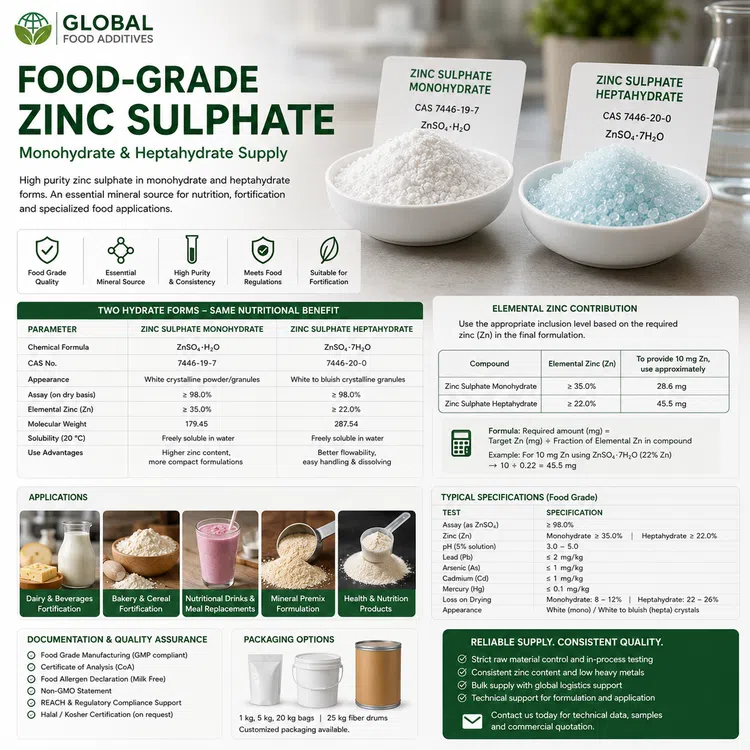
Product identity
| Product family | Zinc Sulphate / Zinc Sulfate |
|---|---|
| Primary function | Mineral source supplying elemental zinc |
| Chemical formula | ZnSO4; common hydrates include ZnSO4·H2O and ZnSO4·7H2O |
| CAS identity | 7733-02-0 anhydrous; 7446-19-7 monohydrate; 7446-20-0 heptahydrate |
| Appearance | Typically a white crystalline powder or granule; exact morphology is grade specific |
| Solubility behavior | Readily soluble in water; concentrated solutions are acidic and should be evaluated in the intended food matrix |
| E / INS number | Do not assume a general E or INS number. Confirm the mineral-source classification and labeling rules for the destination market. |
Application fit
Potential industrial use areas, subject to local authorization and finished-product validation, include:
- Flour, cereal and staple-food fortification
- Dry beverage, nutrition and meal-replacement powders
- Liquid beverages and concentrates after solubility and clarity trials
- Dairy and plant-based systems with mineral-interaction testing
- Vitamin-mineral premixes and compound micronutrient blends
- Fermentation nutrient systems where process use is technically and legally appropriate
- Infant, medical and other special-category foods only under the applicable specific legislation
Hydrate forms and elemental zinc contribution
The water of crystallization changes molecular weight, handling characteristics and the amount of zinc delivered by each kilogram. The values below are theoretical stoichiometric values and are not a substitute for the supplier specification or batch certificate of analysis.
| Commercial identity | Formula | Approx. molecular weight | Theoretical elemental zinc | Purchasing implication |
|---|---|---|---|---|
| Anhydrous Zinc Sulphate | ZnSO4 | 161.44 g/mol | 40.50% | Highest theoretical zinc concentration; confirm actual water and assay |
| Zinc Sulphate Monohydrate | ZnSO4·H2O | 179.46 g/mol | 36.43% | Common concentrated commercial form for dry premixes and fortification |
| Zinc Sulphate Heptahydrate | ZnSO4·7H2O | 287.55 g/mol | 22.74% | More product mass is required to deliver the same elemental zinc target |
Dry-blend and premix engineering
- Use geometric dilution or a validated carrier-premix step when the direct addition rate is low.
- Match particle-size distribution and bulk density with the carrier system to reduce segregation during conveying, filling and transport.
- Define blend time, blender load, sampling locations and acceptance criteria through a homogeneity study.
- Control humidity and reseal opened packages because moisture uptake or hydrate changes can affect flow, caking and assay on an as-is basis.
- Confirm whether the quotation is for neat Zinc Sulphate or a standardized preparation containing carrier, anti-caking agent or encapsulation system.
Liquid-system engineering
- Pre-dissolve in controlled process water when appropriate, then meter into the main batch under adequate agitation.
- Avoid creating a high local mineral concentration near phosphate, carbonate, protein or hydrocolloid systems that may generate turbidity or precipitates.
- Evaluate order of addition, solution pH, water hardness, temperature and hold time in pilot trials.
- Check finished-product clarity, sediment, color, flavor, package compatibility and mineral recovery through shelf life.
- Use corrosion-compatible equipment and follow the supplier safety data sheet for dust and concentrated-solution handling.
Functional behavior in food matrices
Zinc Sulphate dissociates in water and provides zinc ions with high formulation availability. That same reactivity means matrix compatibility must be assessed rather than assumed. In cereal and legume systems, phytate can bind zinc and influence nutritional bioavailability. In beverages and dairy-type systems, phosphate, carbonate, citrate, protein concentration, pH and processing sequence can affect clarity and mineral distribution. Higher fortification levels may also introduce metallic, astringent or mineral taste, making sensory validation and flavor-masking work important for consumer products.
Elemental zinc is not destroyed by ordinary food-processing heat; however, processing can change moisture state, dispersion, solubility, interaction with other ingredients and analytical recovery. The correct technical question is therefore not only whether zinc survives the process, but whether the selected Zinc Sulphate grade remains uniformly distributed, organoleptically acceptable and analytically compliant in the finished product.
Industrial specification review matrix
A purchasing specification should clearly distinguish mandatory release tests from informational properties. Limits must be agreed against the applicable food-grade standard, destination market, customer risk assessment and intended use.
| Control area | What to verify | Why it matters |
|---|---|---|
| Identity | Chemical identity, hydrate form, CAS number and identification test | Prevents substitution between anhydrous, monohydrate and heptahydrate material |
| Assay | Zinc Sulphate assay and/or elemental zinc percentage on a clearly defined basis | Drives dosage, label calculation and cost per unit of zinc |
| Water status | Water of crystallization, loss on drying or water content and reporting basis | Confirms hydrate identity and explains concentration differences |
| Solution properties | Solubility, appearance of solution, pH and insoluble matter | Supports liquid processing, filtration and clarity control |
| Elemental impurities | Lead, arsenic, cadmium, mercury and other market-relevant metals | Critical for food safety, vulnerable populations and regulatory compliance |
| Process impurities | Iron, chloride or other manufacturing-route indicators where relevant | Can affect color, stability, corrosion and customer specifications |
| Physical properties | Particle size, bulk density, flowability and caking tendency | Affects blending, dosing accuracy, dust generation and segregation |
| Microbiological quality | Applicable food-grade microbiological criteria and pathogen statements | Supports risk-based release and customer approval programs |
| Foreign material control | Sieve, magnet, metal detection and packaging-integrity controls | Reduces physical contamination risk |
Quality, traceability and supplier qualification
Minimum technical package
- Current product specification or technical data sheet
- Representative and batch-specific certificate of analysis
- Safety data sheet in the required language
- Food-grade and intended-use statement
- Manufacturing site and country-of-origin information
- Shelf-life, retest and storage statement
- Packaging specification and pallet configuration
Common compliance declarations
- Allergen and cross-contact statement
- GMO status and irradiation statement
- BSE/TSE and animal-origin statement where requested
- Halal and Kosher certificates where commercially required
- HACCP and relevant ISO or GFSI-recognized certification
- Heavy-metal compliance and market-specific regulatory declaration
- Change-notification and lot-traceability commitments
Regulatory positioning
Regulatory status must be evaluated by country, food category, consumer group, use level, nutrient claim and final label. Zinc Sulphate may be treated as a mineral nutrient source rather than as a conventional technological food additive, so a universal E number or INS number should not be presented without an applicable legal basis.
United States
Under 21 CFR 182.8997, Zinc Sulfate is listed among substances generally recognized as safe when used in accordance with good manufacturing practice. This does not replace category-specific standards of identity, nutrient-content rules, labeling obligations or customer suitability assessment.
European Union
Regulation (EC) No 1925/2006 lists zinc among minerals that may be added to foods and lists zinc sulphate among the permitted mineral substances in Annex II. Use remains subject to the Regulation, purity requirements, national provisions where applicable, food-information rules and legislation for specific categories such as supplements, infant foods or foods for special medical purposes.
Packaging, storage and logistics
Commercial packaging can include PE-lined multiwall bags, woven bags with inner liner, fiber drums or larger industrial units. Common bag sizes are often in the 20–25 kg range, but actual pack size, net weight tolerance, pallet pattern and container loading must be confirmed in the quotation. For export orders, request photos or drawings of the primary package, label, pallet, stretch wrapping and container-loading arrangement.
- Store in the original sealed packaging in a cool, dry, well-ventilated area according to the supplier specification.
- Protect from moisture, direct heat, damaged liners and contamination by incompatible chemicals or strong odors.
- Keep bags off floors and away from walls where condensation or water ingress may occur.
- Apply lot control and FEFO inventory rotation using the supplier-declared shelf life or retest date.
- After opening, minimize exposure time and reseal or transfer into an approved moisture-protective container.
- Confirm transport classification, handling precautions and environmental requirements from the current safety data sheet.
Commercial comparison method
For a technically fair supplier comparison, calculate delivered cost per kilogram of elemental zinc rather than comparing only the invoice price per kilogram of Zinc Sulphate. The comparison should also include assay tolerance, moisture basis, packaging loss, minimum order quantity, freight, duty, lead time, payment terms, documentation completeness and the cost of any additional incoming testing.
| RFQ variable | Recommended information |
|---|---|
| Product identity | Anhydrous, monohydrate or heptahydrate; food grade; required reference standard |
| Active basis | Minimum elemental zinc percentage and whether reported as-is or on a dried basis |
| Physical grade | Powder or granule, particle-size range, bulk-density or flow requirement |
| Quality limits | Required assay, insoluble matter, pH, moisture and elemental-impurity limits |
| Commercial quantity | Trial quantity, order quantity, annual forecast and delivery schedule |
| Packaging | Net bag weight, liner, pallet, label language and private-label requirement |
| Destination | Country, port or delivery address, requested Incoterm and target arrival date |
| Documents | CoA, TDS, SDS, regulatory, origin, certifications and customer questionnaires |
| Approval process | Sample size, laboratory evaluation, pilot trial and supplier-audit requirements |
How to request Zinc Sulphate
Send the required hydrate form, target elemental zinc assay, reference specification, physical form, quantity, destination country, packaging preference, requested Incoterm, shipment timing and mandatory documents. If you already use Zinc Sulphate, share your current specification or a redacted certificate of analysis so alternative offers can be compared against the same analytical basis.
Frequently asked questions
What is Zinc Sulphate used for in food manufacturing?
It is primarily used as a source of elemental zinc in approved food-fortification, enrichment, nutrition-powder and premix systems. The correct grade depends on food category, hydrate form, assay, process, sensory targets and destination-market requirements.
What is the difference between monohydrate and heptahydrate?
They contain different amounts of water of crystallization. The monohydrate contains approximately 36.43% theoretical elemental zinc, while the heptahydrate contains approximately 22.74%. They therefore require different addition rates and should not be substituted kilogram for kilogram.
How is the required dosage calculated?
Divide the required elemental zinc amount by the decimal elemental-zinc assay stated on the batch CoA. For example, a material assaying 36.0% zinc would require 27.78 mg of ingredient to supply 10 mg zinc before any separately justified overage.
Is Zinc Sulphate suitable for clear beverages?
It is water soluble, but clear-beverage suitability depends on pH, water hardness, phosphate or carbonate content, other minerals, flavors, sweeteners, processing sequence and storage. Laboratory and pilot shelf-life trials are recommended before scale-up.
Can Zinc Sulphate cause taste or precipitation issues?
At higher concentrations it may contribute metallic, astringent or mineral notes. Zinc ions may also interact with matrix components such as phosphate, carbonate, phytate and proteins. Use-level optimization, order-of-addition trials and sensory testing are important.
Does Zinc Sulphate have an E number?
A general E or INS number should not be assumed. It is often regulated as a mineral source under fortification, supplement or special-category food legislation rather than by a conventional technological-additive number.
Which certificate-of-analysis values are most important?
Confirm hydrate identity, elemental zinc assay, reporting basis, water or loss on drying, solution properties, insoluble matter, relevant elemental impurities and any agreed particle-size or microbiological criteria.
Can Global Food Additives source a customer-specific grade?
Global Food Additives can compare supplier options against a customer specification covering hydrate form, zinc assay, contaminants, particle size, packaging, certifications, quantity, destination and required approval documents.
Send your Zinc Sulphate specification and commercial requirements.
For an accurate comparison, include the hydrate form, minimum elemental zinc assay, reference standard, required contaminant limits, particle size, quantity, destination country, packaging, Incoterm and document list. Our team will review your inquiry and respond from orders@foodgradeadditives.com .
Your message has been received. You will be redirected to the home page.