
Phosphate use in ready meal proteins
Phosphates can support water binding, texture, buffering and processing consistency in protein-containing ready meals. This practical article helps food producers connect target functionality with phosphate type, process conditions, product specifications, supplier documents and quotation questions.
Application context
Phosphate use in ready meal protein systems should be evaluated through the complete formulation and production process. Relevant variables include the protein source, meat or plant-protein content, salt level, pH, water addition, fat content, starches, hydrocolloids, mixing order, heat treatment, freezing, reheating, packaging and shelf-life target.
Ready meals may contain cooked meat, poultry, seafood, dairy proteins or plant proteins combined with sauces, grains and vegetables. A phosphate that performs well in an injected meat component may behave differently in a comminuted filling, protein sauce or plant-based preparation. The selected grade should therefore be matched to the specific component and manufacturing method.
The correct choice is rarely based on price alone. Phosphate products may differ in chemical form, pH, solubility, buffering strength, sodium or potassium contribution, particle size and blend composition. These differences can influence hydration, texture, flavour and process reliability.
Functional roles of phosphates
- Water binding: suitable phosphates may help proteins retain added and natural moisture during processing, cooking and storage.
- Protein functionality: some phosphate systems support protein extraction and interaction, improving cohesion and yield.
- Buffering: phosphates can help control or stabilize pH within the intended formulation range.
- Emulsification support: improved protein functionality may support the stabilization of water and fat phases.
- Texture adjustment: the selected system can influence firmness, juiciness, sliceability and reheated texture.
- Mineral management: sequestration of certain metal ions may reduce undesirable interactions or process variation.
- Process consistency: controlled phosphate functionality may improve repeatability between production batches.
Selection points
- Define the protein component: identify whether the application contains meat, poultry, seafood, dairy protein, plant protein or a combination.
- Clarify the target function: specify water retention, binding, emulsification, buffering, yield, texture or mineral control.
- Review the phosphate type: orthophosphates, pyrophosphates, tripolyphosphates and blended systems provide different properties.
- Check solubility: the product should dissolve or disperse effectively under the actual water temperature, salt level and mixing conditions.
- Evaluate pH impact: excessive alkalinity may create flavour, colour or texture changes and should be tested in the complete formula.
- Consider sodium and potassium: the selected salt form may affect nutritional targets and label positioning.
- Review legal use: permitted phosphate types, food categories, maximum levels and declaration requirements vary by destination market.
- Compare exact grades: quotations should refer to a defined chemical form or blend specification rather than the general term “phosphate.”
Formulation and process considerations
Phosphate performance depends strongly on ingredient addition order and available mixing time. Poor dissolution or local over-concentration may reduce functionality and create uneven texture or flavour.
- Addition sequence: phosphates are often dissolved in water before salt or other ingredients, depending on the process and formulation.
- Water temperature: suitable temperature and agitation can improve dissolution, particularly for less soluble phosphate types.
- Mixing time: adequate contact time allows the phosphate system to interact with proteins before heating or forming.
- Salt interaction: salt and phosphate work together in many protein systems, but order and concentration should be controlled.
- Injection or tumbling: solution clarity, equipment compatibility and distribution should be evaluated in treated meat components.
- Heat treatment: cooking, pasteurization or retort conditions may affect moisture retention and final texture.
- Freezing and reheating: ready meals should be checked for purge, dryness, toughness or separation after frozen storage and reheating.
- Other binders: starches, proteins and hydrocolloids may complement phosphate functionality but also compete for available water.
Overuse or unsuitable phosphate selection may produce excessive firmness, soapy or mineral notes, high pH, surface deposits or label concerns. The lowest effective level should be established through formulation and pilot trials.
Trial and performance evaluation
Trials should reproduce the intended formula, processing sequence, cooking profile, packaging and storage conditions. Useful comparison points may include:
- solution clarity and dissolution time;
- raw-product water uptake and binding;
- cooking loss and finished-product yield;
- firmness, cohesion, juiciness and bite;
- fat or water separation in sauces and fillings;
- pH before and after cooking;
- purge after chilled or frozen storage;
- texture and moisture after reheating;
- flavour, saltiness and mineral aftertaste.
For reliable comparisons, record the exact phosphate grade, use level, water temperature, addition order, mixing time, salt concentration, cooking conditions and storage period.
Documents and quality checks
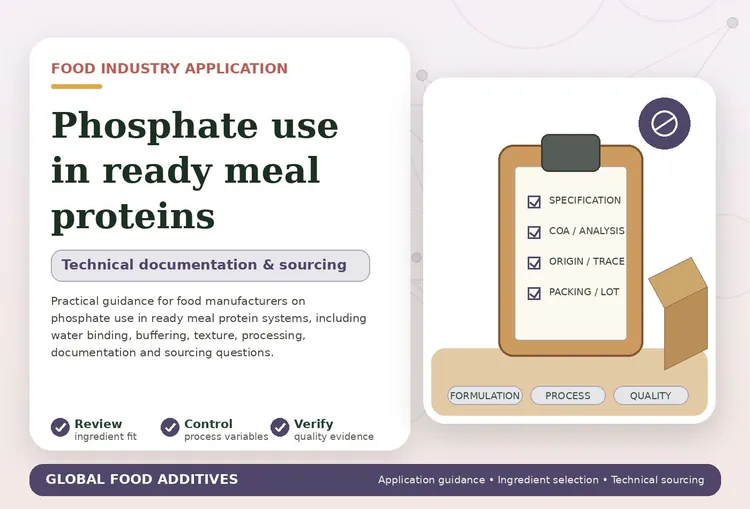
Before confirming an order, buyers commonly review a current specification or technical data sheet, certificate of analysis, safety data sheet where applicable, origin information, shelf-life statement, storage conditions, label details and packing information. Documentation should refer to the exact phosphate or blend being offered.
Depending on the product, customer standard and destination market, additional documents may include:
- chemical identity and phosphate composition;
- assay and purity limits;
- pH and solubility information;
- loss on drying or moisture limits;
- heavy-metal and contaminant specifications;
- allergen and GMO statements;
- Halal or Kosher certification;
- food-grade and regulatory-compliance declarations;
- recommended ingredient declaration;
- storage, transport and packaging guidance.
For blended phosphate systems, buyers should confirm whether the supplier discloses the individual components, total phosphate basis, sodium or potassium contribution and any carriers or processing aids. This information may be important for formulation calculations, nutritional data and ingredient labelling.
Related product group
This topic is commonly connected to Phosphates, Salts & Sequestrants. Phosphate selection should be considered together with salt level, protein type, water addition, processing conditions and destination-market requirements.
Related product pages prepared on this website include:
- Sodium Chloride Food Grade
- Potassium Chloride
- Calcium Chloride
- Magnesium Chloride
- Stannous Chloride
- Calcium Sulphate
How to turn this topic into an inquiry
Send the article title, ready meal type, protein source, target function, current formulation, pH, salt level, water addition, processing method, preferred phosphate type, proposed use level, trial quantity, commercial quantity, destination country, required documents and shipment timing.
It is also helpful to describe the current issue, such as cooking loss, dryness, weak binding, purge, texture variation, poor dissolution or instability after reheating. If you have a current supplier specification, certificate of analysis or formulation outline, include the relevant details so alternatives can be compared more accurately.